
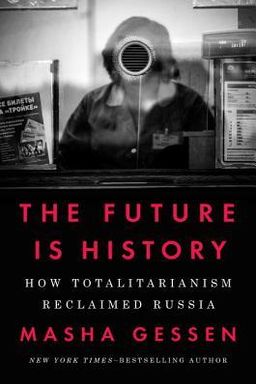
The Future Is History cover

The Future Is History

by Masha Gessen

The Future Is History explores Russia''s complex relationship with democracy, tracing the nation''s journey from the fall of the Soviet Union to the rise of Putin''s authoritarian regime. Through personal stories and historical analysis, Masha Gessen reveals how societal upheaval and nostalgia for Soviet stability have shaped modern Russia.

Generation 1984 and Russia’s Search for Meaning

How do people grow up when the world that raised them vanishes? The book follows the generation born around 1984—those who spent their childhoods in the last Soviet decade, came of age amid its collapse, and live their adult lives in Vladimir Putin’s Russia. Through four trajectories—Masha, Zhanna, Seryozha, and Lyosha—you watch one generation carry contradictory inheritances: Soviet discipline, post‑Soviet chaos, Western markets, and a return to authoritarian certainty.

The microcosm of the collapsed order

Masha’s baptism on Revolution Day, Zhanna’s Gorky childhood filled with shortages and civic protest, Seryozha’s elite dacha life as Yakovlev’s grandson, and Lyosha’s poverty in Solikamsk show the syndicate of contradictions. These families mix ideology and improvisation: engineers and physicists whisper religious curiosity, traders smuggle handbags, and reform officials watch their empires vanish. The collapse of institutions forces people to invent meaning privately—family becomes micro‑state.

Privilege and its moral imprint

Soviet egalitarianism masked rigid privilege. Behind fences and dacha gates, nomenklatura children learn entitlement as normality, while teachers and miners live with absence and humiliation. Those features feed Russia’s later political divide: the privileged adapt to technocracy and liberal markets; the deprived embrace nostalgia and paternal leadership. Childhood behind or beyond fences determines how adults imagine authority.

The emotional cost of transformation

Perestroika, Gorbachev’s reform, and Yakovlev’s intellectual labor produce openings that quickly spiral into national disintegration. By December 1991, the USSR dissolves—creating adults without institutions, children without ideological maps, and bureaucrats without meaning. Structural reforms substitute survival: people sell handbags from China, gamble vouchers in pyramid schemes, and experience shock therapy as moral vertigo. (Note: Gaidar’s liberalization in 1992, celebrated by Western advisors, reads here as trauma.)

From trauma to ideological longing

Because shock therapy shattered trust, citizens rebuild identity through nostalgia, religion, and nationalism. Intellectuals resurrect forgotten disciplines—Levada’s sociology of Homo Sovieticus, Arutyunyan’s psychoanalysis—and discover a lingering personality shaped by fear and paternalism. When democracy produces chaos, people prefer managed stability; when markets feel predatory, they seek a moral code. Putin appears as emotional compensation for decades of uncertainty.

Core takeaway

This generation is the hinge between worlds. It turns memory into ideology, trauma into conformity, and private survival into a public craving for order. Understanding their biographies is the key to decoding how Russia’s past continually re‑enters its future.


Homo Sovieticus and Its Evolution

Yuri Levada and his students—Lev Gudkov among them—act as social archaeologists. They excavate Homo Sovieticus, a social type created by decades of totalitarian rule: people trained to distrust, to expect paternal care, and to survive by conformity. Levada’s concept explains why Soviet behaviors persist even after the empire falls.

Levada’s model of social conditioning

Homo Sovieticus embodies hierarchical egalitarianism—accepting hierarchy above while insisting on equality within one’s circle. The citizen depends on the state but resents it, isolates himself but blames outsiders, practices doublethink as survival. When reforms arrive, these patterns make adaptation paradoxical: desire for freedom coexists with fear of change.

Survey tools and persistence of type

From 1989 onward, Levada Center’s questionnaires test tolerance and trust. Results show enduring contradictions—people admire Western goods but fear Western influence. Gudkov’s later results reveal continuity: doublethink endures; the extinction of Homo Sovieticus fails. The collapse of Soviet power doesn’t erase the Soviet person—it decentralizes him.

Why it matters today

This study becomes a blueprint for interpreting Russian politics. Managed democracy depends on these lingering habits: obedience, suspicion, and cynical complicity. (In Hannah Arendt’s terms, Homo Sovieticus reflects how totalitarianism creates psychological residue that survives beyond institutions.) Understanding that legacy teaches you why reforms stumble—systems can fall faster than personalities can change.


Revival, Privilege, and Intellectual Vacuums

After decades of censorship, the late 1980s open the floodgates of thought. Psychology, sociology, philosophy, and theology return; scholars reconstruct disciplines erased by ideology. Marina Arutyunyan restarts psychotherapy, Lev Gudkov learns survey method, Dugin reinvents metaphysics. In their laboratories and seminars, social science reappears as personal salvation.

The return of the psyche

Arutyunyan’s metaphor of university windows—fortochkas—captures this revival. Freud, Rogers, Frankl, and Luria blend with Russian existentialism. Analysts discover trauma not just clinical but national: repression, silence, and loss of lineage haunt families. They rebuild the ability to feel and to think aloud, vital after decades when the soul was denied.

Sociology and data from scratch

Levada’s team improvises survey design; they quantify moral moods and fears with almost no prior models. This empirical awakening generates self-awareness for a society that never measured itself. (Note: their messy data later become historical treasure—rare chronicles of Soviet self-perception.)

Philosophical hunger and ideological drift

When Western philosophy floods in, unfiltered reading leads to extremes. Heidegger excites mystical nationalism; Dugin fuses esoterica and geopolitics. The absence of coherent liberal institutions lets mythic ideas replace civic ones. The same vacuum that births psychotherapy’s self-awareness also breeds Eurasianism’s metaphysical certainty.

Key reflection

Recovering thought in an unanchored society yields creativity and danger. Intellectual reawakening sustains both empathy and ideological radicalism.


From Perestroika to Shock Therapy

The political story arcs from Gorbachev’s cautious reform to the chaos of Yeltsin’s liberalization. Yakovlev—the ideologue of perestroika—designs feedback and glasnost, imagining modernization without collapse. Yet reforms ignite nationalism in republics and expose imperial contradictions. The August 1991 coup fails because society no longer believes signals of force. The USSR ends in administrative disarray and emotional disbelief.

Economic shock and social pain

When shock therapy begins in 1992, scarcity becomes anxiety. Tatiana sells imported handbags; MMM pyramids promise instant wealth and destroy trust. Inflation demolishes savings; privatization turns ownership into fraud. Arutyunyan’s analysis of envy versus jealousy shows deeper pathology—wealth looks stolen, success feels immoral. Economic liberalization produces a moral vacuum.

The trauma legacy

Families internalize turbulence; psychologists treat not neurosis but societal disorientation. The state’s withdrawal produces criminal authority, rackets, and protection networks—the informal successors to bureaucratic control. Post‑Soviet freedom delivers insecurity, spawning nostalgia for managed certainty; that emotional pattern becomes fertile ground for Putin’s later promise of order.


Memory, Ideology, and the Politics of Forgetting

How does a country reconcile with terror it never fully mourned? The book’s chapters on archives, commemoration, and ideology chart Russia’s battle with memory. Yakovlev’s Rehabilitation Commission seeks truth; Yeltsin’s decrees promise transparency; but bureaucracy, nationalism, and comfort in nostalgia block healing. The 1990s attempt knowledge; the 2000s cultivate forgetting.

Archives and arrested grief

Families conceal arrests and executions; Arutyunyan’s discovery of her grandfather’s file illustrates private silence turned survival. Etkind’s triad—knowledge, grief, justice—remains incomplete: knowing overwhelms, grieving isolates, justice stalls.

Public rituals and nostalgia

Toppling Dzerzhinsky’s statue, the Romanov reburial, and Soviet‑song revivals signal selective remembrance. Television crafts comfort in "Old Songs About the Most Important Things," replacing critique with sentiment. Memory becomes aesthetic—an ornament rather than an ethic.

Ideology filling the void

Into that vacuum steps Eurasianism and the "Russian World." Dugin fuses Gumilev’s ethnos theory and Schmitt’s geopolitical binaries to offer a myth of destiny. The state amplifies that myth through parades, church alliances, and anti‑Western rhetoric. Forgetting turns defensive; amnesia becomes armor.

Insight

Where wounds remain unacknowledged, ideology becomes therapy. Russia’s failure to mourn Stalinism produces narratives that justify new authoritarianism.


Putin’s Manufactured Stability

The book traces how Putin transforms fatigue and humiliation into consensus. Financial collapse (1998), terrorist fear (1999), and Kosovo’s military embarrassment prime citizens for a paternal hero. His rise mixes crisis management and media alchemy—engineered by technologists like Pavlovsky.

Symbolic repair of dignity

The apartment bombings and Pristina episode create emotional closure: Russia regains courage. Approval ratings leap as people equate violence with recovery. Victories and parades ritualize restored pride; acclamation replaces democratic choice. Gudkov calls this pseudototalitarianism—a managed illusion of unity.

Institutional consolidation and economic alignment

Media centralization, oligarch discipline, and distributive economics turn stability into product. Oil and defense contracts become mechanisms of loyalty. The promised normality hides re‑Sovietization through bureaucracy, censorship, and security dominance. Citizens learn again to perform consent as survival.

Emotional logic of governance

Stability itself becomes moral; uncertainty becomes betrayal. The system adapts Levada’s Homo Sovieticus tendencies—deference and fear—to modern media. What begins as crisis management ends as paternal cult.


Law, Policing, and Cultural Control

In later chapters you see repression migrate from courtrooms to classrooms and culture. Law becomes theater; policing expands into moral regulation. The Red Wheel of justice—Paneyakh’s metaphor—turns automatically, grinding citizens caught by arbitrary codes.

Legal ambiguity as weapon

Post‑2012 laws broaden definitions of protest and treason; NGOs become 'foreign agents'; morality statutes criminalize dissent. Enforcement is selective—some punished publicly to warn all. The Bolotnoye trials, Pussy Riot case, and Navalny persecutions show legal process as spectacle of fear. Even media punishment (TV Rain’s cancellation) functions as extralegal messaging.

Moral panic and vigilante justice

The gay‑propaganda ban merges state law with mob action. Groups like Occupy Pedophilia hunt citizens, film humiliations, and find police tolerance. Legislators such as Mizulina and Milonov convert panic into policy; television amplifies outrage. Law and crowd merge into a moral surveillance complex.

Effect on public life

Universities censor; families self‑censor; speech shrinks. Legal uncertainty ensures obedience. The use of psychiatric classification, public trials, and vigilante spectacle resurrects Soviet techniques under modern guise.


Protest, Fragmentation, and Moral Fatigue

The book’s final arc shows the rise and ebb of civic resistance. The 2011–2012 White Ribbon protests, born from election fraud and Navalny’s rhetoric, mark Russia’s largest spontaneous awakening in years. Ribbons, humor, and assembly rebuild public morality—but repression swiftly follows.

Emergence and symbolism

Protesters gather on Bolotnaya and Sakharov avenues, livestreaming rallies and crafting unity through symbols rather than parties. The white ribbon represents purity and legality—a moral, not partisan, statement. For a brief window, streets become forums of conscience.

Repression and exhaustion

Arrests, trials, and bureaucratic harassment sap energy. Investigations drag for months; spectators tire; moral isolation deepens. Activists face depression, exile, or silence. Seryozha’s breakdown, Lyosha’s flight from Perm, Zhanna’s exile after her father’s assassination illustrate personal tolls. Recurrent totalitarianism operates emotionally—it punishes hope until fatigue replaces revolt.

Lesson

Protest without institutional backbone can awaken conscience but not sustain transformation. The political system’s genius is attrition, turning dissidence into exhaustion rather than martyrdom.


Economy, Scarcity, and the Mafia‑State Frame

Scarcity reemerges as governance tool. Sanctions after Crimea and countersanction food bans transform economic pain into patriotic spectacle. You watch cheese and pork burned on camera—a performance of sovereignty. Gudkov observes divergence: economic despair and political support coexist. Pain becomes proof of loyalty.

Patrimonial economics

Bálint Magyar’s mafia‑state model explains the logic: the leader 'disposes' of wealth via loyalists; redistribution serves control. Contracts replace competition; stability equals dependency. Companies like Mechel or Khodorkovsky’s Yukos demonstrate punishment through property—the perfect fusion of economic and political discipline.

Recurrent cycles of control

Gudkov’s theory of abortive modernization pairs with Magyar’s: every social opening ends with simplification, re‑centralization, and new loyalty rituals. Scarcity enables the pattern—fear stabilizes. Citizens trade rights for protection, completing the moral loop from the generation’s childhood to its current adulthood.

Final synthesis

From Soviet conformity to post‑Soviet trauma and Putinist stability, the book reveals continuity disguised as change. Structures fall; habits remain; and survival adapts into ideology—the essence of Russia’s persistent authoritarian rhythm.

Dig Deeper

Get personalized prompts to apply these lessons to your life and deepen your understanding.

Go Deeper

Get the Full Experience

Download Insight Books for AI-powered reflections, quizzes, and more.