
Idea 1
A Future Faster Than You Think
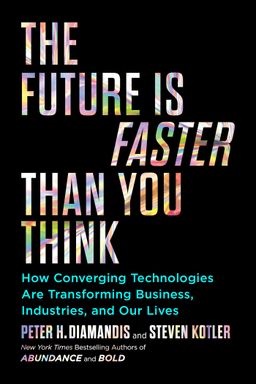
What happens when every major technology—AI, robotics, biotech, quantum computing, and networks—accelerates at once and begins to interconnect? In Future Faster Than You Think, Peter Diamandis and Steven Kotler argue that exponential technologies are not just progressing individually; they are converging, colliding, and compounding each other's effects. This process—called convergence—is the driver of the next technological revolution.
From Exponentials to Convergence
You already sense it in daily life: drones deliver medical supplies, AI writes essays, and your phone carries more intelligence than a supercomputer once did. Each advance follows the Law of Accelerating Returns (coined by Ray Kurzweil), in which anything digital doubles its performance and halves its cost in predictable cycles. But the authors show the hidden multiplier: when two or more exponentials meet—say, AI plus sensors plus robotics—they don’t add, they multiply. Autonomous cars, aerial taxis, and precision medicine emerge precisely at these technological intersections.
Why It Feels Like Science Fiction
Human brains evolved for linear change. Our ancestors saw incremental shifts over decades; now, a century of change compresses into a decade. Diamandis and Kotler remind you that by Kurzweil’s math, we’ll experience 20,000 years of progress in the next century. That explains why technologies from lab-grown meat to brain–computer interfaces leap from research to reality in bewildering timeframes.
The Framework of the Future
The authors organize their exploration through converging technological domains: artificial intelligence, robotics, networks and sensors, augmented reality, quantum computing, and biotechnology. Each chapter tracks how an exponential technology moves through the Six Ds—from digitized and deceptive to disruptive, demonetized, dematerialized, and finally democratized. Once a technology reaches the democratized stage (as smartphones did), it accelerates everything else by giving billions of people tools once reserved for governments or corporations.
Ripples Across Society
Convergence transforms not only industries but also institutions and daily life. Flying taxis result from simultaneous progress in electric propulsion, AI navigation, and materials science. Virtual reality reshapes education through presence-based learning, while gene editing and AI-driven diagnostics turn healthcare from reactive care to continuous prevention. The same exponential logic drives changes in retail, housing, food, and finance—each being remade by data, automation, and networks.
The Acceleration of Acceleration
Even the pace of progress is speeding up thanks to what the authors call seven amplifiers: saved time, abundant capital, falling costs, unleashed genius, global connectivity, new business models, and longer lifespans. These forces continually reinforce one another. For example, lower costs and better connectivity make global collaboration instant, bringing more minds into problem-solving. Longevity and lifelong learning then extend the productive lifespan of that talent.
Opportunities and Obligations
For entrepreneurs, this future is a vast sandbox. You can now combine technologies that were once isolated—AI plus biotech, sensors plus VR—to build entirely new markets. But convergence also raises deep questions: who controls data, who benefits from automation, and how can governance keep pace with exponential tech? The book insists that adaptation—individual, institutional, and societal—is the real survival skill of the 21st century.
A Mindset for What’s Next
Ultimately, Diamandis and Kotler encourage you to adopt an exponential mindset. Instead of linear forecasting, you must look for intersections—AI with quantum computing, robotics with biotech, VR with education—because those intersections birth disruption. The future that once seemed far off is arriving faster than you think, and those who understand convergence will not only ride its wave but shape its direction.