
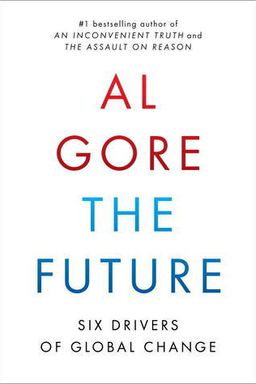
The Future cover

The Future

by Al Gore

In ''The Future,'' Al Gore delves into six pivotal forces that will shape humanity''s destiny. Through a critical lens, he examines the promises and perils of these forces, urging readers to actively engage in shaping a sustainable and equitable future.

Emergence, Systems, and the Human Future

How can you understand a world that seems to change not by increments but in leaps? Across climate, technology, economics, and politics, seemingly separate forces combine to produce outcomes no one designed. Al Gore’s central claim is that humanity now lives inside emergent systems—complex, open networks where new behaviors arise from energy flows and information exchange. In this view, your era is not merely one of crisis but of transformation—a planetary-scale shift comparable to the emergence of life itself.

Drawing on Nobel chemist Ilya Prigogine’s discoveries, Gore explains that when energy flows persist through an open system, the system can self-organize into higher complexity. The Earth is such a system: sunlight drives the biosphere, chemistry and metabolism create feedbacks, and within that complexity, self-aware life has evolved. But now, by burning fossil fuels—ancient sunlight stored as carbon—you alter this balance. The influx of extra energy destabilizes the delicate equilibrium that sustained civilization through the Holocene. Roughly a quarter of today’s greenhouse emissions will still trap heat ten millennia from now, a reminder that your present decisions set emergent conditions on geologic time scales.

The World You Inherit: Earth Inc. and the Global Mind

In Gore’s synthesis, two great emergent entities have arisen: Earth Inc.—a global economy integrated by trade, capital, and automation—and the Global Mind—a planetary nervous system built of networks, sensors, and digital consciousness. Earth Inc. behaves like a single organism driven by profit signals; it reallocates work through outsourcing and robosourcing, concentrates wealth, and accelerates consumption. The Global Mind, by contrast, amplifies awareness and interconnection, but also breeds surveillance and distraction. Their collision defines this century: a contest between market-driven extraction and information-driven collective reason.

You live inside this tension every day. Financial algorithms trade in microseconds, making markets hypersensitive to technological speed rather than human need. At the same time, billions of devices log your behavior, generating “exomemory” that reforms how societies remember and act. This dual emergence carries both promise and peril: empowerment through shared knowledge or coercion through data control. Gore urges you to decide which path prevails.

The Ecological Boundary

The book’s ecological argument flows directly from this systems lens. Population growth, resource depletion, and climate change represent feedbacks out of balance. Humanity’s scale—consumption, pollution, and land use—has exceeded regenerative capacity. Topsoil erodes much faster than it forms, aquifers and fisheries reach limits, coral reefs crumble under acidification, and biodiversity collapses. Gore calls this dynamic Outgrowth: the overshoot of human enterprise beyond Earth's carrying capacity.

These crises are linked. Groundwater pumped in Pakistan and India contributes to global sea-level rise. Nutrient runoff from agriculture deadens coastal seas. Burning coal both warms the air and acidifies the ocean. Each domain—soil, water, atmosphere—feeds back into the others, forming systemic risk. The key insight: solving any one issue in isolation fails; only systems thinking can restore balance.

The Ethical and Political Dimension

Technological revolutions extend this systemic transformation into biology and governance. Genomics, synthetic life, nanotech, and neuroscience offer godlike capabilities to redesign cells and minds. Yet history reminds you that scientific power without ethical governance leads to tragedy—the U.S. eugenics movement and forced sterilizations being stark warnings. Gore’s argument is that progress now demands a revolution of values as much as of tools. Governance, law, and civic institutions must evolve to match the reach of science and the pace of innovation.

Meanwhile, democracy itself is under stress. Economic power distorts representation; lobbying and campaign finance turn governance into a market. Media fragmentation, disinformation, and the cost of political communication amplify short-termism just when planetary cooperation demands long-term thinking. For Gore, institutional redesign—not mere partisan victory—is the essential work of this century. Systems produce what they are structured to produce; change the rules, and you change history.

A Map for Transformation

Across domains, a pattern emerges: you inhabit open systems poised at thresholds. When energy or information crosses a tipping point, small causes yield large effects—social uprisings, market collapses, climatic shifts. Linear thinking no longer suffices. The antidote is adaptive intelligence: governance that internalizes long-term externalities, economic metrics that count real well-being rather than GDP illusions, and technologies aligned with ecological balance and human dignity.

Gore’s final message is not despair but agency. Emergence means novelty is possible: just as chaos can self-organize into life, humanity can reconfigure civilization toward sustainability. What you choose—policies, investments, and dreams—will determine whether today’s turbulence births collapse or a higher order of stability. The future, he insists, belongs to those who understand systems and design for their emergent possibilities.


Earth Inc. and the New Global Economy

In the age of Earth Inc., economic life no longer fits into national borders. You live inside a planetary-scale production web animated by instantaneous finance, robotics, and digital trade. Gore depicts Earth Inc. as an emergent superorganism—efficient, restless, and largely indifferent to ecological or social limits.

Labor Disruption: Outsourcing Meets Automation

Two engines drive global restructuring: outsourcing and robosourcing. Companies move work to low-wage countries and simultaneously replace it with machines. Foxconn’s plan for a million robots and the rise of Narrative Science’s automated journalism exemplify a new economic feedback loop: global integration incentivizes automation, which further reduces labor’s share of income. Middle-income jobs vanish across advanced and emerging nations alike.

Speed and Fragility of Finance

Financial markets now run faster than human cognition. High-frequency trading executes millions of orders per second, creating what Gore calls “tight coupling”—a system so fast and interdependent that small errors cascade. The 2010 Flash Crash, in which the Dow briefly lost a thousand points in minutes, shows how microsecond algorithms can destabilize trillions of dollars. The result is volatility without accountability.

Inequality and Policy Capture

As technological capital outpaces human labor, wealth concentrates. The top one percent claim about a quarter of U.S. income, and political power follows: lobbying eclipses public interest. This feedback loop erodes democracy’s capacity to solve long-term problems—including climate and infrastructure. Earth Inc., optimized for short-term efficiency, externalizes its costs to the biosphere and future generations.

Rethinking Capitalism’s Metrics

Gore’s remedy is structural: replace quarterly capitalism with Sustainable Capitalism. That means lengthening investment horizons, pricing carbon to internalize ecological costs, and adopting new measures beyond GDP to value well-being and resilience. In this system, business remains vital—but aligned with ecological logic rather than entropy. For you as citizen or policymaker, the challenge is to rewrite the incentives so that rational profit seeking produces sustainable prosperity.


The Global Mind and the Digital Commons

Parallel to Earth Inc.’s rise, a planetary layer of consciousness is forming: billions of humans and devices interlinked in real time. Gore calls it the Global Mind. It is both mirror and maker of modern society—an external nervous system that can empower democracy or enable surveillance.

Information Abundance and Cognitive Shift

You now carry an exomemory in the cloud. Psychologists confirm that when facts are searchable, you remember less internally; GPS users lose spatial intuition. Ancient anxieties about writing’s effect on memory (Plato’s Phaedrus) have returned at digital speed. As data multiplies, the challenge is not scarcity but curation—how to preserve depth, reasoning, and reliable knowledge amid information glut.

Empowerment and Control

The same networks that broadcast truth can entrench control. Social media helped ignite the Arab Spring and Occupy Wall Street, yet China’s and Iran’s censorship show how regimes can weaponize connectivity. After Google’s withdrawal from China, Sergey Brin lamented that the genie was “put back in the bottle.” The Global Mind reveals power’s double edge: openness invites innovation and dissent, but also surveillance and manipulation.

Privacy, Cybersecurity, and the Stalker Economy

Gore warns of a “stalker economy” where every click and movement feeds analytics. Cookies, sensors, and state intelligence merge into an invisible infrastructure of prediction. Cyberattacks—from Stuxnet to massive corporate breaches—demonstrate new risks in the fifth domain of conflict. Without legal and ethical standards for data integrity, the Global Mind can turn into a global panopticon.

Digital Norms for Democracy

What you must defend are the principles of transparency, privacy, and openness—the same values that sustain democracy itself. Net neutrality, encryption rights, and independent journalism become forms of civic infrastructure. The Global Mind can evolve into humanity’s conversation with itself, but only if you protect the digital commons from monopolization and authoritarian capture.


Outgrowth and Planetary Limits

The phrase Outgrowth names the collision between exponential human expansion and finite planetary systems. Population, consumption, and technology grow geometrically while soil, water, and ecosystems obey ecological time. For Gore, the defining drama of the twenty-first century is whether civilization can realign its metabolism with Earth’s limits.

Population Pressure and Urbanization

The world added a billion people in just over a decade, moving toward nine billion by mid-century. Most growth concentrates in developing nations, especially Africa. Over half of humanity now lives in cities, with megacities multiplying. Slums already house more than a billion people, foreshadowing infrastructure crises around housing, sanitation, and water supply. Yet urbanization can lower emissions if managed through efficient design—dense, transit-rich, low-energy cities can be green engines of development.

Food, Soil, and Water Constraints

Every staple depends on fragile soils and dwindling groundwater. Topsoil erodes ten to fifty times faster than it forms; China, India, and the U.S. heartland are hotspots. Aquifers such as the Ogallala and North China Plain decline meters per year. Agriculture consumes most freshwater, much from "fossil" aquifers that recharge barely at all. Fertilizers derived from natural gas and phosphorus create temporary yields but long-term pollution. Gulf of Mexico dead zones and toxic algal blooms trace this imbalance directly.

Oceans and Climate Feedbacks

The ocean crisis mirrors the terrestrial one. Overfishing has reduced large predatory fish populations by about 90% since the 1960s; coral reefs lose half their cover within decades; rising CO2 acidifies waters faster than at any time in 300 million years. As reefs, mangroves, and seagrasses vanish, coastal communities lose both food and storm protection. This is not a future scenario—it is an ongoing deconstruction of the biosphere’s stability mechanisms.

Redefining Growth

Gore argues that GDP fetishism blinds societies to depletion. When pollution cleanup counts as positive output, economies celebrate self-inflicted damage. The remedy is to shift measurement toward inclusive wealth—natural, human, and social capital combined—and to slow population growth through education and women’s empowerment. Stability arises not from endless expansion but from balance.


Climate Crisis and the Politics of Denial

At the core of Gore’s argument lies the climate emergency: the decisive feedback in Earth’s emergent system. Humanity emits about 90 million tons of CO₂-equivalent pollution daily. That extra heat destabilizes weather, agriculture, and geopolitics, threatening to turn the planet’s habitability into a casualty of political delay.

The Science of Destabilization

Measurements confirm the trend: Arctic sea ice volume has halved; Greenland’s surface melted nearly entirely in July 2012; extreme-heat events have multiplied a hundredfold in a few decades (James Hansen’s findings). Food systems buckle as yields drop when temperatures exceed crop thresholds; monsoon shifts and droughts intensify water stress; coastal megacities face multi-meter sea-level rise risks this century.

Policy Tools and Blockages

The available policy mix is well known—carbon pricing, removal of fossil subsidies, renewable mandates, and emissions trading—but political inertia persists. Fossil lobbies finance disinformation (“reposition global warming as theory not fact” read one leaked 1991 memo). Senate filibusters and campaign money further paralyze action. Gore stresses that the barrier is no longer technological but moral and institutional: collective denial substitutes for governance.

Geoengineering Temptations

Because prevention seems hard, some advocate planetary tinkering—injecting sulfates to cool sunlight or deploying orbital mirrors. Gore warns that such schemes ignore ocean acidification, alter rainfall, and create dependency: when aerosols stop, stored CO₂ will unleash rapid warming. Geoengineering becomes a moral hazard inviting procrastination. The rational course remains deep decarbonization.

The Transformative Opportunity

Renewable energy already competes on cost; solar and wind are rising exponential technologies. Coordinated policy can accelerate transition, create jobs, and curb emissions. The decisive variable is political imagination: whether democracies can act as though physics applies. For Gore, this is the civilizational test against which history will judge your generation.


Technology, Life, and Ethical Governance

While climate defines the boundary conditions, biotechnology and neuroscience redefine what it means to be human. In the Life Sciences Revolution, you can print tissues, edit genomes, or interface directly with the brain. Gore celebrates the healing promise but insists on ethical guardrails drawn from the past century’s misuses of science.

Genomics and Synthetic Biology

The plunge in sequencing costs—from billions to less than $1,000—turns genetics into code. Craig Venter’s synthetic cell and George Church’s DNA-encoded book illustrate biology’s merger with information technology. Synthetic microbes may produce fuels or medicines, but also pose containment, patent, and security dilemmas. Democratization of biotech tools echoes the early internet—powerful, decentralized, and poorly governed.

Neurointerfaces and Cognitive Frontiers

Optogenetics, deep brain stimulation, and brain–computer interfaces restore sight, hearing, and motion, yet blur the boundary between therapy and enhancement. From Adrian Owen’s fMRI communication with vegetative patients to DARPA’s telepathic helmets project, the mind itself becomes programmable. This demands debate not only about safety but about identity, privacy, and inequality—who controls access to enhanced cognition?

Remembering Eugenics

History’s dark chapters—Buck v. Bell and 64,000 coerced sterilizations—show how pseudoscience justified oppression. As gene editing and preimplantation screening advance, those precedents remind you of the ethical line between prevention and perfectionism. Governance must precede capability. Without it, Life Inc. could reduce human dignity to a patentable asset.

Toward Global Bioethics

Gore calls for international norms akin to nuclear treaties: shared oversight, transparency, and open science balanced with safety. Public debate must keep pace with laboratory speed. In essence, the evolution of ethics must match the evolution of power—or the new biology will outgrow democracy itself.


Democracy, Reform, and Sustainable Capitalism

All previous themes converge in Gore’s closing argument: you must reform capitalism and democracy together or lose both. The issue is not human nature but system design. Rules shape behavior; when incentives reward extraction and short-termism, even good people make harmful choices. Civilization’s task is to realign those incentives with the planet’s and humanity’s long-term interests.

The Structural Problem

GDP growth ignores distribution and degradation; campaign finance converts elections into investments by the wealthy. Quarterly capitalism discounts the future; political polarization disables collective planning. These are design flaws, not moral failings. Just as the U.S. Constitution channelled ambition through checks and balances, modern institutions need updates that internalize externalities and democratize influence.

Reform Agenda

  • Implement carbon pricing and adjust trade rules to penalize free-riding emitters.
  • Integrate natural and social capital into accounting frameworks.
  • Curb the influence of money in politics: campaign finance limits, media reforms, and transparency.
  • Rebuild public goods—education, journalism, health—as long-term social infrastructure.

Earth Inc. vs. the Global Mind

The struggle reduces to whether technological and market forces will concentrate power or disperse it. Earth Inc. prizes profit and control; the Global Mind favors transparency and shared intellect. Which one dominates depends on choices you help institutionalize—laws protecting open information and accountability, or continued capture by private capital.

The Hope of Emergence

Emergence cuts both ways: systems collapse when stressed, but also self-organize into new stability. If citizens act on reason, if markets are re-coded for sustainability, a new equilibrium can form. Gore ends with this moral physics: you cannot command the future, but you can design the conditions for its emergence. Sustainable capitalism and rejuvenated democracy are not utopian—they are the self-organizing next phase of human evolution, if you choose to make them so.

Dig Deeper

Get personalized prompts to apply these lessons to your life and deepen your understanding.

Go Deeper

Get the Full Experience

Download Insight Books for AI-powered reflections, quizzes, and more.