
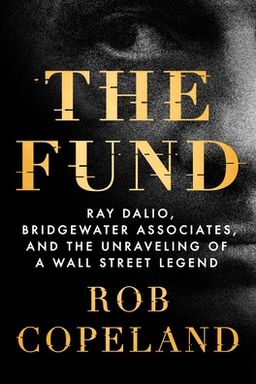
The Fund cover

The Fund

by Rob Copeland

The Fund unveils the intricate world of Ray Dalio and Bridgewater Associates, exploring the bold principles and cultural dynamics that fueled its success. Through detailed research and interviews, discover the challenges and triumphs of this Wall Street powerhouse.

Bridgewater’s Experiment in Radical Truth

How does a hedge fund become a social experiment? In his investigation of Bridgewater Associates and its founder, Ray Dalio, Rob Copeland examines one of the most unusual corporate cultures ever built. What began as a quest for better investment decisions transformed into a grand experiment in human management, data quantification, and radical transparency. Dalio promised an “idea meritocracy” where truth rules over hierarchy—but the deeper you go, the more you find a system that rewards conformity, punishes dissent, and raises profound questions about power and belief inside modern institutions.

Copeland’s portrayal of Bridgewater centers on the paradox between the ideal of principles and the machinery of control. Across its evolution—from Dalio’s early risk experiments to the data-obsessed empire employing thousands—the firm uses rules, algorithms, and surveillance to manage both money and people. Yet each instrument meant to eliminate bias ends up magnifying the founder’s own influence.

Radical Truth as a Creed

Dalio’s Principles begin as a sincere attempt to codify self-improvement. His formula—“Pain + Reflection = Progress”—invites employees to face mistakes publicly and transform discomfort into growth. In theory, every voice counts. In practice, you live under a microscope: recordings of your meetings, feedback via the “Dot Collector” app, and evaluation by your own colleagues are all inputs into a corporate algorithm of judgment. To survive, you must internalize the Principles so deeply that they shape how you think, speak, and even feel.

The rituals—“probes,” “diagnoses,” “issue logs,” and filmed trials—give Bridgewater the air of a philosophical boot camp. Dalio insists that harsh honesty leads to excellence; many insiders experience it as an institutionalized form of surveillance. The result is a world where every conversation becomes potential evidence and every truth an audition for loyalty.

The Machine Behind the Culture

Bridgewater’s investing model, built around its flagship “Pure Alpha” and “All-Weather” funds, reflects Dalio’s obsession with systematic thinking. Markets, he argues, work like machines—predictable if you deconstruct their moving parts. This mechanistic worldview spreads from portfolio construction into the firm’s inner life: managers seek to measure human reliability, emotional stability, and decision quality as if they were financial assets. Tools such as the baseball cards and Believability Index assign numerical ratings to competence and credibility, feeding data loops designed to rank people as cleanly as trades.

In theory, this promises objectivity; in reality, it encodes hierarchy. Dalio’s own ratings become unchallengeable baselines, and those closest to him manipulate or interpret the data to maintain alignment. The “idea meritocracy” begins to look like a founder meritocracy disguised in numbers.

Transparency Turned Weapon

Transparency, intended as moral illumination, becomes institutional domination. Every meeting is taped, every misstep archived. The “Transparency Library” can be used for teaching—or for shaming, depending on who edits the footage. Legal teams and compliance officers treat minor leaks or errors as cause for descent into trials. When former FBI director Jim Comey joins Bridgewater’s legal department, the fund’s internal cases resemble prosecutorial investigations more than managerial reviews. Cameras and microphones become the instruments of both learning and fear.

To justify these measures, Dalio invokes love and discipline in the same breath: “Sometimes you have to shoot the ones you love.” The phrase captures the paradox at the heart of Bridgewater—devotion enforced by punishment, excellence pursued through exposure.

Power, Succession, and Myth

Copeland traces how Dalio transforms personal philosophy into corporate theology. “The Principles” evolve into a brand, an asset, and finally an exportable product. The company’s AI prototypes—like “Prince” and “PriOS”—try to automate the founder’s methods, even as they keep his biases embedded in code. Meanwhile, Bridgewater’s “partnership” and succession plans ensure continued dependence on Dalio: top executives are offered stakes financed by firm-backed loans, tying their financial fate to loyalty. Publicly, Dalio proclaims retirement; privately, he remains the system’s gravitational center.

His myth-making campaign extends beyond the fund: TED Talks, books, PR efforts, and alliances with institutions (from Harvard to the Chinese state) reinforce the narrative of Bridgewater as a moral enterprise. By packaging his management doctrine as universal wisdom, Dalio secures both a legacy and a protective mythos that outlasts individual scandals.

The Human Consequence

Amid these grand systems lie human costs. Employees suffer breakdowns, burnout, and public humiliation. Whistleblowers and victims of misconduct face ostracism or legal silence via nondisclosure agreements. Talented technologists and investors depart disillusioned, citing the gap between professed ideals and lived reality. “Pain + Reflection = Progress” becomes a slogan that justifies cruelty. For many, leaving Bridgewater means recovering from a psychological experiment where trust was conditional and transparency selective.

Ultimately, the story of Bridgewater is both a case study in visionary management and a cautionary tale about ideology unbounded by empathy. Dalio built a mirror for truth—and ended up gazing into eternity at his own reflection.


The Principles and Their Enforcement

At Bridgewater, every decision begins and ends with Ray Dalio’s Principles, a written and living manual that claims to replace arbitrary leadership with universal rules. You encounter these principles everywhere: in training modules, performance tests, and peer evaluations. You are not just encouraged to read them; you must embody and recite them, often under public scrutiny. The firm treats alignment with Dalio’s moral vocabulary as a test of belonging.

From Philosophy to Discipline

The Principles outline a worldview where “pain plus reflection equals progress.” Mistakes are data, and discomfort signals growth. This ethos sounds liberating—until you experience its enforcement. Bridgewater makes adherence measurable. Employees are videotaped, analyzed, and rated on their “living in truth” or “probing to the root cause.” You must log every conflict, accept group interrogations, and grade others in return. Self-critique is no longer optional; it is a job requirement.

Public Trials and Loyalty Tests

Dalio’s quest for honesty produces spectacles. The “probe and diagnosis” sessions—where managers publicly question subordinates—function as both pedagogy and intimidation. Examples like the videotaped breakdown of Katina Stefanova are replayed for recruits as case studies in truth-seeking. Success becomes defined by your willingness to endure exposure. For some, the process spurs accelerated learning; for others, it borders on psychological hazing. Dalio insists the same rigor applies to him, yet the evidence shows his inner circle largely controls and edits the tapes, guarding his image.

The Role of Fear

When every meeting can be archived and replayed, fear becomes self-policing. You rarely lie—but you also rarely speak freely. Bridgewater’s claim to eradicate politics instead institutionalizes a form of moral surveillance. You learn to emulate Dalio’s cadence, borrow his phrasing, and avoid statements that might later be dissected in a feedback session. Radical truth turns from a philosophy of freedom into a system of behavioral conditioning.

In short, the Principles function less as a guide than as a constitution. They replace human judgment with scriptural reference—an experiment that shows how ideals can harden into orthodoxy when welded to authority.


Metrics, Dots, and the Quest to Quantify People

Dalio’s dream is to treat human performance like a quantifiable system. Bridgewater’s grand project—the “baseball cards,” “Dot Collector,” and later “PriOS”—aims to transform subjectivity into data. In this world, every interaction becomes a measurement; every person becomes a profile updated in real time. The assumption is that enough data will yield perfect meritocracy.

Believability and Bias

The foundation of this system is the concept of “believability.” Your opinions carry weight proportional to your prior success in a given domain. In theory, it prevents bad decision-makers from dominating debates. In practice, the weighting reinforces hierarchy: Dalio’s scores are hard-coded as the firm’s benchmark, making him mathematically irrefutable. When engineers observe him reacting angrily to colleagues ranked above him, the algorithm is quietly altered so that his authority remains unchallenged.

The Dot Machine

The Dot Collector app encapsulates the experiment. You rate peers across attributes like “humility,” “assertiveness,” and “open-mindedness.” Each dot updates live dashboards visible to the group. Over time, patterns emerge—but so do strategic behaviors. Employees learn to dot favorably toward high-believability raters, mirroring the social dynamics of an online game. Negative dots spread contagiously: once Dalio marks you low, others follow to avoid conflict. The resulting metrics feel objective but act as instruments of conformity.

PriOS and the Algorithmic Dream

PriOS—a “Principles Operating System”—was designed to automate leadership decisions. Former IBM Watson scientist David Ferrucci tried to encode Dalio’s thought patterns into AI. He failed, not because of technical limits, but because Dalio’s style—intuitive, shifting, self-revising—defied formalization. Instead of liberating managers from subjectivity, the machine replicated it at scale. Bridgewater’s fantasy of precision turned into a feedback loop of founder bias rendered in code.

(Note: Copeland’s portrayal echoes themes from Shoshana Zuboff’s Surveillance Capitalism—algorithms that promise neutrality yet amplify their creators’ intentions. Bridgewater’s system shows that when data becomes performance currency, morality becomes a measurable metric, and individuality a liability.)


Surveillance and Weaponized Transparency

Every corner of Bridgewater is wired for recording. Meetings, hallways, even restrooms fall under the gaze of the “Transparency Library,” an archive of corporate life meant to preserve the truth. In Copeland’s account, transparency mutates into omnipresence: what begins as accountability becomes control. The camera watches not only your decisions but your expressions; silence itself becomes data.

The Ethics of Exposure

Tapes of breakdowns and confrontations—like pregnant manager Katina Stefanova’s interrogation—are edited and distributed internally as teaching tools. Employees watch these emotional autopsies to learn proper behavior. Dalio and his legal team, aided by Jim Comey, treat the archive as both record and deterrent. Leaks trigger forensic hunts through printer logs and security footage. The message is unmistakable: nothing is private.

From Transparency to Punishment

Transparency becomes selective when power skews visibility. When misconduct allegations arise—such as Samantha Holland’s relationship with Greg Jensen—the resulting “Ethics Committees” double as tribunals. Sessions are filmed, conclusions are polled, and verdicts are public. Settlements occur under nondisclosure, while internal messaging frames each case as proof of fairness. In truth, control over the archive allows selective exposure: moments that reinforce the system are preserved; those that challenge it quietly disappear.

Living Under Surveillance

Employees surrender phones, fear offhand remarks, and guard facial expressions. Some joke about “piss investigations and coffee pot probes,” but the effect is chilling. Transparency creates clarity, yes—but also self-censorship and paranoia. Like Bentham’s panopticon, the knowledge that you could be observed at any moment keeps you compliant without force.

Dalio calls this love in service of truth. Copeland calls it a high-functioning surveillance state dressed in management jargon.


Power, Patronage, and Succession

Beneath its rhetoric of meritocracy, Bridgewater runs on patronage. Advancement depends on proximity to Dalio—what insiders call being “in the family.” Those who align with his vision are rewarded with equity, loans, or private trust; those who dissent are cycled out under the banner of Principle enforcement. Copeland shows how loyalty intertwines with debt until even senior leaders become financially and psychologically bound to the founder.

The Inner Circle

Executives like Greg Jensen and Bob Prince exemplify the double bind of privilege. Granted immense authority and wealth, they also bear personal debt to Dalio and the firm. Jensen, once heir apparent, collapses under the combined pressure of expectation and surveillance; his public demotion is both punishment and spectacle. Others, like Paul McDowell, who designed Dalio’s rating systems, receive “family” rewards—phantom equity and emotional validation—for reinforcing the founder’s authority.

The Partnership Trap

Dalio’s succession plan turns ownership into constraint. Seniors are invited to buy shares financed through massive loans from the firm itself. The proposition appears generous until you read the fine print: if you leave, you owe back your investment. Debt replaces chains. Critics like Bob Elliott refuse and face subtle ostracism. The plan ensures continuity, not independence: by tying wealth to allegiance, Dalio makes rebellion too expensive.

Legacy as Leverage

Even as Dalio claims to withdraw, he stages his myth. Media profiles, university alliances, and technology ventures project him as a philosopher-king. His AI assistant “Prince” is sold as evidence that the system can run without him, yet the code itself embodies his biases. Through equity sales to institutions like Temasek and the Texas teachers’ pension fund, Dalio monetizes both his control and his legend. Succession, in the end, is not transfer but transformation: power rebranded as legacy.

Copeland’s insight is clear—institutions built on absolute principles are rarely free from personal politics. Succession reveals that truth most starkly.


The Human Cost and the Moral Reckoning

Bridgewater’s systems aim to improve people; instead, they often break them. Rob Copeland ends his investigation with the toll—the suicidality, burnout, and moral fatigue left in the wake of radical transparency. The psychological strain proves as real as any market drawdown.

Emotional Exhaustion and Collapse

Constant feedback, quantitative scrutiny, and public correction turn self-development into perpetual anxiety. New hires like Joe Sweet experience the progression from idealism to despair, describing the culture as “living in a hole before sunrise.” Even those who thrive often become desensitized—learning to rationalize suffering as growth. Bridgewater labors under a paradox: to produce unflinching truth, it must manufacture unflinching people.

Ethical Blind Spots

Reports of sexual misconduct and coercion, from Samantha Holland’s forced interrogation to Stefanova’s edited public trials, reveal a culture unable to reconcile moral complexity with its mechanistic doctrine. Settlements and NDAs silence dissenters; edited clips rewrite memory. In the firm’s rhetoric, everything—even punishment—serves learning. In lived reality, such rationalizations erode empathy and accountability.

Life After the Machine

Many who leave Bridgewater describe recovery as relearning normal conversation—dialogue without probes, honesty without humiliation. They carry scars and paradoxical admiration: the environment that harmed them also trained immense discipline. Like veterans of an ideology, they exit believing in parts of the mission while rejecting its extremes.

Copeland frames this as the moral heart of the story. The pursuit of perfect truth, stripped of compassion, becomes cruelty disguised as enlightenment. The lesson transcends one firm: a system can win markets and still fail at humanity.

Dig Deeper

Get personalized prompts to apply these lessons to your life and deepen your understanding.

Go Deeper

Get the Full Experience

Download Insight Books for AI-powered reflections, quizzes, and more.