
Idea 1
The Rhythm of History and the Human Saeculum
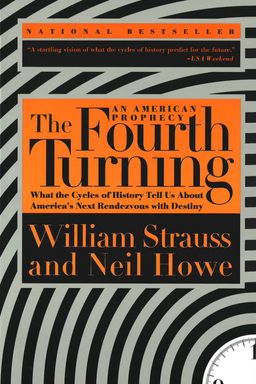
What if you could read history the way you read the seasons of a year or the stages of one human life? That is the central claim of The Fourth Turning by William Strauss and Neil Howe. They argue that modern societies move through recurring 80–100 year cycles—called saecula—each divided into four predictable eras of social mood and institutional strength. Every saeculum ends with a profound Crisis, out of which a new order—and a new cycle—emerges.
Their core proposition is simple yet transformative: history has a pattern, and by mapping that pattern you can anticipate the emotional, institutional, and generational temper of your own time. The book is not prophecy in the mystical sense—it’s sociology with rhythm. Each long cycle mirrors a human lifespan and unfolds with regular changes in leadership generations, civic trust, and cultural energy.
The Saeculum's Four Seasons
Strauss and Howe reintroduce an ancient idea: history’s heartbeat follows the span of memory. The saeculum—used by Etruscans and Romans—marks the rise and decay of shared experience. Each cycle passes through four “turnings,” comparable to seasons: a High (spring of unity and optimism), an Awakening (summer of spiritual revolt), an Unraveling (autumn of fragmentation), and a Crisis (winter of survival and rebirth). When a fourth turning concludes, a new High begins.
These eras are visible in Anglo-American history: the American Revolution (Crisis), early Republic (High), Transcendental Awakening (Awakening), sectional discord (Unraveling), Civil War (Crisis), Reconstruction & Gilded Age (High), and so on. You live inside one of these cycles—what the authors call the Millennial saeculum—that began after 1946.
Cycles Driven by Generational Change
Every turning feels different because the generations that dominate public life change. Four recurring archetypes—Prophet, Nomad, Hero, and Artist—follow each other in sequence. Each archetype’s life stage defines the collective mood. For instance, a society led by aging Prophets (moralists) and staffed by midlife Nomads (survivors) tends to face a Crisis; a society led by pragmatic Heroes and youthful Artists tends toward a High. Each generation’s upbringing prepares it for its role in the next cluster of conflicts.
After World War II, for example, G.I.s (Hero archetype) built strong institutions, while Boomers (Prophets) grew up indulged and later rebelled in the 1960s Awakening. Generation X (Nomads) matured amid disunity and became skeptical pragmatists. Millennials (Heroes) were overprotected youth being trained for teamwork during the next Crisis. The saeculum advances because these generational cast members march through life in procession, pulling mood and institutions with them.
Recurring Moods, Predictable Consequences
Each turning reshapes society’s priorities. In a High, you trust institutions and emphasize conformity. In an Awakening, you challenge authority and chase authenticity. In an Unraveling, institutions decay while individual expression peaks. Finally, a Crisis forces society to trade freedom for unity, rebuilding the civic foundation from scratch. The late 20th-century “Culture Wars” and fiscal fractures were not random—they were symptoms of an Unraveling approaching its Fourth Turning winter.
The authors triangulate their idea with scholars like Toynbee, Wright, and Schlesinger, who found century-long “rhythms” of war and peace. Periods of consolidation and moral revival alternate with disintegration and conflict. When collective memory of the last great war fades, younger generations romanticize struggle, setting the stage for new confrontation. Recognizing those phases lets you see not isolated events but recurring structures of emotion and leadership.
Why the Theory Matters to You
Understanding the saeculum lets you orient yourself in history. You can read the national mood and forecast the kinds of challenges—spiritual, civic, or existential—that will dominate your lifetime. Strauss and Howe warn that the next Fourth Turning (2005–2025) would be America’s next great test, likely emerging from economic instability, political gridlock, and declining trust. Yet they emphasize agency: awareness of the pattern equips you to respond, not resign yourself to fate.
The book blends historical reasoning and moral exhortation. It argues not for determinism but for preparedness: generations who recognize their archetypal duty can steer Crises toward constructive rebirth rather than ruin. You cannot avert winter altogether, but you can build shelter—and set conditions for the next spring. That’s the enduring insight of the saeculum: history moves in seasons, yet meaning comes from how you act within them.
Core insight
When you see history as a living cycle rather than a linear march, you gain foresight. You understand why societies dream, doubt, fragment, and rebuild—and why your generation’s character will help decide what kind of spring comes after the storm.