
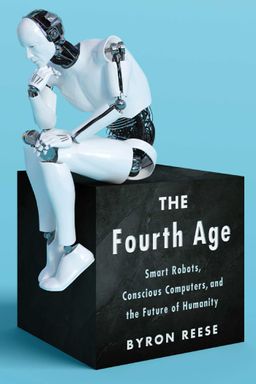
The Fourth Age cover

The Fourth Age

by Byron Reese

The Fourth Age by Byron Reese delves into the transformative power of AI, exploring historical contexts and philosophical debates. This book offers readers a compelling framework to understand AI''s potential impact on the workforce and society, preparing them for a rapidly evolving technological future.

The Fourth Age and the Human Story

Throughout history, technology has not merely changed what people do—it has changed what people are. Byron Reese calls these transformations the Four Ages of Humanity: Fire and Language, Agriculture and Cities, Writing and the Nation-State, and now Robots, Computers, and AI. His central claim is simple but profound: only a few technologies restructure reality itself by outsourcing core human functions—digestion, memory, computation, or even consciousness. We are living through one of those epochs now.

From Flame to Speech: The First Age

Around 100,000 years ago, fire and language rewired human life. Fire expanded diet and energy efficiency, leading to larger brains; language enabled abstract cooperation and storytelling. The union of the two made collective intelligence possible: knowledge could now travel across generations rather than die with individuals. Civilization was born as a shared narrative.

From Farms to Cities: The Second Age

Roughly 10,000 years ago, agriculture created surplus and planning. That surplus made specialization and cities possible—Çatalhüyük, Jericho, and early Sumerian sites exemplify it. The shift birthed institutions (law, markets, hierarchy) and conceptions of the future; humans learned to forecast seasons and manage stored wealth. Time itself became an object of calculation.

From Memory to Law: The Third Age

Writing and wheels transformed oral cultures into institutional ones. Written codes like Hammurabi’s turned custom into explicit law, while wheels extended trade and empire. Memory moved from minds to tablets. (Plato warned that writing might produce forgetfulness—an early critique of cognitive outsourcing.) With writing came bureaucracy, contracts, and civilization-scaled identity. The self extended through documents.

From Computation to Cognition: The Fourth Age

Today’s leap—the Fourth Age—outsources thinking itself. Robots and computing systems model physical and abstract worlds, translating DNA, markets, or weather into data you can manipulate. Reese positions this as a revolutionary mirror: for the first time, our tools can reason about reasoning. Alan Turing’s conceptual machine already showed that any calculable process can, in theory, be executed by a computer. Now, embodied computers perform those calculations in real environments—from self-driving cars to speech recognition to financial trading.

Why this matters

Reese’s lens reframes debates about artificial intelligence. It tells you this is not a mere upgrade but a transformation on par with language and writing—technologies that rewrote cognition and culture. Just as the alphabet reorganized memory and fire redefined biology, computation may redefine mind.

The pattern across ages is that each revolution changes what it means to be human. The first altered our bodies and cooperation; the second reshaped societies and foresight; the third built durable institutions; the fourth challenges the boundary between natural and artificial thought. Reese’s argument invites you to examine not only what AI will do but what it will make of us.


Computation and the Machine Mind

At the heart of the Fourth Age is computation—the astonishing ability to translate almost any process into manipulable information. Reese argues that computation is not a tool like a lever or a wheel but a philosophical event: it challenges how we think about thinking itself. Computers model nature’s own algorithms, implying that cognition and even life processes might be computational in structure.

From Babbage to Shannon: The Four Founders

Reese highlights four intellectual pillars. Charles Babbage conceived mechanical computation in the nineteenth century. Alan Turing proved that all computable functions could be executed by simple rules. John von Neumann formalized the architecture (memory plus processor) that still defines computers. Claude Shannon revealed that logic itself could be physically encoded—transforming ideas into electrically manipulable bits.

Together, they created a map from mathematics to matter. The world, as many physicists and theorists now suspect, might itself be a giant computation. (Stephen Wolfram and Marshall McLuhan, both cited in Reese’s text, argue that media and algorithms extend our cognition the way wheels extend our legs.)

Exponential Transformation

Moore’s Law—transistor count doubling every two years—magnifies this moment. In 1960, a gigaflop of processing cost more than a nation’s wealth; today, it costs cents. This exponential decline forces moral and economic adaptation far faster than political systems can react. As computation spreads, it increasingly serves as a mirror for the human mind: everything you understand about perception, memory, or intention can now be simulated or tested through code.

Key takeaway

Because computation can model processes once thought uniquely human, the question shifts from whether machines will think to whether thinking is just computation. Your assumptions about mind and matter will determine your answer.

For you, understanding computation means recognizing that every model—of weather, language, or disease—is also a model of thought. The digital revolution therefore doubles as a philosophical one: the more the machine reveals about your brain, the less distinct the line becomes between tool, partner, and possible peer.


Brains, Minds, and Philosophical Fault Lines

If machines now simulate perception and decision-making, what distinguishes you from them? Reese divides this into three questions—what is the universe made of, what are we, and what is the self? These foundational issues, not coding or hardware, shape every prediction about artificial general intelligence (AGI).

The Physical and the Dual

Monists see everything—including consciousness—as physical; dualists posit that minds or souls exist beyond matter. The famous “Mary’s Room” thought experiment (can a color scientist who never saw red learn something new by seeing it?) illustrates why this remains unsettled. If experience adds something beyond data, machines may never truly feel; if not, consciousness might rest in computation alone.

What Are We?

Three views dominate: we are machines (the reductive materialist view), we are animals (alive but not duplicable by mechanism), or we are unique beings endowed with reason or soul. Each stance predicts a different AI future. If you embrace the first, AGI is inevitable; if the last, impossible. Reese’s genius lies in mapping belief to expectation—showing how metaphysics governs forecasting.

The Nature of the Self

Neuroscience shows the brain is physical: 2% of your mass consuming 20% of energy, yet endlessly plastic. But subjective experience—your ongoing inner narrative—remains unexplained. The “illusion,” “emergent,” and “soul” camps offer models, from Daniel Dennett’s cognitive tricks to emergent complexity to spiritual dualism. Whether AGI can have a self depends on which story you believe about your own mind.

Big insight

AI arguments are rarely just technical—they are disguised metaphysical debates. When you ask whether a robot can think, you are really asking what thinking is and what kind of universe permits it.

Reese turns philosophy into diagnostics: your stand on mind, matter, and self forms your implicit theory of possibility. Understanding that landscape equips you to interpret every bold AGI claim or skeptical rebuttal that crosses your feed.


From Narrow AI to Robotics Reality

Most of what society labels “AI” today is narrow AI: computers excelling at specific, well-defined tasks. Reese distinguishes these practical systems from the elusive AGI dream to show what intelligence machines already have—and what they still lack.

Three Roads to Machine Competence

AI’s lineage runs through three methods: classic rule-based programming (explicit models), expert systems (if–then knowledge bases), and modern machine learning (pattern extraction from data). Machine learning’s triumphs—face recognition, spam filters, translation—depend on structured inputs and mountains of examples. These are successes of correlation, not comprehension.

Limits in the Wild

Machines see pixels, not meaning; they falter outside training data. Humans generalize intuitively and improvise from sparse cues. That gap—called the Moravec paradox—explains why robots ace math but bungle door handles. Polanyi’s paradox adds that much human skill is tacit knowledge we can’t articulate, so we can’t easily teach it to algorithms.

Robots in the Physical World

When narrow AI meets embodiment—robotics—you encounter friction. Factory bots thrive in repeatable settings; self-driving cars struggle with ambiguity. SLAM algorithms help robots localize, yet a single moving chair can confuse maps. The DARPA Robotics Challenge highlighted these limits: top teams spent years teaching robots simple household tasks. Power demands, brittleness, and sensor noise remain barriers to autonomy.

Why this matters

Understanding where robots fail helps you forecast labor disruption realistically. Automation will hollow out repetitive, structured work, but jobs demanding creativity, emotion, or repair in chaotic environments stay resilient.

Reese pushes you to discern hype from capability: your smartphone performs miracles only within narrow rails. True intelligence, he insists, requires transfer, context, and improvisation—the very traits machines still lack.


Paths to AGI and the Nature of Consciousness

Bridging narrow AI to AGI demands a leap in generalization. Reese surveys both engineering challenges and philosophical puzzles—why machines copy behavior but may not understand it. Classical thought experiments frame the stakes: Turing asks when imitation suffices; Searle retorts that syntax is not semantics. Between them lies the future of mind in silicon.

Beyond Modules

You can’t just bolt dozens of specialized AIs together to get general intelligence. True cognition depends on the ability to learn transferably across contexts. Reese illustrates this with the “preschooler test”: any agent answering a four-year-old’s spontaneous 100 daily questions would display genuine understanding. No machine has come close.

Sentience and Free Will

The book then tackles sentience—the ability to feel—and free will—the sense of agency. Neuroscience blurs both. MRI studies show decisions arising before conscious awareness; yet people who abandon belief in free will act less ethically, suggesting the idea’s social utility. If these processes are physical, machines may one day simulate them. If not, mechanical minds lack inner life by definition.

Competing Theories of Awareness

Eight models frame consciousness: weak or strong emergence, quantum effects (Penrose and Hameroff), panpsychism, Integrated Information Theory, Dennett’s functional “tricks,” and spiritual dualism. Their implications vary—some promise uploadable minds; others shut the door. Reese’s taxonomy explains why forecasters disagree by centuries: each theory defines its own horizon of possibility.

Core insight

AGI optimism or pessimism stems from which theory of consciousness you accept. Science has not yet ruled out any, so belief fills the vacuum. The debate is still as metaphysical as mechanical.

Reese’s balanced view: AGI is conceivable under several scientific maps but unattained because experience itself remains undefined. Until we solve feeling, building minds will be guesswork dressed as engineering.


Work, Wealth, and Ethical Frontiers

If machines reshape thought, they inevitably reshape society. Reese dedicates significant space to the economics and ethics of automation—jobs, inequality, political adaptation, and even warfare. He divides future scenarios by severity: all jobs lost, some jobs displaced, or none lost overall. Each scenario rests on assumptions about human uniqueness.

The Future of Work

Empirical data show that automation targets tasks before occupations. ATMs didn’t eliminate bank tellers; they changed their role toward sales and service. The “training manual test” offers a rule of thumb: if you can easily write a step-by-step guide, a robot will soon do that task. Jobs requiring empathy, adaptability, and ambiguity resist such codification.

Inequality and Universal Basic Income

Automation amplifies returns to capital—those who own scalable tools grow wealthier. Reese revisits the recurring UBI proposal: paying everyone a basic stipend. Calculations show it possible but massive—about $5 trillion annually in the U.S.—making political feasibility uncertain. Alternatives include guaranteed jobs or targeted social programs. Each option measures how far society will go to safeguard dignity when machines outperform humans.

Ethics and Safety

Autonomous weapons, surveillance, and algorithmic bias extend the moral frontier. Asimov’s famous Three Laws highlight how brittle simple rules are in messy worlds. Self-driving cars already face trolley dilemmas; inclusion of values in code proves maddeningly complex. Reese notes that even before AGI arrives, narrow AI raises urgent questions about privacy, fairness, and responsibility.

A pragmatic reminder

Technological progress is unstoppable, but its distribution is a choice. Societies that link policy to moral foresight will fare far better than those that treat automation as destiny.

For you, the lesson is personal: you can’t outsource ethics. The same computational power that predicts flu outbreaks can also predict dissent. The line between empowerment and control will depend on how deliberately humans govern their own creations.


Beyond Humanity: Redefinition and Progress

The book concludes by asking a question older than science fiction and now alarmingly real: if machines think and feel, what remains distinct about humans? Reese urges you to see that every prior age redefined the human condition; the Fourth Age will, too. The crucial task is to ensure that redefinition sustains moral value and agency.

Merging, Uploading, and the Self

Two futures loom large—merging with machines or uploading minds. Challenges abound: scanning brain states at sufficient fidelity is technically staggering, and the philosophical “copy problem” asks whether an uploaded version is truly you. Neural interfaces already blur boundaries, enabling prosthetics controlled by thought and cognitive augmentation. Full mind transfer remains speculative but conceptually plausible under materialist theories.

Redefining Rights and Personhood

When nonbiological minds arise, legal and moral frameworks must stretch. Reese classifies rights as emerging from force, consensus, or innate dignity. Machines capable of moral agency—understanding consequences—might deserve protection as actors, not appliances. Experiments such as children empathizing with robots highlight both hope and hazard: humans anthropomorphize easily but may also abuse the beings they create.

The Promise and the Peril

Technological acceleration could eradicate disease, hunger, and environmental decay. Yet it could equally amplify surveillance, inequality, and bioengineered threats. Reese’s optimism is conditional: with foresight, cooperation, and institutional wisdom, the Fourth Age could become a verutopia—a real-world good place. Without them, it could magnify our oldest vices.

Final reflection

The essence of humanity may not be what tools we use, but how ethically we choose to wield them. The Fourth Age is both our most dangerous invention and our most promising mirror.

Reese leaves you with humility: technology magnifies whatever is already within us. Whether the algorithm becomes angel or demon depends on the choices made by its human authors—and by those who decide what it means to remain human in a world that can now build minds.

Dig Deeper

Get personalized prompts to apply these lessons to your life and deepen your understanding.

Go Deeper

Get the Full Experience

Download Insight Books for AI-powered reflections, quizzes, and more.