
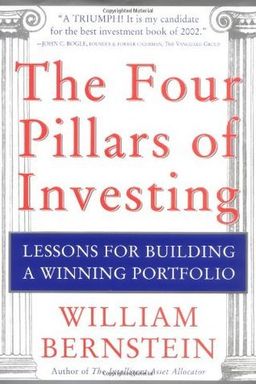
The Four Pillars of Investing cover

The Four Pillars of Investing

by William J Bernstein

The Four Pillars of Investing offers a comprehensive, evidence-based guide to investment success. Author William J. Bernstein combines financial science, psychology, and historical insights to help investors overcome emotional biases, avoid common pitfalls, and harness the market''s wealth-generating potential. With practical strategies, this book is an essential resource for anyone looking to build a prosperous financial future.

Building Wealth on Four Pillars

How can you build long-term financial success without succumbing to greed, fear, or industry gimmicks? In The Four Pillars of Investing, William J. Bernstein argues that the answer lies in mastering four interlocking disciplines: theory, history, psychology, and the business of investing. Each pillar guards against a distinct failure mode—mathematical ignorance, historical amnesia, emotional errors, and industry exploitation. Only when you understand all four can you construct a portfolio that survives market storms and your own behavioral impulses.

Theoretical Foundation: Risk and Return

The first pillar is theory, which teaches you the law governing all finance: higher expected return requires higher risk. Bernstein traces this idea from ancient bottomry loans to modern stocks and bonds. Bonds face credit and interest-rate risk; equities promise growth but fluctuate violently. Understanding their relationship is essential for designing your mix. He shows how tools like the discounted dividend model and the Gordon Equation (expected return ≈ yield + growth) let you estimate realistic long-run returns instead of chasing speculative valuations.

Historical Perspective: The Recurring Cycles of Greed

History is your second teacher. Bernstein travels from the Venetian prestiti to the South Sea and Mississippi manias, railway booms, and dot-com bubbles. Each episode shows how societies rediscover the same speculative delusions roughly once per generation. You learn to recognize patterns—displacement, easy credit, generational forgetfulness, and crowd frenzy—and why crashes provoke regulatory backlash (as with Parliament’s Bubble Act or Pecora’s hearings after 1929). Studying history inoculates you against the next "new era" that promises endless growth.

Psychological Reality: The Investor’s Mind as Enemy

The third pillar is psychology. You are wired to follow herds, overestimate your skill, chase recent winners, and panic when prices fall. Bernstein catalogs these biases—myopic loss aversion, recency, and the illusion that great companies make great stocks. He reminds you that your emotions, not the market, usually dictate poor timing. Behavioral "therapies" include automation through index funds, disciplined rebalancing, and structured accumulation strategies like value averaging, which force you to buy more when prices are low and fewer when prices soar.

Industry Reality: The Business Behind Investing

The fourth pillar exposes how brokers and funds profit from your ignorance. Most brokers are salespeople paid by transaction volume and owe you no fiduciary duty. Mutual funds often lure investors into high-fee products or hot sectors, gunning flows that hurt late entrants. Bernstein contrasts these conflicts with Jack Bogle’s Vanguard revolution: mutual ownership, no loads, and near-zero expense ratios. The result is simple but profound: every dollar you avoid paying in fees compounds in your favor forever.

The Integrative Lesson

You begin with theory to measure risk and return. History teaches humility. Psychology trains discipline. Business knowledge protects you from predation. When you combine them, you understand why markets generally reward patience but punish excitement. Bernstein’s synthesis is both scientific and moral: wealth accrues to those who study, wait, and resist noise. Fail any single pillar, and your structure will collapse—just as Long-Term Capital Management’s brilliant theorists ignored history and lost billions. The book is a call to design an investing life anchored in reason, history, and humility.


Risk, Return, and Market Reality

At the core of Bernstein’s argument lies a stark truth: there is no free lunch. If you want high returns, you must risk losses. He proves this rule not by theory alone but through centuries of financial evidence. Interest rates, credit spreads, stock crashes — all tell the same story. Understanding this risk-return tradeoff lets you design allocation choices suited to your stomach and your timeline.

Understanding Bond and Stock Risks

Debt instruments expose you to credit and inflation hazards. In stable eras like the Roman Empire, yields fell toward 4%; under wartime stress (Venice versus Genoa), interest spiked. The risk premium reflects fear. Equities, meanwhile, outperformed bonds in the long run—roughly 6% real versus 1%—but suffered devastating short-term collapses, such as the 80% drawdown of 1929–1932. Bernstein drives home the emotional dimension: if you sell in panic, you erase the premium that stocks offer.

Short-Term Pain vs Long-Term Catastrophe

You must distinguish between volatility (temporary pain) and permanent loss (true ruin). Market corrections reverse with time; inflation or institutional breakdowns may not. That’s why Bernstein advises global diversification and modest bond holdings for stability, especially in retirement. Investors who conflate noise with danger often sell at bottoms and miss the subsequent decades of recovery.

The Emotional Cost of Risk

Bernstein calls risk the price of admission to markets. If you understand its history, you stop treating volatility as betrayal and start seeing it as opportunity. This cognitive shift—accepting uncertainty instead of fearing it—is how experienced investors stay invested during chaos and earn the long-term rewards that theory predicts. Risk is not a flaw in capitalism; it is the heartbeat that keeps it alive.


How Markets Outsmart Investors

Bernstein argues that the market collectively is smarter than nearly every participant within it. The idea echoes Eugene Fama’s efficient market hypothesis, but Bernstein adds human texture: skill exists, yet is scarce and statistically masked by luck. Most active managers resemble the chimpanzees of his fictional Randomovia—some win for a time, a few spectacularly, but almost none persist once costs and asset growth interfere.

Evidence Against Persistent Skill

From Alfred Cowles’s 1930s studies through Michael Jensen’s fund analyses, the conclusion hardly changes: last year’s winners seldom remain winners. Survivorship bias hides failures, presenting a misleading record of outperformance. Dimensional and S&P research confirm that funds chosen for past success generally underperform after you buy them. Behavioral factors amplify the illusion — investors chase hot funds precisely when they are most overpriced.

The Structural Limits of Active Management

Even talented managers eventually collide with scale. Gerald Tsai’s Manhattan Fund, Robert Sanborn’s Oakmark, and later hedge fund stars show how swelling assets erode flexibility and raise market-impact costs. Add the invisible layers of expenses—commissions, spreads, research fees—and net outcomes trail the index. Bernstein’s message: you can’t reliably identify future superstars, so stop trying.

Embracing the Index Solution

If skill is unidentifiable, minimizing cost becomes the rational path. Low-cost index funds replicate market exposure with integrity, especially under Vanguard’s mutual ownership model. Bill Fouse’s fixed-income index prototype and Jack Bogle’s equity indices illustrate how simplicity beats flair. You gain not just higher average returns but emotional peace—you stop chasing chimps and start owning entire jungles.


Behavior and the Investor’s Enemy Within

You are not undone by math but by emotion. Bernstein’s chapters on psychological pitfalls reveal that our cognitive wiring practically guarantees poor results unless you systematize restraint. He dissects herd behavior, overconfidence, recency bias, and myopic loss aversion, showing how they sabotage investment plans even among well-informed participants.

Common Behavioral Errors

Herding makes you feel safe in crowds—right at the top. Recency bias convinces you that yesterday’s winners will keep running. The great-company fallacy tempts you to overpay for good businesses. Myopic loss aversion focuses your anxiety on short-term losses instead of long-term compounding. These tendencies explain why average investors underperform their own funds by several percentage points annually.

Behavioral Therapies

Bernstein prescribes discipline via automation: pre-set allocations, periodic rebalancing, and value averaging to buy low systematically. He encourages embracing dullness—boring portfolios work because excitement correlates negatively with return. Checking your account less often extends your psychological time horizon, and rebalancing channels greed and fear into a mechanical "sell high, buy low" mechanism.

Humility and System Design

Treat emotions as engineering constraints. You cannot rewire fear and greed, but you can box them inside rules. Bernstein’s humor—the INEPT theory and Beardstown Ladies examples—underscores that self-deception is universal. The therapeutic goal is not wisdom at every moment but creating systems that protect you when wisdom temporarily fails.


Market Manias and Their Aftermath

Bernstein’s historical chapters read like financial archaeology. They expose the human constants of bubbles and panics: an innovation that excites imagination, easy credit that feeds speculation, and collective amnesia that erases old scars. The result is recurrent: euphoria, collapse, blame, and overregulation.

Anatomy of a Bubble

Drawing on Hyman Minsky, Bernstein defines four bubble ingredients—displacement, liquidity excess, generational forgetfulness, and story-driven investing. From diving companies and canals to railways and dot-coms, these triggers recur at roughly 30-year intervals. Early adopters prosper; late entrants suffer.

The Political and Legal Backlash

Crashes create political theater. After the South Sea burst, directors were jailed and Parliament passed the Bubble Act, choking corporate formation. After 1929 came Pecora’s hearings and reforms—the SEC, Glass-Steagall, and mandatory disclosure. Bernstein quotes Fred Schwed’s line: “The burnt customer prefers to believe he was robbed rather than a fool.” That need for villains shapes decades of law.

Lessons from Bottoms

Pessimism births opportunity. When markets reach despair—as in 1932 or 1974—dividend yields soar and valuations plunge. Buy during such gloom and long-term gains often exceed 15% annualized. It feels foolish then but wise later. Bernstein’s moral: you cannot predict bubbles, but you can avoid joining them and prepare to act bravely when they end.


Designing a Durable Portfolio

Having mastered the four pillars, you face the practical challenge: how to assemble assets that match your goals and temperament. Bernstein treats asset allocation as the foundation of outcome. He models the tradeoffs, diversification advantages, and rebalancing discipline that define successful portfolios from youth through retirement.

Core Allocation Decisions

First, choose your stock-to-bond ratio by tolerance for drawdown. Conservative portfolios like Charlie Cringe’s 35/65 split lose little but earn modest returns. Aggressive ones like Wendy Wonk’s 75/25 earn more but face sharp volatility. International diversification (EAFE vs S&P) improves stability, while modest tilts to small-cap and value exploit historical premiums identified by Fama and French.

Accepting Rebalancing and Simplicity

Rebalance periodically to enforce discipline. In tax-sheltered accounts do so every few years; elsewhere, use new contributions. Keep structure simple—total-market funds, low costs, tax efficiency over complexity. A touch of REITs or metals can hedge inflation, but excessive exotica invites behavioral error and high fees.

Applying Allocation to Retirement

Finally, adapt allocation to lifecycle. Young savers should welcome downturns—they buy equity cheaply. Retirees must guard against early-sequence risk through liquidity cushions and conservative withdrawal rates (~3–4% real). Bernstein’s examples—Taxable Ted and Sheltered Sam—illustrate tax-aware design. The enduring truth: simplicity, low costs, global diversification, and rule-based behavior yield durable wealth when combined across decades.

Dig Deeper

Get personalized prompts to apply these lessons to your life and deepen your understanding.

Go Deeper

Get the Full Experience

Download Insight Books for AI-powered reflections, quizzes, and more.