
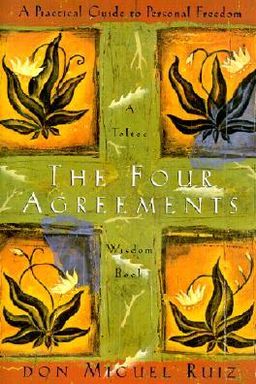
The Four Agreements cover

The Four Agreements

by Don Miguel Ruiz and Janet Mills

Discover the path to personal freedom with ''The Four Agreements'' by Don Miguel Ruiz. This transformative guide draws on ancient Toltec wisdom to help readers break free from societal constraints, embrace authenticity, and achieve true self-discovery through four powerful agreements.

Freedom Through New Agreements: Transforming the Dream of Life

Have you ever wondered why life sometimes feels like a constant struggle between who you are and who you think you should be? In The Four Agreements, Don Miguel Ruiz offers a radical yet profoundly simple answer: our suffering stems from the mental contracts we unknowingly sign with the world — agreements that define how we think, feel, and act. He contends that by breaking these fear-based agreements and forming new ones founded in truth and love, we can reclaim our personal freedom and live with profound happiness.

Ruiz draws upon ancient Toltec wisdom, a spiritual tradition devoted to knowledge, love, and personal mastery, to frame his approach. This Toltec perspective sees life as a collective dream — one shaped by countless personal dreams woven together across generations. However, most of humanity, Ruiz argues, lives in what he calls the Dream of Hell: a world dominated by fear, judgment, and false beliefs. The book offers a path to awaken from this nightmare and embrace a new dream — what he calls Heaven on Earth.

The Dream and the Domestication of the Human Mind

Ruiz begins with a powerful metaphor about the Dream of the Planet — the collective story humanity tells itself. From childhood, our attention is “hooked” by family, culture, religion, and education, which teach us how to dream according to society’s rules. He calls this process the domestication of humans. Like training a dog through punishment and reward, society teaches us what is acceptable or not, gradually replacing our innate freedom and authenticity with fear-based programming. What emerges is the Judge within our mind that constantly evaluates us, and the Victim that endlessly suffers from self-blame.

Ruiz explains that this domestication creates a belief system — a Book of Law — that rules our thoughts and decisions. Though comforting in its familiarity, this inner lawbook is filled with lies that control our lives and cut us off from truth. We punish ourselves repeatedly for the same mistakes, reliving guilt, fear, and shame in a cycle of emotional pain. This is why most people live as prisoners of their own minds. The key, Ruiz insists, is awareness: once we see that our Book of Law is false, we can decide to rewrite it.

The Four Agreements: Tools for Freedom

To escape the Dream of Hell, Ruiz proposes four simple but profound commitments. These are not moral commandments but practical tools for transformation. The first is Be Impeccable with Your Word — a reminder that language is the seed of creation. Every word we speak can be black magic (spreading fear and poison) or white magic (creating truth and love). By using our word impeccably — meaning without sin — we stop using language to harm ourselves and others.

The second agreement, Don’t Take Anything Personally, shields us from emotional poison. Other people’s words and actions are reflections of their own dream, not ours. Refusing to take them personally liberates us from endless cycles of pain and conflict.

The third, Don’t Make Assumptions, invites clarity and direct communication. Most of our suffering comes from false interpretations, imagined stories, and the need to be right. Asking clear questions and expressing what we truly want breaks the fog of misunderstanding.

Finally, Always Do Your Best reminds us that consistency, not perfection, builds mastery. Our best changes from moment to moment, but doing our best without judgment dissolves guilt and self-rejection. Ruiz compares this disciplined practice to a spiritual warrior’s journey — one that requires courage, awareness, and relentless love.

Breaking Old Agreements and Reclaiming Personal Power

Ruiz calls this journey the Toltec Path to Freedom. We begin by recognizing that most agreements we hold — about who we are, what we can do, or what is possible — stem from fear. By replacing them with the Four Agreements, we regain the personal power that was once wasted maintaining illusions. Each broken agreement releases energy that can now be used to create a joyful life. The process demands patience, repetition, and courage, because every false belief resists being unmade.

From Hell to Heaven: Living the New Dream

Ultimately, Ruiz’s message is hopeful: the Dream of Hell is not inevitable. Each person can create a Dream of Heaven simply by shifting perception. Heaven, he writes, is not a place we reach after death but a state of being attainable while alive — where love replaces fear, truth replaces lies, and gratitude replaces judgment. Through awareness, forgiveness, and love, we learn that happiness and suffering are both choices. To choose heaven is to live fully, freely, and authentically.

“Humans have the power to create hell or heaven,” Ruiz reminds us, “but we must claim that power by being aware.”

In essence, The Four Agreements is not a set of rules but a manual for liberation. It asks you to wake up from the inherited dream, reclaim your creative power, and rewrite the script of your life with love. Practicing the agreements turns you from a domesticated thinker into a conscious dreamer — the author of your own heaven on earth.


Be Impeccable with Your Word

The first agreement — Be Impeccable with Your Word — is the most powerful and perhaps the most difficult. Miguel Ruiz describes the word as magic, capable of creating heaven or hell with every syllable. Being impeccable means being without sin, not in the religious sense but in the sense of not going against yourself. Every time you speak with integrity, you heal your mind; every time you use words against yourself or others, you poison your dream.

The Creative Power of Language

Words are seeds, Ruiz explains. When you say something aloud, you plant an idea that can grow and transform lives. The human mind is fertile ground — it will grow whatever seeds you plant. Hitler’s speeches, Ruiz notes, were dark seeds of fear that led to catastrophic destruction. In contrast, truthful words become seeds of love that bloom into peace. Recognizing this power, you must learn to guard what you say, because what leaves your mouth shapes your reality.

Black Magic and Emotional Poison

Ruiz calls the misuse of words “black magic.” When you gossip, criticize, or curse, you plant fear into others’ minds. He tells the story of a mother who, while angry and exhausted, told her joyful child to stop singing because she had an ugly voice. The child believed the words and never sang again. One careless sentence cast a lifelong spell. We perform similar acts of black magic daily — with partners, friends, or even social media posts — without realizing the damage caused.

Truth as White Magic

On the other side of this sword is truth. Speaking with love and authenticity — telling yourself and others what is real and kind — is white magic. When you praise instead of criticize, when you forgive instead of accuse, you purify your dream. Your words become creative rather than destructive. The more you do this, the more your mind becomes fertile ground for truth. Ruiz compares gossip to a computer virus that infects social relationships; being impeccable cleanses the system.

“Only the truth will set us free,” Ruiz says. Impeccability transforms words from weapons into medicine.

The practical application is simple: pause before speaking. Ask yourself if your words create love or fear. Speak kindly to yourself as you would to someone you love. Tell yourself daily, “I am kind. I am enough.” This agreement changes communication and relationships because when your word is impeccable, others cannot cast spells of fear on you. You become immune to their black magic.

Practicing this agreement teaches mindfulness. You realize that every phrase, every thought, is an act of creation. As you make the word sacred again, you shift from manipulating others to manifesting love. In doing so, you begin to craft the dream of heaven with every breath you speak.


Don’t Take Anything Personally

The second agreement — Don’t Take Anything Personally — frees you from emotional slavery. Ruiz calls taking things personally “the maximum expression of selfishness” because it assumes that everything others say or do revolves around you. Yet, everyone lives in their own dream, shaped by their perceptions and agreements. Nothing others do is truly about you — it’s about them.

Emotional Immunity in the Dream of Hell

Ruiz compares this agreement to developing immunity to poisonous words. When someone insults you, they project their own beliefs and fears; if you don’t take it personally, their poison cannot enter your mind. The freedom this brings is immense. By practicing this, you stop feeding drama and suffering. You can walk through life with your heart open, unafraid of rejection or criticism.

The World of Separate Dreams

Each person directs their own mental movie, Ruiz explains. You appear in others’ films as background characters. If someone labels you stupid or ugly, those words come from their personal script, not from any truth about you. When you stop making their dream your reality, you prevent those judgments from shaping your self-image. This principle echoes Stoic philosophy (Epictetus taught that events don't disturb us; our interpretation does).

Detachment and Love

Ruiz even says that if someone shot you, it would still not be personal — an extreme but illuminating point about detachment. Emotional maturity means you can love others while recognizing that their actions reflect their fear, not your worth. Practicing this agreement fosters compassion: you realize others are fighting their own battles with the Judge and Victim within.

“When you don’t take anything personally, anger, jealousy, and sadness simply disappear,” Ruiz promises.

As you internalize this, you no longer depend on external validation. You speak freely, love deeply, and act with courage. In relationships, this transforms interaction: criticisms lose power, rejection becomes irrelevant, and you remain anchored in peace. You learn to say “I love you” without fear, because you trust yourself. This agreement brings enormous freedom — the ability to live in the center of hell while remaining untouched by its flames.

Together, the first two agreements heal the emotional wounds of domestication. When you are impeccable with your word and take nothing personally, seventy-five percent of the poison vanishes from your mind. You reclaim control of your dream and taste what freedom feels like.


Don’t Make Assumptions

The third agreement — Don’t Make Assumptions — addresses one of the most common sources of personal suffering: misunderstanding. Humans, Ruiz observes, hate uncertainty. To feel safe, we create assumptions to fill in information gaps. But these illusions quickly become emotional poison, fueling drama, resentment, and conflict.

Assumptions and the Human Need for Certainty

You assume why your partner didn’t call, what your boss really meant, or how a friend feels — and then act accordingly, often wrongly. Ruiz demonstrates how assumptions fuel endless chaos: we invent stories, believe them, and act on them as if they were true. It’s all built upon fear. Like gossip, assumptions spread emotional viruses through communities. The antidote is direct communication — asking, clarifying, and speaking truthfully.

Clarity as the Cure

Ruiz urges you to ask questions courageously: What do you mean? What do you really want? This active communication removes ambiguity and prevents resentment. It may feel risky at first, but clarity saves relationships. He contrasts couples who assume understanding with those who speak openly. Misunderstandings destroy love; truth preserves it. Assumptions also distort self-perception. You assume you can’t succeed, that others look down on you — but these are just untested beliefs.

Real Love vs. Conditional Love

Ruiz notes that true love needs no justification. When you say, “My love will change this person,” you assume power over another’s dream. Real love accepts people as they are. The agreement frees you to relate authentically, without trying to control or fix anyone. When both sides stop assuming, communication becomes impeccable, and the dream of heaven begins in relationships.

“All human problems,” Ruiz writes, “would be resolved if we could communicate clearly.”

On a practical level, this means cultivating awareness of your mind’s constant storytelling. When uncertainty arises, pause before filling in the blanks. Practice asking, “Is this true?” The goal is not perfection but clarity. As it becomes habitual, this agreement turns you into a master communicator and ends the misunderstandings that fuel the dream of hell.

The agreement goes hand in hand with the first two: don’t make assumptions keeps your word pure and frees you from taking things personally. Together, they dismantle illusions, restoring peace between people and within yourself.


Always Do Your Best

The fourth agreement — Always Do Your Best — transforms the other three into daily practice. Ruiz’s point is simple yet profound: your best is enough. It changes from moment to moment, but doing your best removes guilt and self-judgment. Perfectionism and laziness are traps of the Judge and Victim; doing your best keeps you balanced and free.

The Wisdom of Effort, Not Perfection

Ruiz tells a story of a man asking a Buddhist master how long enlightenment would take if he meditated four hours daily. The master replied, “Maybe ten years.” When the man said eight hours, the master said, “Maybe twenty years.” The lesson: forcing yourself ruins the joy of practice. Doing your best means living intensely and joyfully, not sacrificially. Overdoing leads to resentment; underdoing leads to regret. Balanced effort breeds peace.

Action as Love in Motion

When you act for love instead of reward, action itself becomes joy. Most people work for money or approval and suffer through life waiting for weekends. Ruiz urges us to reverse this: enjoy every action, for it is an expression of life. Doing your best removes the Judge’s opportunity to punish you. You can honestly say, “I did my best,” and guilt vanishes.

Ritual and Presence

Ruiz transforms doing your best into sacred ritual — bathing, working, or speaking with love and mindfulness. In India, this mirrors the practice of puja, the act of honoring the divine through daily actions. Every moment can be a communion with life itself. To do your best is to love God through living fully.

“Expressing what you are is taking action,” Ruiz teaches. “Inaction is denying life.”

This agreement nurtures growth through repetition. You won’t always be impeccable or detached or clear — but by doing your best each day, new habits take root. Transformation doesn’t happen instantly. It is earned through action, because practice makes the master.

Doing your best turns all philosophy into experience. You honor your body, mind, and spirit simply by living consciously. Every small act — from forgiving someone to enjoying a meal — becomes a declaration of freedom. In time, your consistent effort dissolves the Judge and Victim, replacing fear with love. This, Ruiz says, is the path to mastery and heaven on earth.


Freedom, Awareness, and the Path of the Warrior

Ruiz concludes by exploring the Toltec path to freedom — a journey that demands awareness, discipline, and the courage of a spiritual warrior. True freedom, he insists, is not political but internal: the freedom to be who you really are. The enemy is not society but the parasite within — the Judge, the Victim, and the false beliefs that feed on fear.

The Parasite and the Emotional Wounds

Ruiz compares the mind to an infected skin: every belief based on fear forms an emotional wound. These wounds fester, and we call the pain they cause “normal.” The parasite — the collective of fear-based emotions and beliefs — survives on drama and suffering. Healing begins with forgiveness. The truth acts as a scalpel that opens wounds so they can be cleaned and healed. When you forgive, you stop feeding the parasite. You reclaim energy.

The Discipline of the Warrior

The Toltec warrior fights with awareness and restraint. Ruiz explains that victims repress emotions, while warriors refrain — expressing them consciously at the right time. The warrior’s discipline is internal, the ability to maintain control over emotions instead of being ruled by them. This is how one becomes impeccable, maintains clarity, and resists the pull of fear.

The Initiation of the Dead

Symbolically dying — the “initiation of the dead” — is the act of letting the old dream die. The angel of death teaches that life is temporary and precious. Ruiz urges us to live each day as if it were our last, not to fear death but to use it as motivation for authenticity. When we accept mortality, we stop pretending; we start expressing love freely and sincerely.

“The angel of death takes the past away to make life possible,” Ruiz writes. “Surrender, and you will be happy forever.”

A warrior rebelling against fear slowly transforms hell into heaven, confronting the parasite head by head. Facing fears with love replaces illusions with truth. This discipline turns awareness into transformation and intent into love. The real victory of the warrior is not domination but liberation — living in joy, authenticity, and peace.

In the end, Ruiz presents a choice we all share: to suffer our destiny or enjoy it. Both paths exist in the same dream. The difference is awareness — choosing to live intentionally, lovingly, and freely. Heaven is not a distant reward; it’s the dream we choose to create right now.

Dig Deeper

Get personalized prompts to apply these lessons to your life and deepen your understanding.

Go Deeper

Get the Full Experience

Download Insight Books for AI-powered reflections, quizzes, and more.