
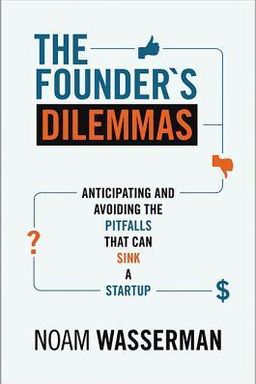
The Founder’s Dilemmas cover

The Founder’s Dilemmas

by Noam Wasserman

The Founder’s Dilemmas by Noam Wasserman is a crucial guide for aspiring entrepreneurs, offering insights from extensive research and real-world case studies. It highlights essential strategies for mastering early start-up challenges, including capital management, role clarity, and effective networking, ensuring you’re equipped to navigate the unpredictable waters of entrepreneurship.

The Founder's Choice Dilemmas

Every founder faces a series of pivotal decisions that shape the destiny of their startup—and their personal fulfillment. In his influential book, Noam Wasserman reveals that from the moment you contemplate launching, you begin navigating a web of trade-offs between wealth, control, and relationships. These choices aren’t just tactical—they define whether you end up being “Rich” (financially rewarded but less in control) or “King” (firmly leading but with limited upside).

The book’s core argument revolves around one recurring theme: founders underestimate how early decisions—about timing, cofounders, investors, titles, hiring, and exit—lock in dynamics that are hard to undo later. Each decision subtly pushes you toward either maximizing wealth or retaining control. If you don’t deliberately decide which outcome you truly value, the path itself decides for you.

The Rich–King Spectrum

Wasserman’s “Rich versus King” framework is the lens through which he explains all founder dilemmas. Control-focused founders fight to preserve autonomy, often self-funding and hiring vertically under their command. Wealth-oriented founders pursue growth aggressively by bringing in cofounders, investors, and executives—trading autonomy for acceleration. Importantly, very few achieve both.

Evan Williams illustrates this tension vividly: with Blogger, he limited funding to maintain control, but this capped growth. With Odeo, he raised venture capital and ceded strategic power, gaining valuation but losing command. Later, he had to buy back control to pursue Twitter—a costly reversal that highlights how deeply early choices entrench long-term outcomes.

How These Dilemmas Unfold

When you decide when to found, timing intersects with your career capital (skills, network, savings). Every additional year in corporate life adds “handcuffs”—financial, familial, psychological—that raise the cost of leaving to start a company. Barry Nalls deliberately waited until he built human and social capital and savings; Humphrey Chen jumped early but hit constraints he hadn’t anticipated. Far from simple, timing dictates not only risk tolerance but also what kind of team and investors you’ll attract later.

Once you start, the next decision is whether to launch solo or build a team. Teams widen capability but dilute control. Homophily—the tendency to partner with similar people—makes early collaboration easier but can later cripple diversity of thought and skill. Pandora’s Tim Westergren benefited from complementary cofounders, while Brian Scudamore learned that friendship-based partnerships erode quickly when roles and stakes grow ambiguous.

The Cascade of Control

Once a founding team forms, control starts slipping subtly through rewards, titles, and equity splits. Founders who hand out equal shares quickly—often without concrete milestones or vesting—lock in fragile structures that later require painful renegotiation. Wasserman’s data shows that hasty equal splits correlate with lower early valuations. Structured vesting, buyout clauses, and transparency protect both fairness and flexibility. Blogger’s 60/40 split devolved into legal conflict when expectations diverged.

Titles add another layer of permanence: inflated C-level titles at founding may feel equitable, but they hinder future reorganizations. Founders discover too late that demoting a cofounder-CTO is far harder than never assigning the title. Egalitarian decision-making feels democratic—but can paralyze scale. Unplanned shifts from consensus to hierarchy ignite conflict unless governed by clear transition plans.

Investors and Scaling

Eventually, the scale of ambition draws you toward outside capital—friends and family, angels, or VCs. Each type comes with a trade-off: family funding shields you from external control but risks blending personal pain with financial failure; angels bring access but low discipline; VCs inject acceleration and structure but often seize board authority and CEO power. Once venture investors own a majority stake, your role depends on alignment, not on your original title.

Lew Cirne at Wily Technology faced precisely that fate—after impressive product success, his investor-heavy board replaced him to match the company’s scaling challenge. Wasserman documents that over two-thirds of founder-CEO successions are board-triggered, often after substantial success changes the skills needed. Founders who anticipate transitions, expand skill sets, and negotiate succession terms stay far more influential even post-handover.

Maturity and Exit

Founders who make it to exit must again reconcile wealth and control. Selling offers liquidity and relief but ends independence; going public creates currency and prestige at the cost of regulatory surveillance and investor pressure. Lynx’s founders sold early to escape fatigue, while others like Williams declined acquisition offers out of deep emotional attachment to mission and product. Some opt for earn-outs—extended reward linked to staying on—but these usually come with external metrics and lowered autonomy.

Key lesson

The book’s unifying message is clear: startup outcomes reflect your deliberate alignment of motives with decisions. The earlier—and more honestly—you identify whether you’re building for wealth, control, mission, or mastery, the fewer contradictions derail you. Every choice in founding, funding, and scaling either preserves autonomy or converts it into external resources.

Ultimately, Wasserman’s research reframes entrepreneurship not as a sequence of heroic decisions but as a system of predictable dilemmas. By understanding and managing these trade-offs—especially the tension between being Rich or King—you can design a company that fits both your ambitions and your temperament, rather than drifting into mismatched expectations that destroy founders and startups alike.


Timing Your Leap

When you decide when to found, you’re balancing readiness against risk. Wasserman identifies three crucial forms of capital that shape your timing: human (skills), social (relationships), and financial (resources). Entrepreneurial timing is about whether these three align before handcuffs—career, family, psychological inertia—restrict your freedom to leap.

Career Handcuffs and Risk Windows

Every career stage strengthens both capital and constraint. Early founders have energy and flexibility but limited networks and savings. Later founders possess credibility and contacts yet resist leaving comfort and stability. Humphrey Chen’s early founding attempt faltered under family pressure and thin finances. By contrast, Barry Nalls methodically built experience and networks, negotiated severance, and launched Masergy strategically—timed to maximize freedom.

The sweet spot often comes when you hold two of the three capitals. You can patch a missing piece deliberately: find cofounders to fill skill gaps, secure family buy-in, or raise pre-seed capital. Waiting too long risks locked-in career inertia, but leaping too soon exposes you to unmanageable volatility.

The Ticking Clock

Timing isn’t static—it’s context-dependent. Some ideas operate under “ticking clocks”: new technologies, fleeting network effects, or first-mover advantages. In those cases, waiting renders the opportunity obsolete. If delay costs market relevance, founders must substitute missing capital through smarter hiring or investor partnerships. The framework suggests calculating—not guessing—whether speed trumps preparation.

(Note: Like Eric Ries in The Lean Startup, Wasserman advocates testing readiness before committing major resources—but he emphasizes founder constraints rather than experimentation cycles.)


Founding Alone or Together

Choosing between a solo start and a cofounding team shapes everything that follows. Solo founders keep control and clarity; teams share burden and capital but invite complexity. Most high-growth startups have two or three founders because complementary skills broaden execution and credibility.

When to Go Solo

You might go solo if you already possess deep domain knowledge, strong networks, and reasonable savings. Barry Nalls did exactly that after decades at GTE—his career capital replaced the need for cofounders. Solo paths suit moderate-to-low complexity ideas where speed and autonomy matter more than bandwidth.

When to Build a Team

Teams accelerate learning and resource access. Pandora’s Tim Westergren partnered with Jon Kraft and Will Glaser to complement his musical background with business and engineering strength. But each added founder dilutes equity, complicates coordination, and slows decision-making. Wasserman cautions against recruiting purely for companionship—Brian Scudamore’s friendship-based partnership proved emotionally draining and strategically weak.

Key Principle

Add cofounders only if they bring non‑redundant value—different networks, skills, or credibility. Friendship and similarity feel safe but weaken strategic coverage.

Founding together resembles a marriage—it succeeds when expectations, equity, and boundaries are discussed upfront. Those who align both commitment and complementary capital create durable partnerships that survive scaling and stress.


Relationships and Founding Chemistry

Founding with friends or family often feels natural but statistically proves riskier. Wasserman calls this the “Playing‑with‑Fire Gap”: close relationships increase emotional harm if things go wrong yet decrease the likelihood of honest early discussion.

Homophily’s Hidden Trap

Teams tend to form between similar people—same schools, backgrounds, or functions. That trust accelerates collaboration but narrows perspective. Smartix’s classmate founders bonded fast but lacked industry connections and struggled externally. Diversity isn’t cosmetic—it’s functional insurance against blind spots.

Fireproofing Founding Relationships

The book recommends preventive structures: written charters defining roles and conflict protocols, compartmentalizing reporting lines between spouses, and explicit buyout agreements. Sittercity’s founders used a “Geneva Convention” document to surface hard truths early, proving that structured dialogue beats assumed harmony.

Core Insight

Prior cowork relationships typically outperform personal ones as founding partnerships because professional norms already frame how to handle conflict.

Founding with affection can succeed—but only if you consciously separate friendship from governance. It’s not the emotion that kills startups but the absence of explicit agreements when emotions test business logic.


Roles, Titles, and Power

Titles and role definitions crystallize authority early—and persist long after the ink dries. Founders who assign C‑level titles too soon or distribute them evenly create lasting hierarchy traps. Wasserman’s research shows 89% of teams used C‑level labels, often to convey equality rather than functional logic.

The Symbolism and Cost of Titles

Every title represents both recognition and decision rights. Once a cofounder becomes “CTO” or “COO,” demoting or redefining them erodes morale. It’s wiser to use interim labels until organizational needs mature. Idea founders often seize CEO roles—data shows 47% of idea originators become CEOs compared with 12% of non‑idea peers—and typically gain extra equity.

Decision Structures

Early egalitarian decision-making sustains unity but stalls growth. Hierarchical models enable speed but risk tunnel vision. Ockham Technologies and Lynx both faced tough shifts from consensus to CEO authority. Planned transitions—timed and structured—avoid crises.

  • Assign titles based on real responsibility and future scalability.
  • Plot the eventual move from consensus to hierarchy explicitly in team charters.
  • Avoid co‑CEO setups unless governance rules clearly define tie‑breaks.

Early clarity around authority lets founders evolve roles calmly rather than through emotional crises when investors or hiring pressures force reorganization.


Splitting Rewards Fairly

Equity, vesting, and compensation determine trust and motivation across the founding team. Founders often rush to “equal splits” under social pressure. Wasserman’s data confirms that over 70% of founding teams divide equity within a month—usually too fast. Quick handshake deals avoid discomfort now but breed resentment later.

Dynamic versus Static Thinking

Static allocations assume everyone’s role and commitment remain constant; dynamic systems recognize evolution. Vesting links equity to time or milestones, converting fairness into a growth mechanism. Blogger’s 60/40 split led to costly legal fallout when one founder left. GovWorks’ chaotic buyouts exceeded $700K just to stabilize ownership.

Equity Premiums & Mechanisms

Empirical analysis shows predictable premiums: idea founders (+10–15%), serial founders (+7–9%), CEOs (+14–20%). These help anchor fair negotiations. Include vesting and buyout provisions early, formal paperwork, and tax elections (Section 83(b)) to avoid later shocks.

Guiding Insight

The right reward structure protects against both overcommitment and undercompensation—equity is a living contract, not an initial transaction.

Clarity and adaptability in reward design prevent value destruction and preserve founder relationships as pressure escalates.


Choosing Investors and Keeping Control

Selecting who funds your startup can define its soul. Investor choice governs your access to capital, speed of growth, and ability to stay in charge. Each funding source offers distinct benefits and traps—for your wallet, your governance, and your psychology.

Friends, Angels, or VCs

Friends and family money provides fast relief but endangers relationships if the business falters. Angels contribute smaller amounts (roughly $450K average) and industry mentoring but can consume attention through many minor stakeholders. Venture capital delivers scale and legitimacy but exerts board presence and control pressure—ownership typically exceeds 50% by Series C.

Negotiating Power and Terms

VC deals often embed liquidation preferences, anti-dilution and veto rights. Founders who overlook these may find that modest exits leave them unpaid, as Lynx’s founders discovered. Due diligence isn’t one-sided—evaluate investors through other founders they’ve backed to see if they enable or replace leaders aggressively.

Practical Rule

You aren’t just selling equity—you’re trading influence. Choose investors whose strategic vision and personal chemistry match your long-term priorities.

Evan Williams transitioned from self-funded control to venture-backed tension at Odeo, ultimately proving that investor alignment matters as much as valuation. Deliberate selection prevents expensive reversals.


Hiring and Scaling Wisely

As your startup grows hiring becomes your largest lever and risk. Early hires define culture; later ones determine scale. Wasserman classifies hiring blueprints into two archetypes—commitment-driven (values-led, informal) versus bureaucracy-driven (professional, structured). Each style works if consistent, fails if switched haphazardly.

Stage-Based Hiring Strategy

Early on, bring in generalists who improvise and align culturally. Lew Cirne hired versatile teammates for Wily’s product phase but later faced pressure to upgrade to specialists. The transition from improvisation to specialization marks maturity. Sales and operational hires at growth stage need experience and equity-weighted incentives to align performance with scaling.

Managing Evolution

Role upgrades—especially replacing founding executives—trigger political strain. Title inflation early on compounds this tension. To mitigate, document role expectations and potential future transitions explicitly. Reference checks and trial projects improve cultural fit; reliance solely on inner circles risks tunnel vision.

Core Idea

Hire ahead of stage, not behind it— anticipate your next structural leap so new hires enable transformation rather than resist it.

Hiring reflects both control and culture: founders who align growth pace, structure, and resources craft scalable companies without losing cohesion.


Founder Succession Dynamics

Succession is the most emotionally charged founder event—often following success rather than failure. Boards initiate nearly three-quarters of these transitions when a company’s dominant problems shift from creation to scaling. Founders who resist change are replaced; those who prepare influence the next stage.

The Paradox of Success

Lew Cirne’s Wily story shows that product triumph triggers new governance realities. Once investors hold power, the board seeks leaders tailored to emerging challenges—sales execution, process management, or IPO strategy. Founders who anticipate this evolution retain relevance as chairpersons or CTOs.

Smoothing Transition

Les Trachtman’s “Three Rs” method—Relationships, Roles, Rewards—illustrates effective transition: build trust with the outgoing founder, define reduced but respected responsibilities, and ensure fair financial outcomes. When founders initiate the change themselves, 90% stay on the board; under forced successions, barely 60% do.

Key Reminder

Succession isn’t an end-state—it’s a transition. Anticipate, plan, and negotiate it like any stage of strategic growth.

Founders who accept skill evolution as a natural process preserve dignity and influence—those who fight the inevitable often lose both position and legacy.


Exit Decisions and Emotional Reality

Eventually every startup faces the question of when and how to exit. Selling or going public represents a final confrontation between financial optimization and personal identity. Founders who define success purely by ownership often resist selling even when rational economics suggest otherwise.

Why Founders Sell—and Why They Don’t

Some founders, like Evan Williams, decline offers to maintain creative control over their mission. Others, fatigued or constrained, choose liquidity—Lynx’s founders accepted a cash deal to end years of pressure. IPOs provide prestige but minority control and constant scrutiny. Earn‑outs incentivize continued engagement but tie outcomes to corporate culture you no longer control.

Negotiating the Exit

Founders must model who gets paid given liquidation preferences and participation terms—small exits sometimes reward investors more than originators. Negotiating autonomy after acquisition—metrics, reporting, scope—defines post‑exit happiness as much as payout value.

Final Insight

Treat your exit as one more deliberate trade-off in the Rich–King framework: if you sell, sell consciously; if you stay, stay strategically.

The book reminds you that exits aren’t failures—they are reflections of motive alignment. Mastery lies in exiting on your own terms, not in clinging until circumstances force the choice.

Dig Deeper

Get personalized prompts to apply these lessons to your life and deepen your understanding.

Go Deeper

Get the Full Experience

Download Insight Books for AI-powered reflections, quizzes, and more.