
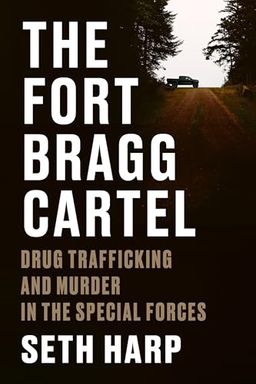
The Fort Bragg Cartel cover

The Fort Bragg Cartel

by Seth Harp

An Iraq war veteran and investigative reporter delves into unsolved murders connected to drug trafficking at the Special Operations base.

The Shadow War Comes Home

How do you wage endless covert war without breaking the institutions meant to control violence? This book argues that the United States built an autonomous special-operations state—centered on JSOC and Delta Force—that normalized secrecy, sped up the kill chain, and quietly shifted risk and rot back onto the home front. The author contends that this architecture—designed for speed, deniability, and lethality—bred a domestic shadow economy of drugs, theft, and impunity around Fort Bragg (now Fort Liberty), and then shielded it from scrutiny when crimes piled up.

You watch an arc unfold: from the Cold War redesign of special missions to a post‑9/11 machine of continuous targeting (F3EAD), then to a garrison culture held together by stimulants, steroids, and secrets. That culture fuses with money channels like OPFUND and off‑book procurement, creating new criminal opportunities and social ecologies—parties, “Cover Girls,” and patronage networks—that blur work and vice. The result is a system that kills swiftly overseas and then struggles to police itself at home.

A kill chain with short oversight

The author traces a straight line from Charles Beckwith’s Delta Force to JSOC’s modern authority. After the Church Committee constrained the CIA, presidents and Pentagon leaders (Reagan, then George H. W. Bush) gave the military a freer covert lane. Under Stanley McChrystal and William McRaven, JSOC industrialized night raids and targeted killings, turning F3EAD (Find, Fix, Finish, Exploit, Analyze, Disseminate) into a nightly factory of capture/kill missions. Two or three links separated shooters from the Oval Office—fewer checks, faster strikes.

In Iraq, Afghanistan, Syria, and the Sahel, that tempo made sense to its architects: you neutralize “nodes” in a global network (AQI, ISIS), then exploit their data and go again. Back home, the same speed, secrecy, and compartmentalization insulated misconduct, from serial drug use to off‑duty violence. Continuous targeting abroad bled into continuous denial at home.

Pharmacology as policy

To sustain that tempo, the force turned to chemistry. Medications authorized in theater—dextroamphetamine to stay awake, Ambien to sleep, and tramadol for pain—became pathways into harder drugs (cocaine, MDMA, heroin, fentanyl). Operators and enablers built peer networks to source pills and pass drug tests; steroids became a performance and status currency. The human toll is everywhere: Keith Lewis’s murder‑suicide, a spike in overdoses, and clusters of sudden deaths among fit young operators.

The book’s signature tragedies—Mark Leshikar’s killing by Billy Lavigne, Enrique Roman‑Martinez’s beheading after an LSD crisis, and the double homicide of Lavigne and Timothy Dumas—show you how drugs, secrecy, and broken investigations intersect. Each case reveals familiar patterns: rapid exonerations, withheld files, and a reflex to protect elite units.

A shadow economy of guns and cash

Money moves matter as much as missions. Cash accounts like OPFUND, preloaded cards, and front companies—tools built for clandestine agility—also enable theft and laundering when audits are thin. Logistics staff (property book officers, contracting NCOs) learn to write ghost requisitions, misplace pallets, and partner with local fixers (e.g., the Hikmat trucking scheme in Kandahar). Stolen weapons and gear flow out; off‑book dollars flow in.

Those channels merge with civilian networks. Former cop Freddie Wayne Huff II runs wholesale meth and cocaine through stash houses and private planes; Dumas brokers product to Fort Bragg circles; Lavigne straddles worlds as a fallen Delta operator and addict. Violence follows—armed robberies in fake U.S. Marshal vests, kidnappings, and, finally, bodies.

Airstrips, opium, and policy blind spots

The war’s externalities boomerang. Afghanistan’s opium boom after 2001 floods global heroin markets (while DEA sampling insists Mexican dominance), and private airfields like Raeford Drop Zone (P K Airpark) become dual‑use hubs—training sites by day, smuggling portals by night. The death of pilot Charles Crooks after he falls from a Rampart Aviation turboprop—ruled an accident—captures why locals distrust official narratives at nodes where war, contracting, and contraband meet.

Secrecy as a system, not a glitch

Investigations stall under interagency opacity. CID’s case files on the Lavigne/Dumas murders are swept by the FBI; FOIA requests return redactions or denials. Leshikar’s case is waved off as justified within hours; Roman‑Martinez’s homicide gets reframed as a possible boating accident despite multiple forensic opinions. That pattern—information control to protect units—undercuts trust and allows patterns of harm to persist.

Key Idea

A system built for covert speed and deniability abroad reproduces secrecy, impunity, and black‑market opportunity at home—until bodies and scandals force attention.

If you care about national security and the rule of law, the lesson is practical: you cannot normalize clandestine power without independent oversight that travels with it. Without that, you get a fortified subculture—part warrior monastery, part cartel—that treats accountability as an external threat rather than a core mission requirement (compare debates after the Church Committee; the book argues the pendulum swung back, but with the military holding the tools the CIA once monopolized).


Building The Kill Machine

The book shows you how JSOC’s design choices—short chains of command, unified intelligence-operations cells, and global reach—industrialized targeted killing. It starts with Delta Force’s 1977 birth under Charles Beckwith, inspired by the SAS and meant for rare, high‑risk rescues. Political support under Reagan and George H. W. Bush then moved many covert tools from the CIA to the Pentagon, exploiting gaps in the post‑Church Committee oversight regime. By 9/11, the hardware and legal theories were ready for a massive scale‑up.

Stanley McChrystal’s command crystallizes the shift. His team reframes disparate insurgent cells as a single networked organism (AQI, then ISIS), a frame that justifies nightly raids as a systems‑attack. F3EAD becomes doctrine: Find (pattern of life), Fix (surveillance), Finish (raid or drone), Exploit (phones, thumb drives), Analyze (fuse intel), Disseminate (feed the next hit). You can picture a conveyor belt where operators capture, analysts triage, and teams relaunch within hours.

Vertical integration and tempo

JSOC collapses silos. Intelligence collectors sit with door‑kickers; lawyers and targeteers ride the loop. The Expeditionary Targeting Force (ETF) globalizes this rhythm—hit anywhere, anytime, with sparse approvals. That vertical integration accelerates success in places like Mosul and Raqqa. It also normalizes a mentality: if the enemy is just a node, you win by removing nodes faster than they regenerate.

But there’s a cost. Speed reduces friction—and oversight is friction. Presidential findings blur into standing authorities; congressional briefings shrink to sanitized summaries. The apparatus grows adept at acting first and explaining later (if at all). Back at Fort Bragg, the same logic privileges mission over process, reputation over transparency.

Masks, cover, and the gray zone

You encounter tactics that live between war and law enforcement: civilian clothes, fake patches, cross‑dressing to penetrate networks, and front companies to move personnel and money. The Mission Support Troop (later linked to the “Cover Girls”) manufactures identities and documentation. This gray‑zone craftsmanship is vital downrange; at home, it seeds a culture where deceit is a tradecraft, not a red flag.

When the institution trains thousands to move goods and people invisibly, a portion repurposes those skills for personal gain. That’s not a moral failing alone; it’s a predictable externality (compare the CIA’s Cold War legacy of proprietaries and cutouts morphing into post‑retirement consultancies and, sometimes, criminal fronts).

Oversight gaps and legal elasticity

The author notes how presidential directives and classified annexes expand authorities, while the War on Terror’s geographic and temporal vagueness removes natural brakes. “Associated forces” language stretches to justify strikes from Iraq to the Horn of Africa. With few durable policy boundaries, ad hoc guardrails emerge—commander preferences, trusted legal advisors. That setup works until a commander rotates and a new interpretation unlocks a broader shot list.

This elasticity travels home. Investigators and local prosecutors, awed by unit prestige, defer. Military justice, where commanders once held gatekeeping power over prosecutions, bends around elite units (a problem Congress later begins to fix by moving certain charging decisions outside command, though implementation remains uneven).

Key Idea

Design a system for maximum lethal tempo, and you will export its values—speed, secrecy, flexibility—into your garrisons, where they collide with rule‑of‑law expectations.

For you, the operational lesson is double‑edged. Integrated kill chains can outpace agile enemies. But without co‑equal integration of audit, medical care, and independent investigative power, you create an internal market for shortcuts. The book’s later chapters—on OPFUND, drug pipelines, and botched homicides—are the domestic bill for those design choices.


Pharmacology Of Tempo

To keep the kill chain spinning, people reach for chemistry. The book shows you how sanctioned meds—dextroamphetamine to stay sharp, Ambien to downshift, tramadol and Xanax to blunt pain and anxiety—seed a broader drug culture. Over time, prescriptions blur into illicit use: cocaine for euphoria and confidence, MDMA for bonding, heroin and fentanyl for escape, and anabolic steroids for size and status. The line between coping tool and addiction dissolves under deployment cycles and unit norms.

Billy Lavigne’s circle illustrates the slide. At his Anhinga Court house, cocaine is a social glue; friends coordinate buys and share tricks to beat urine tests. Mark Leshikar—after tramadol and Xanax scripts—descends into paranoia and seizures before the Disney World bender that precedes his death. The point isn’t moral panic; it’s organizational: when an institution treats meds as operational enablers, it normalizes a biochemical workflow that some can’t switch off.

Two overlapping drug ecologies

The author separates two scenes you might otherwise conflate. In elite circles (Delta/Green Berets), stimulants, cocaine, and meth tie to performance, partying, and power. They also link directly to trafficking networks (Huff’s meth; Lavigne’s cocaine; Tim Thacker’s aviation‑driven meth pipeline). In conventional units (e.g., 82nd Airborne), psychedelics like LSD and mushrooms are widespread, creating different risks—acute mental crises in austere settings (Enrique Roman‑Martinez at Cape Lookout).

Both ecologies corrode judgment. One fuels violence and organized crime; the other creates investigative quagmires after bad trips or drownings. In both, delayed reporting and group loyalty frustrate truth‑finding, as when Roman’s companions returned to base before calling for help and later pled to lesser charges without breaking a code of silence.

Steroids, rage, and sudden deaths

Steroids operate like an open secret. They deliver fast transformations that fit elite aesthetics and identity. Yet the book pairs steroid prevalence with tragic outcomes: Keith Lewis’s escalating aggression ending in a murder‑suicide; clusters of sudden cardiac deaths among otherwise fit operators (Capt. Robert Sean Latham, Major Eric Ewoldsen, Calvin Thomas Rockward). The implication is not causation in every case but systemic tolerance of a high‑risk supplement market.

Command responses vary. Some leaders protect high performers; others quietly reassign or separate users without prosecutions. Master Sergeant Martin Acevedo III, arrested and lightly sentenced, returns to duty—a signal to peers that consequences are negotiable if your unit values you.

From coping to crime

Once drug use embeds in a social network, crime scales. Soldiers move from users to middlemen, from passing urine samples to running stash houses. The mental model—solve problems fast with unconventional means—translates into robberies staged with fake federal credentials, kidnappings to settle debts, and cross‑state logistics. Huff and Rahain Deriggs impersonate U.S. Marshals to rob Mike Sosa; later, phone forensics collapse their cover.

At the macro level, overdose statistics at Fort Bragg spike: 36 deaths per 100,000, far above civilian averages. In 2020–2021, the base sees roughly 109 fatalities, with only four overseas. That mortality—overdoses, suicides, homicides—is the ledger entry for a culture that treats drugs as tools until they kill.

Key Idea

When performance and secrecy outrank care and accountability, drugs shift from medical aids to organizational lubricants—and then to criminal accelerants.

What can you do with this? If you lead, treat pharmacology as a command responsibility: track prescriptions like you track ammo; create independent testing that can’t be gamed by peers; and link discipline to treatment, not just punishment. If you’re a policymaker, resource medical surveillance and independent prosecutors as seriously as you fund the next targeting cell (note: reforms that moved some charging decisions outside the chain of command aim in this direction but need teeth and transparency).


The Bragg Shadow Economy

Behind the hero narratives, the book uncovers a base‑adjacent economy where money, guns, and gear move through covert channels. The centerpiece is OPFUND and small‑purchase authorities that push cash to the edge for speed. In combat, that agility is priceless. At home, it’s a theft vector. Property book officers and logisticians can ghost requisition, “lose” pallets, or over‑order high‑value items for resale. Audits lag; oversight fragments across units and contractors.

The Kandahar “Hikmat” scheme epitomizes the problem. Timothy Dumas tells agents about fake missions paid to a trucking magnate. Money changes hands; paperwork floats; accountability evaporates. Similar patterns surface at Fort Bragg: preloaded debit cards, front companies, and cover accounts blur lines between legitimate clandestine spend and off‑the‑books slush.

From pallets to pistols

Small items disappear easily. Night‑vision devices, optics, weapons parts—anything with resale value—bleeds into gray markets. Some gear reaches gangs and cartels; some bankrolls personal luxuries. Sergeant Christopher Mann’s false requisitions net over a million dollars in stolen kit; others, caught only in part, hint at tens of millions across years. The prosecutions you see are the visible tip; the invisible base is larger.

The psychology is simple: when your day job demands secrecy and speed, normal procurement rules feel like obstacles to mission. That attitude, brought home, rationalizes corner‑cutting and eventually theft. Add peer loyalty and you get an enforcement vacuum—no one wants to burn a teammate over “administrative” missteps that everyone believes the mission requires.

Cash as lubricant

Cash, by design, leaves fewer tracks. Units use it to buy sources, parts, or favors in denied spaces. But cash also funds off‑duty hustles—cars bought in bulk, sudden lifestyle jumps, home businesses that don’t pencil out on military pay. Wives and families become unintentional laundering nodes (rent and school fees paid in envelopes), and local vendors learn which badges never get audited.

This economy ties directly to drugs. The same covert pathways that hide cash hide narcotics. Logistics experts—trained to move sensitive items—become ideal middlemen. When Freddie Huff’s operation surges, Dumas allegedly absorbs half his shipments into the base network. When raids hit stash houses, you see not just drugs but weapons and military kit—evidence of a two‑way exchange.

Enforcers inside the system

Another feature: insiders police insiders. Soldiers and ex‑cops run robberies disguised as federal raids. They kidnap debtors and stage seizures with tactical polish. Deniability rides along; uniforms and credentials confuse witnesses. In Walkertown, armed men invade a home; elsewhere, U.S. Marshal cosplay becomes a criminal brand. When local police hesitate to challenge elite soldiers, the feedback loop strengthens.

Key Idea

Create fast, opaque finance to win wars, and you risk spawning a domestic market where the war’s tools—cash, cover, and logistics—become instruments of theft and trafficking.

What to do? Tighten audits where secrecy is highest. Pair any covert spending authority with an independent, cleared inspector cadre that travels with the unit (In The Phoenix Program, similar debates arise about how clandestine cash distorts incentives). Build early‑warning analytics—lifestyle flags, inventory anomalies—and give civilian prosecutors concurrent jurisdiction over major theft tied to special‑ops units. Without those checks, the shadow economy remains a feature, not a bug.


Operators Turned Traffickers

The Fort Bragg cartel chapters read like organized crime with a military accent. Freddie Wayne Huff II, once a North Carolina state trooper and DEA task‑force insider, becomes a wholesale trafficker moving hundreds of kilos of cocaine and massive meth loads. He leverages “moles” in departments, a sheriff friend, and law‑enforcement tradecraft to evade capture. Timothy (T.J.) Dumas, a logistics expert and civil‑affairs veteran, acts as fixer and enforcer; William “Billy” Lavigne, a Delta alumnus, straddles dealing and addiction. Jaime Rosado fronts kilos when cash is short, bridging Puerto Rican suppliers to Carolinas buyers.

The mechanics mimic military planning. Private planes, curated routes, stash houses, and couriers—all organized with practiced discipline. A Lexington seizure pulls sixty kilos of crystal meth and $300,000 in cash; in Texas, traffic stops tie Deriggs to $210,021 headed east. Violence enforces contracts: an armed home invasion in Walkertown, a staged robbery of Mike Sosa with fake U.S. Marshal gear, and threats that ripple through the network.

The Sosa robbery and the forensic unwind

Huff and Rahain Deriggs plan a cinematic heist—blacked‑out Charger, tactical vests, federal‑style commands. It works until it doesn’t. A discarded phone and 911 triangulation become breadcrumbs HSI follows to collapse the circle. When agents hit Huff’s Lexington hub, the haul confirms scale: drugs, guns, money, and digital evidence that ties Fort Bragg consumers and brokers to national suppliers.

Faced with federal time, Huff flips. He tells investigators about cartel links and, crucially, about Dumas’s alleged “insurance letter”—a blackmail note naming soldiers trafficking on base. Detectives log a thumb drive said to contain the letter; later, when the author tries to obtain it, the drive is blank. Huff receives twenty‑one years—“extraordinary cooperation”—but the names stay sealed in silence.

Murders at McArthur Lake

On December 2–3, 2020, someone kills Lavigne (shot multiple times, rolled in a tarp, left in his truck) and Dumas (face‑down, execution‑style head wound) at McArthur Lake. CID floats a “Third Man” theory: Lavigne is ambushed; Dumas and a third shooter botch a disposal in deep sand; the third shooter kills Dumas to erase a witness. Weeks later, on February 1, 2021, the FBI sweeps CID’s office, seizes files, and blocks further disclosures. Local veterans and families suspect higher‑order protection or an internal purge, though hard proof remains elusive.

In August 2023, prosecutors indict Kenneth Maurice Quick Jr., a twenty‑year‑old from Laurinburg, as the Third Man. Many doubt he acted alone against hardened operators. Meanwhile, the thumb drive with the alleged blacklist is either compromised or empty. The pattern repeats: violence at the edge of elite units, fragmentary indictments, and sealed investigative cores.

From business model to governance problem

This is not random crime. It is a hybrid enterprise where military skills—secure movement, surveillance detection, weapon use—convert into market advantages. It corrodes governance because deference to uniforms buys criminals time, and interagency turf wars (FBI vs. CID) bury leads. Without independent, joint task forces that can pierce unit privilege, these networks metastasize.

Key Idea

When operators repurpose clandestine skills for profit, you don’t get petty crime—you get a paramilitary market with violence, logistics, and cover stories built in.

For you, the fix requires structural changes: joint investigative cells with automatic DOJ participation on any homicide or large‑scale drug case touching special‑ops units; whistleblower channels with immunity and relocation for soldiers naming traffickers; and digital custody tracking for every seized device (no more “blank” thumb drives). Otherwise, the next indictment will look like the last—partial truth, missing records, and unexplained dead.


Sex, Secrecy, And Impunity

The book insists you see culture, not just crime. Around Fort Bragg, an insular scene binds bars (Paddy’s, Mac’s Speed Shop), motorcycle clubs (Coast x Coast), and clandestine hangouts (Warehouse 13) to the unit’s backstage: the Mission Support Troop and its “Cover Girls.” These civilian women, hired for identity work and cover documents, are selected partly for looks and subjected to humiliations and propositions that leadership treats as locker‑room banter. It’s not a sideshow; it’s a signal about who feels protected and who doesn’t.

Courtney Williams and Esther Licea describe dress‑code inspections and crude oversight that blur professionalism and control. The nickname—Cover Girls—brands the misogyny. It packages essential tradecraft inside a sexist frame, making it easier to dismiss complaints as interpersonal drama rather than workplace misconduct. When women push back, security clearances become levers; EEOC battles morph into career death by process.

The Scanlon case

Second Lieutenant Erin Scanlon alleges rape by Delta operator Cristobal “Cris” Vallejo at Warehouse 13. The case moves to Fort Bragg’s jurisdiction; recordings disappear; prosecution stumbles; Vallejo exits Delta but avoids consequences commensurate with the accusation. To you, this reads as a pattern: shift venue, dilute evidence, protect the unit. For victims, it feels like the system weaponizes secrecy to deny justice.

The book ties sexual exploitation to broader impunity. When a culture treats women as adornments or utilities, it normalizes domination tactics that also serve in criminal markets: intimidation, reputation smearing, isolation. The same informal networks that move drugs can move stories—and bury them.

Social ecology as cover

Parties and after‑hours spaces function as both bonding and cover. At Coast x Coast or “Warehouse 13,” guns and sex toys share space; cameras selectively appear; witnesses later go quiet. This blurred line between unit family and underground scene complicates investigations because everyone is both colleague and accomplice to shared rule‑breaking—drugs, fraternization, or worse.

Leadership interventions, when they come, are episodic—tighten visitor checks at Longstreet Gate, ramp urine testing, shut down a venue. But absent a values reset, the scene regenerates in a new warehouse with a new password. Policies without cultural change become theater.

Why misogyny is a security risk

Beyond ethics, exploitation creates blackmail risk. Men with reputational liabilities are easier to coerce. The same goes for women forced into silence; their grievances become material for leverage. In intelligence terms, this is vulnerability management gone wrong. An organization that tolerates predation incubates compromise.

Key Idea

A unit that prizes secrecy and brotherhood over dignity and equity will protect abusers the way it protects operators—until the costs land on victims, cases, and national trust.

If you want applications, they’re concrete: embed independent sexual‑assault prosecutors and victim advocates with security clearances; bar command influence over venue; make clearance adjudications reviewable by an external panel when tied to protected complaints; and audit social venues frequented by unit members after serious allegations (In Invisible Women, Caroline Criado Perez argues that institutions mirror their data; here, the data is silence, and it yields impunity).


War’s Drug Feedback Loop

The global supply picture completes the local puzzle. After the U.S. invasion, Afghan poppy cultivation surges. By 2007, Afghanistan produces nearly a thousand metric tons of heroin—orders of magnitude above the Americas. Prices fall; purity rises; “China White” spreads. Yet the DEA’s sample program claims Mexican dominance, while excluding airport seizures and large air shipments—exactly where Afghan‑sourced heroin would land. ONDCP analysts warn of massive standard deviations and “Alleged Mexican White” placeholders that hide uncertainty. Public narratives drift away from data.

SIGAR reports add a damning layer: U.S.-backed Afghan officials are complicit in the trade. The Taliban are not the sole narco‑actors; the client state swims in opiates. That reality compromises counterinsurgency goals and fuels a domestic overdose crisis. The book connects these dots without conspiracy flourish: a long war reconfigures economies; those economies flood downstream markets.

Aviation as the hinge

Aviation infrastructure—public and private—becomes the hinge between theaters. Raeford Drop Zone (P K Airpark), long used for HAHO training by Delta, doubles as a smuggling node across decades. Gene and Tim Thacker’s arcs reflect this dual‑use reality: one part decorated paratrooper lineage, one part large‑scale drug runs (Tim’s 2019 meth conviction earns forty years). Contractors like Rampart Aviation blur boundaries: training flights, chartered missions, and, in the public imagination, opportunities for illicit cargo.

Then comes July 29, 2022. A CASA C‑212 from Raeford clips the runway; the crew diverts; Charles Crooks runs out the open ramp mid‑flight and falls 3,000 feet to his death. The NTSB finds an accident with “insufficient evidence” for intent. Locals, steeped in Raeford’s history, are unconvinced. In an area where special‑ops training, contractor sorties, and smuggling lore overlap, the burden of transparency is higher than a standard mishap report delivers.

From policy blind spot to public‑health crisis

While policymakers debate surge strategies, heroin and then fentanyl flood communities. Fort Bragg’s overdose rates track the national storm but spike higher. Soldiers return to bases where pills are plentiful and heroin is cheap. Meanwhile, DEA’s narrative lags, misdirecting resources and public understanding. If you can’t measure the market, you can’t pressure its choke points.

The domestic cartography lines up: private airfields, permissive cash channels, trained movers, and a ready customer base. It’s not a grand design; it’s a systems problem. The same pathways that move operators and gear under cover can move dope when incentives flip.

Key Idea

Long wars create commodity booms, and covert logistics create the means to move them. If oversight doesn’t scale, supply chains bend toward profit—legal or not.

Practically, you need three fixes: modernize drug‑origin sampling to include air imports and large seizures; subject contractor airframes supporting special‑ops training to enhanced, random cargo audits (by cleared inspectors); and synchronize SIGAR‑type economic surveillance with domestic overdose mapping to target interdiction where overseas supply meets U.S. demand (Note: similar data fusion drove improvements in counter‑IED networks when intelligence finally integrated finance and logistics).


Broken Cases, Fragile Reforms

The book’s case files document how secrecy and deference break investigations. Start with Mark Leshikar’s killing on March 21, 2018. He returns from a drug‑soaked weekend with Master Sergeant Billy Lavigne; he spirals into paranoia; he goes unarmed into Lavigne’s foyer and is shot multiple times in front of his daughter. Forensics—a four‑inch flap of flesh on the ceiling, wound trajectories, no screwdriver near the body—contradict Lavigne’s claims. Yet deputies release him quickly; the DA calls it justified within hours; CID echoes the county’s story months later. No tox screen for Lavigne; Leshikar’s phone gets wiped by a friend. Process yields to prestige.

Then the double homicide at McArthur Lake (December 2020). CID posits a Third Man and works the scene until, on February 1, 2021, the FBI sweeps Fort Bragg’s CID office, seizes files and whiteboard notes, and walls off records. Later, a Laurinburg twenty‑year‑old, Kenneth Quick, is indicted as the Third Man. Families and veterans doubt the lone‑gunman frame; the truth stays sealed.

Roman‑Martinez and the homicide that went cold

Specialist Enrique Roman‑Martinez vanishes during a Memorial Day LSD trip to Cape Lookout (2020). A biologist finds his severed head days later; four forensic experts agree on homicide—chop wounds, shattered mandible, cut at the seventh cervical vertebra. CID floats a boat‑propeller theory anyway and later calls the case cold after extensive but inconclusive work. The campers plead to lesser offenses—drug use, false statements—but none flips. For the family, it feels like the system accommodates uncertainty rather than forces it to yield.

Pile on aviation mysteries at Raeford and a wave of deaths on base: suicides (21 in 2020, 19 in 2021), overdoses, homicides. Public trust erodes when patterns look obvious to locals and opaque to authorities.

Reforms and their limits

The Army and DoD respond episodically: more urine testing, canine sweeps, tighter gate controls, arrests of mid‑level traffickers (Acevedo, Custis), and, eventually, justice reforms that shift some prosecutorial authority outside the chain of command. Congress passes the 2023 Overdose Data Act to improve reporting. These are steps, not solutions. Investigative turf wars remain; FOIA remains a fortress; commanders still exercise influence in ways that chill witnesses and victims.

To change outcomes, the author argues, you need independence at three choke points: evidence custody (no more missing or blank thumb drives), charging decisions (DOJ‑led for serious crimes touching elite units), and public transparency (time‑bound release schedules for redacted investigative summaries). Add medical surveillance that treats drug misuse as a force‑readiness threat on par with physical fitness, and a cultural pivot that makes bystander reporting a survival skill, not a betrayal.

Key Idea

Secrecy without independent counterweights produces unsolved murders, cold cases, and a body count that outpaces combat—until institutions admit that covert power needs overt accountability.

For you as a reader, the conclusion lands hard but practical: if the United States insists on standing special‑ops at global reach, it must build parallel institutions with equal rigor to track money, drugs, and misconduct—and to tell the truth, even when it hurts the brand. Anything less leaves families with folded flags and no answers.

Dig Deeper

Get personalized prompts to apply these lessons to your life and deepen your understanding.

Go Deeper

Get the Full Experience

Download Insight Books for AI-powered reflections, quizzes, and more.