
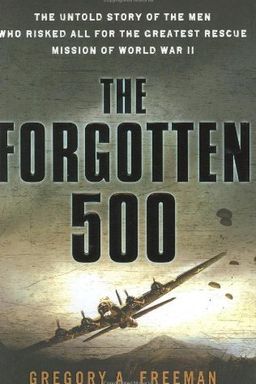
The Forgotten 500 cover

The Forgotten 500

by Gregory A Freeman

The Forgotten 500 uncovers the thrilling and previously classified story of Operation Halyard, the largest rescue mission of World War II. Follow the daring journey of Allied airmen and the brave Yugoslavs who risked everything to bring them home.

Operation Halyard and the Hidden Heroes of WWII

Imagine parachuting from a burning bomber into German-occupied Yugoslavia. Survival seems impossible — yet hundreds of Allied airmen did survive, sheltered by villagers and guerrillas who risked execution to keep them alive. That improbable story leads to Operation Halyard, one of World War II’s least-known triumphs of courage, improvisation, and political irony.

A rescue born of catastrophe

The book opens with the air raids on Ploesti, whose refineries supplied Nazi Germany’s oil. Rippling mechanical failures — jammed turrets, shredded wings, failing hydraulics — send men like Clare Musgrove and Robert Wilson plunging into the Balkan wilderness. Each story introduces the intersection of technology and humanity: aircraft built for war collide with mountainous terrain and the kindness of strangers.

When you follow these airmen into villages, you experience a transformation from chaos to community. Yugoslav peasants who barely know the outside world respond to one word — “Americanski” — with instant loyalty. They hide fliers under beds, share bread meant for their children, and wait with fear for German patrols. This grassroots resistance gives the narrative its moral center: human compassion stronger than military logic.

The emergence of a plan

These small rescues soon accumulate. By summer 1944, hundreds of airmen gather near Pranjane, under the protection of General Draza Mihailovich’s Chetniks. George Vujnovich and George Musulin of the Office of Strategic Services (OSS) turn rumors into logistics. Vujnovich’s Yugoslav roots and Musulin’s field reports merge into a staggering proposition: land C‑47 cargo planes in enemy territory, collect the fliers, and fly them to Italy. No one has tried such a feat before.

The mission becomes a web of courage and bureaucracy. OSS headquarters in Bari juggles skeptical British officers, limited aircraft, and the need for coded radio contact. The signal—crafted by Thomas Oliver and his men with clever personal identifiers—finally persuades Bari that the stranded airmen are real. President Roosevelt’s direct authorization cuts through obstruction, launching Operation Halyard on 9 August 1944.

Audacity in motion

You witness villagers and soldiers carve a runway from pastureland: 250 airmen, 300 farmers, and 60 ox carts tamp earth for weeks. When C‑47s descend in darkness guided by Aldis lamps and burning hay stacks, the spectacle feels unreal. Pilots dodge treetops; each landing shoulders the risk of total exposure. Yet one by one, planes lift away—241 men rescued in the first sorties, 512 by mission’s end—without a single fatality during extraction.

Politics and betrayal

Behind the triumph lies sorrow. The rescue unfolds as allied diplomacy shifts toward Tito’s Communist Partisans, nudged by British intelligence reports manipulated by Soviet mole James Klugmann. Mihailovich, who shelters Americans, finds himself labeled unreliable and abandoned by his supposed allies. Political expediency overshadows fidelity; villages that saved men face reprisals without aid.

When war ends, Washington remains silent. Reports are classified, Mihailovich is executed in 1946, and the Legion of Merit awarded posthumously stays hidden for decades. Only years later do surviving airmen fight to reveal the truth, campaigning for recognition of the general who saved them. Their devotion turns memory into moral protest.

The meaning behind the mission

Operation Halyard teaches you that warfare is not only fought with weapons, but with integrity and remembrance. It’s an anatomy of cooperation among strangers—OSS agents balancing courage and bureaucracy, villagers extending their humanity into danger, and airmen bound by gratitude for life freely risked by others. Yet it is also a cautionary tale about how ideology and diplomacy can bury heroism. (Note: Similar to Ben Macintyre’s works on espionage, this story reveals moral paradox in secret warfare.)

Core insight

What makes Operation Halyard unforgettable is not only its scale, but its silence: a mission that succeeded perfectly yet was buried politically. It shows how ordinary courage can defy systems, and how truth can depend on those who refuse to forget.

By the end, you understand that behind every classified file and coded transmission stands an alliance of faith — neighbors who hid unfamiliar men, leaders who took moral risks, and survivors who spent lifetimes rebuilding history from memory. That is the heartbeat of the book and the enduring lesson of Operation Halyard.


From Bailout to Brotherhood

You begin where metal meets flesh — the chaos inside crippled bombers limping away from Ploesti’s inferno. The airmen’s fall defines their transformation. Clare Musgrove cracks his turret loose with a hand crank; Tony Orsini breaks bones in the descent; Robert Wilson lands among strangers. Their survival depends on chance and compassion more than military protocol.

Villages as sanctuaries

Once on the ground, the word “Americanski” changes everything. What begins as curiosity becomes jubilant rescue. Villagers feed strangers from scarce stores; women offer shelter knowing German patrols could retaliate. These gestures are quiet acts of defiance. The local kindness recasts war not only as destruction, but as solidarity among the powerless.

Networks of hope

Small kindness evolves into organization. Mihailovich’s Chetniks link settlements through secret paths and messengers, funneling airmen toward Pranjane. The community builds an informal refugee system guided by local teachers fluent in English and guerrilla soldiers guarding mountain passes. Each helping hand pushes men closer to home.

Human lesson

Survival in war depends as much on empathy as on tactics. Simple acts — bread offered, a door opened, a signal understood — become lifelines stronger than weapons.

Each rescued man carries lifelong gratitude. Long after victory parades fade, their memory of village compassion remains a moral compass. Operation Halyard began with those moments — frightened strangers becoming brothers through shared danger.


Mihailovich and the Chetniks’ Sacrifice

General Draza Mihailovich and his Chetniks form the backbone of Operation Halyard’s success. Loyal to the exiled Yugoslav monarchy, they control regions of Serbia while fighting both Nazis and Tito’s Partisans — a double war few outsiders grasp. To understand Halyard, you must see Mihailovich not as a political tool but as a man who valued human lives above ideology.

Defending strangers

Mihailovich commands his troops to protect Allied airmen at any cost. He stations guards around Pranjane, hunts German patrols, and repurposes machine guns salvaged from downed planes. Rebels and villagers dig trenches and camouflage fields while maintaining normal routines to mislead reconnaissance flights. Their discipline is astonishing: restraint in aggression to shield civilians from reprisal while sustaining defense lines around hidden airmen.

Moral absolutism

His instruction — execute any officer who fails to protect an Allied flyer — sounds brutal yet underscores the depth of commitment. It’s protection as sacred duty. To Mihailovich, these strangers symbolize Serbia’s bond with liberty; saving them means saving dignity under occupation.

Legacy and paradox

Later Allies turn against him, favoring Tito’s forces under Soviet influence. Yet every rescued airman remembers Mihailovich as savior, not reactionary. Their testimonies—later suppressed—describe his warmth, fairness, and deep concern for villagers who fed the Allies despite hunger. His dual role as nationalist and humanitarian remains the emotional core of this narrative.

Key moral

In Mihailovich’s world, heroism means choosing decency despite political risk — an insight timeless beyond warfare.

Without the Chetniks’ control and restraint, Operation Halyard would never happen. Their invisible service—holding back German reprisals, securing airstrips, and ensuring survival—anchors one of history’s most altruistic chapters.


OSS Agents and the Art of Improvisation

The story of Operation Halyard is also the story of the OSS—America’s wartime intelligence experiment in creative risk-taking. George Vujnovich and George Musulin personify the agency’s ethos: local roots, audacity, and problem-solving under duress. Their partnership fuses distant planning in Bari with boots-on-the-ground leadership in Pranjane.

Training and instinct

Vujnovich trains at the OSS’s famed “Farm,” learning sabotage, coding, and surveillance skills. His personal experience in Yugoslavia—fleeing occupation—gives him empathy and urgency. Musulin, in contrast, becomes the agency’s field brawler: fluent in Serbian, living among Chetniks, bridging cultural divides through charisma.

Conflict and bureaucracy

British SOE agents distrust Mihailovich, causing communication failures and aborted insertions. Musulin’s angry remark—“We can’t fight Germans with bare feet and Radio London”—summarizes frontline frustration with strategic politics. OSS success depends on breaking rules and improvising solutions: bribing officials, creating secret codes, and persuading skeptical superiors by sheer persistence.

Pragmatism as ethics

William Donovan’s OSS values competence over ideology. That flexibility allows missions like Halyard to exist despite British opposition. The agency’s tolerance for unconventional operatives (a trait later controversial) fuels its effectiveness: creativity beats bureaucracy when lives depend on quick action.

Core takeaway

Effective crisis leadership requires improvisation within chaos — the OSS embodies that principle more vividly than any wartime institution.

By linking intelligence craft to moral purpose, the OSS team transforms scattered hope into strategic rescue. Their story reveals how leadership thrives when rules bend under ethical necessity.


Night Landings and Tactical Brilliance

The climax of Operation Halyard unfolds in darkness. Picture villagers marking a meadow with burning hay bales while pilots trace narrow plateaus invisible to radar. Every landing demands precision measured in inches and courage measured in faith.

Building the impossible

Hundreds of airmen and villagers construct a 700‑yard runway using picks and ox carts. They flatten ground by foot, stretch available land, and time work between patrols. This handmade strip, defended by Chetnik patrols, becomes the lifeline between occupied Yugoslavia and Allied Italy.

Precision in peril

The first C‑47s arrive August 9, signaling by Aldis lamps coded red and white. Pilots like Kraigher skim treetops to touch down while villagers cheer. Each takeoff teeters near disaster; fuel loads must stay minimal, and any noise could trigger retaliation. Yet the airlift expands, aided by daylight fighter escorts sweeping valleys against enemy aircraft.

Defining courage

Such precision under threat exemplifies courage as collective performance — pilots, villagers, and rescued men synchronized across danger.

Every plane that rises represents proof that cooperation beats impossibility. Operation Halyard’s success — over five hundred men flown out without loss — stands unmatched in WWII rescue history.


Politics, Betrayal, and Forgotten Heroes

The rescue that defied physics falls victim to politics. Allied diplomacy in 1944 pivots toward Tito’s Communist Partisans as British and Soviet interests align. Behind this shift lies ideological bias and covert influence — notably the role of SOE officer James Klugmann, whose pro‑Communist reports cripple Mihailovich’s reputation.

How truth gets distorted

Churchill and Roosevelt, measuring alliances by short‑term military gains, accept reports claiming Mihailovich’s inactivity, ignoring OSS evidence of his rescues. Supplies reroute to Tito; Mihailovich’s forces starve while sheltering Americans. Musulin and Vujnovich witness bureaucratic obstruction firsthand, realizing politics can kill as surely as bullets.

Aftermath of silence

Postwar, Truman’s Legion of Merit honoring Mihailovich goes classified. Returning airmen face gag orders, and the story vanishes from history textbooks. Only decades later do survivors advocate publicly, achieving symbolic justice in 2005 when Mihailovich’s daughter receives the long-secret medal.

Lesson of betrayal

Politics can eclipse moral clarity; heroes may vanish from memory unless persistence restores them.

In exposing bureaucratic cover-up and ideological manipulation, the book teaches that historical truth depends on those who keep memory alive against official silence. Operation Halyard endures because its survivors did exactly that.

Dig Deeper

Get personalized prompts to apply these lessons to your life and deepen your understanding.

Go Deeper

Get the Full Experience

Download Insight Books for AI-powered reflections, quizzes, and more.