
Idea 1
Why "Realism" Failed—and What Must Replace It
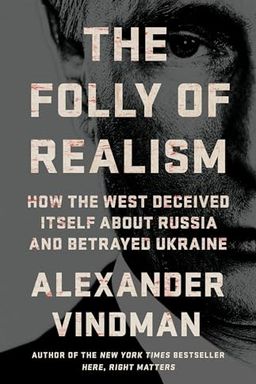
When do you decide that a long‑used strategy at work—or in life—isn’t delivering, and that sticking with it is quietly making the problem worse? In The Folly of Realism, Alexander Vindman argues the United States faces exactly that moment in foreign policy. His core contention: three decades of a Russia‑first, crisis‑averse “realist” approach—shared by both parties—didn’t tame Moscow, it enabled it. By consistently privileging short‑term deals, avoiding hard choices, and overestimating the benefits of appeasing a nuclear‑armed power, Washington deceived itself about Russia and, in the process, betrayed Ukraine.
Vindman contends that the West’s deference to Russian exceptionalism—from denuclearization terms that funneled Ukraine’s deterrent into Moscow’s hands (1992–1996), to a NATO decision in Bucharest that promised membership to Ukraine and Georgia while denying the very first step (2008), to incremental, delayed support after Russia’s 2014 seizure of Crimea—has taught the Kremlin a ruinous lesson: bold aggression meets Western hesitation. He proposes an alternative he calls “neo‑idealism,” drawing on the work of Benjamin Tallis: a tough‑minded, values‑anchored strategy that treats democratic self‑determination, rule of law, and human dignity not as nice‑to‑haves but as the United States’ most durable interests.
What This Book Covers
You’ll first see why Ukraine matters far beyond today’s headlines. Vindman walks you through a millennium of shared—and fiercely contested—identity, from Kyivan Rus’ to the Cossacks, the Holodomor, Soviet Russification, and Chernobyl’s searing lesson about governance and risk. He shows how Ukrainian statehood in 1991 didn’t spring from nowhere; it rested on a deep, resilient national tradition (for a complementary long view, see Serhii Plokhy’s The Gates of Europe).
Next, you’ll meet the Washington team that quietly set much of U.S. policy: the 1989 National Security Council “Ungroup” (Condoleezza Rice, Stephen Hadley, Robert Blackwill, Paul Wolfowitz, Eric Edelman, Robert Zoellick, Dennis Ross). Tasked with gaming out the end of the USSR, they elevated one overriding objective—secure Soviet nukes under a strong center in Moscow—above all else. That logic made Ukrainian sovereignty contingent and framed the 1990s “Russia‑first” reflex that lingered for decades.
Vindman then reconstructs, step‑by‑step, how a series of decisions compounded: the Lisbon Protocol and Budapest Memorandum (1992–1994), which removed Ukraine’s nuclear deterrent in exchange for security “assurances,” not guarantees; the Clinton team’s trilateral diplomacy that secured disarmament but underinvested in Ukraine’s democratic and economic resilience; the West’s non‑response to Russia’s growing authoritarianism at home and coercion abroad; the 2004 Orange Revolution where Washington condemned fraud but tiptoed around Kremlin interference; Bucharest 2008’s muddled half‑promise; and the echoed consequence—Russia’s invasion of Georgia (2008) and Ukraine (2014, 2022).
Why It Matters to You
If you care about whether democracies can safely choose their futures—your own included—Vindman’s story is a manual in how not to manage authoritarian challengers. The lesson isn’t that values are naïve; it’s that ignoring values is naïve. Realism, as practiced, promised stability; in reality, it delivered drift, self‑deterrence, and wider war. Vindman, drawing on his service in Kyiv and Moscow and later at the Pentagon and the National Security Council, shows from the inside how bureaucratic habits (“avoid escalation,” “don’t spook Moscow,” “wait for allies”) can harden into an alibi for inaction that invites aggression.
The book’s thesis in one line
“In selling out our values for short-term calm, we’ve undermined our interests—and taught deterrable autocrats that they can act with impunity.”
What You’ll Learn in This Summary
- How centuries of history make Ukraine the crux of Russia’s imperial identity—and why that shapes today’s war.
- How the late‑Cold War “Ungroup” locked in a Russia‑centric, nuclear‑first reflex that sidelined Ukraine.
- Why denuclearization without hard security guarantees (Budapest, 1994) created a fatal credibility gap.
- Where U.S. administrations—Bush 41, Clinton, Bush 43, Obama, Trump, Biden—repeated the same pattern: hope, hedge, hesitate.
- What “neo‑idealism” means in practice: values as interests, early action over late reaction, and concrete steps to anchor Ukraine in the West.
How to Read This Moment
Vindman doesn’t ask you to choose between starry‑eyed idealism and hard‑nosed interests. He argues the two converge when you deal with autocrats who test red lines: equip partners early, set bright‑line consequences, and back words with means. His critique extends to neoconservative overreach after 9/11 (which tried to nation‑build by force while bartering with Moscow) and to liberal institutionalism that trusted process to tame power without building leverage (compare to Robert Kagan’s argument in The Jungle Grows Back).
In short: if you want a durable peace in Europe, you don’t center your diplomacy on the aggressor’s self‑image or your own fear of escalation. You center it on the agency of threatened democracies—and give them the tools and alliances that make aggression unprofitable. That’s the pivot this book argues for, with Ukraine as the test case that will either revitalize the liberal order or confirm its decline.