
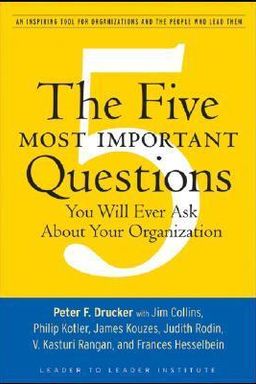
The Five Most Important Questions You Will Ever Ask About Your Organization cover

The Five Most Important Questions You Will Ever Ask About Your Organization

by Peter F Drucker

Peter F. Drucker''s ''The Five Most Important Questions You Will Ever Ask About Your Organization'' equips managers with vital questions to enhance organizational success. Tailored for nonprofits but applicable to all, this guide fosters a deeper understanding of mission, customer insight, and strategic planning.

Asking the Five Questions That Define Your Organization

What if your organization’s long-term success had less to do with your answers—and everything to do with the questions you ask? In The Five Most Important Questions You Will Ever Ask About Your Organization, legendary management thinker Peter F. Drucker challenges leaders to look inward with uncommon honesty. He argues that asking five deceptively simple questions can illuminate the soul, purpose, and direction of any business, nonprofit, or government agency. The key, Drucker insists, is not clever answers but courageous inquiry—questions that demand reflection, humility, and disciplined action.

Drucker’s five questions are: What is our mission? Who is our customer? What does the customer value? What are our results? and What is our plan? Through these core inquiries, he builds a framework for leadership grounded in clarity, accountability, and continual learning. Instead of chasing trends or technology, he urges leaders to pursue alignment—between purpose and performance, between values and value delivered.

Why Questions Matter More Than Answers

Drucker believed that leadership begins with self-assessment, a radical act of self-confrontation. He warns that too many organizations act without thinking—or worse, define success only by output or profit. Real effectiveness, he says, begins by slowing down to ask why you exist and whom you truly serve. Every leader, he argues, must periodically stop "doing things right" long enough to ask whether they are still "doing the right things."

This book grew out of Drucker’s Self-Assessment Tool, first developed for nonprofit leaders who lacked a financial bottom line to measure success. But the questions quickly transcended sectors. Business executives found them equally transformative because they forced a deeper conversation—about continuity and change, relevance and renewal, purpose and performance. Contributors like Jim Collins, Philip Kotler, Jim Kouzes, Judith Rodin, and V. Kasturi Rangan build on Drucker’s concepts, showing how organizations across industries—from hospitals to museums—can apply these questions to steer through complexity.

From Self-Assessment to Transformation

Drucker describes self-assessment as both diagnosis and catalyst. The process, he explains, typically unfolds in three phases: gathering insights from across the organization; wrestling with the five questions together; and translating discoveries into concrete plans. This is not a quick exercise—it’s an act of strategic introspection. Frances Hesselbein, longtime CEO of the Girl Scouts and Drucker’s collaborator, emphasizes that self-assessment is a leadership discipline, not a compliance ritual. Done well, it deepens ownership, sparks innovation, and fosters unity of purpose.

The questions themselves are remarkably simple—but the meaning behind them is profound. “Who is our customer?” forces leaders to name the real beneficiary of their work, not just the people who pay for it. “What does the customer value?” invites humility: only they can answer. “What are our results?” measures success in changed lives or improved conditions, not merely internal activity. Finally, “What is our plan?” ties mission and measurement together into disciplined action.

Why This Still Matters

Although written largely for nonprofits, Drucker’s framework has become a universal language for strategic clarity. In a time of rapid disruption, his insistence on mission-centered management feels more relevant than ever. When organizations chase too many opportunities, he warns, they spread themselves thin and lose focus. When they fail to examine what customers truly value, they drift. When they cling to obsolete programs or traditions, they stagnate. These questions are a safeguard against complacency—a way to keep purpose, people, and performance aligned.

As you move through this framework, you’ll discover themes of focus (staying true to your mission), listening (really hearing customers), measurement (defining meaningful results), discipline (converting insight into plans), and renewal (constantly reassessing what no longer works). The journey isn’t just organizational—it’s deeply personal. Drucker’s five questions are also questions every leader must ask of themselves: Why am I doing what I’m doing? Who am I serving? Is it working? And what must I do next?

“Self-assessment,” Drucker said, “is the first action requirement of leadership: the constant re-sharpening, constant refocusing, never being really satisfied.”

By the end of The Five Most Important Questions, you realize that these are not merely business tools—they’re questions about legacy. Drucker ultimately asks, “What do you want to be remembered for?” It’s a question that transcends organizations and goes straight to the heart of leadership itself.


Clarifying Purpose Through Mission

Your mission is your organization’s reason for being—the heartbeat that gives meaning to everything else you do. Drucker begins his framework with a deceptively simple question: What is our mission? According to him, every organization must determine the specific difference it seeks to make in people’s lives. Without this clarity, effort becomes scattered and results diffuse.

Define Purpose in Human Terms

Drucker insists that mission cannot be impersonal or bureaucratic. A hospital’s mission is not “to provide healthcare services”—it’s to give assurance to the afflicted. That reframing moves focus from activity to impact—from what an organization does to how it changes lives. He even suggests that an effective mission statement should be short enough to fit on a T-shirt and clear enough to inspire pride.

Jim Collins expands on this idea by highlighting the tension between continuity and change. Great organizations, he writes, “preserve the core, yet stimulate progress.” Their mission remains fixed, even as strategies and methods adapt. For example, universities evolve their tenure systems, but never abandon the ideal of free inquiry; the Girl Scouts pursue new programs, but always to help each girl “reach her highest potential.”

Opportunity, Competence, and Commitment

Drucker’s triad of mission design—opportunity, competence, and commitment—forms a practical test. The mission must align with opportunities in the external environment, with the competence of the organization, and with the genuine commitment of its people. A mismatch between any of these creates dissonance. For leaders, this means constantly reviewing whether your mission still fits changing realities.

Guard Against Mission Drift

Perhaps Drucker’s sternest warning is to never subordinate the mission for money. Many leaders face the temptation to pursue funding that doesn’t align with purpose. Drucker recounts a museum board that turned down a major art donation because its conditions violated core principles. “Otherwise,” he said, “you sell your soul.” This moral clarity keeps organizations from sacrificing integrity for financial survival—a theme echoed in Collins’s Good to Great and the Social Sectors.

Start with Eternity, Act Today

Ultimately, Drucker reminds leaders to balance vision with action. He quotes John Donne: “Never start with tomorrow to reach eternity.” Start with your long-term difference in mind, then work backward to what you must do today. A strong mission becomes both compass and anchor—a statement that holds steady through uncertainty, guiding decisions large and small toward lasting impact.


Knowing and Serving Your True Customer

Once your mission is clear, Drucker’s next challenge is to ask, Who is our customer? This question sounds straightforward but can be surprisingly tricky—especially for nonprofits or public institutions that serve multiple stakeholders. Drucker redefines a customer as anyone who must be satisfied for the organization to achieve results. The primary customer is the person whose life is changed by your work; supporting customers are those who enable that change—donors, volunteers, partners, regulators, or employees.

Focusing on the Primary Customer

The key discipline is focus. Drucker describes a nonprofit helping people with multiple barriers to employment—ranging from disabilities to addiction recovery. Its 25 programs all serve one unifying mission: enabling those individuals to gain and keep productive work. While other potential groups could be served, the organization’s results come from concentrating on one clear customer.

Frances Hesselbein’s Girl Scouts offer another case study. Their primary customer is “the girl.” Yet they also recognize supporting customers—parents, volunteers, funders, and communities. By understanding how demographics were changing, Hesselbein expanded access to include girls of every race and income group. The organization’s success lay in balancing focus on the primary customer with sensitivity to supporting ones.

From Customers to Fans

Marketing pioneer Philip Kotler adds that Drucker’s insights apply equally in business. “The purpose of a company is to create a customer,” Drucker wrote decades ago. Kotler updates that idea for the digital era: today, the best companies don’t just create customers—they create fans. He urges organizations to choose their customers instead of trying to please everyone. True customer focus, he says, means deeply understanding—and selectively serving—those whose success you can genuinely advance.

Kotler’s example of buying a family car illustrates the complexity of real-world decisions. Multiple roles—initiator, influencer, decider, buyer—shape purchasing behavior. Knowing your “customer” often means understanding an ecosystem of decision makers, not a single person. The best organizations map these relationships carefully and tailor communication accordingly.

Customers Change—So Must You

Above all, Drucker insists that customers are never static. Their needs, demographics, and aspirations change continually, and organizations must adapt to remain effective. He recounts a pastor who built a program for newly married couples but was surprised when attendees were mostly cohabiting partners deciding whether to marry. The lesson: your customers are always one step ahead, so keep asking, “Who is our customer—today?”

By returning to this question regularly, you avoid the trap of designing programs for yesterday’s audience. You stay aligned with your mission and remain dynamically relevant.


Discovering What the Customer Values

Knowing who your customer is leads naturally to the third question: What does the customer value? Drucker calls this the hardest—and most neglected—question. Too often, leaders assume they know what people want instead of listening. The first rule, he says, is that there are no irrational customers. They act rationally according to their own experience and context. Your job is not to correct their logic but to understand it.

Value is Defined by the Customer

Drucker tells of a homeless shelter that thought value meant offering good food and clean beds. After interviewing residents, they learned those amenities addressed comfort but not the deeper aspiration: safety, stability, and the chance to rebuild a life. By redesigning services to serve that aspiration—letting residents stay longer and engage in planning for reentry—the shelter increased both impact and accountability. Value begins where assumptions end.

Listening Shapes Value

Jim Kouzes reinforces this with a story from Detroit’s Sinai-Grace Hospital. When new president Patricia Maryland arrived, she found enormous ER wait times and poor community morale. By simply asking patients what they valued, the team discovered that speed, cleanliness, and compassion mattered most. They redesigned facilities, added triage areas, and retrained staff. Wait times dropped 75 percent, satisfaction soared, and the hospital’s finances recovered. Listening wasn’t just good ethics—it was good management.

Kouzes observes that customers value leaders who listen, empathize, and act courageously. In his terms, “everything exemplary leaders do is about creating value for their customers.” That requires challenging entrenched habits and sometimes redefining how success is measured.

Assumptions vs. Reality

Philip Kotler notes that even organizations with clear missions often misinterpret value through their own lens. To bridge that gap, leaders must systematically gather and test feedback through interviews, focus groups, and data—not intuition alone. The process can feel uncomfortable but inevitably leads to richer insights and stronger relationships.

Ultimately, Drucker’s advice is simple yet radical: stop telling customers what they should value. Ask them. Then design your work around their answers.


Defining and Measuring Results That Matter

After mission, customer, and value come accountability. The fourth critical question—What are our results?—forces organizations to move from intention to impact. For Drucker, results are not internal metrics but external change: “The results of social sector organizations are measured outside, in changed lives and conditions.”

Measure What Happens Beyond Your Walls

Drucker contrasts activity with outcomes. A mental health center he studied achieved extraordinary results with people diagnosed as schizophrenic—not by tracking hours of counseling but by measuring life changes: fewer hospitalizations, greater independence, renewed family relationships. That, he said, was the true bottom line—transformed capacity, not completed tasks.

He distinguishes between qualitative (depth and meaning of change) and quantitative (numbers and statistics) measures. Both matter. For example, a museum might measure how many visitors attend an exhibit and also collect stories of individuals whose perspectives changed profoundly. Together, they build a full picture of results.

Abandon What No Longer Works

Drucker introduces one of his core disciplines: planned abandonment. Every organization must ask, “If we weren’t doing this today, would we start doing it?” If the answer is no, it’s time to stop. Clinging to yesterday’s programs drains energy from tomorrow’s opportunities. He reminds leaders that even what once succeeded can become obsolete—and courage is required to move on.

Using Results to Improve Plans

Judith Rodin extends Drucker’s thinking by linking evaluation directly to planning. Results, she argues, must feed back into continuous learning. The best organizations treat measurement as a tool for adaptation, not judgment. Rodin warns of two extremes: measuring only what’s easy (outputs, not outcomes), or avoiding measurement because human impact feels complex. The goal is balance—measurement that enlightens action, not replaces it.

For you as a leader, this means redefining success as meaningful progress toward your mission. Numbers alone can’t capture that; stories without data can’t sustain it. But together, they make strategy visible.


Planning for Action, Learning, and Renewal

Drucker’s fifth question—What is our plan?—translates insight into execution. After all the reflection, a leader must decide what to do next. A plan, in Drucker’s view, is a concise map connecting mission, vision, goals, objectives, action steps, and budget. It aligns people and resources around priorities and converts good intentions into outcomes.

Goals, Objectives, and Accountability

Drucker distinguishes between goals—broad long-term aims approved by the board—and objectives—specific, measurable achievements that management pursues. He warns against having more than five goals; otherwise focus dissolves. Each objective must answer who will do what by when and with what resources. Leadership’s job is to approve direction and allocate resources, leaving detailed planning to those responsible for execution.

The Five Elements of an Effective Plan

  • Abandonment: Stop what no longer works or is irrelevant.
  • Concentration: Build on your strengths and proven successes.
  • Innovation: Seek new opportunities that align with mission and customer value.
  • Risk-taking: Balance safety and boldness; some risks are worth taking.
  • Analysis: Pause for reflection when knowledge is incomplete before making key commitments.

These elements ensure that planning is dynamic, not bureaucratic. Drucker calls planning a “continuous process of strengthening what works and abandoning what does not.” A good plan lives and learns.

Planning as Learning

V. Kasturi Rangan reinforces that planning is not a static document but an evolving process. He contrasts strategy formulation (choosing goals) with planning (executing and learning). Effective plans balance stability of purpose with flexibility in method. For example, a museum might plan a special exhibition to attract visitors but must remain adaptable if circumstances or audience trends shift midstream. The best plans treat surprises as feedback, not failure.

Finally, Drucker ends where he began: with renewal. True self-assessment never ends. Plans must evolve as environments and results change. The leader’s role is to keep asking, "What do we want to be remembered for?"—and let that vision guide every next step.


Transformational Leadership and Continuous Renewal

Frances Hesselbein concludes the book with a call to transformational leadership—leadership that aligns mission, people, and purpose across changing times. She outlines eight milestones organizations must pass to become relevant and effective. These milestones apply equally to corporations, governments, and community groups—and they expand Drucker’s philosophy into practical change management.

Eight Milestones of Transformation

  • Scan the environment: Keep your eyes on trends; anticipate shifts before they force your hand.
  • Revisit the mission: Review purpose regularly to ensure relevance to evolving needs.
  • Ban the hierarchy: Replace rigid structures with flexible, circular systems where knowledge flows freely.
  • Challenge the gospel: Question every policy and tradition; practice planned abandonment.
  • Employ the power of language: Communicate a few powerful messages consistently, shaping culture through words.
  • Disperse leadership: Develop leaders at every level; leadership is everyone’s responsibility.
  • Lead from the front: Model values visibly; leadership is behavior, not position.
  • Assess performance: Embed continuous evaluation linked to Drucker’s five questions.

Leadership as a Shared Journey

Hesselbein emphasizes that leadership today is not about control but connection. By dispersing leadership and fostering inclusion, organizations become more agile and innovative. Her experience—from leading the Girl Scouts to cofounding the Leader to Leader Institute—shows that genuine transformation depends on shared ownership of mission and results.

She insists that every organization must revisit these five questions continuously. Transformation, she writes, is not a one-time event but a journey “from where we are to where we want to be.” When leadership is grounded in purpose, fueled by inquiry, and measured by results, organizations—and the people in them—become instruments of social renewal.

Dig Deeper

Get personalized prompts to apply these lessons to your life and deepen your understanding.

Go Deeper

Get the Full Experience

Download Insight Books for AI-powered reflections, quizzes, and more.