
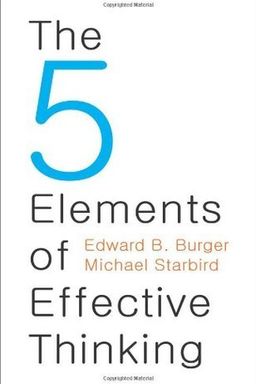
The Five Elements of Effective Thinking cover

The Five Elements of Effective Thinking

by Edward B Burger and Michael Starbird

The Five Elements of Effective Thinking guides you to unlock your potential by mastering foundational skills, embracing failure, and nurturing your curiosity. Learn how to harness the power of effective thinking for lasting change and personal growth.

The Five Elements of Effective Thinking

Have you ever wondered why some people seem to come up with brilliant ideas effortlessly, while others struggle to make sense of problems? The secret, according to The Five Elements of Effective Thinking by Edward B. Burger and Michael Starbird, lies not in raw intelligence but in how you approach thinking itself. The authors argue that effective thinking can be learned, practiced, and mastered just like any other skill. They propose a powerful framework built on five natural elements — Earth, Fire, Air, Water, and Change — each representing a distinct mental habit that transforms how you learn, problem-solve, and innovate.

In essence, Burger and Starbird contend that thinking effectively means engaging deeply, questioning continuously, learning from mistakes, and embracing transformation. The five elements form a cycle of intellectual growth: grounding your understanding in basics (Earth), using mistakes as sources of fuel and insight (Fire), engaging curiosity and questions (Air), letting ideas flow sequentially and evolve naturally (Water), and willingly changing yourself and your methods to adapt (Change).

Earth: The Foundation of Mastery

The authors begin with Earth — the element symbolizing solid understanding. They argue that most people rush to complex problems without taking the time to master the fundamentals. Whether learning music, science, or mathematics, the path to excellence lies in perfecting the basics. The book uses the story of trumpet virtuoso Tony Plog, who astonished master performers by demonstrating how even the simplest exercise can be played with extraordinary depth. Through his mastery of fundamentals, Plog illustrated how a deep understanding of the basics creates the foundation for all brilliance.

Fire: Learning Through Failure

Fire represents the energy of growth through mistakes. The authors show that failure is not an obstacle but a vital step toward understanding. By examining your errors instead of avoiding them, you build resilience and refine your approach. Thomas Edison’s relentless experimentation — discovering “10,000 ways that won’t work” before inventing the lightbulb — captures this mentality. Every failed experiment was data, instruction, and progress. Burger and Starbird even encourage readers to intentionally fail, exaggerating potential errors to uncover flaws and innovate more effectively (a method echoed in design thinking and agile innovation).

Air: The Power of Questioning

Air clears intellectual clutter. The authors remind readers that curiosity fuels deep understanding — and that asking effective, focused questions can be life-changing. Children do this naturally by asking “why” repeatedly. Adults, in contrast, often stop questioning because they fear looking uninformed. To re-engage your mind, you must think like a teacher: articulate your understanding clearly enough to explain it to others, then question every assumption. Whether you’re pondering “How can I solve this problem?” or “What if my question is wrong?”, every inquiry opens new paths to insight.

Water: Flowing Ideas and Continuous Innovation

Water stands for conceptual flow — the idea that new insights evolve from old ones. The authors argue that no idea appears from nowhere; each is part of a continuum. Just as Isaac Newton admitted he saw further only by “standing on the shoulders of giants,” every innovation is rooted in history. Understanding the lineage of ideas helps you connect your own thinking to broader networks of knowledge. The authors urge readers to see every discovery as a starting point, not a destination — mirroring R.H. Bing’s advice that “the time to work on a problem is after you have solved it.”

Change: The Catalyst for Growth

The fifth element, Change, reminds you that no progress occurs without transformation. Doing the same thing repeatedly and expecting new results — as the old saying goes — is insanity. The authors encourage embracing change as a lifelong habit: to constantly revise, rebuild, and evolve your thinking. Just as a city requires continuous renovation to stay vibrant, your mind thrives through ongoing adaptation. Once you integrate Earth, Fire, Air, and Water into your habits, Change binds them together into an ever-evolving process of self-improvement.

Why These Elements Matter

Together, these five elements are not abstract metaphors but actionable steps. They can transform how you study, approach creative work, lead teams, or solve personal challenges. The beauty of the framework lies in its accessibility: you can begin with any element, apply it immediately, and evolve your own way of thinking. The process reinforces itself — every mistake leads to a question, every question sparks a new insight, and every insight forces you to change again.

“The five elements show that effective thinking is not about being gifted — it’s about cultivating precise habits of learning, wondering, failing, connecting, and evolving.”

In short, The Five Elements of Effective Thinking is a manual for intellectual transformation. It tells you not only what to think, but how to think better. Whether you’re a student, a leader, or a lifelong learner, mastering these five elements gives you the tools to build understanding from the ground up, turn failure into fire, let your curiosity breathe, allow your ideas to flow, and embrace change as the ultimate element of growth.


Mastery Begins with the Basics

In nearly every field, from mathematics to music, the temptation is to rush into advanced material or complex skills. Yet, as Burger and Starbird stress, true mastery begins with understanding and refining the basics. This principle sits at the heart of the first element — Earth — the solid ground on which all intellectual growth depends.

The Danger of Skipping the Fundamentals

Think of a student cramming for an exam. She might fill her mind with lists of facts and advanced theories, hoping that volume equals understanding. However, without a firm grasp of the foundation — the conceptual basics — her knowledge collapses under pressure. The same is true of professionals who attempt sophisticated strategies without understanding the underlying principles.

Burger and Starbird illustrate this with the story of Tony Plog, a world-class trumpet player. When he asked seasoned musicians to perform a simple beginner’s exercise, none of them played it beautifully. But when Plog took his turn, he transformed the simple notes into a demonstration of mastery. His secret? He approached even the simplest exercises with the same depth and precision he applied to complex concertos. This attitude exemplifies how depth in fundamentals leads to brilliance.

From Basics to Breakthroughs

Mastering fundamentals is not a one-time step but a lifelong practice. The authors compare this to NASA’s Apollo mission. Before landing humans on the moon, they first sent unmanned rockets to test basic mechanics. Each success built on mastering one layer of complexity before tackling the next. Without these foundational trials, a moon landing would have been impossible. The same logic applies universally: before solving difficult problems, strip them down to their simplest components and succeed one piece at a time.

This concept parallels principles in other learning classics, such as George Leonard’s Mastery, which also champions the long, patient commitment to fundamental practice. In creative or strategic work, starting from the ground up ensures stability and resilience under pressure. The authors encourage readers to continually revisit the basics — not because they are easy, but because they offer endless refinement and insight.

Practical Application

To implement this idea, choose an area you want to improve in — be it writing, coding, or public speaking. Identify the most basic principles underlying the skill, and deliberately practice them until they become second nature. Then, challenge yourself to revisit them regularly. Ask: “Have I truly mastered the fundamentals, or have I simply moved on?”

“The basics are not the first step — they are every step.”

Mastering the basics is the most profound act of intelligence because it forces you to slow down, reflect, and build a mental foundation strong enough to support every future insight. Like Earth itself, this element reminds you that real progress begins by digging deep.


Finding the Core of Every Problem

When faced with a problem, most people look for quick explanations or accept familiar patterns. Burger and Starbird warn that this tendency leads to false conclusions. The key, they argue, is to uncover a problem’s essence — the hidden structure that truly drives it.

Seeing Beyond the Obvious

For centuries, people observed birds, bats, and insects and concluded that flapping wings was the secret to flight. Yet flight isn’t about flapping — it’s about wing shape and airflow. Similarly, solving problems requires seeing beyond surface details to understand the invisible principles underneath. Effective thinkers learn to look for what’s actually there rather than what tradition or assumption suggests.

The authors connect this skill to the scientist’s mindset. Galileo and his peers refuted Aristotle’s teaching that heavier objects fall faster by questioning assumptions and observing reality directly. That willingness to re-examine “what everyone knows” led to breakthroughs in physics — a reminder that progress begins with skepticism.

Finding What’s Missing

Sometimes, the essence of a problem lies in what’s not there. Burger and Starbird use a creative example: black-and-white photography. Before color film, these photos weren’t considered limited; they were just “photographs.” Only after color appeared did people realize something had been missing all along. Seeing absence as meaningful can reveal new opportunities for discovery or innovation — a skill designers, inventors, and entrepreneurs often rely on.

This insight echoes advice from Richard Feynman and Edward de Bono, who both championed “thinking outside the apparent frame.” In any field, the ability to identify what’s missing — the unseen variable, the unasked question — separates pioneers from imitators.

Practical Application

To uncover a problem’s essence, start by observing without judgment. List what you actually see, not what you expect. Then, ask: “What’s missing here?” or “What assumption am I making?” This technique can simplify complexity and help you arrive at insights others overlook.

“Understanding grows when you strip away the noise and focus on the heartbeat of the problem.”

By focusing on essence rather than surface, you cultivate intellectual clarity — the kind that distinguishes effective thinkers from those lost in distraction.


Failure as the Fuel for Learning

No one enjoys making mistakes, yet Burger and Starbird insist that failure is the most powerful teacher you have. Represented by the element Fire, mistakes are uncomfortable but transformative — they burn away illusions and forge deeper understanding.

Reframing Failure as Progress

For many people, failure signals defeat. However, to effective thinkers, failure signals data. The authors describe Thomas Edison’s inventive persistence: every failed experiment brought him closer to success. He’s famous for saying, “I have not failed, I’ve just found 10,000 ways that won’t work.” Failure, in this sense, becomes fuel — each mistake illuminates what doesn’t belong, narrowing the path to what does.

Turning Setbacks into Discoveries

The story of 3M’s Post-it Notes reveals this principle in action. A scientist created a weak adhesive that was originally deemed useless. Years later, another researcher turned that “failed” product into the wildly successful Post-it, a classic example of accidental innovation. Mistakes, when examined rather than discarded, can contain hidden solutions to entirely different problems.

Practicing Constructive Failure

To embrace failure effectively, make reflection part of your process. Whenever something goes wrong, analyze it: What went wrong? Why? What can I learn? In design fields, this process resembles rapid prototyping or “failing fast” — a philosophy shared by innovators like Pixar and IDEO (note: both encourage iterative feedback loops and small-scale experiments). Each attempt becomes a lesson rather than a loss.

“The fire of failure, if faced directly, forges the steel of understanding.”

You can’t grow without discomfort. By reframing failure as exploration, you learn to adapt, iterate, and eventually ignite success from the ashes of what didn’t work.


Fail Intentionally to Innovate Boldly

If fear of failure limits action, then intentional failure liberates creativity. Burger and Starbird introduce the radical idea that purposeful failure — deliberately trying, knowing you’ll err — is a method of discovery. This approach amplifies the Fire element’s lesson: turning fear into experimentation.

Setting Expectations to Fail

The authors suggest a practical mental shift: assume you’ll fail nine times before succeeding once. That ratio changes everything. By expecting setbacks, you remove emotional resistance and free yourself to explore boldly. This is similar to the creative philosophy behind Google’s innovation model (“fail fast, learn faster”) or the iterative design cycle in engineering.

Stress-Testing Ideas

They also recommend exaggerating potential problems to force flaws to emerge. For example, software companies perform “stress tests” to deliberately overload systems, revealing weaknesses before real users encounter them. Similarly, penetration testers — ethical hackers — intentionally break systems to expose vulnerabilities. The same principle can improve creative or intellectual work: when you push an idea to its limit, you learn where it snaps.

Suspend Judgment in Creation

Another strategy is to silence your inner critic while brainstorming. Write down every idea, good or bad, without censorship. Only later should you evaluate what works. This separation of creation and judgment keeps ideas flowing freely, a technique echoed by writers and artists from Julia Cameron (The Artist’s Way) to design-thinking educators at Stanford’s d.school.

“Fail early, fail often, fail better — and watch your mind catch fire with innovation.”

By adopting failure as part of your creative process, you replace fear with curiosity. Each failed attempt becomes an invitation to innovate further, teaching you that mistakes are not just acceptable — they’re essential.


The Art of Asking the Right Questions

Questions are the oxygen of thought — they give ideas room to breathe. In the element Air, Burger and Starbird explore how asking better questions leads to clearer thinking, more creativity, and sharper problem-solving.

Teaching to Learn

One transformative exercise is imagining yourself as a teacher. Once you can explain a concept clearly, you reveal both what you know and what gaps remain. Preparing to teach forces you to organize your knowledge logically — an approach backed by educational research on the “Feynman Technique,” where explaining concepts in simple language exposes fuzzy understanding.

Becoming Inquisitive Again

Children instinctively ask “why?” — not to annoy, but to build frameworks of understanding. Adults, constrained by fear of seeming ignorant, tend to stop questioning. The authors urge readers to rekindle that curiosity by constantly asking “what if…” or “why not…” This habit creates fresh pathways of thinking. In their university lectures, assigning one student as “the questioner” — required to ask two questions per class — consistently produced deeper comprehension and retention than silent participation.

Shaping Effective Questions

Not all questions are equal. “How can I get better grades?” is too vague to generate action, but “How can I understand this subject more deeply?” targets a process within your control. Similarly, life’s challenges often require reframing questions entirely — for instance, shifting “How can I avoid failure?” to “What can I learn from failure?” This small linguistic change directs your brain toward constructive solutions rather than fear.

“The quality of your thinking is determined by the quality of your questions.”

Asking better questions doesn’t just clarify problems — it transforms how you experience life. Every new question opens a door to deeper understanding, renewed curiosity, and ultimately, more innovative solutions.


Ideas Flow from the Past to the Future

The element Water symbolizes flow — and in Burger and Starbird’s philosophy, that means understanding how new ideas emerge continuously from old ones. Creativity isn’t a lightning bolt but a river: every concept originates from what came before, then evolves into something richer.

Standing on the Shoulders of Giants

Consider Isaac Newton and Gottfried Leibniz, who independently developed calculus in the seventeenth century. Their breakthroughs were not spontaneous miracles; they were extensions of existing mathematical progress. Newton himself admitted that he saw further “by standing on the shoulders of giants.” Similarly, modern science and art evolve not by revolution alone, but through continuous refinement.

The authors emphasize tracing idea lineages when developing new work. By studying how others approached similar challenges — what they knew, what mistakes they made — you can find starting points for your own creativity. This mindset aligns with the work of Steven Johnson in Where Good Ideas Come From, which reveals how innovation often arises from networks of prior ideas rather than individual inspiration.

From One Idea to Many

An idea sparks others endlessly. The lightbulb led to electric heaters, radios, and computers — each development flowing naturally from what preceded it. The mathematician R.H. Bing summarized it perfectly: “The time to work on a problem is after you’ve solved it.” Solutions, in other words, are beginnings, not conclusions. Let each discovery provoke the question, “What’s next?”

“Ideas don’t emerge in isolation — they drift, merge, and evolve like water flowing through time.”

Seeing creativity as a continuum helps you stay humble, curious, and persistent. Every idea is both an inheritance and a bequest — a point in the unending current of human thought.


Embracing Change as the Ultimate Element

At the heart of The Five Elements of Effective Thinking lies a final truth: progress demands Change. The fifth element isn’t separate from the others — it integrates them, turning reflection and learning into transformation. As the authors remind us, doing the same thing repeatedly while expecting new results is, quite literally, insanity.

The Willingness to Transform

Change begins with willingness. It’s easy to stay comfortable, trusting that hard work alone will fix stagnation. But without altering how you think or act, effort can become repetition. Burger and Starbird challenge readers to deliberately change their approach, try new perspectives, and welcome mistakes as signs of motion. The very act of changing is a thinking exercise — proof of mental flexibility.

Incremental Improvement

The authors liken transformation to renovating a city: you can’t rebuild everything at once. Improvements happen section by section, and by the time one area is renewed, another will need attention. Thinking works the same way — it requires constant iteration. Once you’ve “fixed” one part of your life or understanding, revisit the beginning. Growth, they say, is a loop, not a line.

The Elements in Harmony

All five elements interlock to create transformation: Earth grounds understanding; Fire fuels learning through failure; Air refreshes knowledge through questioning; Water connects ideas across time; and Change catalyzes continuous renewal. Together they create an intellectual ecosystem — one that evolves endlessly as long as you remain open to it.

“Change is not a destination — it’s the rhythm of effective thought.”

The path to mastery never ends. Once you embrace change as a permanent element of thinking, you empower yourself to evolve infinitely — intellectually, creatively, and personally.

Dig Deeper

Get personalized prompts to apply these lessons to your life and deepen your understanding.

Go Deeper

Get the Full Experience

Download Insight Books for AI-powered reflections, quizzes, and more.