
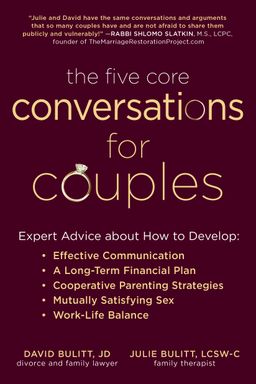
The Five Core Conversations for Couples cover

The Five Core Conversations for Couples

by David Bulitt and Julie Bulitt

The Five Core Conversations for Couples delves into essential topics every couple should discuss to build a lasting relationship. Expert advice from family therapist Julie Bulitt and divorce lawyer David Bulitt guides you through effective communication, intimacy, parenting, and work-life balance strategies to strengthen your bond.

Building Stronger Relationships Through Real Conversations

What makes couples stay together when so many relationships fall apart? In Five Core Conversations for Couples, David and Julie Bulitt—a divorce lawyer and a family therapist who have been married for more than thirty years—argue that long-term love isn’t sustained by compatibility alone. Instead, it’s built through ongoing, honest conversations about the issues that matter most. They contend that every strong relationship rests on five pillars: connection, money, parenting, sex, and balance. These are the core conversations that couples must keep having, not once but continually, to stay aligned as life changes.

Drawing from decades of personal experience and professional insights, the Bulitts merge humor and hard truths into a candid look at marriage as an evolving dialogue. The book reads like being invited into their living room—you hear them debate, tease, and argue, each chapter bringing their dual perspectives: David’s practical, legal realism and Julie’s emotional and therapeutic empathy. Together, they model how conversation itself can be both messy and transformational.

The Core Premise: Marriage as Maintenance

The Bulitts suggest thinking about relationships like houses—the foundation must be strong, but the upkeep is what keeps it livable. They open with metaphors about building, cleaning garages, and fixing leaky roofs. Too many couples, they note, stop maintaining their connection once the initial excitement fades. A clean garage will get dirty again; a repaired roof will leak again if ignored. Relationships require regular maintenance—acts of kindness, time together, communication, and attention—before disrepair turns into resentment.

This idea of relationship maintenance underlies the whole book. When partners neglect emotional upkeep—whether failing to talk or failing to listen—the accumulation leads to breakdown. Their story about clients Sarah and Ron, overworked parents who hadn’t spent time alone in a year, shows how intentional small gestures (“trips to the candy store,” as Julie calls them) can rekindle intimacy. The takeaway: love doesn’t evaporate suddenly; it rusts slowly when ignored.

Why These Conversations Matter

David and Julie’s perspective is unique because their professions expose both the start and end of relationships. As a divorce lawyer and therapist, they’ve witnessed what destroys couples: miscommunication, unspoken expectations, divergent money habits, sexual disconnection, and parenting conflicts. By sharing their professional anecdotes alongside their own trials—raising four daughters, coping with addiction, adoption, and financial setbacks—they show that even the most loving marriages hit painful complexity. What determines survival is not perfection but persistence in talking through it.

Each conversation corresponds to one of the five cores:

  • Building and Filling emphasizes the need for continual nurturing and emotional repair—connection as the relationship’s lubrication.
  • Money tackles the anxieties, secrets, and power dynamics embedded in financial decisions.
  • Parents and Partners explores how raising children reshapes identity, intimacy, and teamwork.
  • Bumping and Grinding dives into sex as both a pleasure and pressure point, examining mismatched desire and communication failures.
  • Balance concludes with strategies for maintaining individuality and gratitude within partnership.

A Voice That Blends Candor and Compassion

The Bulitts rarely sugarcoat things. David’s sections are dry, witty, and sometimes blunt, filled with analogies about garages, car maintenance, and courtrooms, while Julie’s voice is nurturing, grounded in empathy, and reframing anger into learning moments. Their interplay mirrors a good marriage: disagreement without destruction. They show readers that talking—however imperfectly—is always better than silence. As Julie says, “Dogs bark, cats meow, humans need to speak.” Silence between partners breeds distance faster than any fight.

Their humor also makes the book’s lessons memorable. Through playful banter about Keith Urban fantasies or David’s obsession with bourbon, you witness real marital dynamics—not idealized love, but practical partnership. This multi-perspective storytelling transforms abstract advice into relatable wisdom: you see how sex, money, and stress coexist in one marriage and how continuing to talk keeps things intact.

From Repair to Appreciation

Throughout the chapters, the Bulitts move from managing crisis toward developing gratitude. The “candy store” metaphor returns in their closing advice—do small, intentional things that remind you why you chose this person. Their own marriage survived infertility, addiction, and money strain because they practiced repair through dialogue. By the final pages, David underscores gratitude with an anecdote about his grandfather’s humble chicken dinner: appreciating what you have, not yearning for what others have. That quiet appreciation, not perfection, is the ultimate emotional lubricant of lasting love.

Key takeaway

Long love isn’t built once—it’s maintained daily. Relationships fail not because people change, but because they stop changing together. The five core conversations are invitations to reconnect—to speak, listen, repair, and appreciate—again and again.


Building Connection and Emotional Lubrication

Julie Bulitt insists that connection isn’t something you simply feel—it’s something you actively create. In her analogy, connection is the 'lubrication' of a relationship’s engine: without it, friction builds until everything overheats. Just like oil keeps a car’s engine smooth, connection keeps intimacy alive. You maintain it through small, ordinary acts—shared morning coffee, walks, mundane conversations about work, laughter, physical touch, and kindness. These gestures may look ordinary, but they are the oil that prevents emotional wear and tear.

Making Connection a Daily Habit

The idea here is simple but powerful: connection isn’t found; it’s made through repetition. Julie tells clients, 'Work, grind, eat, sleep, and repeat.' Relationships require conscious tending. Her story about Sarah and Ron, the couple who rediscovered closeness through a midweek date, provides proof. All they did was hire a babysitter, turn off their phones, and enjoy a quiet dinner. Those two hours of reconnection transformed their tone and trust. Small doses of 'adult alone time' rebuild intimacy faster than grand romantic gestures.

David plays the skeptic—cracking jokes about 'lubrication' in the sexual sense—but ultimately agrees that both emotional and physical intimacy depend on deliberate effort. Connection is also about noticing what matters to your partner. For Julie, it’s when David vacuums or takes out the trash. For David, it’s when she notices him instead of just picking up his dry cleaning. Each learns to speak affection in the other’s language, echoing Gary Chapman’s The 5 Love Languages in practice, though the Bulitts never preach formulaic approaches.

Silence and Style: How We Say Things

Connection falters when tone replaces tenderness. David admits that their fights rarely stem from what is said but how it’s said. When Julie scolds him like a six-year-old (“That ridiculous Yeti cooler”), he feels dismissed. They realize that tone is the medium through which affection travels—or dies. Respectful phrasing turns criticism into collaboration. Her advice? “If it won’t matter tomorrow, don’t say it tonight.” He complements that with his lawyer-like restraint: biting his tongue when a reaction won’t help, channeling patience into silence that prevents escalation.

Overcoming Disconnection

The worst mistake couples make, they agree, is weaponizing silence. The 'silent treatment,' Julie argues, isn’t maturity—it’s punishment. It breeds emotional distance like mold in a closed garage. Her lesson: if dogs bark and cats meow, humans must speak. Communication—even arguing—keeps air flowing. They illustrate this with humor, recalling cartoon examples from The Flintstones where Fred and Wilma stop talking until frustration explodes. In marriage, silence feels like erasure, not peace.

Essential insight

Connection thrives through everyday grace: listening, laughing, apologizing, touching, and tending. Whether through emotional 'lubrication' or sex itself, couple closeness depends less on intensity than on frequency and care.


Money Matters and Emotional Value

Few topics trigger conflict like money. David Bulitt sees it daily in his divorce practice: people who can’t communicate about finances end up communicating through lawyers. The second core conversation, Money, Money, Money, unpacks how financial habits mirror emotional habits. Spending unconsciously, hiding debt, or competing through purchases erodes trust as much as infidelity does.

The Price of 'Fun'

Early in their marriage, the Bulitts lived by the motto 'It’s only money.' That lighthearted naivety led to cars they didn’t need, furniture they couldn’t afford, and credit card debt that nearly broke them. Their teal Thunderbird—a birthday gift Julie adored—became a symbol of both love and recklessness. Selling it was painful but necessary. They liken that turning point to going on a 'debt diet'—slimming spending and strengthening partnership. The real weight they lost wasn’t financial but emotional: guilt, blame, and secrecy.

Money as Power and Control

Many couples fall into what David calls the 'balance of power' trap. He compares it to Cold War deterrence—each spouse spends, splurges, or retaliates to maintain equality. Julie’s shoes and David’s golf bags become weapons in a domestic arms race. Their humor reveals a truth: financial decisions often disguise deeper emotional needs—validation, autonomy, fairness. Real balance happens when spouses become transparent about income and priorities rather than competing in secrecy.

Julie adds the 'repo man' cautionary tale—a client whose ignorance about her family finances led to losing her car and marriage. Living in what David calls the 'Cocoon of the Uninformed,' she never asked questions until bankruptcy forced reality. Their advice is blunt: every partner should know what’s in the account and what’s owed. Ignorance isn’t innocence—it’s risk.

Cultural and Emotional Undercurrents

Julie connects money conflicts to upbringing. One chapter compares two spouses raised in different financial worlds—Paul from scarcity and Jackie from abundance. Their 'swimming pool' metaphor describes learning to dive into financial discussions instead of standing awkwardly on the sidelines. If one partner avoids talking about money out of fear, the other feels abandoned. Jump in, she says. Even cold water warms with use.

Key takeaway

Financial honesty equals emotional safety. Money conversations aren’t about numbers—they’re about respect, transparency, and teamwork. As David jokes, 'Stay out of the dark, or the repo man will bring you the light.'


Parenting as Partnership, Not Perfection

When children enter the picture, marriages shift from romantic to logistical. In the third core conversation, Julie explores parenting not as an instinct but as a joint enterprise. 'Kids don’t come with tech support,' she reminds readers. Being partners means learning together, disagreeing privately, and presenting a unified front publicly. Their experiences raising four daughters—including adoption and mental illness—illustrate how parenting tests solidarity more than love.

Shared Struggles, Shared Fronts

The Bulitts faced relentless trials with their daughter Natalie, whose behavioral issues led to therapy, hospitalization, and later addiction. Through it all, David and Julie disagreed privately—she saw mental health complexity, he saw defiance—but maintained unity in front of their children. Their strategy echoes family studies on triangulation (Ernest Abelin, 1971): children often exploit parental disagreement to gain control. To avoid manipulation, they learned to 'ride in the same ambulance'—you can argue later, but throughout the crisis, move in the same direction.

Letting Go of Control

Parenthood requires surrender. Julie’s infertility story, followed by adoption, reflects how letting go opens love beyond biology. When one child becomes self-destructive, parents must also let go of rescue fantasies. Her unsent letters to Natalie, written after years of addiction, show the painful boundary of 'loving from a distance.' Sometimes support means withdrawal—a radical form of self-care that acknowledges limits. 'You can’t help anyone breathe if you’re suffocating,' she writes, echoing her earlier 'oxygen mask' metaphor.

Acceptance Over Aspiration

In another case, Julie advises parents to pair acceptance with aspiration: accept current constraints but aspire toward shared goals. Her 'jar method'—saving small amounts for mutual desires, like a concert or spa day—transforms sacrifice into teamwork. Whether parenting through ADHD or addiction, the underlying lesson is clear: partnerships thrive when compassion outweighs blame.

Core insight

Raise children as partners, not protagonists. The goal isn’t perfect parenting—it’s united parenting. You don’t need to agree on everything; you just need to agree that you’re together in trying.


Sex, Intimacy, and Honest Desire

In their fourth core, “Bumping and Grinding,” David and Julie tackle the topic most couples avoid: sex, not as an act but as an ongoing conversation about desire, identity, and fairness. David jokes that regular 'heavy breathing' keeps him patient and pleasant; Julie counters that sex can feel like 'another job.' Their humor masks deep insight: lovemaking reflects how partners handle power, vulnerability, and listening.

Desire Mismatch and Respect

Julie acknowledges that libido differences are normal—the problem is pressure. When one partner feels obligated, sex becomes obligation rather than intimacy. 'If you wouldn’t let your boss assign overtime without consent,' she quips, 'don’t let your partner assign sex.' Yet David argues that kindness includes sexual generosity. Their compromise is humorously coined 'Two Minutes and a Tissue'—Julie’s pragmatic solution to keep both partners content without resentment. Beneath the laughter is respect for agency: sex should serve connection, not compliance.

The Role of Play and Openness

The Bulitts reveal that creativity revives passion far more sustainably than drama. From timed fertility sex to accidental X-rated encounters involving their daughter’s “tussy” comment, they show that laughter can heal sexual frustration. Their discussion about pornography reframes it as potentially healthy if both partners consent—'greasing the wheels,' as David says—but toxic when used as a performance standard. Like Esther Perel in Mating in Captivity, they argue that eroticism thrives on curiosity, not comparison.

Talking About Sex Without Shame

Couples should discuss sex as openly as they discuss budgets. When a client complains of boredom, Julie suggests identifying what each partner wants—spontaneity, novelty, tenderness—and experimenting without blame. Their “hitch in your giddyup” story about a husband proposing a threesome turns into therapy about communication. The key isn’t fantasy itself but how you negotiate it. Good sex, she reminds us, begins outside the bedroom, in conversations where vulnerability is welcomed, not mocked.

Key lesson

Sex doesn’t guarantee connection—but silence guarantees disconnection. Treat desire not as demand, but dialogue. Humor helps; honesty heals.


Finding Balance and Gratitude in Partnership

The Bulitts close their book with the fifth core: balance. After decades together, they conclude that maturity in marriage means learning to alternate between being the 'wide load' and the 'escort car'—sometimes you need help, and sometimes you give it. Balance also means maintaining individuality within togetherness, humor within hardship, and gratitude within chaos.

Independence Versus Intimacy

Julie’s “Stay Out of My Tub” story epitomizes this idea. Her nightly bath isn’t selfish—it’s sanctuary. Space in marriage allows self-renewal, which in turn sustains connection. 'There might not be an I in we, but there needs to be,' she writes. Taking time apart lets love breathe. Similarly, maintaining friendships outside of marriage adds perspective. When Julie compares her girlfriend conversations to panoramic photos—they widen empathy—it reminds us that relational health thrives on multiple dimensions of belonging.

Turning Conflicts Into Compromise

The 'Costco' and 'Minivan' chapters use humor to show how humility softens conflict. Whether she apologizes to strangers in line or watches clients replay petty power struggles, Julie proves that admitting fault disarms anger. Taking responsibility, even for small mistakes, can transform blame into bonding. Similarly, David’s “Bumper Cars” analogy captures how constant irritation can become sport. Healthy couples stop colliding for fun and start driving with care.

Gratitude as the Final Balancer

David’s closing metaphor—the chicken in the pot—sums up the book’s emotional core. His grandfather’s humble dinner wasn’t about deprivation but contentment. Gratitude keeps couples from comparing their marriage to others’ highlight reels, an antidote to the 'Assbook' culture of performative happiness. As Julie and David emphasize, happiness worth keeping rarely looks glamorous—it looks grateful. Their decades of turmoil didn’t extinguish love; they sharpened appreciation for ordinary joy.

Final insight

Balance isn’t 50/50—it’s give and take in motion. Some days you lead; some days you lean. Through conversation, humor, and humility, love becomes less about perfection and more about gratitude.

Dig Deeper

Get personalized prompts to apply these lessons to your life and deepen your understanding.

Go Deeper

Get the Full Experience

Download Insight Books for AI-powered reflections, quizzes, and more.