
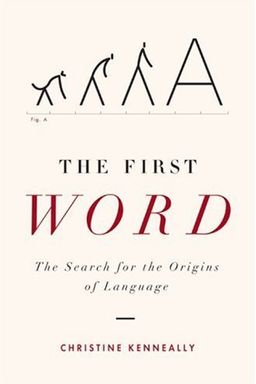
The First Word cover

The First Word

by Christine Kenneally

The First Word by Christine Kenneally delves into the origins of language, exploring various theories from Chomsky''s innate grammar to evolutionary biology insights. Discover how language, a unique human tool, shares traits with animal communication and evolves symbiotically with humans, providing a fascinating exploration of our most defining characteristic.

The Human Language Puzzle

How did language—the most complex symbolic system on Earth—arise from primate minds? In The First Word, Christine Kenneally takes you on an interdisciplinary journey through linguistics, neuroscience, genetics, anthropology, and artificial intelligence to answer that question. Her central claim is that language did not emerge from a single mutation or divine event, but from an evolving web of biological mechanisms, social interactions, and cultural feedback loops that have shaped our species for millions of years.

Kenneally begins by reframing language not as a passive mirror of reality but as an active symbolic network. Every word you know connects to others, forming a mental web dense enough to rival galaxies. This web exists not only inside your head but across the world—language as a shared planetary infrastructure, the first true global network before the internet ever existed.

From Taboo Origins to Scientific Revolution

Kenneally traces the historical arc of thinking about language’s beginnings—from early myths and royal experiments (like Pharaoh Psammetichus’ infant isolation test) to Jean-Jacques Rousseau’s naturalistic speculations and Darwin’s evolutionary framing. For over a century, the question was banned: in 1866, the Société de Linguistique de Paris outlawed discussions of language origin, making it a scientific taboo. Only in the late 20th century—after Steven Pinker and Paul Bloom boldly argued that language could be an adaptation shaped by natural selection—did the topic become legitimate again. This revival was supported by new evidence from genetics and brain imaging and by a broader appreciation of interdisciplinary science.

The Chomsky Paradigm and Its Limits

To understand the field’s evolution, you must grasp the influence of Noam Chomsky. His concept of a Universal Grammar—an innate mental architecture generating infinite combinations from finite rules—dominated 20th-century linguistics. Yet Chomsky’s emphasis on internal, idealized grammar detached the study of language from its social, biological, and evolutionary roots. Kenneally shows how that focus, while transformative, limited inquiries into language’s messy origins until other scientists reconnected linguistic theory with material evidence from brains, fossils, and behavior.

Ape Experiments and Continuity

You then encounter Sue Savage-Rumbaugh’s work with bonobo Kanzi, who learned lexigrams and understood spoken English commands, revealing striking continuities with human symbolic thought. Apes like Kanzi or Panbanisha demonstrate how much of human linguistic ability is scaffolded by social immersion and developmental timing. While they never attain full syntax, they prove that the roots of meaning and reference are not uniquely human—they are extended, refined, and culturally amplified in us.

Biology Meets Culture

Modern research reveals that no single brain center, gene, or mutation explains language. Instead, language is distributed across neural networks (involving Broca’s, Wernicke’s, basal ganglia, cerebellum), shaped by evolutionary plasticity, and grounded in motor systems shared with other animals. Genes like FOXP2 modulate motor sequencing and vocal control but do not encode grammar per se; they connect genetic regulation to learned vocal behavior, paralleling song learning in birds. Biology provides the platform—but culture programs the software.

Language as a Cultural Ecosystem

The most provocative idea comes when Kenneally turns from evolution to cultural evolution. Through Simon Kirby’s iterated learning experiments and robotic models by Luc Steels, language emerges as a self-organizing system optimized for learnability and transmission. Languages aren’t fixed entities; they evolve like living organisms, adapting to children’s brains and communicative constraints. This coevolutionary dance between mind and culture—what Terrence Deacon calls a “Baldwinian loop”—means human biology is sculpted by the very symbols it enables.

A Connected, Evolving Vision

In the end, The First Word paints language as both ancient and emergent: a hybrid of gestures, motor skills, imitation systems, and neural plasticity, amplified through cooperative culture. Kenneally invites you to see language not as a sudden spark but as the most elaborate outcome of continuity—between species, between neurons and words, and between evolution and history. The book’s ultimate argument is that to understand language, you must stop searching for a single origin story and instead study how countless smaller stories—biological, cultural, and cognitive—braid together into the vast, living network that lets you speak, imagine, and connect.


Networks of Meaning

Kenneally begins by dissolving the illusion that words are labels pasted onto reality. Language is not a mirror but an active symbolic network. Your mental lexicon is a galaxy of interconnected nodes: sound, shape, memory, emotion, and cultural context fused into millions of dynamic relationships. The word “rose” links to scent, color, romance, gardening, and literature—and differs subtly between you and another speaker. Aggregated across a species, these private networks form a planetary web of shared meaning.

When Language Diverges from the World

Language’s power lies in its mismatch with reality. You can describe a “camel passing through the eye of a needle,” which physics prohibits but syntax allows. That creative gap is the engine of imagination, metaphor, and narrative. By freeing thought from direct perception, language becomes the first virtual space shared among minds.

From Individual Minds to Collective Lattices

Because your linguistic web overlaps with others’, language forms a collective infrastructure. Billions of such networks overlap to produce cultural stability: idioms, dialects, and traditions are the ripples of connection patterns. This planetary lattice allows knowledge, emotion, and identity to circulate at scale—what Kenneally calls “the first global virtual environment.”

Why It Matters

Approaching language as a network reframes research. Instead of hunting for fossil traces or single genes, scientists must map social transmission and cognitive structure. This leads to cross-disciplinary work in neuroscience, genetics, and computation—precisely the fusion Kenneally celebrates throughout the book. Language, she argues, is best understood as the human experiment in connection: a symbolic system that reorganizes both our brains and our societies.


From Taboo to Theory

For centuries, asking “Where did language come from?” was not merely difficult—it was forbidden. Kenneally reconstructs this intellectual taboo and shows how it shaped modern linguistics. Ancient rulers like Psammetichus conducted cruel “first speech” experiments, watching isolated infants for divine words. Philosophers such as Rousseau and Herder later naturalized the debate, proposing that language arose gradually from gesture and emotion. Darwin completed the shift, arguing that language evolved “slowly and unconsciously by many steps.”

The Age of Silence

In 1866, the Société de Linguistique de Paris banned discussion of language origins. With linguistic evolution deemed unscientific, scholars focused on description, not genesis. This institutional muzzling lasted a century, reinforced by Chomsky’s skepticism about adaptive storytelling. Kenneally shows how scientific authority, not evidence, determined what questions could be asked—a reminder that taboos can sculpt whole disciplines.

Pinker, Bloom, and the Evolutionary Reboot

The freeze ended in 1990 with Steven Pinker and Paul Bloom’s “Natural Language and Natural Selection.” They argued that language’s complex design required evolutionary explanation: like eyes, grammars confer clear fitness benefits. Their challenge to Chomskyan orthodoxy reignited origins research, uniting linguists, anthropologists, and biologists under a shared question—not “if” language evolved, but “how.” The once-forbidden topic became a vibrant, interdisciplinary frontier.


The Biology of Expression

Language is carried by flesh. Kenneally introduces Philip Lieberman’s work to ground speech in anatomy and neural circuitry. Human vocal tracts differ subtly but crucially from apes’: the descended larynx and flexible tongue enable a rich vowel system. Yet Lieberman argues that syntax itself draws on ancient motor systems. The basal ganglia, which sequence actions, also handle sequencing words. Evidence from Parkinson’s patients—who struggle with syntax as well as motion—supports this view.

Distributed Language Networks

Contrary to textbook maps, language is not confined to Broca’s or Wernicke’s area. Fred Dick, Elizabeth Bates, and others used fMRI to show that speech, comprehension, and grammar activate broad, overlapping circuits involving cortex, cerebellum, and subcortical structures. Lieberman even connected syntax deficits in hypoxic climbers on Everest to motor sequencing failures. These patterns reveal that speaking and moving share neural architecture—an argument for evolutionary continuity rather than modular novelty.

Plasticity as Evolution’s Tool

Through studies of children recovering speech after hemisphere surgery and animal experiments on cortical rewiring, Kenneally demonstrates that the brain’s plasticity underwrites language resilience. Neural tissue can reassign function when early input changes. This flexibility explains why evolution could repurpose motor and perceptual circuits for communication, and why cultural environments—from bonobo labs to human classrooms—can shape outcomes so profoundly.


Genes, Apes, and the FOXP2 Revolution

The discovery of the FOXP2 gene offered the first molecular clue to language’s biological roots. In the KE family, mutations caused severe speech and sequencing deficits, not just grammatical errors. FOXP2 acts as a regulatory gene influencing many downstream targets during brain development, particularly in motor circuits. Studies in songbirds and mice showed analogous roles in vocal learning. When Svante Pääbo’s team found human-specific amino acid substitutions with signs of positive selection, FOXP2 became a landmark in bridging genetics and speech.

Continuity Across Species

Ape language research reinforces this continuity. Kanzi the bonobo’s spontaneous lexigram use and comprehension of novel sentences reveal that aspects of symbolic thought predate humans, though full syntax remains distinct. Combined with FOXP2’s cross-species conservation, these findings dismantle the myth of a genetic silver bullet; what evolved was a reorganization of shared systems into uniquely human combinations.

A Polygenic, Environmental System

Kenneally warns against “the language gene” fallacy. Language emerges from interacting genes, neural circuits, and cultural scaffolds. FOXP2 matters not as a trigger but as evidence that complex cognitive capacities can have identifiable biological pathways—fusing genetics with comparative behavior and environmental influence.


Cultural Evolution and the Language Suite

Language is not a single invention but an assembly of capacities—what Kenneally calls the language suite: gesture, vocal control, symbolic reference, social cognition, and structure. Each evolved at a different pace but converged through cultural feedback. From New Caledonian crows crafting tools to Alex the parrot naming colors, you see that cognition and communication are widespread. Humans alone fused these threads into an open-ended, self-perpetuating system.

Cultural Selection for Learnability

Simon Kirby’s iterated learning experiments reveal how languages evolve to fit human learners. When artificial agents or human subjects transmit languages over generations, structure spontaneously emerges because compositional systems are easier to learn and remember. Luc Steels’ robotic “talking heads” similarly developed stable vocabularies through interaction. Language thus adapts not merely to communicate efficiently but to be learnable—a process akin to biological selection acting on culture.

The Baldwin Loop

Terrence Deacon describes the Baldwin effect: behaviors can create selective pressures that reshape biology. Language use favored brains better equipped for symbol learning, which in turn made languages more complex. Through this loop, culture and biology coevolve. You are, in this sense, adapted to language as much as language is adapted to you.

Human Uniqueness Revisited

By tracing shared foundations—from mirror neurons to gesture—Kenneally argues that human uniqueness lies not in isolated traits but in integration and acceleration. Language is the peak of a long continuum, amplified by cultural ratcheting and cooperative intelligence.


Frontiers and Future Debates

Kenneally closes with open questions rather than conclusions. The Hauser–Chomsky–Fitch distinction between the broad and narrow language faculties reframed the field: which elements are unique, and which are shared with other animals? Advances in genomics, modeling, and neuroimaging now allow these questions to be asked empirically. Svante Pääbo’s sequencing of Neanderthal genomes, for instance, compares ancient and modern FOXP2 variants to see when linguistic traits arose.

Methods and Ethics

The tools shaping the next decades—robotic communication trials, computational simulations, lesion studies, field linguistics—build from precisely the interdisciplinary base Kenneally champions. She reminds you that language science carries practical and moral weight: understanding origins informs education, therapy, and the preservation of linguistic diversity. It also reshapes human self-understanding, revealing language not as a divine gift but a collective invention authored by evolution itself.

The Galápagos Question

In a thought experiment, Kenneally asks leading scientists: if two infants stranded on an island grew up together, would language emerge? Responses vary—from optimism (Pinker, Marcus) to caution (Arbib, Lieberman). The question encapsulates the book’s spirit: human linguistic creativity is both inevitable and fragile, requiring bodies, brains, and communities to bloom. The “first word” was not a flashpoint but a gradual awakening across generations, species, and systems—a story that continues with every sentence you speak.

Dig Deeper

Get personalized prompts to apply these lessons to your life and deepen your understanding.

Go Deeper

Get the Full Experience

Download Insight Books for AI-powered reflections, quizzes, and more.