
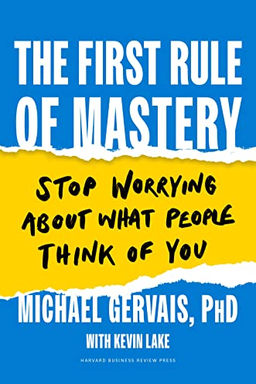
The First Rule of Mastery cover

The First Rule of Mastery

by Michael Gervais

The First Rule of Mastery by Michael Gervais guides readers to break free from the paralyzing fear of others'' opinions. It provides actionable insights for embracing personal values and mindfulness, fostering self-awareness and true potential.

The First Rule of Mastery: Freedom from the Fear of People’s Opinions

Have you ever held back from sharing your true thoughts because you were worried about what others might think? Psychologist Dr. Michael Gervais argues in The First Rule of Mastery that the greatest obstacle to human potential isn’t lack of talent, opportunity, or intelligence—it’s our hidden obsession with external validation, what he calls FOPO: the Fear of People’s Opinions. This deeply ingrained habit of evaluating ourselves through others’ eyes has become a modern epidemic, silently sapping confidence, creativity, and purpose.

Gervais contends that FOPO is not just a personality quirk or performance inhibitor—it’s an ancient survival mechanism that no longer serves us in today’s hyperconnected world. In tribal times, fitting in could mean the difference between life and death. Today, though, our primitive need for approval has been distorted by social media metrics, corporate hierarchies, and comparison culture, leaving countless people paralyzed by self-doubt. Instead of mastering our craft, we try to master others’ perceptions of us.

The book’s argument is both simple and radical: you will never reach authentic mastery while living for other people’s opinions. The first rule of mastery, therefore, is mastering what's within your control—your thoughts, words, effort, and purpose—and releasing the futile effort to control the rest. Only when you stop outsourcing your self-worth can you perform, lead, and live freely.

The Hidden Epidemic of FOPO

Gervais opens with the story of Olympic softball player Lauren Regula, who nearly quit her comeback dream because of judgment from others: she was too old, too selfish, or a bad mom for leaving her kids. Her story encapsulates our collective struggle—when we allow others’ voices to outweigh our own inner knowing, we trade authenticity for approval. Gervais calls this the invisible limit of human potential, arguing that FOPO quietly drives much of our self-censorship, overthinking, and anxiety.

Lauren’s breakthrough came not from silencing self-doubt but from reclaiming her inner authority. She learned that everyone has opinions, but only hers truly matters. As Gervais puts it, “The sooner you change your relationship with other people’s opinions, the sooner you become free.” In that freedom lies true mastery.

Why We Care So Much

Our brains are wired to care about belonging. Using research from psychologist Mark Leary, Gervais explains that self-esteem functions like a “sociometer”—an unconscious gauge that monitors our social standing. When we sense social exclusion, our brain registers it as a physical threat. This is why criticism can feel like a punch in the gut: the brain doesn’t distinguish social rejection from physical danger. Our prehistoric need for tribal acceptance now runs amok in a digital world that exposes us to judgment 24/7.

In today’s environment—where likes, comments, and performance metrics define value—the natural human desire for acceptance mutates into over-valuation of other people’s perceptions. FOPO becomes chronic mental background noise—like unwanted software draining your device’s battery. We become “mentally multitasking” our own self-worth, constantly scanning for approval.

From Approval to Mastery

True mastery, Gervais insists, begins when you shift focus from performance-as-validation to performance-as-expression. He uses Beethoven as an example. For years, the legendary composer hid his hearing loss, terrified that discovery would ruin his career. Only when he stopped performing for public approval and embraced his deafness did he create his greatest, most transcendent works. By releasing the need to control others’ opinions, Beethoven became radically free—his Ninth Symphony a product of inner, not outer, mastery.

Mastery, then, is not about perfection or achievement; it’s about alignment between who you are inside and how you express it outside. Whether you’re leading a company, raising a family, or competing in a sport, the first rule holds: focus on what’s 100% within your control—the internal state that produces external results. Everything else is noise.

How to Turn FOPO into Fuel

The book structures its guidance around three phases: Unmask, Assess, and Redefine. You learn first to recognize and name FOPO when it arises (“unmask”), then examine its triggers and mechanics (“assess”), and finally reconstruct a new mental model grounded in your own values and purpose (“redefine”). Each step combines psychological insight with practical exercises—from exploring where your self-worth is outsourced to building a “roundtable” of trusted voices whose opinions truly serve your growth.

Unlike quick-fix self-help, Gervais blends neuroscience, sport psychology, and timeless philosophy. Think of it as Stoicism for the social-media age—Seneca and Marcus Aurelius updated with data and stories about Olympians, astronauts, and entrepreneurs. The goal isn’t to stop caring altogether, but to care wisely and selectively. As he writes, “Care deeply about people, not their opinions.”

Why It Matters Now

In a world where identity and worth are constantly commodified and compared, FOPO isn’t just personal—it’s cultural. It shapes leaders who play it safe, artists who self-censor, and organizations that fear innovation. Gervais calls FOPO “the single greatest constrictor of human potential” precisely because it erodes courage, honesty, and creative risk-taking—the essential ingredients for mastery. His message is a rally cry for psychological freedom: become less interested in impression management and more invested in inner development.

At its heart, The First Rule of Mastery challenges you to reclaim authorship of your own story. You will explore fear and identity, learn to separate self-worth from performance, and replace the anxious need for approval with a calm sense of intrinsic value. When you stop being a prisoner to others’ opinions—and your own self-criticism—you don’t just perform better; you start living as your fullest, freest self. That, Gervais says, is mastery in its truest form.


The Mechanics of FOPO

Gervais breaks down FOPO as a self-reinforcing psychological cycle that operates beneath our awareness but governs our daily choices, interactions, and confidence. To understand how FOPO takes hold and how to unwind it, you first need to see it for what it is: a looping internal process built on anticipation, checking, and response. Each phase drains our energy and focus, leaving us controlled by others’ imagined judgments rather than our authentic motivations.

The FOPO Loop: Three Phases

1. Anticipation. Before an encounter—say, a meeting, a date, or a presentation—you start pre-living potential scenarios: “Will they like me?” “What if I say something stupid?” This mental rehearsal isn’t preparation; it’s preemptive self-defense. Your attention moves from the task at hand to predicting reactions you can’t control. The result is distraction and self-consciousness. You lose presence even before entering the room.

2. Checking. During the event, you become hyperattuned to signals of approval or rejection: micro-expressions, tone, pauses, body language. Like an emotional radar, you scan for cues confirming or threatening your worth. This constant vigilance is exhausting—it’s why after social or work events you feel oddly depleted even if nothing catastrophic happened.

3. Responding. After interpreting others’ reactions—often incorrectly—you modify your behavior: conforming, overexplaining, withdrawing, or aggressively seeking validation. Each response reinforces the belief that your value depends on others’ evaluation. Over time, this cycle forms a psychological pattern that feels permanent but can be broken through awareness and practice.

The Two On-Ramps to FOPO

Gervais identifies two root causes that make us vulnerable:

  • A Poor Sense of Self: When you lack clarity about who you are—values, strengths, beliefs—you lean on others to define you. Their opinions become a mirror for your worth. In effect, you outsource self-definition.
  • A Performance-Based Identity: When your identity hinges on achievement, every interaction feels like a test. You’re either “enough” or “not,” depending on your latest performance or approval rating. This creates chronic anxiety in any evaluative setting.

The Hidden Costs of FOPO

FOPO is like background software that constantly drains psychological battery life. Gervais compares it to apps that run quietly in the background, consuming your system’s memory. Every attempt to manage impressions or preempt judgment diverts resources away from creativity and focus. Imagine driving with one foot on the gas and one on the brake—that’s how FOPO operates.

Unchecked, this pattern erodes authenticity and joy. You might laugh when you don’t find something funny or bite your tongue during moral disagreement. These behaviors accumulate until you no longer recognize where your truth ends and social compliance begins.

From Awareness to Mastery

Awareness alone doesn’t dissolve FOPO—but it’s the gateway. Gervais encourages deliberately uncomfortable exercises to surface the pattern, such as wearing clothes that make you self-conscious and observing the cascade of mental chatter. The goal isn’t embarrassment; it’s observation. The more you watch FOPO in real time, the more power shifts back to you.

“The goal each time you hear the chimes of FOPO,” Gervais writes, “is to focus more on who you want to be versus who you think they want you to be.”

Understanding this loop allows you to intercept it early. Once you can recognize anticipation creeping in, redirect focus to curiosity (“What can I learn here?”) and grounding (“What’s within my control?”). Over time, anticipation becomes preparation, checking becomes presence, and response becomes choice. This is how you rewrite the FOPO software and start performing from authenticity—not approval.


Identity and the Trap of Performance

Why do critiques, even small ones, cut so deep? Gervais argues that it’s because most of us build identities too fragile to withstand disapproval. When your sense of self equals your achievements, mistakes feel existential. This chapter maps how identity—who you believe you are—can either free you from FOPO or keep you enslaved to it.

The Mailman Doesn’t Deliver on Sundays

Gervais uses a vivid story from basketball lore: 1997 NBA Finals. Karl Malone, nicknamed “The Mailman,” steps to the free-throw line in a tie game. Chicago’s Scottie Pippen whispers, “The mailman doesn’t deliver on Sundays.” Malone misses both shots—and the Bulls win. The line worked because it pierced Malone’s identity. He wasn’t just shooting; he was defending the image of a man who never fails to deliver. When the image cracked, so did his focus.

How Identity Is Built—and Broken

Identity forms through relationships, roles, and beliefs we accumulate over time—parent, leader, athlete, entrepreneur—but these become traps when they define us absolutely. In modern culture, the self is often built around performance. We live in what Gervais calls a “performance-obsessed society,” where worth is quantified through grades, metrics, or followers. Achievement promises love, safety, and belonging; failure threatens them. The result is chronic FOPO disguised as ambition.

Developmental psychologist Ben Houltberg calls this a performance-based identity, characterized by contingent self-worth, fear of failure, and perfectionism. It masquerades as drive but hides fragility: you’re only as good as your last result. This explains why high achievers—athletes, CEOs, students—can feel empty even when they're winning.

The House Built on Sand

A performance-based identity is inherently unstable because life constantly changes. Injury, job loss, or aging dismantles the structure. Olympic swimmer Missy Franklin, who won multiple gold medals as a teenager, confessed that after her later Olympic defeat, her world “was totally rocked.” Despite mindful parenting and support, she’d tied her identity to being “Missy the swimmer.” When that identity broke, so did her sense of self.

Gervais warns that identity foreclosure—committing too early and narrowly to one identity—prevents long-term growth. It explains midlife crises and burnout: we build whole selves around outcomes that inevitably change.

From Performer to Learner and Purpose-Driven Self

The alternative is constructing identity on discovery and purpose, not perfection. Instead of answering “Who am I?” with “I’m what I achieve,” answer: “I’m someone who learns, serves, and lives by my core values.” This learner’s mindset enables flexibility. Mistakes become feedback, not verdicts. Purpose anchors you when applause fades. Florida State coach Leonard Hamilton models this beautifully: he defines victory not by wins but by seeing his players grow into good fathers and leaders. His purpose reframes success through contribution, not status.

“The privilege of a lifetime,” Gervais quotes Joseph Campbell, “is being who you are.”

When you ground identity in purpose rather than performance, opinions lose their sting. Instead of chasing validation, you align your behaviors with your deepest values. You measure yourself not by applause but by integrity. This is how identity becomes a foundation for mastery—a house built on rock, not sand.


Outsourcing Self-Worth

If FOPO is the disease, outsourced self-worth is the mechanism that sustains it. Gervais reveals how we learn—often from childhood—to base our value on meeting others’ standards rather than on our inherent worth. The result is a fragile ego constantly in need of reassurance. This chapter explores how that pattern forms, what it costs, and how to reclaim your self-worth as something unconditional.

How We Learn Conditional Worth

From the moment you’re born, your survival depends on pleasing caregivers. You learn early what earns love and what withdraws it. Psychologists Edward Deci and Richard Ryan call this conditional regard—a parenting strategy that teaches children love is earned, not given. A child praised only when successful begins to think, “I’m lovable when I perform.” This belief hardens into adulthood scripts: “I’m valuable when I’m productive,” “attractive,” or “liked.”

Gervais summarizes decades of research by psychologists Jennifer Crocker and Connie Wolfe, who identified seven domains where people commonly stake self-worth: appearance, approval, competition, academics, family, virtue, and faith. When your sense of value hinges on these external markers, you’re at the mercy of circumstances you can’t control.

The Costs of Conditional Self-Worth

Externally anchored self-worth feels temporarily rewarding—success brings dopamine hits and fleeting security—but over time it corrodes mental health. Gervais cites research showing that those who base self-esteem on external success experience more stress, anger, anxiety, substance abuse, and eating disorders. Why? Because they must protect the identity that props up their worth. Every setback becomes a threat to survival.

As Gervais quips, we become like Jason Bourne—hypervigilant, scanning every social environment for threats. A boss’s silence or colleague’s frown triggers a defensive cascade. The brain confuses social threat with physical danger, activating fight-or-flight responses. The system never rests.

The Shift to Inherent Value

Freedom begins with a radical truth: You are worthy simply because you exist. This intrinsic worth is nonnegotiable, unearned, and unlosable. As Gervais puts it, “Your value stems from being, not doing.” Once you accept that, you stop chasing validation and start cultivating competence, connection, and courage because they align with who you already are—not because they make you enough.

He cites ad man Rory Sutherland, who famously said most problems are matters of perception, not reality. The same applies to self-worth. You don’t need to become valuable—you just need to change the lens through which you see yourself. From that foundation, true growth emerges. Effort transitions from proving yourself to expressing yourself.

Ultimately, reclaiming your self-worth isn’t arrogance; it’s accuracy. Once you stop outsourcing your sense of value, other people’s opinions lose their grip. You can care deeply about others’ well-being without giving them the power to define your own.


Courage, Fear, and the Biology of Threat

To dismantle FOPO, Gervais argues, you must understand the biological machinery of fear. Fear isn’t weakness; it’s ancient intelligence. Yet when that system misfires in social contexts, it drives FOPO. By exploring neuroscience and case studies—from elite golfers to ballplayers—Gervais shows how to rewire that circuitry.

Fear Is Protection, Not the Enemy

Fear evolved to keep you alive. Thousands of years ago, your ancestors benefitted from overreacting to tigers lurking in the bushes. In modern life, the brain can’t distinguish a predator from a performance review. The same stress cascade—adrenaline, raised heart rate, shallow breathing—fires whether you’re facing a bear or a boardroom.

The brain’s amygdala alerts the hypothalamus, triggering the sympathetic nervous system—the fight, flight, or freeze response. This explains why your palms sweat or voice shakes under scrutiny. Understanding this physiology demystifies fear. It’s not moral failure—it’s misdirected survival instinct.

Reconditioning the Fear System

Fear becomes maladaptive when you avoid what activates it. Gervais draws on classical conditioning to show how fears are learned—and unlearned. One embarrassing presentation can pair public speaking with danger, creating a lifelong avoidance pattern. The cure is exposure—a principle rooted in behavioral therapy. By gradually and safely confronting the feared stimulus, you teach your brain new associations.

He demonstrates this through his work with a Cy Young–winning pitcher crippled by anxiety. Together they built a fear hierarchy—from mild (driving to the stadium) to extreme (pitching under television lights). Using breathing, visualization, and relaxation techniques, the pitcher intentionally confronted each level until fear gave way to calm mastery. By the end, he even jogged to the mound smiling—a symbol of liberation from FOPO’s grip.

Gervais reminds us that courage isn’t eliminating fear; it’s tolerating it long enough to see through its illusion. As Mandela said, “The brave man is not he who does not feel afraid, but he who conquers that fear.”

When you train your nervous system to associate challenge with curiosity rather than danger, you transform threat into opportunity. Fear becomes your teacher, not your cage. Every time you face judgment, uncertainty, or pressure—and stay—you reclaim another piece of your freedom.


The Neurobiology of FOPO and Mindfulness

Why is it so hard to stop thinking about what others think? Gervais points to the default mode network (DMN)—a cluster of brain regions active when we’re not focused on external tasks. Left unchecked, it becomes the home of rumination: replaying regrets, imagining judgment, fearing disapproval. Neuroscientist Marcus Raichle discovered the DMN decades ago when uncovering that the brain, even at “rest,” burns nearly as much energy as when working. In other words, your mind is never off—it’s constantly storytelling.

The Default Mode Trap

When you’re not occupied, the DMN defaults to self-referential thinking—reviewing the past, imagining the future, and judging yourself through others’ eyes. Harvard research by Dan Gilbert found that nearly half of waking time, people’s minds wander away from the present—and the more they wander, the less happy they feel. The FOPO mind is a wandering mind fixated on social approval.

Mindfulness: The Antidote

To quiet FOPO, you must quiet the DMN. Mindfulness—paying attention to the present on purpose and without judgment—interrupts that loop. Dr. Jon Kabat-Zinn, founder of Mindfulness-Based Stress Reduction, reframed meditation for modern science and proved that awareness training not only reduces stress but changes the brain’s structure, dampening DMN activity.

Gervais integrates mindfulness into high performance as both a skill and a state. By anchoring on breath, sensation, or sound, you build attentional stability—the ability to notice when your mind drifts into FOPO and bring it back. Over time, awareness creates space: between stimulus (criticism, social media, pressure) and response (reactivity or grounded presence). In that space lies freedom.

“We are not the thoughts we hold about ourselves,” Gervais writes. “We are far more dimensional.”

Through consistent mindfulness practice, you retrain perception itself. Instead of filtering everything through FOPO, you begin seeing clearly. Judgment loses power. The chatter dims. You become, quite literally, the master of your own mind.


Redefining Connection and Purpose

Underneath FOPO’s surface lies a deeper need: belonging. Gervais argues that our fear of others’ opinions stems not from vanity but from an ancient drive to stay connected. The problem is that modern culture has glorified the separate self—rugged individualism, self-reliance, personal branding—at the expense of the collective. The result? A loneliness epidemic disguised as competition.

We’re Wired for Connection

Drawing on social neuroscience by Matthew Lieberman, Gervais explains that humans aren’t independent beings who later learn to socialize—we are social beings who learn to appear independent. Our brains are literally wired for attachment; rejection activates the same pain circuits as physical injury. FOPO, then, is the distorted modern expression of our biological need to belong.

Experiments like the “community game” studies show that with the smallest framing shift—from competition to cooperation—people choose generosity 70% of the time. We want to collaborate more than we assume.

The Culture of Self and Its Illusions

Gervais critiques Western worship of self-sufficiency as a myth. No one achieves mastery—or happiness—alone. Even icons like Steve Jobs and Olympians stand on networks of mentors, teams, and communities. When we define success solely by personal achievement, we sever connection to something larger and lose the natural buffer against FOPO: belonging.

Our alienation extends beyond people to planet. As journalist Richard Schiffman writes, we act like “little gods locked in the gated community of our own skull,” forgetting we’re part of nature’s ecosystem. This disconnection breeds both environmental and psychological neglect.

Reconnection as Remedy

The cure for FOPO isn’t withdrawal—it’s contribution. Connection, service, and virtue pull your attention outward, dissolving self-obsession. Gervais suggests cultivating virtues—kindness, generosity, integrity—as daily practices that reconnect you to your place in the social fabric. When your energy serves others, other people’s judgments lose their hold.

To live without FOPO is not to stop caring what people think—it’s to care differently. You care from love, not fear; purpose, not performance. As Gervais writes, “The antidote to the fear of people’s opinions is to act in alignment with your purpose and for the well-being of others.”


Facing Mortality: The Litmus Test of What Matters

In the book’s closing, Gervais brings the philosophy full circle with an unexpected teacher: death. Drawing from hospice nurse Bronnie Ware’s research, he notes that people’s top regret at life’s end is not having lived true to themselves but according to others’ expectations. In other words, FOPO is not just a performance killer—it’s the root of lifelong regret.

Mortality as Mirror

When you remember your time is finite, FOPO loses its grip. Gervais quotes Stoic philosophers like Marcus Aurelius and Seneca: reflection on death clarifies life. What you fear today—judgment, embarrassment, rejection—shrinks when seen against the reality of impermanence. As Steve Jobs told Stanford graduates, “Remembering I’ll be dead soon is the most important tool I’ve encountered to make big life choices.”

Death introduces what psychologists call perceived scarcity. Limited time makes every hour precious. We stop wasting energy on approval and start investing in purpose, creativity, and love. Awareness of mortality, Gervais emphasizes, isn’t morbid; it’s motivating.

Living by the Inner Scorecard

Borrowing from Warren Buffett’s concept, Gervais encourages you to replace the external scorecard (applause, metrics, followers) with an internal one: Did I live according to my values today? Did I express courage and curiosity even if no one clapped? Each “yes” is a vote for freedom. Over time, this redefines success not as reputation but as alignment.

In the end, all of mastery reduces to a single choice: will you live your life performing for others or expressing your true self? Every moment gives you the opportunity to practice the first rule—not to suppress fear of judgment but to recognize it and act anyway. Because one day, when the lights fade and opinions dissolve, only your relationship with yourself remains. The art of mastery is simply living so that, at your final breath, you have no need to apologize for the parts of you you never allowed to be free.

Dig Deeper

Get personalized prompts to apply these lessons to your life and deepen your understanding.

Go Deeper

Get the Full Experience

Download Insight Books for AI-powered reflections, quizzes, and more.