
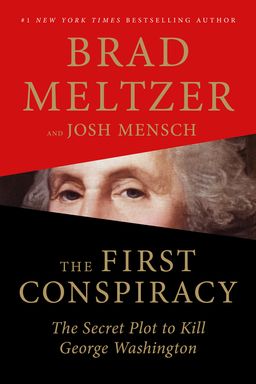
The First Conspiracy cover

The First Conspiracy

by Brad Meltzer and Josh Mensch

Explore the gripping narrative of ''The First Conspiracy,'' where George Washington faces a covert plot to end his life. Discover a world of treachery, shifting alliances, and the resilience needed to lead a nation toward independence.

Character, Crisis, and the Birth of a Nation’s Security

What holds a revolution together when its army is outgunned, underfed, and short of faith? This story argues that the answer begins not with an ideology or army, but with the disciplined moral gravity of one man—George Washington—and unfolds into the founding of America’s first counterintelligence system. Across a single tense year, you watch character become strategy, trust become infrastructure, and secrecy become necessity. From the ragged camp at Cambridge to the conspiracies simmering in New York, the Revolutionary War isn’t just fought on the battlefield but in loyalty, rumor, and information.

Washington’s Leadership as Public Character

You learn early that Washington’s authority rests on his cultivated restraint—the “rules of civility” he copied as a youth that shaped his code of honor and modesty. Those rules are practical: they make him visible yet humble, powerful yet principled. When he avoids lobbying for command or publicly downplays ambition, you see that humility can itself be a tactic. His authority radiates through self-control, his silence in meetings, and the steady presence that converts chaos into discipline. His leadership embodies a moral physics: character attracts cohesion.

Creating Order from Disorder

When Washington arrives at Cambridge in 1775, he inherits confusion. The Continental Army is a patchwork of farmers, drunks, and boys—38 barrels of powder instead of 308, filthy camps, spreading disease. Yet he imposes military structure, writing daily orders that govern sanitation, behavior, and even appearance. Symbols—the blue sash, the gray horse—become signals of stability. Logistics, not just rhetoric, turn volunteers into soldiers. Like any modern startup surviving adversity, Washington transforms improvisation into an organizing principle.

Disease, Race, and Necessity

Crisis shapes policy. The smallpox epidemic forces Washington to blend morality with pragmatism, choosing inoculation despite controversy. The shortage of manpower compels him to reverse his initial resistance to Black enlistment, foreshadowing his later moral evolution on slavery. Every survival choice reveals how necessity rewrites ideals under pressure.

The Rise of Espionage and Counterespionage

From early betrayals like Dr. Benjamin Church’s espionage to the later urban webs in New York, you see the Revolution invent counterintelligence on the fly. When Church’s encrypted letters to General Gage are discovered, Washington learns that security must be proactive, not reactive. The war’s internal front—finding spies, decoding messages, silencing leaks—becomes as crucial as open combat. In this sense, America’s intelligence culture begins not in modern agencies but in the moral panic of Cambridge in 1775.

New York: The Perfect Trap

By 1776, New York is both heart and hazard: a cosmopolitan hub where Loyalists, merchants, criminals, and patriots mingle in shared taverns. Vice, disease, and divided loyalties make it impossible to police clearly. Into this cauldron sails British Governor William Tryon, who, from a ship in the harbor, masterminds a clandestine war through bribery, counterfeiters, and recruiters. His operation fuses politics, intelligence, and crime—showing that in revolution, enemies within can do more damage than those outside the gates.

The Conspiracy That Nearly Undid the Revolution

The Tryon conspiracy—a paid network reaching from the Duchess of Gordon ship to Washington’s own Life Guards—reveals how fragile the rebellion is. Isaac Ketcham, a jailed counterfeiter, hears Life Guard Thomas Hickey brag about an inside plot. John Jay’s secret committee cross-checks this rumor through quick arrests and interrogation. Within days, the cabal’s structure—Tryon to Mayor David Mathews to gunsmith Gilbert Forbes to recruiter William Green and the bribed Life Guards—becomes clear. The aim is stunning: disable or capture Washington as the British fleet approaches.

Justice, Secrecy, and Spectacle

When Hickey is court-martialed and executed before twenty thousand spectators on June 28, 1776, the army sends an unmistakable signal: betrayal invites annihilation. The scene coincides with Jefferson’s Declaration reaching Congress and Howe’s fleet appearing offshore—a triad of treason, birth, and invasion. Washington’s response is both judicial and theatrical: secrecy to protect intelligence, public hanging to restore faith. It’s a dual lesson in leadership—quiet investigation followed by loud discipline.

Rumor, Myth, and Aftermath

Afterward, rumor fills the gaps in surviving evidence—poisoned peas, vanished servants, mysterious mistresses. Yet verified testimony shows the essence clearly: an organized attempt to turn soldiers with cash and promises. John Jay’s Committee on Conspiracies evolves into the Committee for Detecting and Defeating Conspiracies—the embryo of American counterintelligence. From then on, protecting internal trust becomes as vital as facing external cannons.

The Larger Meaning

The saga—the shifting from chaos to structure, from rumor to institution—teaches you that revolutions depend as much on moral nerve and organizational intelligence as on battlefield courage. Washington’s personal code becomes the Republic’s early moral software; Jay’s secrecy committees become its security hardware. When the Declaration of Independence arrives days after the army roots out a conspiracy among its own guards, you realize that nationhood itself is born amidst suspicion, discipline, and faith in unseen virtues.


Washington’s Moral Architecture

Washington’s leadership is a masterclass in how internal ethics translate into external trust. His “gentlemanly code,” learned from early loss and deliberate self-mastery, doesn’t merely define his manners—it structures his entire command. He understands that reputation is his armor and modesty his weapon. The army’s survival depends on believing in his integrity more than on paper orders.

Honor as Strategy

When Washington steps out of the room to avoid seeming eager for command, he practices a calculated humility that strengthens legitimacy. Every visible gesture—his composure on horseback, the brevity of his speech, his measured silence in councils—communicates steadiness. You sense why John Adams called it the “gift of silence.” It’s charisma without theater, authority earned by self-discipline rather than display.

The Burden of Reputation

His fear of disgrace is constant. From the day he accepts command, he writes of “marking my potential fall.” That anxiety keeps him within the narrow path between ambition and duty. It also makes him hyperaware of optics: he disciplines soldiers publicly, yet controls anger privately. When he personally breaks up a brawl at Harvard Yard by seizing combatants, you see how presence substitutes for punishment. Discipline for him is psychological infrastructure, not just a tool of fear.

Modeling Virtue Under Fire

If you examine modern leadership theory—whether in business or military contexts—you find its roots here. Washington teaches that consistency is contagious, that self-command can scale. The ragtag army around Cambridge begins to imitate his restraint. Deferred anger, precise speech, upright bearing: traits that seem private become organizational assets. (Note: Like later stoic leaders from Grant to Eisenhower, Washington converts modesty into morale.) His moral architecture becomes the invisible scaffolding for national endurance.


Building the Continental Army

Washington’s first real crisis is logistical, not ideological. To convert a loose coalition of militias into an army, he must build structure from scarcity. You watch him wrestle with shortages of powder, pay, and patience while exercising the same careful order he demands in himself. These months at Cambridge are an improvisational blueprint for building institutions under duress.

Discipline as Infrastructure

Amid squalid tents and disease, Washington issues almost obsessive general orders: no swearing, no gambling, proper latrines. He understands that hygiene equals health, health equals readiness. His insistence on routine is not pedantic—it’s existential. You can’t fight if typhoid or dysentery wipes out battalions. The repetition of procedure becomes a culture of competence.

Innovation and Logistics

Henry Knox’s massive winter transport of artillery from Fort Ticonderoga to Boston—120,000 pounds hauled over frozen lakes—demonstrates ingenuity under constraint. With those guns on Dorchester Heights, Washington forces the British out of Boston without a fight. This achievement marks how logistics and secrecy can outmatch brute power. (Note: It’s no accident that the Continental Army’s first moment of strategic success is also its first organized use of deception and coordination.)

Constraints Create Change

Necessity gradually erases prejudice. Initially rejecting the enlistment of Black soldiers, Washington later authorizes it when supply and morale demand it. Similarly, the smallpox crisis forces him to balance risk and survival through inoculation. Each concession born of crisis becomes a moral inflection. The Continental Army by 1776 isn’t polished—but it’s institutional. Improvised from nothing, it emerges disciplined enough to face an empire.


The Web of Spies and Traitors

The American Revolution’s hidden war unfolds in whispers, letters, and codes. Before there are victories, there are betrayals. The case of Dr. Benjamin Church, an early patriot turned British informant, punctures the illusion of unity and exposes Washington’s vulnerability. Once Church’s ciphered letters are decoded, Washington realizes that defense must include secrecy. Intelligence isn’t just about knowing the enemy—it’s about guarding yourself from within.

From Improvisation to System

At first, counterintelligence is ad hoc: interrogations, volunteer codebreakers, secrecy by instinct. But the exposure of Church and the rising threat of Loyalist plots in New York push the Continental leadership toward structure. Washington calls for a “Secret Committee” under the Provincial Congress, led by Philip Livingston, Gouverneur Morris, and John Jay. This body becomes the embryo of American intelligence institutions—able to operate quickly, quietly, and with legal authorization.

William Tryon’s Floating Conspiracy

Meanwhile, British loyalists mount one of the war’s first organized covert operations. Governor William Tryon, exiled aboard the warship Duchess of Gordon in New York Harbor, builds a clandestine network of merchants, tavern owners, and even Congressmen’s servants. Money and rumor flow outward in skiffs; information and recruits flow inward. This operation will ultimately reach into Washington’s own bodyguard, proving that counterintelligence must become an institution, not an improvisation.

Ordinary Agents in Extraordinary Games

The Loyalist network thrives on ordinary people—gunsmiths like Gilbert Forbes, tavern keepers like Corbie and Houlding, counterfeiters like the Young brothers. Their motives blend profit and ideology. You realize intelligence work is not glamorous but human: a trade of paper, rumor, and greed. Revolution, in practice, is a social web—one where anyone can be node or traitor depending on the highest bidder.


The Tryon Conspiracy Exposed

The unraveling of Tryon’s plot begins with an unlikely hero: Isaac Ketcham, a jailed counterfeiter. While imprisoned under City Hall, he overhears two soldiers, Thomas Hickey and Michael Lynch, boasting about a plan linked to the Governor’s ship. His report reaches New York’s secret subcommittee—John Jay, Gouverneur Morris, and Philip Livingston—and sparks the swiftest intelligence operation of the war.

From Rumor to Proof

Through corroboration by foreman William Leary and recruit James Mason, investigators assemble a pattern: Tryon funds Mayor David Mathews, who funds gunsmith Gilbert Forbes, who pays Life Guard William Green to recruit soldiers. Each link makes the conspiracy real. The subcommittee acts with secrecy and precision; arrests sweep through Manhattan within hours, even as the British fleet is sighted offshore. This is the first modern American example of a coordinated counterplot actively neutralized before execution.

The Guards Turn Against Their General

The revelation that the betrayal reaches Washington’s personal Life Guards makes the crisis existential. Hickey, Green, and others have taken British payment, promising to defect or sabotage. Washington—whose lucidity under pressure now defines him—chooses swift justice. The Mayor is seized in a midnight raid; the conspirators are court-martialed. The operation is proto-FBI in its methods: secret warrants, intelligence corroboration, and public demonstration.

Spectacle as Security

Thomas Hickey’s execution on June 28, 1776, before a crowd of twenty thousand, becomes America’s first great political warning. Washington himself orders full attendance to deter further treachery. The same day, in Philadelphia, Congress debates nationhood. War, treason, and birth converge in living color. Public order and intelligence secrecy merge into a single message: loyalty is survival.


The Legacy of Secrecy and Independence

The aftermath of the Hickey affair transforms both governance and myth. In response, John Jay’s “Committee for Detecting and Defeating Conspiracies” becomes semi-permanent—a forerunner of national intelligence infrastructure. What started as crisis management turns into institutional memory. The idea that intelligence is vital to liberty becomes part of the new nation’s DNA.

Institutionalizing Counterintelligence

Jay’s committee operates with oaths of secrecy, designated militias for raids, and legal warrants. Its mission—to detect and defeat conspiracies against America’s liberties—creates both a mechanism for protection and a template for abuse. You can trace a through-line from this committee to later espionage structures, from the Culper Ring to modern intelligence agencies. (Note: The moral tension between secrecy and transparency begins here.)

Rumor, Myth, and Memory

Out of missing documents and partial truths, legend grows. Stories of poisoned peas and vanished housekeepers dramatize what records cannot explain. David Mathews’s later confession about planning Washington’s capture offers realism behind the myth. The point is not the fable itself but what it reveals: how nations narrate their near-deaths to understand their rebirths.

From Conspiracy to Declaration

By the time the Declaration of Independence is signed, Washington’s army has purged its own traitors. The simultaneity is striking: the political assertion of autonomy mirrors the military defense of moral cohesion. Independence is not declared from safety—it is declared while conspiracies are still unfolding. The Revolution teaches that freedom requires both courage and confidentiality: the visible act of declaration and the invisible art of protection.

Dig Deeper

Get personalized prompts to apply these lessons to your life and deepen your understanding.

Go Deeper

Get the Full Experience

Download Insight Books for AI-powered reflections, quizzes, and more.