
Idea 1
Mastering Skills Quickly in the Modern World
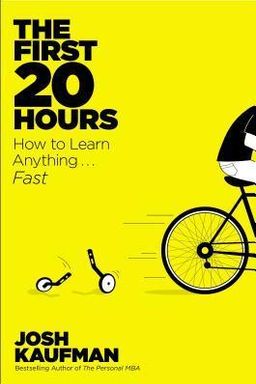
Have you ever wanted to master a new skill—coding, playing an instrument, or yoga—but felt you simply didn’t have enough time? In The First 20 Hours, entrepreneur and author Josh Kaufman argues that you don’t need ten thousand hours to become really good at something. Forget the myth popularized by Malcolm Gladwell—it’s possible to acquire any new skill rapidly if you approach learning strategically. Kaufman defines rapid skill acquisition as a process of smart, focused effort applied consistently over about twenty hours to break through the frustration barrier and reach a level of competent performance.
Kaufman’s core contention is that the difference between beginners and competent practitioners often isn’t time, but how you practice. Most people give up too soon because they encounter confusion, fear, and frustration. These “emotional barriers,” he writes, are the main obstacles to learning—not intelligence or talent. He combines insights from neuroscience, cognitive psychology, and case studies from his own experiments to prove that skill acquisition can be accelerated through structure and deliberate practice.
Breaking the Myth of 10,000 Hours
Kaufman begins with a direct challenge to the idea that only massive amounts of practice lead to mastery. The so-called “10,000-hour rule” comes from research by psychologist Dr. K. Anders Ericsson on expert performance. But Ericsson studied Olympic-level performers, not everyday competence. Kaufman reminds us that most goals don’t require mastery—they require sufficiency. To cook edible meals or speak conversational French, you need only the fundamentals, acquired through about twenty hours of deliberate practice. He likens this approach to climbing the steep part of the learning curve—the stage where your ability improves fastest and frustration drops dramatically. Once you make it through those first twenty hours, practice becomes its own reward.
The Science of Learning
Learning happens because your brain is plastic—it physically rewires itself as you practice. Kaufman explains that skill acquisition follows three neurological phases. First, there's the cognitive stage, where you consciously think through what you’re trying to do. Then comes the associative stage, where patterns emerge, and feedback helps you refine your approach. Finally, there's the autonomous stage, when you can perform smoothly without thinking. This progression, long supported by research from cognitive scientists like Kurt VanLehn, shows that mastery is more about smart repetition than innate talent. Kaufman draws on Carol Dweck’s concept of the “growth mindset,” emphasizing that persistence and adaptability—rather than fixed ability—unlock improvement.
How Rapid Skill Acquisition Works
To learn fast, Kaufman introduces four steps that form the backbone of his method: (1) Deconstruct the skill into smaller subskills, (2) Learn enough about each part to self-correct, (3) Remove barriers to practice—both physical and emotional, and (4) Practice deliberately in focused blocks for at least twenty hours. Through this formula, you can reach deliberate competence, the level where your performance is noticeably better than the average beginner. He emphasizes that doing rather than debating is key—“no practice, no skill acquisition.”
Why This Matters Today
In a world of distractions and constant digital noise, we often confuse “learning” with “research” and “reading” rather than “doing.” Kaufman’s argument reframes mastery for the modern age: the fastest path to confidence is focused, time-bound experimentation. When you learn strategically, you not only build competence but also reclaim the joy of learning itself. His system isn’t just about hacking productivity—it’s about reconnecting to curiosity.
Takeaway
You don’t need years to transform your abilities. You need twenty hours of deliberate practice, placed in an environment that supports focus, feedback, and persistence. Skill acquisition isn’t mystical—it’s intentional.
From yoga, coding, touch typing, and playing the ukulele to windsurfing and Go, Kaufman demonstrates that this method works across disciplines. Each example shows how a curious beginner can achieve competence quickly through passion, focus, and smart practice. The rest of the book unpacks ten principles of rapid skill acquisition and ten principles of effective learning, illustrating them through his real-world experiments. By the end, you realize the goal isn’t perfection—it’s progress made possible by beginning.