
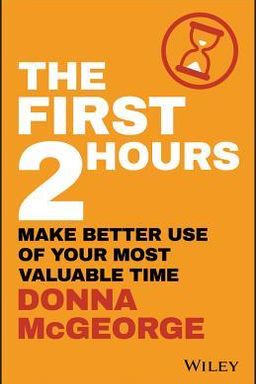
The First 2 Hours cover

The First 2 Hours

by Donna McGeorge

The First 2 Hours offers a revolutionary approach to structuring your workday. By aligning tasks with your body''s natural rhythms, you can enhance productivity and focus. Discover how to prioritize effectively, manage energy levels, and make each hour count.

Designing Your Day Around Your Body Clock

Do you ever feel like your days slip by in a blur of meetings, emails, and exhaustion, leaving you wondering where your productive hours went? In The First 2 Hours, Donna McGeorge argues that the key to reclaiming your energy and achieving meaningful work lies not in classic time management tricks — but in understanding when you do your best work rather than what you do. She suggests that by aligning tasks with your natural energy rhythms and protecting the most alert parts of your day, you can dramatically boost productivity, reduce stress, and feel more in control.

At its core, the book challenges our ingrained habits and turns the concept of productivity on its head. Instead of assuming that longer hours or endless to-do lists yield better outcomes, McGeorge proposes that we start thinking about time like money. Every minute is a finite, valuable resource — so it should be invested wisely. Her approach is grounded in practical strategies, real-world stories, and accessible science about the way our bodies and brains function throughout the day.

The Myth of Traditional Time Management

McGeorge begins by pointing out a frustrating truth: most people describe their workdays as “busy” — and wear it like a badge of honor — yet feel perpetually tired and behind. Traditional time management techniques encourage us to organize and prioritize endlessly, but they fail to account for the fluctuating energy levels driven by our circadian rhythms. These are the biological cycles that govern alertness, decision-making capacity, and even our moods. When we ignore them, we end up fighting our own physiology, pushing through fatigue, and confusing activity with achievement.

Drawing inspiration from works like Daniel Pink’s When and Michael Smolensky’s The Body Clock Guide to Better Health, McGeorge uses research to show that we are biologically wired for peak alertness in the morning, a natural dip early in the afternoon, and a rebound later in the day. The result: if you use your best mental energy for low-payoff tasks like email, you’re literally spending your brain’s prime currency on the wrong things.

Time as Currency: Value and Return

To help you rethink your relationship with time, McGeorge offers a vivid analogy drawn from the film In Time, in which people’s lives are measured in literal minutes on a forearm clock. Imagine if your life worked the same way: would you spend your hours attending fruitless meetings, refreshing your inbox, or reacting to everyone else’s demands? If each minute were a dollar, you’d probably invest it more strategically. That’s the mindset she urges readers to adopt — be “miserly,” even “frugal,” with your most valuable hours.

She compares time to real estate: beachfront property is more valuable than a studio over a freeway. Likewise, your early hours of focus are prime beachfront time — rarer and more valuable than the afternoon’s mental backstreets. You should reserve that “prime real estate” for activities that matter most. This concept echoes Stephen Covey’s idea from The 7 Habits of Highly Effective People: “Put first things first.” But where Covey emphasizes priorities, McGeorge emphasizes timing. The difference is subtle but transformative.

From Stress to Design: The Four Two-Hour Framework

McGeorge divides the average eight-hour workday into four productive blocks: Proactive (first two hours), Reactive (second two hours), Active (third two hours), and Preactive (final two hours). Each set aligns with a distinct physiological state of energy and focus. This model transforms your day into a rhythm that works with your brain’s natural highs and lows rather than against them. The morning becomes a time for creative problem solving and deep work; late morning for collaboration and responsiveness; the post-lunch slump for routine or mechanical tasks; and late afternoon for reflection and planning.

For example, she shares an anecdote about Li, a client overwhelmed by meetings and late nights who struggled to find focus. By reserving the first two hours of each day — his “purple patch” — for focused, high-impact work, he reversed the tide. Within weeks, he was more productive and less stressed, able to leave work earlier and spend time with his family. The lesson is simple: you can create your own “purple patches” by consciously designing your day.

Why This Approach Works

McGeorge’s approach is grounded in behavioral psychology and neuroscience. When you guard your best hours for high-value, high-intensity tasks, you reduce decision fatigue — the mental drain that makes even small choices exhausting by the end of the day. (Daniel Kahneman’s Thinking, Fast and Slow is referenced throughout for its insights on System 1 and System 2 thinking: fast vs. deliberate mental modes.) The key is to match System 2 tasks — deep analysis, complex problem-solving — with your energised hours, and system 1 tasks — routine, reactive work — with your dips.

What makes The First 2 Hours compelling is that it’s not prescriptive but empowering. McGeorge doesn’t ask you to overhaul your life overnight. Instead, she provides experiments, challenges, and micro-habits — from eating better to ending multitasking — that cumulatively reset your daily rhythm. You begin to treat each day as a designed experience instead of a chaotic marathon.

A Day That Works With You, Not Against You

Ultimately, the book’s promise is not about working harder, but smarter — in harmony with your biology. McGeorge wants you to wake, work, and wind down in a way that restores energy rather than drains it. From the food you choose and the hours you sleep to when you send emails and meet colleagues, every detail can either amplify or sabotage your productivity. The magic lies in designing your day — deliberately — so that your energy, attention, and purpose align. With that, every day can flow like a well-timed dance between effort, focus, and rest.


Work With Your Natural Rhythms

Most people rise, rush, and react — but Donna McGeorge insists that how you structure your day should depend on your natural rhythms, not on your inbox. In Chapter 1, she unpacks the concept of circadian rhythms, which dictate when your brain and body perform best. Ignoring these rhythms, she warns, is like flying through time zones without adjusting your watch — you end up in perpetual jet lag.

Your Body Clock Is Your Secret Weapon

Our internal clock influences almost every biological function — from alertness and memory to mood. Research cited in the book (drawing on psychologists Michael Smolensky and Lynne Lamberg) shows that most people peak in alertness around 10 a.m., hit an energy low around 3 p.m., and get a mild rebound after 5 p.m. Understanding this curve allows you to schedule tasks aligned with your state:

  • Morning: Best for deep, high-stakes thinking and decisions.
  • Afternoon: Ideal for repetitive or operational work.
  • Late day: Great for reflection, planning, or creative linkage.

The Cost of Working Against Your Clock

McGeorge illustrates with vivid studies: Israeli judges were far more generous in parole hearings held in the morning, plummeting in leniency by late afternoon. The message is clear — our cognitive and moral capacities crash after long hours of decisions. That explains why you snap at coworkers, buy fast food after work, or send regrettable late-night emails — your brain is simply out of gas. This “decision fatigue” (a concept investigated by social scientists like Roy Baumeister and Daniel Kahneman) cripples good judgment.

Morning Larks, Night Owls, and Everyone Between

Not everyone fits one mold. About 20 percent of people are extreme early birds, another 20 percent are true night owls, and the rest fall in between. McGeorge invites you to assess your chronotype — your natural productivity spectrum — using Daniel Pink’s simplified “midpoint test.” For instance, if you go to bed at 10 p.m. and wake at 6 a.m., your midpoint is 2 a.m. — meaning you’re likely a morning type. But if your midpoint is 4 a.m. or later, you may thrive later in the day.

Once you identify your chronotype, you can schedule accordingly. Whether you rise at 4 a.m. like McGeorge’s friend Rebecca or hit your stride at midnight like Sharon, the goal remains: do complex, creative work during your personal peak hours and easy, administrative work during your troughs. Simple shifts — not total life overhauls — make your day sync with how your brain naturally runs.


Fuel, Movement, and Rest — The Real Productivity Trifecta

When McGeorge asks clients when they feel at their best, their answers often have nothing to do with to-do lists and everything to do with energy: “after a good night’s sleep,” “after a healthy breakfast,” or “after exercise.” In Chapter 2, she argues that productivity starts in the body. Without proper fuel, movement, and rest, no planner or technique will save you.

Fuel: Eat for Your Brain, Not Just Your Belly

Your brain runs on glucose — but not all calories are equal. Sugary snacks deliver a burst of energy followed by a crash, leading to poor focus and bad decisions. McGeorge likens it to feeding a fire: hardwood (complex carbs and proteins) burns clean and slow, while newspaper (sugar) flares and dies. She shares her habit of traveling with homemade granola because hotel breakfasts often sabotage performance. Studies from the British Journal of Health Psychology confirm her point — more fruits and vegetables correlate with both higher productivity and greater happiness.

Movement: Boost Focus and Mood

Citing a Bristol University study, McGeorge notes that employees who exercised were 21 percent more focused and 41 percent more motivated on those days compared to sedentary ones. The best part? You don’t need to become a gym junkie. Even light activities — walking meetings, stretching breaks, stair climbing — improve concentration and creativity. Movement releases serotonin and dopamine, chemicals tied to optimism and persistence. Like the research in Charles Duhigg’s The Power of Habit, small physical rituals lead to wider behavioral change.

Rest: Sleep Is a Strategic Asset

Sleep isn’t laziness but maintenance. Less than 7.5 hours per night, says McGeorge (referencing University of Pennsylvania studies by David Dinges), impairs judgment, creativity, and memory just like mild intoxication. What’s worse, the illusion of busyness – staying late or bragging about sleeping little – disguises declining performance. Churchill and Edison may have boasted of minimal sleep, but modern neuroscience proves otherwise: sleeping rewires learning, clears toxins, and prevents burnout.

She urges readers to create “phone-free zones” before bed. Blue light blocks melatonin and keeps the brain restless, leading to foggy mornings. In short, productivity isn’t built by doing more — it’s built by recovering better. Eat smart. Move daily. Sleep deeply. The rest will follow.


Rethinking Time: Treat It Like Real Estate

One of McGeorge’s most provocative ideas comes in Chapter 3: we must stop managing time as an endless supply and start valuing it like our most prized property. Imagine that your hours were parcels of land. Would you lease your beachfront to meaningless meetings or fill your sunset hours with small talk? Probably not. Yet that’s what we do every day when we multitask and react mindlessly.

The Price of Multitasking

Psychology Today reports that multitasking slashes productivity by up to 40 percent — a devastating loss hidden under the illusion of “visible progress,” as behaviorist Jason Fox describes. Checking off minor tasks feels good because of dopamine hits, but it creates false progress while draining energy reserved for meaningful work. McGeorge calls multitasking an addiction fueled by novelty-seeking: every ping, text, or notification gives a jolt of pleasure, which soon escalates into compulsion.

Her remedy: “Check yourself into multitasking rehab.” Turn off alerts, mute your phone, eliminate browser clutter, and focus for short bursts using Francesco Cirillo’s Pomodoro Technique — 25 minutes of deep work followed by a 5-minute break. It’s not about squeezing more in; it’s about protecting focus like a fortress.

Intensity vs. Impact: The New Rules of Prioritization

McGeorge introduces a powerful grid combining two critical filters: intensity (how much mental energy the task requires) and impact (the return on that energy). Your goal is to spend prime mental hours on high-intensity, high-impact work — like strategy, creation, or problem-solving — and batch low-impact tasks like routine admin or easy planning into low-energy windows.

This model parallels Cal Newport’s argument in Deep Work: the ability to focus without distraction on cognitively demanding tasks is a superpower in our distracted age. McGeorge’s addition is practical timing: know your brain’s “real estate value” at each hour and schedule accordingly.

Creating Purple Patches

Her client Li’s transformation shows this in action. Overwhelmed by meetings, Li rarely had time for substantive work. When he color-coded the first two hours of every day “purple” and protected that time for deep focus, his productivity soared. In weeks, he finished projects earlier and reclaimed family time at night. The takeaway: your calendar is not a reflection of your job, but your strategy. Design it like a portfolio — invest in what appreciates, not what just fills space.


Mastering the First Two Hours: Go Proactive

The heart of McGeorge’s framework is the first two hours — your “proactive” zone. This is when your energy, focus, and decision-making are at their peak. It’s the moment to tackle the tasks that will move the needle — not emails, not reports, but high-impact, high-intensity work.

Protect Your Prime Time

McGeorge urges readers to literally block these hours in their calendars, treating them as non-negotiable appointments with themselves. For a manager, this might mean crafting proposals, solving people problems, or designing strategy. For a creative professional, it could be writing, coding, or designing. The rule: if you’ll regret not doing it, do it now.

She gives practical tips: arrive ten minutes early, grab your coffee, close apps, and mark your top three tasks. Then focus. If you must check email, scan only for the 10 percent that require thoughtful responses, tag them, and handle them later. Email sorting should never replace real progress.

Why Proactivity Beats Busyness

Starting your day reactively — answering emails or solving others’ crises — hands over your cognitive fortune to someone else’s priorities. A story about “Dave,” one of McGeorge’s clients, makes this clear. He used to wake up and immediately dive into overnight emails from global teams. By delaying replies until later in the day and focusing first on his strategic deliverables, Dave not only achieved more but also reduced inbound messages. The new rhythm trained others to adapt to his tempo instead of dictating it.

Being proactive is about control. When you decide what deserves your best attention — and when — you start leading your workday instead of being led by it. You can measure success not by how “busy” you were but by whether you advanced what truly matters.


The Second Two Hours: Stay Reactive, Not Chaotic

After conquering your biggest tasks, the next phase — the second two hours — is about thoughtful reaction. It’s time to lift your head from the dance floor and step onto the balcony, as leadership author Ron Heifetz would say. You’ve set your direction; now you help others move.

Being Available with Intention

McGeorge suggests scheduling your “open-door hours” here. Meet with your team, hold one-on-ones, troubleshoot projects, or assist colleagues with high-impact tasks. You’re still mentally sharp, but not buried in deep concentration. She tells the story of Ivan, a senior manager who moved his desk out of his private office for two hours every morning to make himself approachable. The change broke hierarchy barriers and improved communication, all without sacrificing focus time earlier.

Practicing Controlled Responsiveness

Being reactive doesn’t mean being overwhelmed. You must still choose which fires to fight. McGeorge teaches readers to test “urgency assumptions.” When someone asks for something “ASAP,” push for clarity: do they really need it today, or will 10 a.m. tomorrow suffice? This habit prevents the false rush culture that fuels burnout and inefficient work.

Use this window to review quick emails, meet clients, or coach team members — but draw boundaries. McGeorge even recommends limiting daily meetings to a set quota. Once you reach your cap, you’re “booked out.” Thoughtful accessibility, not constant availability, is the mark of a professional manager.


The Third Two Hours: Work Smart During the Slump

The post-lunch period, often called the “afternoon slump,” is the most maligned time in the corporate world — but Donna McGeorge calls it the active two hours. Instead of fighting fatigue, she encourages you to leverage it. This is when your mind craves routine, so fill this slot with low-intensity, low-impact tasks that keep you moving.

Rituals, Routine, and Respite

Repetitive work like filing, processing emails, or logging reports fits perfectly here. McGeorge cites studies showing that motor skills and muscle memory perform better in the afternoon than morning — making this ideal for “autopilot” activities. She encourages building small rituals: a 10-minute walk, a chat with a coworker, or a stretch — all of which renew mental energy without heavy thinking.

Breaking the Email Habit

This is also the time, she says, to finally process your inbox. Why? Because only about 10 percent of emails require real thought; the rest are admin clutter. Processing them now keeps your most valuable hours untouched. For the email-addicted, McGeorge offers a compromise: scan for urgency in the morning, respond later. Over time, people will adjust their expectations — fewer interruptions, fewer replies, and fewer wasted hours.

The Science of Smart Rest

She even advocates for micro-naps. Borrowing from Daniel Pink’s When, McGeorge describes the “nappuccino”: a 20-minute nap with a pre-nap coffee so caffeine kicks in just as you wake. It recharges mental batteries without torpedoing nighttime sleep. Studies back her up — short naps outperform caffeine alone in restoring alertness.

In short, the third two hours are not wasted time. They’re active recovery. If you use them well, your last two hours can become powerful again — not a countdown to escape.


The Fourth Two Hours: Reflect and Prepare

As the day winds down, McGeorge’s final quadrant — the preactive two hours — shifts from doing to designing. This is when you reflect, wrap up, and plan so that tomorrow starts with clarity instead of chaos. She calls it your gateway to sustainable productivity: review today, preview tomorrow, and then truly rest.

Reflect and Regain Perspective

McGeorge begins with gratitude. Instead of fixating on unfinished tasks, acknowledge progress. Her friend Russell keeps a “scrapbook of wins” — printed compliments, milestone moments, and emails of appreciation — to boost morale. This taps into oxytocin, the “feel-good” hormone, shifting focus from fault-finding to fulfillment. Appreciating accomplishments not only improves sleep quality but also builds momentum for the next day.

Plan Tomorrow, Today

The fourth two hours are ideal for writing to-do lists, clearing email backlogs, or drafting communications you’ll send in the morning. She even suggests scheduling emails to deliver during others’ peak hours — a subtle act of respect and efficiency. Like Winston Churchill’s naps, this end-of-day discipline fuels creativity; your subconscious continues processing ideas overnight.

Friday Rituals and Weekly Horizons

Finally, McGeorge recommends the “Friday 3–8” ritual. Block your last Friday hours for review: score the week, plan next week’s top three priorities, and overestimate how long key projects will take (an antidote to “planning fallacy,” as described by Kahneman and Tversky). Close the loop before the weekend so your mind is free to recharge. When you start Monday, you’ll already have momentum. The final two hours of each day — and week — aren’t a downshift into fatigue. They’re your launchpad for lasting focus.

Dig Deeper

Get personalized prompts to apply these lessons to your life and deepen your understanding.

Go Deeper

Get the Full Experience

Download Insight Books for AI-powered reflections, quizzes, and more.