
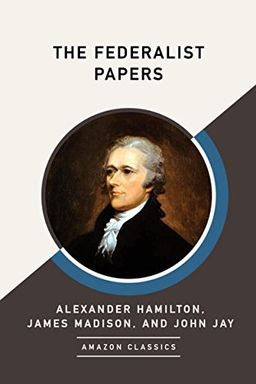
The Federalist Papers cover

The Federalist Papers

by Alexander Hamilton, James Madison, John Jay

The Federalist Papers, crafted by Hamilton, Madison, and Jay, present compelling arguments for the U.S. Constitution''s ratification. This seminal work delves into the core principles of American governance, emphasizing unity, federalism, and checks and balances, remaining influential in political thought.

The Argument for an Energetic Union

The Federalist Papers collectively build a decisive argument: only a strong, well-constructed Union can preserve liberty, ensure security, and sustain republican government. You are asked to see what Alexander Hamilton, James Madison, and John Jay saw—a nation at risk of disunion and foreign manipulation unless it adopted a Constitution that gave adequate energy to national institutions while safeguarding the people's freedom.

Across the essays, the authors weave together history, political science, and practical economics to persuade you that federal union is indispensable. The work moves from diagnosing the failures of the Articles of Confederation to designing the structural remedies found in the proposed Constitution. When you follow their reasoning, you uncover a pattern—strength from unity, safety from balanced powers, and liberty secured not by weakness but by well-calibrated authority.

The stakes of union

Hamilton opens by reminding you that the choice between union and fragmentation determines your safety and prosperity. John Jay develops this by showing that only one government can speak with credibility to foreign powers, coordinate defense, and negotiate consistent commercial policy. If divided into small confederacies, America would suffer duplicative bureaucracies, rival treaties, and foreign manipulation—exactly the fate of the vulnerable Greek and Germanic leagues (Hamilton, Federalist Nos. 1–4, 13).

Union, therefore, becomes a device of self-preservation. It provides the collective strength needed to protect trade routes, arbitrate conflicts among States, and prevent jealousies that historically have bred civil wars. The authors insist that disunion would not merely be inconvenient—it would be fatal to republican ideals.

From confederacy to working government

Madison and Hamilton then expose the fundamental flaw of the Articles of Confederation: its laws bound States, not individuals. That defect reduced federal directives to moral appeals. When States refused requisitions, Congress had no coercive instrument except war. The proposed Constitution changes that relationship; now federal laws would act directly on people through courts and regular enforcement. Government becomes effective, lawful, and republican simultaneously (Federalist Nos. 15–22).

The foreign and economic dimension

Foreign threats and economic rivalry press the urgency of unity. Jay details how Britain and Spain already constrained American commerce at the Mississippi and Saint Lawrence, while Hamilton in Federalist No. 11 envisions a future where a united America constructs a navy to protect its trade and compel respect abroad. Domestic disunion would make every treaty suspect and every border porous. Unity, by contrast, converts America’s resources—southern timber, northern seamen, and mid-Atlantic iron—into coordinated power.

Economically, Hamilton argues that the Union economizes on expense and increases creditworthiness. Divided governments would each sustain duplicative civil lists and diplomatic corps, multiplying costs without expanding capacity. One consolidated government means one efficient administrative machinery capable of borrowing at lower rates and funding defense credibly.

Political design and protection of liberty

But unity alone does not guarantee liberty. Madison’s great essays on factions and separation of powers establish the internal architecture that keeps energy from degenerating into despotism. In Federalist No. 10, you learn why faction is inevitable but controllable through representation and the extended sphere of the republic. In Federalist Nos. 47–51, Madison shows that overlapping checks and balances—each branch guarding its prerogative while depending on the others—make power self-regulating. His prescription, that “ambition will counteract ambition,” translates human motives into civic equilibrium.

This compound republic divides authority twice—vertically between national and State governments, and horizontally among branches. Those divisions, Madison explains, multiply interests so that unjust majorities become improbable. In that structure, liberty and strength coexist.

What the framers built

By the time you reach Hamilton’s defenses of the fiscal and executive powers, the argument becomes pragmatic. The Union must raise revenue sufficient for defense and emergencies (Federalist Nos. 34–36); States retain concurrent taxation except where the Constitution clearly prohibits it (No. 32). Federal authority requires “necessary and proper” means to execute enumerated powers, and federal law must be supreme when constitutional (No. 33). Yet the people remain the final judges—unconstitutional acts are null.

In government design, the framers blend national and federal features. Ratification occurs through States, the House arises from people, and the Senate reflects State equality. This mixed structure allows effective national operation while preserving local authority. The same balance animates the military clauses: uniform militia discipline under federal regulation, paired with state appointment of officers (Nos. 24–29). It pervades the executive’s construction—one energetic President with limited tenure, accountable veto, and shared treaty-making with the Senate (Nos. 67–77).

The moral conclusion

The Federalist writers end where they began—with prudence. They concede that any government can abuse power, but they ask whether weakness is safer than strength. Their answer is that carefully balanced energy is the only way republics endure. You are invited to see the Constitution not as an experiment in consolidation but as a rational solution that fuses liberty with capacity. The Union secures peace and prosperity through institutions capable of both governing and being governed—a design that stands as a practical philosophy of freedom bound by law.


From Confederation to Constitutional Authority

Hamilton and Madison dissect the failures of the old Confederation to show you why reform was unavoidable. Under the Articles, Congress issued mere recommendations to States; there was no mechanism to compel compliance except war, which they call the parent of anarchy. Federal resolutions lacked sanctions on individuals and left debt unpaid, treaties violated, and defense neglected.

The structural defect

You learn that government means the ability to command individuals through law. Without direct authority over persons, the Confederation was incapable of execution. Its operation through State intermediaries created delays, evasions, and factional defiance. Every historical league that adopted such a plan—Greek, Germanic, and Dutch—ended in domination by a few strong members or collapse into civil strife.

Why coercive power must be legal power

The remedy, Publius explains, is not military coercion but lawful coercion via courts. By enabling federal laws to bind individuals, you substitute judicial enforcement for inter-State warfare. Laws gain the ordinary machinery of courts and sheriffs, and resistance becomes an act of personal violation, not State rebellion. This innovation—so simple yet transformative—turns a league into a government.

Why precedent justifies change

Madison’s defense of the Convention’s authority (Federalist No. 40) completes the logic. Delegates were charged to render the Union adequate to its objects, and when adequacy required reconstruction, they pursued it. Ratification by popular conventions would cure any technical irregularity. Madison’s reasoning converts necessity into legitimacy: a constitution born from crisis but validated by democratic choice. You come to see that reform of the Confederation was not a breach of trust—it was an act of preservation.


Union, Commerce, and Defense

Jay and Hamilton ask you to view the world as an arena of competing empires where commerce and defense intertwine. Only a united America can defend its maritime rights and bargain effectively for trade privileges. Fragmented States would each court different alliances, letting foreign powers play them against one another.

Commerce as collective leverage

Hamilton vividly explains how unified trade regulation serves diplomatic ends. If a single national government can withhold port access from Britain, it compels negotiation on equal terms. Foreign powers respect consistent policies, not contradictory local tariffs. The Union transforms geography and resources into national bargaining strength: northern seamen, southern naval stores, and mid-Atlantic iron combine to support a federal navy protecting Atlantic and West Indian trade.

Defense and the necessity of arms

Hamilton confronts fears of standing armies by acknowledging real threats—Spanish garrisons, British fleets, domestic rebellion—and explaining constitutional safeguards. The army’s funding is limited to two-year appropriations, ensuring legislative oversight. Uniform militia regulation allows coordinated defense while leaving State appointment of officers intact. Liberty is guarded by procedure rather than paralysis.

Economic and fiscal readiness

To support defense and commerce, Hamilton insists the Union must wield broad revenue powers. Wars and emergencies cannot be predicted; therefore national taxation must be indefinite in extent. Relying solely on import duties invites smuggling and regional inequality. Federal and State taxing powers coexist except where forbidden by the Constitution. This concurrent authority prevents fiscal strangulation and enables collective solvency—a practical foundation for security and prosperity.


Faction and the Extended Republic

Madison tackles the greatest internal threat: faction. He defines it as any group driven by interest or passion adverse to the rights of others or the common good. Since liberty itself produces faction, you cannot eliminate it; you can only control its effects through well-designed institutions.

Two remedies—representation and extent

Madison’s cure operates at two levels. First, representation refines public opinion: elected officials deliberate beyond immediate passions. Second, an extended republic multiplies interests so that no majority shares a single motive to oppress others. Shays’ Rebellion and the volatility of small democracies illustrate why scale matters; a larger sphere dilutes contagious impulses and builds interdependence.

How size protects liberty

You learn that expanding the republic alters political mathematics. Diverse economic and regional interests make tyranny by majority improbable. Representation adds filtration; diversity adds dispersion. Together they convert potential disorder into moderated governance. This logic allows the Union to reconcile liberty and stability without sacrificing one for the other—a cornerstone of Madison’s institutional realism.


The Mixed Constitution and Separation of Powers

Madison’s Federalist No. 39 and related essays reveal the Constitution’s hybrid nature: federal in foundation, national in operation. Ratification occurs through States, yet laws act on individuals nationwide. The government’s powers are enumerated (federal trait) but exercised through national institutions. This deliberate mixture reflects America’s dual identity as both union and confederation.

Checks and balances

In building safeguards, Madison reinterprets Montesquieu: freedom depends not on absolute separation but on mutual control. Each branch—the legislature, executive, judiciary—has constitutional means and personal motives to resist encroachments. Dividing the legislature into House and Senate further diffuses ambition. “Ambition counteracts ambition” becomes the operational principle of republican durability.

Compound republic and double security

Power is divided between national and State governments, each subdivided among departments. This double division offers a double security to the people: if one layer overreaches, the other moderates. Human nature’s tendency toward power is converted into a stabilizing equilibrium, sustaining liberty by engineering competition within constitutional boundaries.


Design of Representation and Legislative Balance

Madison’s analysis of the House and Senate answers how representation can be both popular and prudent. The House’s biennial elections ensure accountability while allowing members time to master national issues. Population-based apportionment and periodic census updates make representation dynamic. The controversial three-fifths compromise is treated as a pragmatic bridge between taxation and representation rather than moral endorsement.

The Senate’s stabilizing role

The Senate represents States equally, securing their sovereignty within the Union and tempering rapid legislative shifts. Six-year terms and indirect election cultivate experience and deliberation. Madison offers six reasons for its necessity—from resisting popular passions to sustaining national reputation abroad. Fears of aristocracy, he argues, misread both history and mechanics; extensive dependencies would be required for corruption, which wide representation makes nearly impossible.

Coordination under constitutional checks

Together, the House and Senate exemplify the Constitution’s mixed character: one body responsive, the other reflective. Laws thus require concurrent majorities—of population and of States—transforming impulsive legislation into considered policy. You experience representation not as chaotic democracy but as organized republicanism made sustainable by design.


Executive Power and Responsible Energy

Hamilton’s defense of the presidency embodies the principle that energy and accountability need not contradict each other. He defines executive energy as unity, duration, adequate support, and competent powers—qualities essential for good administration and national defense.

Unity and duration

A single, identifiable Executive enables decision, secrecy, and clear responsibility. Plural executives divide accountability and breed paralysis. Four years is long enough for firmness but short enough for electoral control. Re-eligibility encourages conscientious service; permanent disqualification would tempt short-term exploitation.

Election and appointment

The Electoral College combines popular choice with deliberative filtering. Electors vote in their States, preventing mob tumult and foreign intrigue. Excluding current federal officeholders safeguards independence. In appointments and treaties, the President shares power with the Senate—an elegant combination of initiative and restraint that avoids both monarchy and legislative tyranny.

Constitutional restraints

Fixed compensation prevents legislative coercion. The qualified veto allows revision without autocracy. Impeachment guards against abuse. The presidency, in Hamilton’s vision, is vigorous yet accountable: capable of decisive action while constantly answerable to law and public judgment—a model of republican energy disciplined by design.


Judicial Independence and Constitutional Guardianship

Hamilton’s closing essays establish the judiciary as the guardian of the Constitution. Judges must hold their offices during good behavior and have secure compensation to maintain independence from legislative intimidation. Without such autonomy, the interpretation of law would fall to the strongest faction.

Judicial review and constitutional supremacy

Hamilton defines judicial review not as superiority over the legislature but fidelity to the people’s charter. If a statute contradicts the Constitution, judges must apply the higher law. This doctrine makes the judiciary the instrument of limited government, ensuring that delegated power never exceeds its commission.

Scope and structure

Federal courts hold jurisdiction in cases arising under federal laws, between States, or involving foreign interests—arenas where local prejudice might distort justice. Appeals from State courts maintain uniformity. The Supreme Court oversees coherence, while inferior tribunals handle local execution. Since the judiciary lacks sword and purse, its safety lies in independence, not power.

Trial by jury and local wisdom

Hamilton reassures you that criminal juries remain sacrosanct, and civil juries are preserved by State systems where practice varies. The Constitution leaves room for adaptation. Ultimately, the courts stand as a quiet yet essential pillar—strong enough to invalidate unconstitutional laws, and weak enough to remain faithful servants of liberty.

Dig Deeper

Get personalized prompts to apply these lessons to your life and deepen your understanding.

Go Deeper

Get the Full Experience

Download Insight Books for AI-powered reflections, quizzes, and more.