
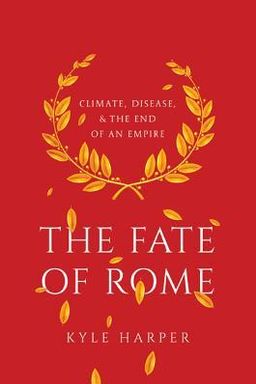
The Fate of Rome cover

The Fate of Rome

by Kyle Harper

Kyle Harper''s ''The Fate of Rome'' delves into the overlooked roles of climate change and disease in the decline of the Roman Empire. This captivating narrative combines historical analysis with scientific insights, offering a groundbreaking perspective on one of history''s greatest civilizations.

Nature’s Empire: Climate, Disease, and Rome’s Fate

What if the rise and fall of Rome were as much a story of nature as of politics or war? This book argues that the Roman Empire was not merely a human institution but an ecological system—one whose fortunes rose with favorable climate and fell with the unpredictable rhythms of the natural world. The empire’s expansion, urbanization, and economic vigor depended on a stable environment. When that stability faltered, through climate cooling and pandemic disease, Rome’s complex machinery began to fail.

The Climate Background of Empire

During the centuries of Roman ascent, the Mediterranean enjoyed the Roman Climate Optimum (ca. 200 BC–AD 150). Warm, wet, and stable conditions raised crop yields, expanded arable frontiers, and sustained booming populations. Ancient accounts from Pliny and Ptolemy match what modern proxies (tree rings, ice cores, speleothems) reveal: a period of gentle weather and reliable Nile floods. The Roman achievement, from Augustus’ consolidation to the Pax Romana, drew strength from this environmental “natural subsidy.”

But nature changed. From the mid–second century onward, rainfall patterns grew erratic and volcanic activity increased. This shift, followed by the Late Antique Little Ice Age, disrupted food supplies and economic systems just as new ecological stresses emerged: pandemics that exploited the very networks of trade and urban life Rome had built.

Pandemics as Ecological Turning Points

Rome’s integrated world made it uniquely vulnerable to infectious disease. The Antonine Plague (AD 165–180), likely smallpox introduced through military and trade routes, broke demographic momentum and destabilized the imperial economy. The Plague of Cyprian a century later compounded drought and fiscal crisis, precipitating the disintegration of the third-century system. And the Justinianic Plague (beginning AD 541) unleashed a bacterium—Yersinia pestis—that would devastate populations for two hundred years, colliding with volcanic cooling and economic fragility.

Each outbreak exploited the empire’s ecological design: dense cities, extensive grain networks, and fleets that moved goods—and rats—across the sea. Every pandemic thinned labor forces, eroded fiscal revenue, and shattered faith in centralized control. Yet each also triggered institutional innovation—from Diocletian’s reforms to Christian charity—that reshaped Roman society’s responses to crisis.

Resilience and Transformation

Even as environmental shocks struck, Rome adapted. The tetrarchic and Constantinian reforms reorganized provinces, taxation, and currency to preserve state capacity. In the fourth century, modest climatic recovery and administrative stability produced renewed economic and demographic vigor. Christianity, evolving from persecuted sect to state institution, became a new framework for social resilience: bishops coordinated famine relief, hospitals, and moral support during times of hardship.

Still, adaptation had limits. When the Huns were driven westward by a steppe drought in the fourth century, migratory dominoes toppled into Roman frontiers. Climate instability on the Eurasian grasslands thus became a prelude to political collapse in the west, culminating in the sack of Rome in 410 and the fragmentation of imperial control.

The Final Eco-Political Convergence

By the mid–sixth century, the dual shock of plague and volcanic winter—the Late Antique Little Ice Age—formed an existential test. Dendrochronology and ice cores show eruptions in AD 536 and 540 producing the coldest decade in two millennia. Procopius reported a sun that “gave forth its light without brightness.” In that environment, the plague of Justinian crippled Egypt’s grain machine and hollowed imperial finances. Though not the sole cause of Rome’s reduction, these natural forces narrowed imperial options to the point of failure.

A Living Lesson from Antiquity

The book’s central claim is humbling: human civilizations are contingent on ecological balance. The Romans mastered engineering and governance, but they could not master microbes, solar cycles, or volcanic dust. Modern readers inherit the same vulnerability, now magnified by global interconnectedness. By reading Rome’s fall not as moral decline but as ecological misfortune, you see history as feedback—between human ambition and planetary systems that react in unpredictable ways.

The Roman experience invites you to think of history as ecology in motion: how prosperity fosters density, density fosters disease, and environment intermittently resets the stage. This pattern, echoed in modern pandemics and climate instability, remains the book’s enduring warning—and its most compelling insight into the fragile foundations of civilization.


The Roman Climate Optimum

The Roman Climate Optimum (RCO) forms the quiet miracle beneath early imperial success. Roughly from 200 BC to AD 150, the Mediterranean basin experienced unusually stable warmth and generous rainfall. Tree rings and glacier retreats confirm this era of mild solar highs and minimal volcanic activity. Ancient testimony—from Pliny’s botanical notes to Ptolemy’s weather observations—corroborates what science now proves: nature granted the empire an ecological bonus round.

Fertility and Expansion

Warmer, wetter conditions expanded arable margins and improved yields across Italy, Gaul, and North Africa. Reliable Nile floods stabilized food supply chains, while the Iberian–Roman humid phase boosted western agriculture. These gains fed population growth from 60 to roughly 75 million under the early emperors. A stable climate therefore underwrote urbanization and sustained the giant city of Rome—arguably the largest pre-industrial metropolis in history.

Climate as Natural Infrastructure

The book characterizes the RCO as a “natural subsidy.” It expanded wheat and olive frontiers into upland terraces, reduced famine cycles, and facilitated trade. The Pax Romana, often credited to politics and military genius, also depended on mild climate’s invisible advantage. When solar output later weakened, famines became common and the social equilibrium frayed.

From Prosperity to Transition

By the mid–second century, this benign regime faded. Droughts appeared in North Africa, and Nile failures reflected monsoon shifts. Volcanic aerosols darkened skies, beginning the Roman Transitional Period. Archaeological signs of adaptive stress mount: Hadrian’s 120 km aqueduct to Carthage responded to years of drought, while Libyan foggara irrigation collapsed under groundwater decline. The foundations of prosperity had started to erode long before visible political decline, reminding you that climate’s turn is rarely instant—but always consequential.


Pathogens and the Roman Network

Rome’s greatness created its biological peril. The intricate network of roads, ports, and markets that bound the empire together also bound it epidemiologically. As you follow the Antonine and Cyprian plagues, you see microbes exploiting these very arteries of empire.

The Antonine Plague: A Smallpox Invasion

When Lucius Verus’s armies returned from Parthia around AD 165, the empire encountered one of its earliest global pandemics. Galen’s observations of pustular eruptions and black scabs fit smallpox. Mortality reached up to a tenth of the population, doubling prices and crippling the army. Civil coinage failed, silver minting in Alexandria halted, and Marcus Aurelius’s war treasuries evaporated. The epidemic marked the end of the high imperial demographic surge.

The Plague of Cyprian: Crisis Multiplied

A century later (AD 250s), another unidentified killer struck during drought and economic contraction. Cyprian described hemorrhagic fevers, necrosis, and blindness—diseases consistent with a viral hemorrhagic fever. Grain failures in Egypt magnified famine, while imperial turnover accelerated collapse. Cities emptied, armies mutinied, and the state fragmented into rival claimants. The Crisis of the Third Century was thus not only political: it was ecological and biological at once.

Human Networks and Microbial Highways

Imperial connectivity—grain fleets, insulae apartments, slave markets—created ideal transmission loops. Trade that once moved wealth now carried contagion. Rome’s centralized ecological design amplified vulnerability: when each node in a network depends on the next, shock in one zone cascades everywhere else. (Note: the author draws parallels to modern globalization and pandemic spread through air travel.)

In short, the Roman Empire can be read as the ancient world’s first true “disease ecosystem.” Its integration propelled prosperity and then magnified disaster in equal measure.


From Crisis to Reform

Pandemics broke Rome’s old equilibrium but also provoked reform. After the Cyprian crisis, the empire reinvented its governance to survive. You can view Diocletian, Constantine, and their successors not as presiding over decline but as systemic engineers responding to ecological constraint.

Resilience and Fiscal Reinvention

The third-century collapse exposed the limits of an overstretched revenue base. Declining population slashed tax receipts even as the army grew more expensive. Debasement followed—severely eroding monetary trust. Diocletian’s solution was radical: a new hierarchy of provinces, bureaucratic expansion, heavier but more uniform taxation, and price edicts tied to subsistence needs. Constantine’s introduction of a gold-backed solidus later stabilized imperial currency.

Social Shifts and Christianity’s Rise

As cities rebuilt, Christianity became an adaptive institution. Bishops coordinated food relief, hospitals, and moral governance—roles vacated by weakened civic elites. Christian charity created resilience networks that transcended imperial bureaucracy. Over time, this transformed the moral economy: cities became administrative and spiritual nodes rather than purely economic ones.

Recovery and the New Equilibrium

By the fourth century, reforms had rebuilt a smaller but coherent system. Climate moderation aided recovery; population and trade revived. Villas flourished, especially in the east, and monetary stability under the solidus restored long-distance exchange. This recovery, while uneven, demonstrates that complex societies can re-equilibrate after ecological catastrophe—though rarely to their original form.


Climate Forcing and the Hunnic Wave

Not all shocks came from within. In the mid–fourth century, environmental upheaval on the eastern steppe reconfigured the geopolitics of Eurasia. Tree-ring and lake data reveal an extraordinary megadrought around AD 350–370—the driest of two millennia—which tore at the pastures sustaining nomadic herders. The displacement of steppe confederations cascaded into Europe, culminating in the arrival of the Huns.

Migration and Military Innovation

Pushed west by ecological stress, Hunnic horse-archers crossed the Volga and shattered the Gothic world. The displaced Goths sought asylum within Roman borders, where exploitation and hunger sparked rebellion at Adrianople (AD 378). Emperor Valens fell in battle, and the empire lost irreplaceable manpower. Climate-driven migration on the steppe thus transmitted instability thousands of miles downstream.

Cascade Effects and Western Collapse

The Hunnic shock wave transformed Roman frontiers into porous borders. Rome could still adapt administratively in the east, but the west fractured. Successive raids by Attila and the federate system’s failures culminated in the sack of Rome (410). Ecology supplied the trigger: political failure the outcome. When integrated over centuries, local drought became imperial dissolution.


The Late Antique Little Ice Age

Around AD 536, the ancient climate abruptly darkened. Multiple volcanic eruptions, compounded by a solar minimum, initiated a century-long chill known as the Late Antique Little Ice Age (LALIA). Tree rings from Eurasia and Greenland ice cores show a sudden drop in temperatures—likely the coldest decade in two thousand years. Procopius lamented a sun that “shone without brightness.”

Volcanic Dust and Solar Decline

Massive eruptions in 536 and 540, visible in ice sulfate layers, reduced solar radiation for years. At the same time, the sun’s own activity waned. Alpine glaciers advanced; growing seasons shrank. Abundant documentary evidence—from Cassiodorus’s letters to Chinese chronicles—describes crop failure and persistent mists. Weather turned from a backdrop to a historical agent.

Hydrological Shifts and Regional Stress

This was no uniform freeze. The north grew wetter while the southern Mediterranean dried. Egypt’s hydraulic systems faltered, demanding imperial repairs even as plague cut available labor. Italy and Anatolia endured storms and floods. Climatic extremes, though regionally uneven, shared a theme: they tested every existing mechanism of resilience simultaneously.

The Ecological Consequences

Colder, wetter years expanded rodent populations and reshaped disease ecologies, preparing the ground for the Justinianic plague. The LALIA was therefore not just environmental background—it directly modulated the timing and intensity of pandemic waves. In those dark years, climate and microbes converged into the most lethal alliance the late empire would endure.


The Justinianic Plague

In AD 541 the world changed again. At Pelusium, a Nile delta port, grain ships became vectors not only of food but of death. The Justinianic Plague was the first pandemic of Yersinia pestis, moving through rats (Rattus rattus) and fleas (Xenopsylla cheopis) that thrived in imperial trade networks. Thirty million people may have died across its first centuries of recurrence.

Constantinople and the Collapse of Systems

By 542, Procopius saw bodies piled in Constantinople’s towers. Thousands perished daily; Justinian himself contracted the disease. Egypt’s grain supply withered as farmers and engineers died; wages spiked, coinage debased, recruitment faltered. Y. pestis DNA recovered from Bavarian graves proves the pathogen’s identity and extinction-prone lineage.

Ecological and Biological Mechanisms

Plague’s biology explains its persistence. Fleas regurgitated bacteria into human wounds when starving after rodent crashes. Reservoir species sustained the bacterium between waves, producing periodic resurgences until the eighth century. Warm, wet springs encouraged epizootics; colder intervals reduced vector activity. The pandemic’s rhythm therefore mirrored climate variability.

Centuries of Aftershocks

After the initial devastation, plague reappeared dozens of times—from Constantinople to Syria (the ʿAmwas outbreak, AD 639) and across the Mediterranean until roughly 749. As populations thinned, fiscal capacity dwindled and labor dynamics shifted, undermining Byzantium’s hold over reconquered provinces. What Justinian regained by arms, nature reclaimed by infection.


Faith, Culture, and the Human Response

When nature and disease humiliated empire, people turned upward. The sixth and seventh centuries birthed an intense religious imagination: fasting, processions, and apocalyptic expectation. Plague and famine became moral proofs of a nearing end.

Collective Ritual and Consolation

Pope Gregory the Great’s litanies through plague-stricken Rome illustrate a paradigm: public ritual as social medicine. In the east, Marian and Michaelic devotions multiplied; art and architecture mirrored fear and hope. Church building itself—like Justinian’s Nea in Jerusalem—became a prophylactic act of faith.

Apocalyptic Crosscurrents

Christian, Jewish, and early Islamic sources alike read the disasters as eschatological. In a world thick with calamity, prophetic movements flourished. This atmosphere of moral urgency and social reordering laid the psychological groundwork for transformation across religions and empires.

Faith, then, was not escapism but adaptation. Religion gave form to anxiety and channeled it into communal endurance. Through theology and ritual, societies metabolized catastrophe—and ensured continuity when secular institutions could not.


Rome’s Ecological Legacy

In closing, the book stretches its gaze from ancient catastrophe to modern vulnerability. Its Malthusian echo is clear: human prosperity always depends on ecological balance. Yet unlike Thomas Malthus’s static model, the Roman story shows dynamic feedback—how disease and climate evolve in response to human systems.

Energy, Density, and Disease

Rome’s agricultural energy regime, powered by solar photosynthesis and slave labor, set hard ceilings on growth. As productivity rose, so did population and disease pressure. Only fossil fuels centuries later could break that biological bottleneck—though new ones have since emerged in climate change and zoonotic spillover.

Microbes as Historical Agents

The author reframes microbes as actors, not accidents. They evolve alongside cities, trade, and climate, shaping the trajectory of civilizations. If Rome’s collapse reminds you of anything, it’s that pathogens will always exploit new forms of connectivity just as humans create them.

Modern Lessons

The book argues that humility before natural complexity is an imperative. You now inhabit a world as interconnected as Justinian’s—only faster and warmer. The same ecological dynamics linger: a shifting climate, global commerce, and microbial evolution. Understanding Rome’s ecological history is more than antiquarian—it is an education in survival.

In short, nature remains empire’s most enduring rival. To endure, you must learn not to master it, but to live intelligently within its limits.

Dig Deeper

Get personalized prompts to apply these lessons to your life and deepen your understanding.

Go Deeper

Get the Full Experience

Download Insight Books for AI-powered reflections, quizzes, and more.