
Idea 1
Faith, Truth, and a Multiracial Democracy
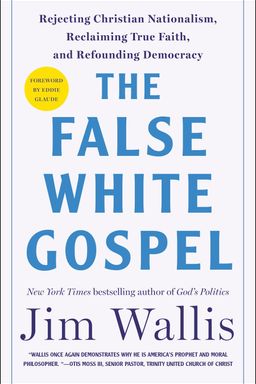
Can Christian faith help save American democracy rather than undermine it? Jim Wallis argues that it can and must. He contends that a political-religious heresy he calls the false white gospel (white Christian nationalism) now threatens both the integrity of Christian witness and the survival of a multiracial democracy. To resist it, you need a public discipleship grounded in Scripture, formed by proximity across racial and class lines, disciplined by truth-telling, and organized for civic action that protects votes, budgets for the poor, and makes peace.
Wallis’s core claim is stark: when churches trade Jesus’s priorities for ethnic power and partisan loyalty, they invert the gospel and imperil the republic. He proposes six biblical tests as a practical theology for public life and maps how to apply them to today’s flashpoints: voting rights, disinformation, poverty, policing, and war. Along the way, he shows how coalitions of conscience—from poll chaplains to budget advocates—are already pushing back. The call is not for culture-war victory but for a remnant church willing to repent, cross lines, and act.
The danger: a racialized political religion
White Christian nationalism fuses a mythic American past, whiteness as identity, and a selective reading of Scripture to preserve power. Wallis traces roots from the Doctrine of Discovery and Cotton Mather’s providential rhetoric, through pro-slavery theologies that Frederick Douglass condemned as a different religion, to modern operatives like Jerry Falwell and Richard Viguerie who helped harness evangelicalism for partisan ends. He names the current effects: MEGA/MAGA churches that sacralize party loyalty, the embrace of strongman politics (think the St. John’s Bible photo-op), and public advocates like Marjorie Taylor Greene and Doug Mastriano who frame Christian nationalism as civic salvation.
The counter-vision: Scripture as civic formation
Against this, Wallis re-centers six scriptures as public tests: neighbor love (Luke 10), the image of God (Genesis 1:26), truth that frees (John 8:32), the least of these (Matthew 25), peacemaking (Matthew 5:9), and unity across lines (Galatians 3:28). Each offers a concrete question for policymaking and congregational life. Do your politics widen the circle of neighbor? Do your laws honor every person’s divine image with full voice and vote? Do you confront lies that enslave? Do your budgets lift the least? Do you actively make peace? Do you dismantle tribal hierarchies to build one body? (Note: this approach resonates with Catholic social teaching’s common good and Black church prophetic tradition.)
Proximity that converts
Wallis insists moral change begins with proximity—deliberately crossing the color line to be formed by other people’s realities. He tells of his Detroit upbringing, a teenage job in the inner city, and how two mothers coached their sons differently about police—two worlds in one city. He points to Dietrich Bonhoeffer’s time in Harlem’s Abyssinian Baptist Church as formative for resisting Nazism. Your own pilgrimage—showing up in Black churches, immigrant sanctuaries, or under-the-bridge ministries—can rewire your moral reflexes and re-anchor your politics in people, not slogans.
From theology to tactics
Wallis moves from biblical framing to practical models: Faiths United to Save Democracy trains poll chaplains (lawyers and collars) to de-escalate tensions and protect access; the Circle of Protection reframed federal budgets as moral documents, helping secure exemptions for anti-poverty programs and later championing an expanded Child Tax Credit that briefly cut child poverty nearly in half. He highlights peacemaking as active work—from Kansas City’s gang peace summit at St. Stephen’s Baptist to Barrios Unidos’s healing programs and Witness for Peace’s nonviolent accompaniment that helped deter a U.S. invasion of Nicaragua.
The crisis of truth—and its cure
Disinformation is not just bad information; it is spiritual bondage. Wallis reads John’s gospel to show how lies enslave and fuel violence—from the Big Lie that spurred January 6 to the Great Replacement myth that influenced the Buffalo shooter’s manifesto. Churches must become truth communities that teach media literacy, correct rumors, and confront conspiracies publicly. Truth-telling, in this view, is pastoral care and civic responsibility.
A remnant church for a third founding
Finally, Wallis calls for a remnant: an ecumenical, justice-focused body that links personal discipleship with public courage—repenting of whiteness as idol, practicing Galatians 3:28 unity, and making democracy a spiritual discipline. He lifts examples like Reverend Raphael Warnock’s framing of voting as a kind of prayer, young evangelicals organizing for climate (Kyle Meyaard-Schaap), and incarcerated students whose seminary work at Sing Sing produced leaders like Bishop Darren Ferguson. Desmond Tutu’s wisdom undergirds the tone: hope is a discipline that fuels action even when evidence is bleak.
Big picture
Wallis offers a theology of democracy: love God, love neighbor, honor the image of God in everyone, tell the truth, center the least, make peace, and break tribal hierarchies. Live these convictions in public—or watch both church and democracy corrode.