
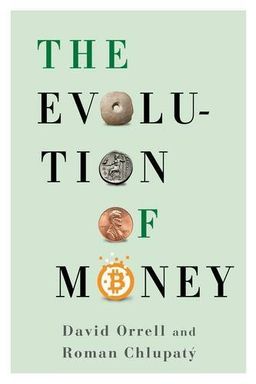
The Evolution of Money cover

The Evolution of Money

by David Orrell and Roman Chlupatý

The Evolution of Money by David Orrell and Roman Chlupatý delves into the rich history of currency, from primitive forms to today''s digital age. Discover how money functions like religion, dependent on belief, and explore the future challenges of global financial systems in this insightful journey through economic history.

Money as a Human Technology of Power and Trust

Why does money shape every part of your life—from work and politics to psychology and belief? This book argues that money is not a neutral tool or universal lubricant for trade; it is a social technology built to record, transmit, and enforce obligations, carrying with it power, trust, and political intent. The story moves from Sumerian ledgers to Bitcoin and explores why every era redefines money’s nature while repeating its conflicts between material, number, and meaning.

The myth of barter and the birth of credit

You likely learned that money arose to fix the inefficiency of barter—that early traders needed coin to exchange goods. But the archaeological record tells another story: in ancient Mesopotamia around 3000 BCE, temples and palaces operated complex credit systems. Transactions were recorded as ledger entries, not exchanges of metal. Silver (the shekel) served as a unit of account, not daily currency. This meant money began as recorded promises—a technology of accounting, backed by institutions able to enforce them.

(Note: This insight overturns generations of textbook narratives tracing a simplistic progression from barter to coinage.)

From metal stamping to empire-building

When states began stamping metal coins, they did so as acts of control, not convenience. Lydian and later Greek and Roman coinages paid soldiers, collected taxes, and spread imperial imagery—monarchs literally imprinted authority onto metal. Coinage made taxation enforceable and tied populations to their rulers. Debasement—reducing metal content while preserving face value—became a hidden tax that transferred wealth to the issuer. Economies henceforth balanced between convenience and coercion.

Money as number and matter

Every money object lives in two dimensions: physical (the coin, note, or electronic token) and abstract (its numerical and institutional value). This duality runs deep—from Pythagorean number mysticism to modern account balances—and explains why gold feels ‘real’ despite digital dominance. Money transforms qualitative value into quantitative measure, enabling global markets but also causing instability when its physical and symbolic halves diverge, as in crises where numbers outstrip real production.

The long arc: ledgers to virtual finance

Periods of scarcity tend to foster virtual money. Medieval Europe’s bills of exchange and double-entry bookkeeping prefigured modern banking. The Renaissance’s merchant families—Medicis, Fuggers—created trust networks independent of kings. The Enlightenment and mercantilist era linked currency to bullion and empire, culminating in the British gold standard. The twentieth century severed that anchor: John Law’s paper experiment showed fiat’s promise and peril; Nixon’s 1971 gold suspension completed the shift to pure fiat and credit expansion.

Power, psychology, and the post-crash era

Once money became virtual and state-backed, its creation concentrated in banks and governments. Credit cycles now drive booms and busts—Minsky warned that stability breeds speculative excess. Behavioral economists (Kahneman, Tversky, Ariely) add that money warps judgment and social norms: it triggers comparison, status-seeking, and the crowding-out of generosity. Understanding this means seeing money not as passive balance, but as a living system that affects emotions and governance alike.

Rethinking economics and designing futures

Mainstream models treated money as a ‘veil,’ excluding banks and credit entirely—until crises exposed their blindness. Today’s thinkers, from Adair Turner to Steve Keen, argue for plural, adaptive models. Experimenters test complementary currencies (Swiss WIR, Bristol Pound) and blockchain tokens (bitcoin, ethereum) to rebuild resilience and autonomy. The final vision is pluralistic: diverse monetary ecosystems—local and global, public and private—balanced between stability and innovation, between trust and technology.

Core insight

Money is a political and psychological technology before it is economic; understanding its origins, dual nature, and institutional form reveals not just how economies work, but how societies organize power, value, and trust.


Credit and the Birth of Accounting

Money began not as shiny metal but as notation—a system of trust recorded in temple and palace ledgers. In Sumerian civilization, clay tablets stored entries of barley owed, beer consumed, and fines imposed in terms of the shekel, an abstract unit of account. These records formed one of humanity’s first large-scale information systems.

Ledger money versus barter

Barter required coincidence of wants—you must find someone who has what you want and wants what you have. Ledgers solved that through credit: obligations persisted over time and circulated symbolically. Debts could be transferred, sealed in clay envelopes, and monetized far before coins existed. This virtual credit linked economic life to administration and law.

Temples as proto-central banks

Temple authorities functioned precisely like central banks: they used standardized units (shekels, minas, talents), charged interest, and periodically cancelled debts to keep society stable. Their ledgers created predictable systems of value, and the political decision to forgive debts was akin to modern monetary resets.

Modern parallels

Today’s central banks maintain virtual ledgers much as Sumerian temples did: assets and liabilities appear as entries, not metal moved across tables. The lesson is durable—money’s essence lies in recording and enforcing claims, not in physical exchange. Understanding this lineage helps you grasp why digital money, accounting standards, and institutional trust form the backbone of the modern economy.

Key insight

Money’s first purpose was to store social memory—to track who owes what—not to facilitate barter. Once you understand that, you see modern finance as an extension of ancient bookkeeping technologies.


Coinage, Empire, and the Politics of Metal

With the invention of coinage, money acquired its visible form: metal stamped with authority. But far from being just convenience, coinage served conquest and control. Coins were propaganda and payroll wrapped in silver and gold.

Lydia and the birth of stamped metal

The first coins in Lydia (7th century BCE) appeared as electrum pieces marked with royal symbols. Each stater’s value matched a soldier’s monthly wage, revealing its military purpose. Subsequent empires—from Alexander to Rome—used coinage to pay armies and enforce tax systems denominated in their ruler’s metal. Accepting those coins meant accepting imperial law and hierarchy.

Law and legitimacy

Rome explicitly married coinage and law. Coins bore the emperor’s image, and property contracts assumed value in official currency. Debasement episodes—such as the late Roman silver collapse—proved monetary power’s fragility: when rulers overstretched their privilege of issuance, inflation eroded trust and toppled administrations.

Lesson for modern states

Every coin still carries that dual message: economic denomination and sovereign identity. Today, fiat currencies continue this heritage. Inflation and monetary expansion are political acts disguised as technical policy. Seeing coinage as political technology helps you interpret why monetary crises often coincide with legitimacy crises—from hyperinflation to currency collapse.

Key insight

Coins and fiat alike are instruments of governance. Whoever controls minting or issuance controls the economy’s language of value—and thus people’s material lives.


From Ledgers to Banks: The Virtual Turn

As Europe fragmented after Rome, metal grew scarce and trade turned to paper promises. Medieval innovations—double-entry bookkeeping, bills of exchange, and letters of credit—created the infrastructure of modern virtual money. The logic that began with Sumerian ledgers returned, powered by new mathematics and trust networks.

Mathematical revolution

Arabic numerals and negative numbers (Brahmagupta’s debts as negative quantities) allowed precise accounting. Luca Pacioli’s 1494 treatise codified double-entry bookkeeping, enabling merchants to balance vast webs of credit without carrying coins. These numerical conceptual leaps transformed economic imagination.

Trust as currency

Merchant families like the Medicis managed vast bills of exchange across Europe; payment required only trust and signatures. Knights Templar operated proto-bank systems for pilgrimage finance. In all these, credibility replaced metal as the key collateral. Economic life proved that shared belief can circulate wealth more smoothly than gold.

Moral and political dilemmas

Religious bans on usury forced communities to invent workaround institutions—insurance premiums, partnerships—that balanced faith and commerce. These constraints produced a hybrid economy balancing moral norms and profit motives—a pattern repeating today with ESG investing and ethical finance.

Key insight

Every era with limited metal rebuilds money as trust and information. Banking’s virtual turn was not modern invention but historical recurrence.


Fiat Money, Credit Cycles, and Financial Instability

Fiat and credit systems gave unprecedented flexibility—but also systemic fragility. From John Law’s 1720 paper boom to the 2008 crash, the same dynamic recurs: expansion fueled by optimism, contraction triggered by lost confidence. Understanding this requires both psychology and feedback theory.

The mechanics of credit creation

In modern banking, money arises when loans are issued. Each mortgage or business loan simultaneously creates a deposit—new money—multiplying liquidity far beyond reserves. The Bank of England acknowledged this openly in 2014: banks create money by lending, not by redistributing existing funds.

Minsky’s cycle: growth and collapse

Hyman Minsky described financial stability as self-undermining. Prosperity breeds confidence, which breeds leverage, until the debt tower collapses—a Minsky moment. Positive feedback loops (rising prices, rising credit) create bubbles; negative loops restore balance but often through painful contraction.

Policy lessons

Central banks fight crises via interest adjustments or quantitative easing. Yet QE mainly benefits asset holders; direct fiscal transfers (Australia’s 2008 stimulus checks) often stabilize better. The takeaway: who receives new money matters as much as how much is created.

Designing stable systems

Full-reserve banking, negative-interest local currencies, or basic income proposals all reimagine how unit creation interacts with social welfare. Rather than treating instability as accident, reformers see it as design flaw—one correctable by changing issuance rules and feedback mechanisms.

Key insight

Credit creation is both the engine of growth and root of fragility. Managing its feedbacks—psychological and institutional—is the true art of monetary stability.


Money, Mind, and Society

Beyond economics, money shapes identity, comparison, and social norms. Behavioral and cultural evidence shows that money is not just a medium—it rewires motivation and emotion.

Psychology and bias

Kahneman and Tversky’s work reveals people value certainty and proximity over probability and delay. Money’s abstraction magnifies biases: you crave immediate gain, undervalue systemic risk, and equate numeric increase with safety. Marketers and financiers exploit these instinctive responses daily.

Status and relative wealth

Studies show happiness rises with income only up to subsistence; beyond that, relative position dominates. Millionaires express anxiety about missing peers’ success—a modern proof of John Stuart Mill’s ‘envy motive.’ The more money becomes scorekeeping, the less it improves well-being.

Social and market norms

Dan Ariely distinguishes gift and market exchanges: when you pay for what should be a gift, generosity collapses. Communities like Freecycle or Wikipedia thrive precisely by removing price tags. Designing institutions that protect social exchange—time banks, mutual credit, voluntary service—is thus social engineering as much as economics.

Key insight

Money operates not only in markets but in minds; it changes what you value and how you relate. Managing that influence consciously preserves community and mental health.


Plural Money and the Blockchain Future

The twenty-first century reopens monetary experimentation. Blockchains, local scrip, and complementary currencies diversify money’s forms beyond national fiat, reviving ancient pluralism in digital guise.

Complementary systems

The Swiss WIR mutual-credit network, founded in 1934, lets small firms trade using interest-free internal units—countercyclical and resilient. Local currencies from Ithaca Hours to Bristol Pounds reward community work and keep trade local. Negative-interest currencies like Wörgl’s scrip boosted employment by discouraging hoarding.

Bitcoin and blockchain logic

Bitcoin contrasts sharply: decentralized, proof-of-work-based, and limited to 21 million units. It eliminates need for intermediaries but introduces new constraints—energy cost, volatility, and deflationary bias. Yet the blockchain concept transcends currency; it anchors property records, smart contracts, and digital trust systems (Ethereum, Ripple).

Emergent monetary ecology

Monetary diversity—state, corporate, local, crypto—mirrors ecological diversity. Bernard Lietaer and Adair Turner advocate coexistence to enhance resilience. Just as biological ecosystems buffer shocks through variety, monetary systems benefit from plural anchors and institutional types.

Key insight

A single global currency concentrates risk; a pluralistic monetary ecology builds resilience and local empowerment.


Rethinking Economics and Designing Post-Growth Money

The book concludes by critiquing modern economics’ blind spots and by imagining humane, sustainable monetary futures. It calls for pluralism in theory, policy, and practice.

What economics missed

Neoclassical models—Arrow-Debreu, DSGE—assumed neutral money and equilibrium stability. The 2008 collapse revealed how absent banks and credit distort forecasts. Adair Turner, Steve Keen, and heterodox schools now urge complexity-based and historical approaches that reintroduce money’s institutional detail and feedback loops.

Money and ecological limits

Kenneth Boulding’s ‘cowboy vs spaceman’ metaphor defines the dilemma: growth-driven monetary systems reward exploitation; sustainable ones require circulation and balance. Reforms include money-financed basic income, full-reserve banking, and demurrage currencies that promote flow rather than accumulation.

Toward plural utopias

Rather than seeking one perfect design, the authors recommend plural coexisting systems: fiat for global exchange, local currencies for care work, blockchain tokens for transparent governance. Implemented thoughtfully, this mosaic could reconcile prosperity with planetary limits and social fairness.

Key insight

Monetary reform is climate, equity, and governance policy combined; designing money differently is designing a different civilization.

Dig Deeper

Get personalized prompts to apply these lessons to your life and deepen your understanding.

Go Deeper

Get the Full Experience

Download Insight Books for AI-powered reflections, quizzes, and more.