
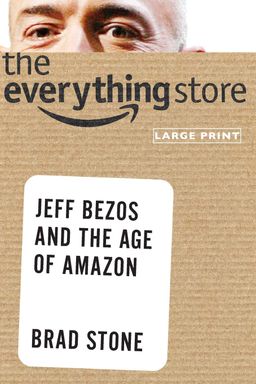
The Everything Store cover

The Everything Store

by Brad Stone

Explore the remarkable journey of Amazon from a Seattle garage to a global retail empire. Learn how Jeff Bezos'' visionary leadership and innovative strategies shaped the Everything Store, offering compelling insights for entrepreneurs and business enthusiasts.

Building the Everything Store

How does a small online bookstore transform into one of the most powerful companies on Earth? In *The Everything Store*, Brad Stone argues that Amazon’s rise rests on Jeff Bezos’s singular vision—to create an institution built around the customer rather than the product. It is a story of obsession, operational mastery, and long-term thinking that reshaped not just retail but how businesses approach innovation and platforms.

Stone traces Bezos’s path from D.E. Shaw, where he learned analytical rigor, to founding Amazon in 1994 with a simple premise: start with books, then scale to everything. You learn how Bezos’s data-driven discipline and scientific mindset built a company that prizes experimentation, customer trust, and relentless speed over comfort or convention.

Discipline and Discovery

At D.E. Shaw, Bezos mastered the art of building mechanisms—rules and processes that remove subjectivity. He imported this ethos into Amazon’s DNA: hiring bar raisers to review talent, turning customer complaints into metrics, and preferring written memos to presentation slides. His mantra—start with the customer and work backward—became Amazon’s organizing principle.

When Bezos spotted a statistic that web usage was growing at 2,300% per year, he looked for a product category large enough to exploit that surge yet simple enough to distribute. Books fit perfectly: standardized, plentiful, and easy to source from a few wholesalers. From this beachhead came the ambition to sell “everything.”

Culture by Design, Not Accident

Amazon’s internal environment was engineered with the same precision as its technology. Frugality symbolized focus—door desks replaced expensive furniture; every executive flew coach; and a “Just Do It” award celebrated risk-takers. These visible rituals enforced values that would later scale: customer obsession, ownership, bias for action, and invention.

Bezos eliminated PowerPoint in favor of six-page narratives that every participant read in silence before meetings. This ensured clarity, reduced charisma bias, and elevated substance over style. Communication itself became a strategic differentiator. (Note: similar narrative techniques later appeared at other tech giants influenced by Amazon alumni.)

Product and Process as One Strategy

Amazon’s technology originated from the same logic Bezos applied at inception: if something delights a customer or removes friction, it deserves investment. Reviews, personalized recommendations, and 1‑Click checkout may seem ordinary now, but at the time they were radical acts of trust and efficiency. These small product decisions created cumulative advantage—reducing uncertainty, increasing loyalty, and turning the site into a habit.

Stone shows that Amazon’s ambition could appear chaotic—a blur of experiments, acquisitions, and reinventions—but it followed a discernible loop: improve customer experience → lower cost → reinvest savings into speed and selection. This became the Amazon Flywheel, an engine that compounded momentum year after year.

From Risk to Resilience

The book captures not only triumphs but existential challenges. During the dot‑com crash, analyst Ravi Suria predicted Amazon would run out of cash, and morale plummeted. Bezos responded by raising European convertible bonds, mocking Suria’s calculations internally as “milliravis,” and doubling down on efficiency. Out of that near‑death came tighter discipline and the resolve that would sustain later gambles like Prime and AWS.

Ultimately, *The Everything Store* portrays Bezos as an engineer of systems—human, technical, and logistic—whose ambition radiates far beyond books and into space itself. The same method that built a retailer also built Blue Origin: a passion project grounded in patience, iteration, and the belief that long horizons unlock extraordinary outcomes. Bezos’s story teaches you that invention, when scaffolded by structure, can be made habitual.

Core idea

Amazon’s rise is not an accident of timing but the product of a deliberate system: a founder’s vision of relentless customer focus, disciplined experimentation, and operational mastery orchestrated into a self-reinforcing machine.


Inventing Culture as an Operating System

You can think of Amazon’s culture as its core software—an operating system written by Jeff Bezos to make decisions scale as fast as the company itself. Every ritual, from door desks to six-page memos, functioned as executable code in that system.

Cultural Mechanisms and Symbols

Bezos formalized Amazon’s first principles long before it became fashionable to publish them: customer obsession, ownership, frugality, and bias for action. These weren’t abstractions—they were rituals. Paying for your own parking and building your own desk reinforced thrift. The “Bar Raiser” program ensured every new hire lifted the average talent bar. Even the “Just Do It” award—a beat‑up pair of Nike shoes—turned initiative into heroism.

Clarity Through Writing

Where most companies rely on charisma, Amazon relies on prose. PowerPoint is banned. Six-page narratives force deep thought; mock press releases make teams articulate customer value before building anything. These mechanisms favor thinkers who reason from first principles rather than consensus. (Parenthetical note: this practice echoes the writing rigor of early Intel and later influenced leadership practices at LinkedIn and Airbnb.)

The Cost and Power of Obsession

The same intensity that produces excellence creates strain. Stone documents long nights, emotional churn, and high attrition. Bezos openly preferred “missionaries over mercenaries,” people animated by purpose more than perks. Employees who stayed shared a near‑religious devotion to customers and data; those who left often did so burnt out but proud.

Lesson

Culture can’t stay aspirational—it must be operational. The mechanisms you design become the behaviors you get.

Amazon’s engineered culture—frugal, analytical, and customer-obsessed—became the invisible architecture that let it scale faster and think longer than rivals resistant to such structure.


From Features to Flywheel

Amazon’s breakthrough wasn’t just cheap prices—it was inventing an interface that trained customers to trust digital purchases. Each new feature reinforced that trust and thereby accelerated the Flywheel: growth driving lower costs, enabling more innovation, yielding faster growth.

Reengineering Trust

User reviews, once radical, gave buyers social proof; 1‑Click made checkout instant; personalized recommendations (“people who bought this also bought…”) turned shopping from a search into discovery. These elements were engineered by Shel Kaphan, Eric Benson, and Greg Linden not as gimmicks but as friction killers. Each reduced cognitive load, increasing purchase frequency.

Operational Muscle Becomes Strategy

Behind every front‑end innovation, Amazon built back‑end capacity—distribution centers, order routing software, and metrics dashboards—to ensure reliability at scale. This focus culminated in Jeff Wilke’s operations overhaul: algorithmic inventory placement, elimination of wave batching, and relentless measurement. The result was faster delivery and lower unit costs that competitors couldn’t easily match.

Prime and the Behavior Lock-in

Prime in 2005 demonstrated what happens when logistics meets psychology. Conceived from an internal suggestion, Prime turned expedited shipping into a paid membership that changed customer behavior. Even though each package initially lost money, members bought far more often. The subscription solidified brand loyalty, triggered seller adoption of Fulfillment by Amazon, and transformed two‑day shipping into the new industry standard.

Core concept

Operational excellence isn’t an efficiency play—it is a customer‑experience weapon that powers the Flywheel, turning logistics into growth.


Platform Power and Marketplace Evolution

As Amazon matured, it faced a critical question: could it grow beyond its own inventory? The answer birthed its real transformation—from retailer to platform—through a series of experiments that started with failures and ended with Marketplace’s defining success.

Failures that Taught Scale

Amazon Auctions, zShops, and the Junglee acquisition each tried to expand Amazon’s footprint. Yet Auctions couldn’t overcome eBay’s community advantage, and Junglee’s comparison-shopping model sent customers elsewhere. Each failure, however, refined Bezos’s understanding of network dynamics: selection wins only when it’s embedded inside the customer journey, not offered as a detour.

Marketplace’s Breakthrough Insight

Marketplace merged seller offers directly onto Amazon’s own product pages. Suddenly customers could choose between Amazon and third parties without leaving the site. This small design choice generated massive impact: selection expanded without capital, sellers gained traffic, and Amazon collected commissions. Internal retail teams hated it, but Bezos enforced it—the customer always came first.

From this foundation came Fulfillment by Amazon (FBA), which let merchants store goods in Amazon’s warehouses, piggybacking on its delivery promises. Marketplace plus FBA evolved into a self-reinforcing platform—millions of independent businesses powering Amazon’s inventory engine.

Strategic insight

When you control the catalog and the customer interface, you can let others bear inventory risk while deepening customer trust through consistent experience.


Disruption, Conflict, and Expansion

Stone illustrates that Amazon’s growth often came through confrontation—against competitors, suppliers, and even its own executives. Conflict, for Bezos, was a sign of truth‑seeking, not dysfunction.

Ruthless Inside, Relentless Outside

The Milliravi episode, when analyst Ravi Suria predicted bankruptcy, crystallized Amazon’s siege mentality: financial survival demanded speed and boldness. Internally, Bezos clashed with senior hires like Joe Galli and early architect Shel Kaphan, proving that culture had to scale faster than people’s egos. Roles changed, loyalty was tested, but the mission stayed steady.

Killer Instinct and Competitive Tactics

You later see this combative instinct turned outward. Endless.com’s short‑term war forced Zappos to capitulate; Amazon Mom crushed Quidsi before buying it; and Lovefilm’s planned IPO in Europe was blocked to secure Amazon’s acquisition. These plays show how Bezos used pricing pressure and logistical leverage as strategic weapons. (Note: similar aggression drew comparisons to Walmart’s channel dominance, adapted for the digital era.)

Even partners felt the heat. Brands like Wüsthof saw their premium products discounted below MAP due to algorithmic price matching. Marketplace democratized access but also exposed companies to relentless transparency, forcing them either to adapt or exit.

Trade-off

Amazon’s customer-first principle often meant competitor-last. The same mechanisms that built loyalty also concentrated power and controversy.


Beyond Retail: Kindle, AWS, and Blue Origin

After conquering retail, Bezos turned to new frontiers—digital publishing, cloud computing, and space—each extension applying Amazon’s core DNA: think long-term, build primitives, and iterate relentlessly.

Reinventing Reading with Kindle

The Kindle emerged from Lab126’s secret “Fiona” project in Palo Alto. Bezos aimed to make every book instantly available, so he demanded wireless connectivity and eye-friendly e‑ink. The launch in 2007 included a shock: bestsellers priced at $9.99, enraging publishers but delighting readers. The move accelerated e‑book adoption and triggered industry realignment culminating in legal battles over Apple’s collusion with publishers.

Building the Cloud: AWS

AWS began as an internal effort to untangle Amazon’s infrastructure bottlenecks, led by Andy Jassy, Chris Pinkham, and Chris Brown. Inspired by Steve Grand’s concept of building from primitives, they launched S3 and EC2—storage and compute as modular services. Bezos likened it to electricity: companies no longer needed their own generators. AWS lowered barriers for startups and gave Amazon a lucrative second business line that subsidized its retail ambitions.

Blue Origin and the Long View

Bezos’s passion for exploration extended into Blue Origin, his private space company guided by the motto “Gradatim Ferociter”—step by step, ferociously. Modeled on Amazon’s iterative methods, it invested in reusable rocket technology and long-term human spaceflight prospects. Rather than quick profit, Bezos treated it as an investment in civilization’s future options.

Final takeaway

Whether launching e-books, cloud platforms, or rockets, Bezos applies a single formula: combine patience, technical leverage, and willingness to antagonize incumbents in pursuit of transformative scale.

Dig Deeper

Get personalized prompts to apply these lessons to your life and deepen your understanding.

Go Deeper

Get the Full Experience

Download Insight Books for AI-powered reflections, quizzes, and more.