
Idea 1
Mastering the People Side of Business
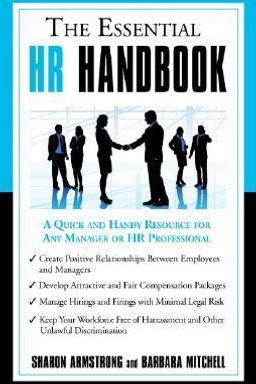
What truly makes organizations succeed—their technology, their strategy, or their people? The Essential HR Handbook by Sharon Armstrong and Barbara Mitchell argues that in the modern workplace, human resources is not just an administrative function—it’s the beating heart of organizational success. The authors contend that the ability to hire, grow, engage, and retain talented people is not merely an HR concern but a strategic imperative for every leader. Whether you’re a manager, a small-business owner, or an HR professional, understanding how to navigate the human side of work can make the difference between thriving and merely surviving.
Armstrong and Mitchell reframe HR as a holistic discipline that drives business strategy. They blend decades of experience with actionable tools, revealing how human capital management links directly to productivity, innovation, and profitability. Their central message is that HR is everyone’s job—a shared responsibility that requires clarity, compassion, and compliance. They believe that when people practices are aligned with organizational goals, performance soars and cultures flourish.
From Administrative HR to Strategic Leadership
The authors begin by redefining HR’s role. Once seen as a back-office function focused on payroll and policies, HR is now recognized as a strategic partner that helps shape the organization’s vision and purpose. This evolution from the “personnel department” to strategic HR mirrors the shift from managing people as costs to nurturing them as assets. The opening chapters detail how HR leaders should participate in developing mission statements, conducting workforce planning, and integrating HR objectives with organizational strategy.
In this vision, HR professionals must understand not only people processes but also business fundamentals—finance, marketing, and operations—to align human capital with business outcomes. They become storytellers translating organizational strategy into motivational energy for employees. The authors use practical questions—like “Do your people understand how their work fits into the company’s mission?”—to push managers toward strategic clarity.
The Employee Lifecycle: From Hire to Inspire
Armstrong and Mitchell organize the book around the employee lifecycle—acquisition, onboarding, development, performance, compensation, relations, and retention. Each chapter provides realistic advice for both seasoned HR professionals and those managing HR alongside other duties. In the hiring process, they warn against “emergency recruiting” and emphasize planning tied to organizational needs. Recruiting, they argue, is marketing—your culture is your brand. They detail behavioral interviewing techniques and provide sample questions such as “Tell me about a time you had to adapt to major change.” Their approach moves beyond checking boxes toward uncovering how candidates think, communicate, and collaborate.
Once employees join, onboarding becomes the crucial bridge between promise and performance. A mere orientation session isn’t enough; effective onboarding integrates new hires into culture, purpose, and relationships. Armstrong and Mitchell highlight practical steps—like using a “buddy system” and regular check-ins—to ensure engagement and early productivity. They quote data showing companies with robust onboarding enjoy double the profit growth of those without it.
Ongoing Development as a Retention Strategy
The book emphasizes that professional development isn’t a perk—it’s survival. In today’s knowledge economy, learning agility is one of the most valuable traits. The authors introduce concepts like individual development plans (IDPs), mentoring, and coaching as methods to unlock employees’ potential. They explain adult learning theory—adults need to see relevance, autonomy, and immediate application in what they learn. This insight leads to actionable advice: tailor training to the learner’s style, mix generations for cross-learning, and measure outcomes through the Kirkpatrick model of evaluation.
They champion “learning organizations,” echoing Peter Senge’s The Fifth Discipline, where everyone continuously improves both skills and systems. Viewed this way, talent development becomes part of a company’s DNA—integrated into everyday practice rather than episodic training sessions.
Performance Management Reimagined
Few topics provoke more dread than performance appraisals. Armstrong and Mitchell demystify this process, tracing its flawed history—from Jack Welch’s infamous “rank and yank” era to modern, feedback-driven alternatives. They urge readers to replace annual reviews with continuous coaching conversations that focus on growth rather than judgment. The manager’s role, they write, is to “encourage improvement, not enforce perfection.” Their BEER (Behavior, Effect, Expectation, Result) feedback model offers a simple and humane conversation structure. Regular “check-ins” nurture engagement and trust—both crucial retention factors in an era of rapid job-hopping.
Importantly, they balance empathy with accountability: feedback must be specific, timely, and tied to measurable outcomes. In contrast to pop-management trends, they argue performance systems shouldn’t vanish but evolve—serving development, succession planning, and cultural alignment.
Compensation, Benefits, and the Fair Deal at Work
The middle of the book expands on pay and benefits, offering detailed frameworks for equitable and competitive compensation. Michael Strand’s chapters provide technical insight into market pricing, pay ranges, and equity adjustments—translating complex formulas into accessible guides. The message is consistent: fairness is both moral and strategic. Employees who feel valued stay motivated; those who perceive inequity disengage or leave. Benefits, from health insurance to flexible work arrangements, are reframed as part of “total rewards”—expressions of an employer’s respect for whole-person wellbeing.
Strand reminds readers that the cost of benefits can reach 30 percent of total compensation, underscoring their weight in employee satisfaction and retention. Rather than treating them as expenses, leaders should view them as investments in loyalty and productivity.
Diversity, Inclusion, and the Modern Workforce
The text devotes meaningful attention to diversity, equity, and inclusion—not as buzzwords but as business essentials. They expand the definition beyond visible traits like gender or race to include invisible elements: thought diversity, communication style, life experience. Diversity councils, mentorship programs, and flexible recruitment pipelines are recommended tools to embed inclusion into strategy. The authors echo thought leader Vernā Myers’s famous quote, “Diversity is being invited to the party; inclusion is being asked to dance.” The goal, they write, is creating a culture where everyone contributes fully to shared goals.
Armstrong and Mitchell show that inclusive organizations outperform peers because they attract wider talent pools and understand diverse markets better. They encourage HR leaders to measure diversity’s impact—representation at all levels, retention rates, and employee voice.
Navigating Law, Technology, and Workplace Challenges
The book’s later chapters are pragmatic handbooks on staying compliant and future-ready. Employment law expert Paul Mickey outlines essentials—from discrimination and ADA compliance to wage laws and terminations—grounding the reader in risk management. Then, huge attention is given to technology: HRIS systems, analytics, and self-service portals that automate admin work and free HR for strategic initiatives. They explore data ethics, privacy, and the risks of social media and cyber breaches, advocating strong governance and digital literacy.
Finally, the authors address today’s evolving landscape—hybrid work, generational shifts, well-being, the opioid crisis, and globalization. Each issue is treated as an opportunity for leadership rather than a stumbling block. Their tone remains assuring: HR’s tools may change, but the heart of the profession—respect, communication, and fairness—endures.
Core Message
At its core, The Essential HR Handbook is a playbook for creating thriving workplaces. It teaches that strategy succeeds only when people flourish, and that every leader—regardless of title—shares responsibility for crafting that environment. By merging practicality, empathy, and business acumen, Armstrong and Mitchell turn HR from a support function into a source of competitive advantage.