
Idea 1
The Case for a Colorblind America
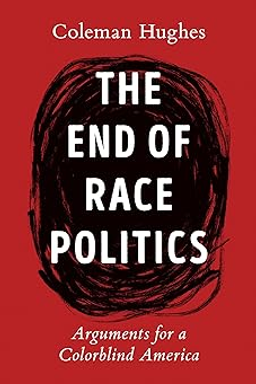
What would it mean to truly see beyond race? In The End of Race Politics, Coleman Hughes argues that America’s next civil rights movement must reject the pervasive obsession with racial identity and recommit to the colorblind ideals at the heart of the original one. Hughes contends that what now passes for “anti-racism” has metastasized into neoracism—an ideology that cloaks itself in the rhetoric of justice while reviving the same race-based thinking that past generations fought to abolish. To move forward, he says, the nation must return to a vision of moral equality that measures people by their character, not skin color.
Colorblindness, in Hughes’s framing, is not a call to ignore difference but to remove race as a factor in how we treat others privately and how we design public policy. Throughout the book, he explores how race-based frameworks in education, government, and culture—even when meant to fight racism—entrench division and injustice. The idea that discrimination can fix discrimination, he argues, is not progress but a dangerous illusion.
From Personal Story to National Diagnosis
Hughes opens with his own experience: a black and Hispanic child in New Jersey who barely thought about race until elite schools and progressive institutions forced him to. A lesson he learned as a teen at a “People of Color Conference” haunts the rest of the book: he was told that having his hair touched out of curiosity was a microaggression, a “microdose of the same poison” that killed Emmett Till. That reframing—of irritation as victimization—revealed how an ideology of racial essentialism could turn curiosity or normal discomfort into moral transgression. When he later saw that same worldview dominate his college experience at Columbia, Hughes realized that the so-called anti-racist revolution was deepening racial consciousness, not dissolving it.
He positions neoracism as the successor to both segregation and white supremacy, claiming the same foundation: the belief that race defines moral meaning. Authors like Ibram X. Kendi and Robin DiAngelo, he says, have institutionalized a new racial etiquette—one that demands submission to collective guilt and racialized rules of speech. Hughes warns that this new creed, dominant across universities, corporations, and media, “brands itself anti-racist yet operates as the mirror image of what it condemns.”
Why Colorblindness Still Matters
For Hughes, colorblindness isn’t naivety or denial—it’s an ethical commitment. Like Martin Luther King Jr. and Frederick Douglass before him, he sees it as the only workable principle for a multiethnic democracy. Race, Hughes reminds us, is partly social fiction and partly biological shadow. It has no fixed scientific basis, yet society uses it as though it were destiny. Policies that depend on racial classification—whether to segregate, preferentially hire, or shape education—force impossible questions: Who counts as black or Hispanic? How black? By what ancestry or perception? From the absurd pencil tests of apartheid to today’s grant applications asking for blood fractions or checkboxes, Hughes sees bureaucracy repeating moral mistakes in new forms.
He argues that if America’s historic evil was discrimination by race, many now embrace its “progressive” inversion—discrimination in favor of some races. Both rest on the same flawed logic. To heal, we must, as King put it, eliminate “the idea of race” from politics altogether. Hughes connects this not only to moral clarity but to practical justice: race-based policies fail because racial identity is a crude proxy for the problems—poverty, disadvantage, and exclusion—that policy actually seeks to solve. Income, education, and opportunity make far better measures.
The Cost of Race Obsession
Hughes traces how an age of moral victory—the Civil Rights Act of 1964—was swiftly followed by backsliding. Within years, he shows, government, corporations, and universities replaced segregation with quotas. What began as an effort to abolish racial distinctions gave way to programs that required them. The contradiction, he says, explains the rise of today’s polarized racial politics, where elite “diversity” initiatives coexist with racial resentment. America, he warns, has normalized what Justice John Marshall Harlan condemned in 1896: the idea that government should see color.
Through the book’s six main parts, Hughes dismantles the myths sustaining neoracism—from the Disparity Fallacy (assuming that unequal outcomes always prove racism) to the Myth of Undoing the Past (believing new discrimination can correct historic wrongs). He draws on logic, data, and history to show that neoracism not only misdiagnoses but worsens inequality. Racism, he notes, is not healed by condemning one tribe and sanctifying another; it’s cured when we build systems that treat every individual fairly, blind to race.
Why This Argument Matters
For readers exhausted by the new moral theater of guilt and grievance, Hughes’s case offers both critique and hope. He writes not to dismiss the reality of racism but to insist that the cure matches the disease. “We can’t fight bias by institutionalizing it,” he says. His aim is not ideological reversal but ethical consistency: the same principle for all. The dream of colorblindness isn’t about blindness at all—it’s about vision clear enough to see people as more than proxies for their race. In an America tempted to trade old hierarchies for new ones, Hughes asks us to remember why the first revolution against race politics succeeded—and what it will take to finish it.