
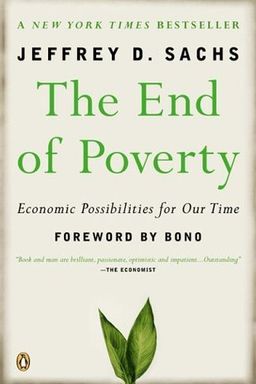
The End of Poverty cover

The End of Poverty

by Jeffrey Sachs

The End of Poverty is Jeffrey Sachs'' compelling guide to eradicating extreme poverty worldwide. This insightful book explains how strategic investments and lessons from successful economies can transform the lives of millions, highlighting the achievable goal of global equity.

Ending Extreme Poverty Is Achievable

Jeffrey Sachs argues that the end of extreme poverty is not a utopian fantasy but a realistic, data-driven, and ethically urgent project. His book presents the world economy as a vast ladder of development—one where some people stand high above, supported by infrastructure, technology, and institutions, while more than a billion remain stuck on the ground, unable to reach the lowest rungs. According to Sachs, the pressing question is not whether the poor can climb, but what precise investments and policies will help them do so.

The Global Development Ladder

You can picture the global economy divided into four broad tiers. At the bottom live the extreme poor—those surviving on less than a dollar a day—followed by the moderately poor, the emerging middle-income nations, and finally the high-income world. Sachs illustrates these tiers vividly: a starving household in Nthandire, Malawi struggling with depleted soils; a garment worker in Dhaka working her way into industrial footing; and a Chennai IT transcriber participating in global service industries. The distance between these levels, he argues, is not infinite. It can be bridged through targeted interventions, chiefly in health, agriculture, education, and infrastructure.

Diagnosis Before Prescription

Sachs’s signature contribution is the idea of clinical economics: treat each country like a patient. Instead of one-size-fits-all ideological solutions, you conduct a differential diagnosis, identifying the country’s binding constraints—whether poor soil fertility, corrupt governance, high disease burden, or debt overhang—and design tailored remedies. This parallels the transformation in medicine over the past century: precise diagnoses replaced magical thinking and produced real cures.

In Bolivia, Sachs’s diagnosis revealed runaway central-bank financing of deficits as the root of hyperinflation; the treatment—ending fuel subsidies, tightening fiscal control, and negotiating debt relief—stabilized prices. In Poland, the diagnosis was systemic collapse after communism, treated through quick liberalization, Zloty stabilization, and external financing. Both show how truthful diagnosis, political courage, and international cooperation create recoveries that stick.

Health, Ecology, and the Poverty Trap

Central to Sachs’s thesis is how health and ecology trap Africa’s poorest. Malaria, AIDS, and tuberculosis devastate communities, remove working adults, and deter investment. The root is not culture or character but biology and geography. Africa’s dominant mosquitoes bite humans almost exclusively, and its warm climate accelerates parasite development, giving malaria extraordinary power. These ecological facts explain why malaria remains entrenched in Africa but was eliminated in cooler regions. Yet Sachs insists it can be controlled: long-lasting insecticidal nets, modern medications, and community clinics can dramatically reduce fatalities at affordable costs.

In Malawi’s Nthandire or Kenya’s Sauri villages, poverty, hunger, and disease reinforce each other. When outside aid supplies fertilizer, bed nets, and clinics—as in the Millennium Villages—the loop begins to break. Food production rises, school attendance improves, adults return to work, and saving becomes possible. The cost of transformation, Sachs shows, can be as little as $70 per person per year.

Global Goals and Collective Action

This logic underpins the Millennium Development Goals (MDGs)—a United Nations framework that benchmarks global progress in halving poverty, improving health and education, and promoting environmental sustainability. Sachs, who directed the UN Millennium Project, framed them as the halfway station to ending poverty entirely by 2025. The MDG approach unites analytical rigor with moral commitment: set measurable goals, diagnose constraints, cost the needed investments, and hold both donors and governments accountable.

To finance those investments, Sachs calls for donor nations to honor the 0.7% of GNP aid target agreed decades ago. He emphasizes that the sums are trivial relative to rich-country income yet transformational for the poor. The shift from neglect to global institutions—such as the Global Fund to Fight AIDS, Tuberculosis, and Malaria—shows collective action can emerge when analytical evidence (WHO’s Commission on Macroeconomics and Health), moral persuasion (Paul Farmer’s HIV treatment successes), and political leadership (Kofi Annan, Bono) converge.

Learning from Success and Overcoming Myths

Throughout, Sachs rebuts fatalistic myths—that aid fails, that Africa is doomed by corruption, or that markets alone can lift the poor. He demonstrates that past aid was too small and intermittent to test properly. Where financing was adequate and well-governed—South Korea, China, the Green Revolution, or child immunization programs—the results were transformational. The lesson: aid works when it is clinically targeted, adequately funded, and locally owned.

Across its case studies—from Bolivia’s stabilization and Poland’s re-emergence to Africa’s fight against malaria and India’s IT surge—the book tells one integrated story: poverty can end through diagnosis, technology, and solidarity. With the world’s wealth, science, and moral capacity aligned, Sachs argues, the historic project of ending extreme poverty by the early 21st century is within reach—and failing to act is not economic realism, but ethical blindness.


Diagnosing Why Nations Fail

Not all poor countries are poor for the same reasons. Sachs’s framework for understanding stagnation distinguishes eight mechanisms that trap societies below the first rungs of the development ladder. You, as a policymaker or analyst, must learn to separate symptoms (like inflation or hunger) from structural causes (like geography or disease).

Common Development Traps

The Poverty Trap occurs when households are too poor to save or invest. Without capital, they cannot improve productivity, and as soils degrade or machines wear out, incomes keep falling. The Fiscal Trap binds governments that cannot raise revenue for essential services. Corruption and poor governance worsen it by misallocating scarce funds.

The Geography Trap highlights how landlocked or disease-prone regions face higher transport costs and weaker market access (Bolivia’s mountains, sub-Saharan Africa’s malaria belt). Yet physical geography is not destiny: investments in infrastructure and health can neutralize these disadvantages. Sachs contrasts Bolivia’s logistical struggles with coastal China’s trade arteries to show how location magnifies growth differences unless offset by policy.

Innovation, Demography, and Culture

Innovation depends on scale—large markets, research funding, and public goods. Poor countries lack all three, thus perpetuating dependence on outside technologies. The Demographic Trap adds pressure: high fertility divides limited land and resources, leaving families unable to invest in each child’s education. Reducing fertility through girls’ education and reproductive health creates long-term growth dividends (mirroring East Asia’s demographic transition).

Cultural and geopolitical barriers further distort development. Norms that exclude women from education or politics waste half of society’s talent. Sanctions and regional conflicts cut trade and trust. Sachs avoids cultural blame—it’s policy design, not inherent values, that determines whether norms evolve toward inclusion.

Key Lesson

The right remedy depends on accurate diagnosis. Just as malaria and malnutrition produce the same symptom—weakness—but need different treatments, so do nations require different policy mixes based on their precise binding constraint.

Sachs’s diagnostic map guides you to ask pragmatic questions: Is poor health cutting labor productivity? Is high debt blocking investments? Is weak governance deterring business? The art of development, he argues, lies in clinical reasoning—look for constraints, not headlines—and combining local data with global expertise to produce customized solutions.


Clinical Economics in Practice

Sachs’s concept of clinical economics transforms development policy from ideology into craft. Just as a physician cannot cure every disease with the same pill, no economist should apply blanket prescriptions to complex national systems. The goal is to diagnose constraints, prescribe interventions, monitor results, and adjust with evidence.

Borrowing Lessons from Medicine

Modern medicine evolved through empiricism—careful diagnosis, testing, and feedback. Sachs imports five medical principles: economic systems are interconnected; symptoms have many causes and require differential diagnosis; social context matters; continuous monitoring ensures accountability; and professional ethics demand truth-telling, not political convenience.

Applying Clinical Economics

A seven-part checklist guides any national assessment: poverty mapping, policy framework, fiscal health, geography and disease ecology, governance, cultural barriers, and geopolitical context. The approach rejects ideology in favor of patient-specific prescriptions. In Bolivia during 1985, this method revealed that central-bank monetization of deficits—exacerbated by a distorted fuel pricing regime—was the true driver of hyperinflation. The cure was tough: raise domestic fuel prices, impose fiscal restraint, and restructure debt. The treatment worked within weeks, proving that clinical precision can outperform formulaic austerity.

Still, Sachs underscores ethics: the economist’s role is akin to a doctor’s duty—not to please funders, but to tell the truth about needed remedies even when politically challenging. In this view, development becomes an applied science built on data, compassion, and accountability, replacing ideological prescription with measurable healing.

Once you grasp clinical economics, aid policy becomes coherent. You can align interventions with pathology—roads where isolation is binding, bed nets where malaria kills, fertilizers where yields are low. The methodology restores credibility to development work, moving it from opinion-driven aid toward evidence-based transformation.


From Disease to Development in Africa

Nowhere is the intersection of health and poverty more visible than in sub-Saharan Africa. Sachs presents malaria and AIDS not only as humanitarian crises but as economic epidemics that prevent accumulation of human and physical capital. The costs are visible in households where grandparents raise orphans and clinics run out of basic drugs.

The Disease–Poverty Feedback

Disease causes poverty by killing or weakening workers and eroding incentives for long-term investment. Poverty, in turn, perpetuates disease by denying access to prevention and care. Sachs describes this vicious cycle vividly: malaria makes countries too poor to afford prevention, keeping malaria endemic. Yet this cycle can be broken through inexpensive but high-coverage interventions—bed nets, indoor spraying, and antimalarial drugs—combined with nutrition and sanitation improvements.

Understanding Africa’s Unique Malaria Ecology

Africa’s challenge is biological and climatic. The dominant mosquito species feeds almost exclusively on humans, transmitting the deadliest malaria parasite in warm, humid climates ideal for its life cycle. This creates a force of transmission many times stronger than elsewhere, explaining persistent prevalence. Europe and the U.S. eradicated malaria decades ago largely because their mosquito species preferred animals and faced cooler climates; those same tools fail under African conditions unless scaled massively.

Sachs translates this science into policy: focus on sustained coverage, integrate health with agriculture and infrastructure, and match technology to ecology. He cites Sauri, Kenya, where re-opening the clinic, distributing bed nets, and improving food production turned decline into progress.

From Neglect to Global Mobilization

Until the early 2000s, donor aid for malaria and AIDS was negligible. Through the WHO Commission on Macroeconomics and Health, Sachs, Gro Harlem Brundtland, and colleagues quantified the economic cost of poor health and the benefits of investment. Linking economic rationale to moral urgency, they convinced world leaders to act. This led to the creation of the Global Fund to Fight AIDS, TB, and Malaria, leveraging billions for lifesaving programs worldwide. Paul Farmer’s work in Haiti and the Harvard Consensus statement proved that antiretroviral therapy could succeed even in poor rural areas, defeating the myth that treatment was impractical for Africa.

The lesson for you is clear: health is not charity; it is infrastructure for productivity. By scaling simple, proven health investments, entire regions can escape the disease–poverty trap and begin the climb toward sustained development.


The Role of Aid and Global Goals

Sachs sees aid not as charity but as catalytic investment. The world’s poorest remain trapped because they cannot generate the small surpluses to invest in capital, infrastructure, or human capacity. External assistance can bridge that threshold, allowing countries to save and grow autonomously thereafter.

How Aid Breaks the Trap

In simple economic terms, without external input, capital per person declines as populations rise. Modest aid injections—fertilizer distribution, clinic construction, teacher salaries—lift output, creating virtuous circles. Sachs calculates that roughly $65 per capita per year in donor support can finance the needed public goods for countries to achieve the Millennium Development Goals (MDGs). With only 0.7% of rich-country GNP, global donors could fund this transformation—and still spend less than military or farm subsidies consume annually.

Millennium Goals as Midpoint Milestones

The MDGs provided time-bound targets—halving poverty, achieving universal education, reducing child and maternal mortality—that transformed aspiration into accountability. Sachs’s leadership of the UN Millennium Project delivered a roadmap: identify national gaps, cost out solutions, coordinate donors, and monitor results. Sauri, Kenya, exemplifies how $70 per person annually—covering seeds, clinics, and school lunches—can double incomes and reduce malaria deaths. Scaling this model globally requires predictable financing and shared responsibility among donors and local communities.

From Political Promises to Performance

Sachs connects aid effectiveness to governance. Programs work best where transparency and community oversight ensure accountability. Thus, the MDG process combines moral commitment with quantitative discipline: track metrics, publish data, and learn systematically. In this sense, global goals are not bureaucratic checklists but a practical experiment in collective problem-solving.

When aid flows are coordinated, purposeful, and monitored—as in successful health campaigns or postwar recovery projects—growth and human welfare expand jointly. Sachs’s argument is that well-designed aid is not about dependency; it is the bridge to self-reinforcing prosperity, analogous to a doctor’s initial treatment enabling a patient’s long-term immune recovery.


Scaling What Works

Sachs leaves no room for the defeatist notion that large-scale change is impossible. The world has repeatedly demonstrated that coordinated effort, technology, and financing can solve massive public problems—from eradicating smallpox to doubling crop yields. The central question is not whether solutions exist, but how to scale them effectively.

Proven Models of Scale

Historical successes show how global mobilization works: the global eradication of smallpox, the polio campaign led by WHO and Rotary International, and the child survival movement’s GOBI package all relied on empirically proven interventions, clear logistics, and relentless monitoring. In agriculture, Norman Borlaug’s Green Revolution multiplied cereal yields through hybrid seeds, fertilizers, and irrigation—an example of science meeting political will. Sachs argues that similar technical revolutions, such as agroforestry and soil restoration in Africa, can mirror these gains if properly financed.

Economic and Technological Scaling

Beyond health and agriculture, organizational innovations—like export processing zones or Grameen’s village-phone microfinance model—illustrate scalable social technologies. Both blend private enterprise with public coordination, using design rather than ideology to meet people where they are. The guiding principle: start small, prove results, then replicate through institutional networks and predictable funding.

For malaria, for instance, combined scaling of insecticide-treated bed nets and artemisinin-based therapies at national levels has already cut deaths dramatically in countries like Ethiopia and Rwanda. Successes like these reveal the compound impact of coordination—technical ingenuity supported by strong governance and community participation.

Overcoming Myths and Building Trust

Critics often claim aid fails due to corruption or waste. Sachs counters that most aid flows have been too modest or inconsistent to gauge fairly, and where funding matched needs—such as PEPFAR or debt cancellations for Poland—the results were transformative. Governance, he insists, improves with rising incomes and transparency; the solution is not to withhold aid, but to design it with accountability—audits, data transparency, and local involvement.

The ultimate message: large-scale change is possible when proven solutions are delivered systematically, guided by evidence, and amplified through global partnership. Ending extreme poverty is not a single act but a process of scaling compassion through disciplined implementation—a moral commitment married to managerial precision.

Dig Deeper

Get personalized prompts to apply these lessons to your life and deepen your understanding.

Go Deeper

Get the Full Experience

Download Insight Books for AI-powered reflections, quizzes, and more.