
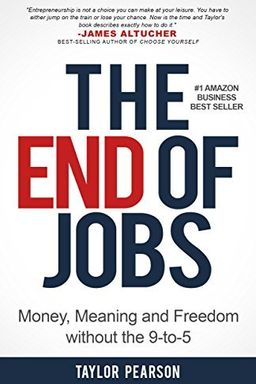
The End of Jobs cover

The End of Jobs

by Taylor Pearson

The End of Jobs by Taylor Pearson explores the rise of entrepreneurship as a safer, more profitable alternative to traditional employment. By examining historical trends and modern technological advances, the book presents a compelling case for why now is the ideal time to embrace entrepreneurial ventures for greater freedom and meaning.

The End of Jobs: The Shift from Employment to Entrepreneurship

What if the future of work didn’t center on jobs at all, but on individuals? In The End of Jobs, Taylor Pearson argues that we’ve reached a historic turning point: traditional employment—long considered the safest and most lucrative path—is no longer either. Instead, he contends that the most secure and fulfilling future belongs to those who think like entrepreneurs. The promise of a stable career has disintegrated in the face of globalization, automation, and technological acceleration, ushering in what Pearson calls the Entrepreneurial Economy.

Drawing on history, economics, and real-life examples from digital entrepreneurs worldwide, Pearson makes the case that humanity has entered a new phase where creativity, flexibility, and ownership are the true levers of wealth and meaning. He argues that the rise of the internet and the democratization of tools, production, and distribution have made entrepreneurship safer and more accessible than any job could ever be. Ironically, the very same forces that are destroying jobs are expanding opportunity for those willing to seize it.

The Collapse of the Job Economy

Pearson begins with an alarming observation: the job market as we know it is vanishing. The 20th-century assumption that college leads to job security is no longer true. When a law firm in Atlanta requires its file clerks to hold college degrees, while graduates like Landon and Megan struggle under crushing debt for low-level roles, it’s clear credentials have stopped guaranteeing opportunity. The rise of global competition and automation is eroding the very foundation of traditional employment.

He calls this moment “Peak Jobs.” Every historical revolution—from the agricultural to the industrial to the knowledge era—thrived when society addressed its central economic limit. Today, that limit has shifted again: from knowledge to entrepreneurship. Knowledge is abundant in a world where anyone can learn from YouTube or MIT online. The scarce resource now is the ability to create new systems, to build rather than follow them.

The Rise of the Entrepreneurial Economy

Pearson proposes that we’ve entered a fourth economic phase, the Entrepreneurial Economy, following the Agricultural, Industrial, and Knowledge eras. Each period had a scarce resource: land, capital, knowledge—and now entrepreneurship. In this new era, individuals can use globally available tools, markets, and technology to build independent businesses that were once only possible for large corporations. The playing field is flatter than ever.

Entrepreneurs like Dan Andrews in Asia, Rob Walling running software companies, or Jesse Lawler managing developers remotely embody this shift. All of them run “micro-multinationals,” leveraging low-cost global talent, powerful cloud tools, and niche online markets. They are, as Pearson describes, overwhelmed by opportunity. Traditional job-seekers, by contrast, are trapped in outdated systems chasing scarcity where none remains.

Technology, Globalization, and the End of Stability

The engines driving this shift are unstoppable: rapid globalization, technology, and the internet. The same innovations that allow you to call a designer in Manila or a coder in Mumbai for $20 an hour also enable you to sell to customers worldwide. Pearson describes this world as “Extremistan”—borrowing from Nassim Taleb—a realm of extremes where a few win big and the middle class erodes. In Extremistan, predictability vanishes, and fragile systems (like stable jobs) collapse, while adaptive, entrepreneurial people thrive.

He warns that clinging to Mediocristan’s stability—where average effort rewarded steady careers—makes you a turkey fattened before slaughter. Each paycheck may seem secure, but your risk accumulates invisibly until technology or outsourcing wipes you out. True security now lies in building antifragile systems of your own—entrepreneurial ventures that adapt and grow through uncertainty.

From Worker to Designer

The heart of Pearson’s argument is empowerment: you are no longer limited to choosing from preset career options; you can design your own. Entrepreneurship isn’t just about founding a startup—it’s about applying creativity to seize freedom and meaning. In this sense, “entrepreneur” is less a job title than an identity: a designer of reality. Instead of being a cog within institutions, you can create your own systems to deliver value to the world.

That’s why, he writes, “Jobs are over—but work is not.” Work, when self-directed, aligned with autonomy and competence, leads not only to better income but to more meaning. The future belongs to definite optimists—those who harness technology, global networks, and personal initiative to craft specific, ambitious outcomes rather than waiting for progress to happen by default.

Why This Matters

Pearson’s vision connects economics, psychology, and personal fulfillment. He argues that the same structural forces transforming our world are also awakening innate human drives for freedom and expression. Each previous generation sought greater liberty—from monarchies to democracy, labor to knowledge. Our generation’s frontier is self-determination: the right to design our own work, wealth, and legacy.

In exploring this revolution, The End of Jobs teaches not just how to survive the collapse of old systems but how to thrive in the new one. It’s both a wake-up call and a blueprint for a freer, more meaningful life—one built not on job security, but on personal sovereignty.


How Technology and Globalization Reshaped Work

Pearson begins his journey in Asia, observing digital entrepreneurs running global businesses from their laptops. These ‘micro-multinationals’ operate with fewer than a dozen employees scattered around the world, managing complex e-commerce stores, software development, and logistics—all remotely. Their secret? The unprecedented power of globalization and communication technology.

From Factories to Freelancers

The first wave of globalization moved manufacturing to cheaper labor markets. Blue-collar jobs went to China. But the second, quieter wave—what Pearson calls the “white-collar outsourcing boom”—is moving office and knowledge work offshore. Programmers in the Philippines, designers in Vietnam, and accountants in India now complete tasks once limited to local professionals. The internet has shattered geographic barriers and created a unified global labor pool of billions.

For someone in the West, this means competing against skilled, educated professionals who charge a fraction of the salary. Yet for the entrepreneur, this new talent pool represents opportunity. Instead of being replaced by global workers, you can hire them and multiply your productivity. Pearson’s example of Evil Genius Technologies—a one-man software company with a team spread across continents—illustrates this shift perfectly.

The Power of Communication

In just two decades, the cost and difficulty of communication have fallen close to zero. Pearson recalls how calling overseas once required prepaid phone cards and long-distance fees; now, a free video call through Skype connects collaborators instantly. Platforms like Slack, Trello, and Zoom have turned even small teams into global organizations. As a result, small businesses can scale like major corporations, using global collaboration networks once reserved for giants like General Electric.

Software Is Eating the World

Venture capitalist Marc Andreessen’s line—“Software is eating the world”—frames this transformation. Pearson explains that software doesn’t just automate; it reshapes entire industries. Netflix devours Blockbuster. Airbnb dethrones Hilton. PayPal replaces Western Union. As Moore’s Law accelerates, computing power grows exponentially while costs plummet. Every technological leap transfers more agency from institutions to individuals capable of wielding these tools.

But society often misunderstands exponential change. Pearson recounts the Human Genome Project, which seemed slow at first—it took seven years to map just 1%—but finished far ahead of schedule thanks to exponential scaling. Similarly, technological progress accelerates in invisible ways. The AT&T prediction of fewer than a million cellphone users by 2000 (the real number was 100 million) epitomizes this blindness. The danger, Pearson warns, is relying on linear thinking in an exponential age.

“We live in a world where a $40 internet connection can access a talent pool of seven billion people.”

Technology and globalization don’t just change business models; they redefine what it means to work. Pearson’s message is clear: you can’t fight the tide by clinging to job security. The only rational response is to surf it—to use these forces to design your own leverage and create systems that scale beyond yourself.


Why Credentialism Is Failing

If globalization and automation have reshaped work, credentialism—the belief that degrees guarantee success—has failed to keep pace. Pearson uses vivid examples: Angie, a law school graduate, waits tables for a year before finding work; graduates with MBAs fight for entry-level jobs. Even advanced degrees no longer secure high-paying careers.

The Cynefin Framework

Pearson introduces the Cynefin framework by Dave Snowden to show why. Modern jobs have shifted from “Complicated” work—where solutions follow logic—to “Complex” work—where cause and effect only become clear after experimentation. Universities, designed to train students for the complicated domain (like following defined procedures or best practices), fail to prepare people for the complex domain of entrepreneurship, where learning comes from testing and iteration.

From Common to Creative

Pearson traces this back to Horace Mann’s Common School model in the 19th century: it trained factory workers to be obedient, punctual, and standardized—a perfect fit for the Industrial Economy. But in today’s Entrepreneurial Economy, compliance kills. The market rewards creativity, adaptability, and initiative—the very qualities traditional schooling suppresses.

Degrees vs. Skills

Knowledge is no longer scarce. As Pearson notes, a self-taught learner can complete MIT’s computer science curriculum online for $2,000 instead of $150,000, just as Scott Young did. The true differentiator isn’t information; it’s how you apply it to solve novel problems. In an abundant knowledge economy, what’s scarce is the capacity to navigate uncertainty—a skill that apprenticeships, projects, and entrepreneurship cultivate better than classrooms.

Pearson concludes that chasing more credentials is like showing up to a gunfight with a sword: you’re mastering an obsolete weapon. The future belongs to those who stop collecting degrees and start building things.


Thriving in Extremistan

In one of Pearson’s most potent metaphors, he borrows Nassim Taleb’s term “Extremistan” to describe today’s economic landscape. In the past, most professions followed a bell curve—what Taleb calls “Mediocristan.” Effort and reward correlated. Work hard, earn proportionally more. But modern economies now follow power laws. A few earn massively while the majority stagnate. Welcome to Extremistan, where the average is meaningless and randomness rules.

The Turkey Problem

Pearson demonstrates this shift through “The Turkey Problem.” A turkey is well-fed and safe each day until Thanksgiving—the moment of greatest danger is when life feels most secure. Similarly, jobs create an illusion of safety while hiding accumulating risk. Your paycheck arrives regularly until, one day, automation, outsourcing, or restructuring erases it overnight. The silent danger lies not in volatility, but in its absence.

The Accountant and the Entrepreneur

Pearson contrasts two paths: Max, the complacent accountant, and Rand, the restless entrepreneur. Max stays at his firm, earning predictably until he’s replaced by Marissa in the Philippines for $10 an hour. His years of “stability” have built invisible fragility. Rand, by contrast, experiments with a small product business. His income fluctuates wildly, but he adapts and learns. Short-term chaos builds long-term robustness. The difference? Max’s risk is invisible, Rand’s is transparent.

Becoming Antifragile

To thrive in Extremistan, you must become antifragile—a system that benefits from disorder. Entrepreneurs embody this. Each failure teaches them faster; volatility strengthens them. Corporate employees, by contrast, become weaker the longer they avoid uncertainty. Pearson’s message echoes Taleb’s: fragility lives in comfort. Every career that avoids experimentation accumulates hidden exposure to disruptive shocks.

In Extremistan, the only safety is agility. The key is not eliminating randomness but feeding on it—launching projects, acquiring new skills, and adapting quickly. Variability, not security, is the new measure of resilience.


The Long Tail of Opportunity

Chris Anderson’s concept of “The Long Tail” plays a pivotal role in Pearson’s vision. In the Industrial and early Knowledge eras, success required access to mainstream distribution: big labels, publishers, or retailers. If you couldn’t sell to the masses, you couldn’t sell at all. But the internet flipped that logic. It democratized both production and distribution, making niche markets wildly profitable.

From Hits to Niches

Pearson tells the story of Derek Sivers, a musician who built CD Baby to sell indie albums online. Before the web, a small record store couldn’t justify stocking niche artists. But CD Baby made digital shelves infinite. A $35 listing could reach global audiences. Sivers’s platform unlocked “latent demand”—listeners who loved offbeat genres but had no access. Eventually, Amazon bought CD Baby for $22 million, proof of niche power.

The Democratization of Production and Distribution

Today, anyone can start a business using low-cost SaaS tools, rent global manufacturing through Alibaba, and reach customers via YouTube or Google. Pearson calls this “The Democratization of the Tools of Production.” It’s now 100 times cheaper to start a company than a generation ago. As a result, markets once invisible—like dentist marketing agencies or CB radio enthusiasts—are now multi-million-dollar ecosystems.

Each newly accessible tool fuels another wave of creation. AirBnB leveraged Craigslist; new apps leverage APIs; niche communities thrive thanks to Facebook groups and Substack newsletters. For those willing to explore the long tail, Pearson shows, the potential is limitless.

Designing Your Own Reality

Entrepreneurship is ultimately about design. You no longer wait for someone to “hire” you into an opportunity; you build one that aligns with your skills and interests. Whether you run a micro-agency, podcast, or small product brand, the long tail rewards individuality over scale. Each small, meaningful business becomes part of a wider entrepreneurial ecosystem that, collectively, redefines the economy.


From Safe Jobs to Safe Entrepreneurship

Pearson dismantles one of society’s deepest myths: that entrepreneurship is risky while jobs are safe. Using probability and expected value (EV), he demonstrates mathematically that—over time—entrepreneurship is the smarter bet.

The Slow Lane vs. the Fast Lane

Borrowing from MJ DeMarco’s The Millionaire Fastlane, Pearson contrasts the “slow lane” of employment with the “fast lane” of entrepreneurship. Jobs limit both leverage and control; you trade time for money and depend on someone else’s system. Even high earners are capped by hours worked. Entrepreneurs, however, detach money from time. They leverage systems, automation, and assets that grow without direct effort.

Expected Value Thinking

Professional poker players understand expected value: losing nine times out of ten still yields profit if the single win outweighs losses. Similarly, launching ten small ventures, failing at nine, and succeeding at one can produce lifetime wealth. Dan Norris failed at 83% of his projects before WP Curve became a seven-figure business. Entrepreneurship, done repeatedly, offers positive expected value; employment rarely does. Failure becomes not risk, but tuition.

Building Assets, Not Paychecks

When you grow a business, each dollar of profit compounds your wealth through asset value. A company earning an extra $50,000 a year with a 2× multiple adds $100,000 in valuation—a kind of built-in raise most employees never experience. Wealth grows geometrically for owners and linearly (if at all) for workers. As Pearson notes, “Jobs protect the downside in stable times—but we no longer live in stable times.”

Entrepreneurship, paradoxically, is the risk-managed path in an unstable world. It diversifies your income across clients, products, and experiences. The most dangerous strategy today is dependence on a single paycheck.


The New Apprenticeship and the Stair Step Method

Pearson offers two practical blueprints for entering entrepreneurship safely: the Stair Step Method and modern apprenticeships. Both reimagine career growth as iterative learning rather than all-or-nothing leaps.

The Stair Step Method

Rob Walling, a software entrepreneur, coined this framework to describe gradual entrepreneurship. Step 1: build a small product with a single marketing channel—say, a WordPress plugin or an ebook. Step 2: diversify to a few semi-passive products generating steady income. Step 3: use the skills, capital, and confidence you’ve built to launch larger ventures, like SaaS companies or productized services. Each stage compounds learning and reduces risk.

Examples abound: Nathan Barry began with design books and evolved into ConvertKit, a SaaS tool now earning millions. John McIntyre turned email marketing freelancing into a full agency. Each “stair step” teaches entrepreneurship through action, not theory.

The Apprenticeship Revival

Centuries before MBAs, people learned through apprenticeships. Pearson argues for their return. Instead of paying $150,000 for a degree, you can work under a seasoned business owner, contribute meaningfully, and learn complex entrepreneurial skills firsthand. He describes how his own apprenticeship inside a remote company taught him SEO, project management, and leadership—all while being paid.

Modern apprenticeships offer immediate advantages: hands-on skill development, mentorship, and networks that later fuel your own ventures. They’re particularly effective because they teach “complex domain” skills—judgment, adaptability, and initiative—that traditional education can’t replicate.

As Pearson summarizes, the new path to success is to earn while you learn—bootstrapping your way into entrepreneurship by stacking small wins and relationships instead of chasing degrees or one big break.


Freedom, Meaning, and the Future of Work

At its core, The End of Jobs isn’t just about making money—it’s about reclaiming freedom and meaning. Pearson argues that the human quest for autonomy runs through every historical era: from monarchs to democracy, factories to corporations, and now toward entrepreneurship. Building your own business is the next step in humanity’s long march toward freedom.

Freedom Through Design

Pearson distinguishes between “choice” and “design.” Choosing from available options—like job titles or corporate ladders—keeps you confined to systems others built. Designing, however, means creating your own. Companies like Airbnb didn’t ask Hilton for permission; they redefined the category. You can do the same in your career: step beyond options and design work around your strengths and values.

Meaning as Motivation

Drawing on psychologists like Mihaly Csikszentmihalyi and Viktor Frankl, Pearson explains that humans crave challenge and purpose. Flow arises when we pursue difficult goals we freely choose. Jobs often suppress this drive; entrepreneurship channels it. As the industrial notion of “work as obligation” fades, work becomes an act of self-expression. When we do meaningful work, we not only earn more—we generate more value for society.

Legacy and Agency

Pearson ends with a call to authorship: you are writing the story of your life. Unlike previous generations, no president or CEO will chart your path. Your tools—a laptop, an internet connection, and curiosity—are your printing press. The cursor blinks on a blank screen; the question is what story you’ll type next. To paraphrase the book’s final words: “Write, young man, write.”

The End of Jobs is really a beginning—the dawn of work as freedom, entrepreneurship as meaning, and life as a creative act of design.

Dig Deeper

Get personalized prompts to apply these lessons to your life and deepen your understanding.

Go Deeper

Get the Full Experience

Download Insight Books for AI-powered reflections, quizzes, and more.