
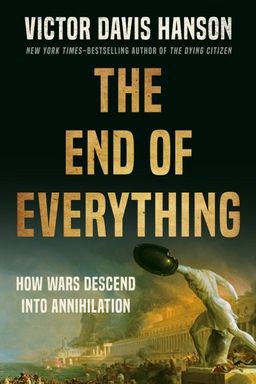
The End Of Everything cover

The End Of Everything

by Victor Davis Hanson

The author of “The Dying Citizen” and “The Case for Trump” looks at how some societies obliterate their foes.

How Civilizations End in Hours

How can you recognize when a society is one breach away from disappearance? In The End of Everything, Victor Davis Hanson argues that civilizations often die not by slow decline but by a sudden, annihilating blow focused on a capital or civilizational node. He contends that when attackers concentrate force on a symbolic center—with superior organization, timely innovation, shrewd diplomacy, or simple luck—the fall can erase a people’s political life, institutions, and identity in days or hours. To see this pattern, you must understand the special role of capitals, the psychology of miscalculation, the compounding power of military innovation, the volatility of alliances, and the contingency that turns sieges at the brink.

In this guide, you’ll trace how Thebes (335 BC), Carthage (146 BC), Constantinople (1453 AD), and Tenochtitlán (1521) move from normality to nonexistence with startling speed. You’ll learn why capitals become annihilation targets; how leaders indulge Thucydidean hope; why new technologies (from sarissas to bombards to brigantines) unmake old doctrines; how allies defect or decide outcomes; and how singular moments—Giovanni Giustiniani’s wound at Constantinople, or the timely arrival of smallpox in the Valley of Mexico—tip history. Finally, you’ll draw modern lessons about deterrence, small-state vulnerabilities, and the risks that nuclear, biological, and AI-era tools pose to concentrated populations and fragile polities.

Capitals as civilization’s fuse

Hanson shows that annihilation usually follows a final siege or sack of a capital or cultural heart: Thebes after Alexander’s lightning march, Carthage under Scipio Aemilianus, Constantinople under Mehmet II, and Tenochtitlán under Cortés. Destroying a capital does more than win terrain. It vaporizes archives, priesthoods, marketplaces, and governing elites—the infrastructure of continuity. When the capital falls, the social memory and institutional web collapse with it (a point reminiscent of Shelley’s Ozymandias, which Hanson invokes to frame how grandeur decays into dust).

Hope, miscalculation, and the decision to risk extinction

Across cases, defenders trust in myths, reputations, or external rescue. The Thebans bet on a Panhellenic uprising; Carthaginians comply at Utica only to face an ultimatum to erase themselves; Byzantines expect Western relief that never coheres; and Aztec elites count on numbers and ritual valor against unfamiliar combined arms. Hanson quotes Thucydides—“Hope, danger’s comforter”—to argue that elites often fail to update beliefs, even as technological and political realities shift beneath them. The result is a tragic Melian dilemma: fight for honor and perish, or sue for survival only to misread an enemy intending erasure.

Innovation and organized overmatch

Annihilation often accompanies disruptive military systems wielded by adaptive attackers. Philip II’s Macedonian reforms (sarissa phalanx, drilled professionals, integrated cavalry) outclass Theban hoplite habits; Roman siegecraft and logistical learning tilt the Punic balance; Ottoman bombards stress Byzantium’s manpower and walls; and Cortés’s steel, cavalry, cannon, and lake brigantines negate Aztec mobility. The issue is not technology alone but organizational synthesis—how leaders combine tools, logistics, and doctrine to break defenders’ margins. (Compare John Keegan’s emphasis on warrior culture with Hanson’s focus on institutional adaptability.)

Allies, betrayal, and siege ecology

Alliances prove brittle at decisive moments. Alexander mobilizes Thebes’s Boeotian enemies; Rome flips Utica and cultivates Numidian pressure; Mehmet benefits and suffers from Genoese-Venetian rivalries; and Cortés converts Aztec victims, especially Tlaxcalans, into the bulk of his fighting force. Siege outcomes reflect political ecosystems as much as walls and guns. You must score not just headcounts but the reliability of allies under stress.

Contingency at the gates

Hanson rejects inevitability. Constantinople very nearly survives; Janissaries exploit a briefly unclosed gate in the chaos after Giustiniani’s wounding. Tenochtitlán reels after the Noche Triste yet falls because brigantines choke the lake and smallpox decimates an immunologically naive elite. History turns on small levers—wounds, rumors, logistics—once wider structures set the stage.

Afterlife and modern warnings

Annihilation reshapes worlds. The polis yields to Hellenistic kingdoms; Rome inherits the western Mediterranean; the Ottoman capital shifts the trading map; Mexico City rises on Tenochtitlán’s ruins. Conquerors often reanimate strategic sites while ending prior cultural continuities (Note: Mehmet styled himself “Caesar of Rome,” while the modern name Istanbul formalizes only under Atatürk in 1923). Today, nuclear and biological weapons, AI-enabled targeting, and the vulnerability of small states in dangerous neighborhoods keep Hanson’s warnings uncomfortably current: capitals remain fuses, and a single breach can still end everything.


Why Capitals Decide Wars

Hanson argues that attackers often do not merely defeat armies; they seek to erase a civilization by destroying its capital—the locus of government, archives, ritual, markets, and collective memory. When Thebes falls to Alexander in 335 BC, Carthage to Rome in 146 BC, Constantinople to Mehmet II in 1453, and Tenochtitlán to Cortés in 1521, you watch a similar script: overwhelm a symbolic center, shatter administrative cohesion, and decapitate cultural reproduction. The end is disproportionately fast because capitals concentrate identity and function.

Motives behind capital targeting

Several incentives converge to make capitals first-priority targets: deterrence (Alexander razes Thebes to warn 1,500 Greek poleis), revenge (Rome answers Hannibal’s terror with urban erasure), preemption (remove the only node that could rally a rival), and profit (slaves, treasure, land). These motives stack with geography: Constantinople and Carthage are trade crossroads whose capture or demolition rewires commerce (Portuguese and Spanish Atlantic exploration quickens as the Ottoman chokehold grows after 1453).

Symbol substitution and continuity of place

Conquerors rarely abandon strategic sites; they overwrite them. Hagia Sophia becomes a mosque; Roman Carthage rises eventually on the cursed ground; Mexico City is built atop Tenochtitlán’s causeways. The shell persists because rivers, harbors, and crossroads do not move—even as the spirit inside changes. (Note: Hanson emphasizes this paradox—legalized erasure coupled to geographic continuity.)

Epoch shifts from single-city falls

Hanson invites you to see epochal transitions as the byproduct of capital destruction. The end of Thebes catalyzes the move from polis autonomy to Hellenistic monarchy; Carthage’s annihilation cements Rome’s unchallenged dominance; Constantinople’s capture tilts Europe toward the Atlantic; Tenochtitlán’s obliteration ushers in Iberian colonial states. A single city’s fall can reset an entire region’s institutions, economies, and identities.

Practical lens for modern conflict

If you want to grasp stakes fast, locate the symbolic nodes—capitals, sanctuaries, financial hubs, data centers. Their loss can collapse a polity’s ability to organize or reproduce itself, even if field armies remain. Modern equivalents include attacks on command networks, critical infrastructure, or nuclear-tipped blows against compact populations. The logic holds: reach the center, and you can end everything at once.

Key Idea

“A capital concentrates what makes a polity coherent: government, ritual, economy, and symbolic memory. Without it, administrative cohesion and cultural reproduction become far harder.”

For you, the takeaway is stark: the decisive act in many wars is not the attrition of front lines but the capture and transformation—or leveling—of the one place that makes the rest make sense. That is why, from Thebes to Tenochtitlán, the last day matters more than the long years before it.


Hope’s Trap and Miscalculation

Across Hanson’s cases, annihilation is preceded by a fatal optimism. Defenders indulge in comforting illusions—overrating reputations, underrating innovations, and counting on allies who will not come. Thebes puts faith in a Panhellenic uprising and a canonical hoplite tradition; Carthage trusts treaties and Roman restraint even as it hands over weapons at Utica; Constantinople waits for a Western relief that arrives piecemeal and late; Aztec elites assume mass and ritual valor can outlast strange horses and thunderous guns.

Thucydides’ warning, updated

Hanson channels Thucydides: “Hope, danger’s comforter,” blinds most when they have least room to gamble. Leaders equate moral rightness with strategic leverage, mistake fame for force structure, and fail to stress-test assumptions against enemy innovations. The psychological pull is strong; the structural failures—doctrine ossified, repair budgets starved, elites factionalized—make it lethal.

Components of the error

You can map the miscalculation: 1) Overreliance on past prestige (Theban Sacred Band myth, Byzantine walls), 2) Underestimation of enemy learning (Roman siegecraft and logistics), 3) Assumption of external rescue (Peloponnesians for Thebes; the Latin West for Byzantium), and 4) Misreading of intentions (Rome seeks erasure, not accommodation, at Carthage). These patterns appear before the breach—warning lights defenders ignore.

The Melian dilemma

Do you fight for honor and risk extinction or submit to survive? Hanson shows both choices can fail if you misread your adversary. Thebes and Tenochtitlán fight on and die; Carthage negotiates step by step and discovers Rome’s bottom line is self-erasure. The “right” choice is contingent on enemy intention, relative power, and time—variables the hopeful habitually misjudge.

Your antidote: sober counters to hope

As a policymaker or analyst, you must replace hope with quantified assessment. Audit the enemy’s adaptations, test ally reliability, red-team final-assault scenarios, and plan for the hour when no help comes. Update doctrine before crisis: Thebes never absorbed the Macedonian revolution; Byzantium underestimated gunpowder’s strain on manpower; Carthage surrendered leverage before appraising Rome’s true aim.

Key Idea

Decline limits options; hope without adaptation converts limited options into none.

The lesson is unsentimental: measure, update, and hedge. Otherwise, you step into Hanson’s fatal sequence—misread, resist, isolate, and vanish.


Innovation as Overmatch

In Hanson’s narrative, annihilation arrives on the back of integrated innovation—new weapons married to new organizations and doctrine. What breaks cities is not a gadget but a system that stretches defenders beyond their logistic and cognitive margins. You see this at Thebes, Carthage, Constantinople, and Tenochtitlán, where attackers align technology, training, logistics, and leadership to achieve decisive overmatch.

Macedonian revolution

Philip II’s refashioned army—sarissa phalanx, hypaspists, elite cavalry, drilled professionals—replaces seasonal levies and city militias. By 335 BC, Theban hoplite tactics look heroic but obsolete. Alexander’s rapid march and coordinated assault convert tactical novelty into strategic shock, and Thebes’s civic life evaporates in a day. (Note: This complements Victor Hanson’s earlier work on hoplite warfare while emphasizing organizational change.)

Roman adaptability

Rome learns at scale. In the Punic conflicts, it builds fleets from scratch, invents boarding tactics, and standardizes siege methods. By the Third Punic War, Scipio Aemilianus combines isolation (Nepheris), earthworks across the isthmus, and relentless assaults. Organizational persistence, not genius alone, destroys Carthage’s options.

Gunpowder at the walls

Mehmet II’s bombards (including Orban’s “Basilic”) do not pulverize the Theodosian walls outright, but they force nightly repairs, exhaust scarce defenders, and synchronize with mining and massed infantry attacks. The innovation is an ecosystem—artillery, logistics, Janissary shock troops, and naval pressure—that inflates Ottoman endurance while shrinking Byzantine margins.

Cortés’s combined arms

Cortés pairs steel, firearms, cavalry, and war dogs with indigenous mass and a naval solution on a lake: thirteen brigantines. Supervising their overland transport and assembly, he flips Tenochtitlán’s moat into a prison, severing supplies and mobility. Smallpox—arriving conveniently in the campaign’s middle—cripples Aztec command and morale, amplifying the mechanical edge.

Modern parallels

Today, AI-enabled targeting, drones, cyber, and biotech could combine as unexpectedly as sarissas and bombards once did. Hanson’s warning is timeless: if doctrine does not evolve as fast as the toolset, capitals become brittle. Count systems, not just sensors; assess integration, not just inventory.

Key Idea

Numbers alone do not save cities; integrated innovation decides whether a wall is a refuge or a trap.

Your check is simple: has the defender adapted organizationally as much as materially? If not, the end can arrive in a single assault.


Allies And Betrayals

Hanson frames sieges as political ecosystems. Allies, neutrals, and opportunists shape outcomes as much as guns and walls. You must study how coalitions form, fracture, and flip—because the critical moment often turns on a partner’s panic, a rival’s defection, or an enemy’s diplomatic trap.

Isolation as prelude to erasure

Thebes expects Peloponnesian aid; instead neighboring Boeotian rivals—Plataeans, Thespians, Orchomenians—help Alexander dismantle Theban power. Macedonians exploit local hatreds to legitimate harsh measures and deflect blame. The moral is uncomfortable: the closer your neighbors, the sharper the knives when your capital is besieged.

Carthage: diplomacy as weapon

Rome orchestrates Carthage’s isolation. Utica defects; Masinissa’s Numidians harry the hinterland; Roman consuls demand hostages, fleets, elephants, and arms—then spring the fatal demand to move the city inland. Compliance strips Carthage of leverage; refusal provides Rome the casus belli of annihilation. The alliance map decides the war before the legions breach the walls.

Byzantium’s thin lifelines

Genoese and Venetian detachments fight bravely on the walls, yet East–West schism and the memory of 1204 blunt a broader crusading response. When Giustiniani—commander of the land defense—is wounded, Genoese morale cracks and a sector collapses. One ally’s exit becomes a system failure. (Note: sources disagree whether he fled or was mortally struck—a reminder that defeat narratives seek scapegoats.)

Tlaxcalan mass and vengeance

Cortés’s “Spanish” army is mostly indigenous. Tlaxcalans and other Aztec enemies furnish tens of thousands of fighters and the ferocity of street-to-street combat. Coalition warfare—married to Spanish technology—multiplies effect. Aztec rituals and tributary brutality make coalition-building easy for a canny invader.

Your siege ecology checklist

Test alliance depth under duress; map local grudges; identify keystone allies whose collapse unravels defense; and expect attackers to use local proxies to launder atrocities and share spoils. Hanson’s lesson: politics is the hidden artillery that opens gates from within.

Key Idea

Sieges are network wars; break enough ties, and the walls fall by themselves.

For you, alliance analysis is not a courtesy section; it is the center of gravity analysis—often the only predictor that matters for whether a capital lives or dies.


Contingency At The Gates

One of Hanson’s most bracing claims is that annihilations often hinge on minutes, wounds, and rumors. The larger forces—innovation, alliances, morale—set the stage, but contingency pulls the trapdoor. Constantinople’s 1453 siege demonstrates how narrowly a civilization can survive—or not—based on a single human event.

Constantinople’s near-rescue

The city’s defense is not farcical. Constantine XI fields 6,000–8,000 veterans on the land walls, 26 galleys in the Horn, limited artillery, and up to 35,000 civilians for nightly repairs. Giovanni Giustiniani, a Genoese condottiere, centralizes wall defense, sectors troops at the Lykos valley, and coordinates with Venetian seamen. Ottoman bombards batter but never breach decisively; mining and escalades suffer bloody repulses; logistics and disease strain Mehmet’s camp. Advisors press for withdrawal.

A wound that unmakes a world

On May 29, Giustiniani is wounded—arrow or bullet—and withdrawn. In the panic, Genoese positions waver; gates are left unsealed; Janissaries flood a narrow opening and convert disorder into collapse. Whether Giustiniani fled or was dying is less important than Hanson’s point: leadership continuity is a fortress; its loss is a breach. Had a substitute been pre-appointed, some contemporaries insist, the city might have held.

Small levers in Mexico

Tenochtitlán also swings on thin hinges. After the Noche Triste rout, Spanish survival depends on mounted shock at Otumba and the audacious decision to build and portage brigantines to Lake Texcoco. Once afloat, the lake fleet severs Aztec lifelines, and smallpox hammers command coherence in a dense, immunologically naive capital. Each event by itself is not destiny; together, and precisely timed, they become fate.

Avoiding the decisive wobble

If you manage a defense, plan for the hour your Giustiniani goes down. Cross-train deputies, clarify succession at critical sectors, and practice closing gates—literal and metaphorical—under chaotic conditions. In offense, seek the same levers: demoralize a keystone cohort, exploit rumor, and be ready with reserves for the first hint of unraveling.

Key Idea

History is not inevitable; it is path-dependent. At the wall, a single absence can be the end of everything.

Hanson’s counterfactuals are disciplined: contingencies matter only because structures make them decisive. Your task is to harden the structure so that no single shock can end the world you are sworn to defend.


Vengeance Into Policy

Carthage’s end reveals how memory, theater, and profit can turn annihilation into a state policy. Hanson shows Rome in the Third Punic War not as a reluctant hegemon but as a polity deciding to erase a rival—less from immediate necessity than from accumulated fear, rage, and political entrepreneurship. The lesson transcends antiquity: democracies and empires alike can choose total war when vengeance, deterrence, and spoils align.

Pretexts and ultimatums

At Utica, Roman consuls demand hostages, fleets, elephants, and weapons. Carthage yields. Then comes the fatal ask: raze your harbors and move your city inland. It is an order to self-destruct—designed either to break Carthaginian will or justify Roman invasion when refusal comes. Polybius notes that Rome “had made up their minds” and sought only a suitable pretext.

Motives that stack to erasure

Strategic calculation (never again Hannibal), political theater (Cato’s Carthago delenda est!), and profit (slaves, land, triumphs) weave into a consensus. Scipio Aemilianus executes a systematic siege—earthworks, starvation, isolation—and when the breach comes, the Senate’s decision to annihilate is policy, not passion. Survivors are enslaved; the city is leveled; a warning to all rivals is minted in ash.

From republic to empire by example

The destruction of Carthage (paired in 146 BC with the sack of Corinth) signals a Rome willing to reorder the Mediterranean by terror and precedent. Hanson argues that this pivot normalizes annihilation as a strategic instrument—shaping Roman governance and expansion in the next century. (Compare to Clausewitz: policy uses war as instrument; Hanson adds that memory and theater can bend policy toward extremes.)

Modern resonance

You should ask which contemporary powers cultivate annihilatory rhetoric, enshrine it domestically, and prepare pretexts for erasure. Public memory of past trauma (e.g., Hannibal in Italy) can mobilize majorities for maximalist ends. Beware leaders who convert fear into applause lines; they are manufacturing mandates for the next Carthage.

Key Idea

States do not drift into annihilation; they legislate, ritualize, and then operationalize it.

Your antidote is vigilance about narrative escalations at home: once a polity blesses erasure in speech, someone will find a siege to make it real.


Aftermath And Warnings

The end of a city remakes regions. Hanson’s final move follows how annihilation resets institutions, trade, demography, and memory—while conquerors often preserve useful shells and repurpose symbols. He then maps these lessons onto modern threats, from nuclear salvos to biological catastrophes and AI-era command ruptures, with a special warning for small states in hard neighborhoods.

Remaking worlds from ruins

After Thebes, the polis ideal shrinks beneath Hellenistic monarchies; after Carthage, Rome dominates Africa’s grain and sets provincial governance; after Constantinople, Ottoman control of the straits nudges Europe toward the Atlantic; after Tenochtitlán, Mexico City inherits the lake and causeways while extinguishing Aztec sacrificial politics. Legal rituals—Roman curses on Carthage, Ottoman claims to Roman succession, Spanish syncretism—seek to make erasure permanent even as geography compels resettlement. (Note: Mehmet moves the capital to Kostantiniyye and converts Hagia Sophia; the city is later nationally renamed Istanbul in 1923.)

Patterns you can apply today

Hanson distills a checklist for annihilation risk: isolation; internal factionalism; faith in walls or past impregnability; underestimation of enemy generalship; reliance on rescue; and doctrinal stagnation. When defenders then fight fanatically at the end, attackers escalate to exterminatory violence—and later repurpose the site, claiming regret while owning the ground.

Modern equivalents of capital strikes

Nuclear or precision strikes against compact populations, cyber-physical attacks on capital grids and data centers, or biological events that incapacitate leadership can replicate the old logic: remove the node, and the polity unravels. Hanson highlights flashpoints—Russia–Ukraine, Iran–Israel, the Koreas, the subcontinent—where annihilatory rhetoric and short decision times coexist. Small countries like Armenia, Greece, or Cyprus illustrate the ancient predicament: deterrence by alliance is only as strong as others’ interests on the day of need.

What you can do

If you steward a vulnerable polity, disperse capitals’ critical functions; build redundant command and logistics; cultivate allies with teeth, not tweets; invest in doctrinal adaptation as much as hardware; and rehearse succession at every critical post. If you analyze risk, watch for narrative escalations and pretext shopping—the Carthage tell—alongside technical trends that compress warning times.

Key Idea

“Decline did not ensure extinction, but it certainly limited the options for surviving an invasion.” Limit decline or multiply options—those are the only choices when the siege begins.

Hanson’s closing admonition is simple: annihilation is rare, but it is patterned and repeatable. The faster you see the pattern, the better your odds of never starring in the last chapter.

Dig Deeper

Get personalized prompts to apply these lessons to your life and deepen your understanding.

Go Deeper

Get the Full Experience

Download Insight Books for AI-powered reflections, quizzes, and more.