
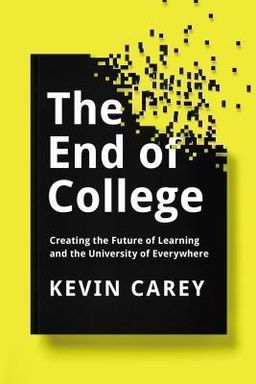
The End of College cover

The End of College

by Kevin Carey

The End of College explores the evolution and future of higher education, advocating for the University of Everywhere-a model that utilizes technology to provide accessible, flexible, and affordable learning opportunities, challenging the traditional elitist and expensive educational systems.

The University of Everywhere: Learning Without Walls

What if the world’s best education were as accessible and personalized as the Internet itself? In The End of College, Kevin Carey envisions exactly that: a global network of learners, courses, and credentials—the University of Everywhere—where anyone can learn anything, from anywhere, at any time. This is not a metaphorical dream. It’s a direction already visible in the rise of MOOCs, cognitive tutors, adaptive learning technologies, and open credentials that replace the traditional, costly, and often inefficient university model.

Carey’s argument unfolds through history, technology, and economics. He first unpacks how universities became expensive hybrids unable to balance teaching, research, and prestige. Then, he introduces the forces dismantling that monopoly: digital transmission, platform economics, cognitive science, and data-driven adaptive systems. Finally, he shows how a new global system of open, verifiable credentials can make higher education cheaper, more democratic, and lifelong. You’ll discover how this transformation disrupts the “Absolut Rolex” economics of brand-based price inflation, unlocks new pedagogical power through design, and redefines how you and future generations will learn, prove knowledge, and build careers.

From Scarcity to Abundance

Traditional universities arose in an era of scarcity: limited campuses, faculty, and libraries. The scarcity became profitable, allowing elite institutions to charge high tuition justified by exclusivity. Carey argues that digital technology flips that logic. Once lectures, simulations, and assessments are online, their marginal cost approaches zero. MIT’s open course offerings, Carnegie Mellon’s cognitive tutors, and Stanford’s online experiments demonstrate education’s new law of abundance: what was once rare can now reach millions. The University of Everywhere embodies that shift from


The Hybrid University and Its Contradictions

Before the digital era, higher education’s structure was shaped by competing missions—research, liberal education, and vocational training. This hybrid university model, born in the late nineteenth century when Harvard’s Charles Eliot merged the German research ethos with Newman's liberal ideals and America’s land-grant practicality, created an enduring contradiction. Professors were rewarded for producing knowledge, not teaching it. Departments pursued specialization rather than coherence, leaving undergraduates adrift in a sea of electives without cumulative learning paths.

Carey exposes these structural flaws through voices like William James and Jacques Barzun, who lamented that the Ph.D. system prized credentials over pedagogy. The hybrid model institutionalized misaligned incentives: tenure tied to research prestige, not student success. The result, Carey notes, is tuition hyperinflation, rising debt, and mediocre learning outcomes—a system that expands enrollment but fails to strengthen cognition.

Why the Model Persists

Accreditation systems and cultural prestige lock the hybrid model in place. Faculty autonomy, administrative bloat, and rankings reinforce status signals. Public subsidies and student loans mask inefficiency. When research funding exploded after World War II, universities doubled down on labs and prestige buildings, marginalizing teaching even further. (Carey’s metaphor of the university as an “education platform” built on scarcity becomes crucial here: the institution controls supply, therefore it controls price.)

Recognizing this history clarifies why genuine reform is rare. Innovation is not blocked by lack of technology but by incentives designed for prestige rather than pedagogy. The hybrid university optimizes self-preservation, not learning. Carey’s later chapters show how digital-first systems can realign those incentives by separating the functions of instruction, assessment, and credentialing—what he calls the unbundling of the academic enterprise.


From Broadcast to Design

Carey distinguishes between two kinds of educational technology: broadcast technologies that only extend reach (radio, TV, early MOOCs), and design technologies that change how learning happens. Historically, attempts like televised courses, Columbia’s Fathom.com, or early online lectures failed because they replicated lecturing rather than improved pedagogy. The key transformation begins when computational design enables real-time feedback, adaptive practice, and personalized pathways.

Why Design Matters

Computers can model student thinking, diagnose misconceptions, and adjust tasks instantly—something the lecture never could. Carnegie Mellon’s Open Learning Initiative (OLI) and the Virginia Tech Math Emporium exemplify this design shift. The Emporium replaced lectures with adaptive software and reduced costs while maintaining outcomes. OLI courses run controlled experiments on student interactions to continually refine content. This is what Carey calls “instructional engineering.”

By contrast, MIT OpenCourseWare’s early success in open content was limited by its lack of experimental feedback. It broadcast knowledge but couldn’t personalize. True digital pedagogy requires building systems that measure understanding, not just access. Carey emphasizes that design—not format or brand—is the key variable in whether technology actually improves learning.

Carey’s Principle

“In education, the medium is not the message.” What changes learning is not the screen or software but the design that turns information into disciplined practice and feedback.

The lesson for you, as a learner or policymaker, is clear: don’t mistake broadcasting for education. Evaluate technologies by whether they offer adaptive practice and individualized feedback—the tools that make mass learning truly personal.


Cognitive Tutors and Adaptive Intelligence

Carey links the promise of digital learning to decades of cognitive science. Drawing on Herbert Simon, John Anderson, and K. Anders Ericsson, he shows how expertise develops through deliberate practice and feedback loops. Computers, embedded with models like Anderson’s ACT-R, can replicate those loops at scale. That means a well-designed tutor can track your reasoning step by step, detect specific misconceptions, and reroute your path until mastery—something even dedicated human tutors struggle to scale.

Inside the Cognitive Model

The ACT-R model breaks knowledge into 'chunks' of declarative and procedural understanding. Cognitive tutors built on it recognize where your solution deviates from expert reasoning. For example, physics tutors anticipate common errors like assuming heavier objects fall faster. At Carnegie Mellon, Wilfried Sieg’s logic tutor gave students instant proof feedback; humanities majors who worked longer achieved parity with science students because time-to-mastery replaced seat time. These systems represent the next step toward personalized, data-driven education.

Carey argues this convergence—AI plus cognitive science—forms the pedagogical core of the University of Everywhere. The constraint is front-end effort: building a tutor requires hundreds of hours and investment, but the resulting system serves thousands with negligible marginal cost. Once data accumulates, improvement becomes continuous. Learning ceases to be an artisanal process and becomes a measured science, where evidence replaces tradition. This mechanization of “personalization” is what will ultimately unlock scalable equity.


MOOCs, Platforms, and Global Scale

When Stanford’s Sebastian Thrun and Peter Norvig offered their artificial intelligence course to the public, 58,000 people enrolled. That experiment revealed education’s new physics: zero marginal cost and exponential network effects. MOOCs—massive open online courses—behave like software platforms, not classrooms. They link professors and students through code, not walls. Carey explains that this shift produces competing platform logics: venture-capital-funded (Udacity, Coursera) and nonprofit (edX).

Platform Economics

A platform connects producers and consumers while owning the marketplace infrastructure. Its power scales as users join. Coursera aggregates university courses, uses brand leverage to expand catalog size, and pursues growth-first monetization. Udacity rebuilt courses from scratch, betting on industry-aligned nanodegrees. MIT and Harvard’s edX countered with nonprofit status, using their brand power to ensure credibility and experiment with credentialing. Each reflects the same dynamic: brand meets scalability.

These platforms blur lines between education and technology. Carey stresses that whoever controls discovery, assessment, and credentialing will control the industry. The University of Everywhere materializes when platforms interconnect—allowing learners to move freely across providers and employers to trust algorithmic credentials as much as Harvard’s paper diplomas. The old university’s monopoly on validation dissolves under the weight of platforms that treat education as a global network service.


Unbundling and Reassembly

The “unbundling” of higher education dismantles its monopoly bundle—teaching, housing, social life, credentialing—into specialized, often cheaper, services. Carey traces how Silicon Valley’s thunder lizards (fast-scaling start-ups) and new institutions exploit this logic. Chegg sells cheaper textbooks; Course Hero and Quizlet handle study aids; Dev Bootcamp compresses four years of coding education into nine weeks; UnCollege and Minerva recreate specific social and academic functions of college with streamlined design.

Specialization and Choice

Dev Bootcamp teaches the “just enough to start” ethos: job-relevant, intensive, short-duration training. Minerva, by contrast, reassembles the best parts of elite schools—rigorous seminars, small cohorts, a global residential experience—while shedding campuses and sports teams. Saylor.org, funded by Michael Saylor, offers almost 300 free online courses with plans for digital credential verification. These examples prove you can reform higher education either by fragmenting or redesigning it.

Unbundling Means Choice

The four-year campus monopoly is eroding. Learners can now assemble a custom path combining content, mentoring, credentials, and networks at vastly lower cost.

Carey suggests you ask: what part of college do you truly need? For some, it’s career training; for others, identity formation or access to peer networks. Once you separate those elements, alternative institutions can compete on quality and price. The future learner becomes a designer of their own educational ecosystem, not a passive consumer of one institutional package.


Credential Revolution and Digital Identity

The linchpin of Carey’s argument is credential disruption. A degree’s true value lies not in the paper but in the social trust it symbolizes. So long as employers use diplomas as hiring filters, universities hold power—even if cheaper, better learning exists elsewhere. Carey shows how digital badges and verified identities now threaten that monopoly by making competence visible and machine-readable.

Digital Credentials in Motion

Mozilla’s Open Badges framework turns credentials into metadata objects describing who issued them, evidence of skill, and verification links. Purdue University and UC Davis issue badges for specialized skills; Carnegie Mellon uses them to certify progressions in computer science. Stack Overflow reputation systems and Accredible portfolios extend this logic informally. Michael Saylor’s Usher platform envisions secure mobile credentials—portable, verifiable, and resistant to forgery.

A Credential Is Just Information

Once credentials become discoverable metadata rather than physical seals, employers can search for specific capabilities directly, bypassing traditional universities as gatekeepers.

For you, this means controlling evidence of learning—certificates, projects, test results—across digital portfolios. In the world Carey describes, success depends on transparent proof of skill, not institutional prestige. The rise of open credentials completes the architecture of the University of Everywhere by making reputation as fluid as information itself.


Status, Price, and Resistance to Change

Even with better technology and pedagogy, disruption stalls when prestige economics overrides educational value. Carey’s “Absolut Rolex Plan,” borrowed from George Washington University’s Stephen Joel Trachtenberg, reveals how colleges use high prices to signal quality. Like luxury goods, expensive tuition conveys exclusivity rather than learning efficiency. Administrators escalate costs through amenities and branding because consumers equate price with status.

Government subsidies, easy credit, and employer reliance on degrees sustain this cycle. Institutions seek prestige rather than affordability, creating tuition inflation and massive student debt. Attempts to lower delivery costs often fail to reduce tuition, as savings are reinvested in amenities or research ranking pursuits. Cultural inertia—parents valuing brand names, employers trusting legacies, regulators enforcing traditional accreditation—locks the system in place.

Carey’s Challenge

To change higher education, reformers must rewire incentives: build new credentials with comparable trust and restructure subsidies to reward demonstrated learning, not institutional prestige.

Change may thus begin not with universities but with markets and policy: employers adopting demonstrable-skill hiring, governments funding evidence-based platforms, and families prioritizing actual learning outcomes over luxury branding. The University of Everywhere can only thrive when status and substance finally align.


Learning by Data

Once learning moves online, every click becomes data. Carey argues that education poised on this frontier resembles medicine after genomics—the birth of rational education. Instead of anecdotes and tradition, instruction can now be tested, measured, and optimized through experimentation. Massive datasets from MOOCs and cognitive tutors provide the foundation for this empirical science of learning.

Empirical Pedagogy

Digital courses capture continuous streams of information: completion times, error types, discussion posts, and pauses. With tens of thousands of learners, platforms can run A/B tests on interface design, problem sequencing, or feedback modes. Carnegie Mellon’s OLI uses such data to refine behavior models. Peter Norvig’s “unreasonable effectiveness of data” principle (borrowed from his machine-learning work) applies directly: iterate empirically rather than theorize abstractly.

For students, that means learning systems that automatically calibrate difficulty to your progress. For educators, it offers quantitative insight into what works. For policymakers, it offers defensible evidence of value. As Carey notes, education is shifting from craft to engineering—measured, modular, and improvable. The University of Everywhere thus depends not on ideology but on the intelligence of data networks continuously learning how people learn best.


Choosing Wisely in a Changing System

In the book’s closing guidance, Carey turns practical. For parents and students, navigating the transition to the University of Everywhere requires discernment: pay for purpose, not prestige. He highlights schools like the University of Minnesota Rochester, which integrates coherent curricula, small class sizes, and real workload expectations—an antidote to the lax academic rigor typical of many research universities.

Invest in Learning, Not Signaling

Choose challenging majors that develop skills—STEM fields or serious liberal arts—and avoid debt-heavy degrees built on status promises. Foster in children habits that align with digital learning: self-regulation, curiosity, and portfolio building. The future will reward documented skills and persistent learning, not one-time credentials.

A Rule of Thumb

Spend your resources on programs that challenge and measure you, rather than on prestige that flatters you. The best hedge for the future is to become a demonstrably capable learner.

The University of Everywhere democratizes opportunity but raises expectations. In an open, data-rich ecosystem, you can no longer rely on the shield of an institution’s name; your value will come from the transparent evidence of your ability to learn, adapt, and create.

Dig Deeper

Get personalized prompts to apply these lessons to your life and deepen your understanding.

Go Deeper

Get the Full Experience

Download Insight Books for AI-powered reflections, quizzes, and more.