
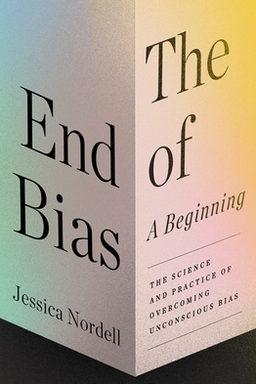
The End of Bias cover

The End of Bias

by Jessica Nordell

The End of Bias by Jessica Nordell explores the science behind unconscious bias and its societal impact. It offers practical strategies for replacing ingrained prejudices with balanced thinking, fostering a culture of diversity and conscious choice.

The Science of Automatic Bias and Social Change

Why do even well-intentioned people perpetuate inequality? This is the question that drives The End of Bias: A Beginning by Jessica Nordell. Drawing on decades of psychological, sociological, and organizational research, Nordell argues that bias isn’t primarily a matter of conscious prejudice but of automatic thinking habits shaped by culture, history, and repetition. We live inside patterns that reproduce inequality, often without noticing them. The book’s central message is both sober and hopeful: because these biases are habitual rather than hardwired, they can be changed—through deliberate awareness, systemic redesign, and sustained practice.

Automatic associations and their origins

Psychologist Patricia Devine’s experiments revealed that implicit bias operates even among self-described egalitarians. When participants were subliminally primed with words related to “Black,” both prejudiced and non-prejudiced subjects judged an ambiguous character as more hostile. This showed that culture implants associations that can override conscious values. The mind has two modes—automatic and deliberate—and the automatic mode triggers stereotypes before you can intervene. Similarly, Anthony Greenwald’s Implicit Association Test (IAT) quantifies those reflexes at scale, finding consistent patterns across millions of subjects: pro-white, pro-young, and pro-heterosexual biases. The IAT doesn’t predict individual morality, but it measures the social air we breathe.

How bias begins and multiplies

Rebecca Bigler’s work with children shows that bias is learned through categorization as much as imitation. When children were assigned to wear blue or yellow shirts and teachers mentioned the colors daily, stereotypes and group favoritism emerged within days. The simple act of labeling creates salience—making some differences matter. By contrast, when teachers ignored groupings, children did too. Similar findings emerge in the “Notel” study: when television arrived in a previously isolated Canadian town, children’s gender stereotypes increased dramatically within two years. Across media, environments, and schooling, you absorb tacit messages about which traits are “normal” or valuable.

From micro-bias to macro-inequality

Small slights accumulate into structural disadvantage. Nordell and data scientist Kenny Joseph simulated a company called NormCorp to quantify this compounding effect. Introducing subtle gender penalties—a few percentage points of bias in credit, failure penalties, and opportunity access—led to an executive suite that was 82% men after twenty promotion cycles. This mirrors real-world dynamics like those documented in Ellen Pao’s lawsuit or Walmart’s gender-disparity cases: countless micro-decisions add up to macro inequities, even without explicit intent. Complex-systems theorist Thomas Schelling offered the same insight decades ago: small local preferences can produce total segregation. Bias isn’t just personal—it’s emergent and self-reinforcing.

Breaking and redesigning habits

If bias behaves like a habit, it can be unlearned like one. Devine’s “habit-breaking” training programs prove that awareness, motivation, and replacement strategies can produce durable change. When participants learn to slow down, question first impressions, and substitute alternate explanations, their behavior and institutional outcomes shift measurably—faculty hiring rates for women in STEM rose from 32% to 47% after workshops at the University of Wisconsin. Crucially, intermittent, coercive diversity trainings fail; only structured, ongoing interventions sustain progress. Effective programs appeal to your need for consistency between values and actions, creating cognitive dissonance that motivates correction.

Culture, design, and structure

Beyond individuals, Nordell explores how systems—police departments, hospitals, corporations—can redesign their choice architecture to prevent bias. Checklists, blind evaluations, universal screening, and cooperative structures reengineer procedures so fairness becomes the default. When Johns Hopkins introduced a digital checklist for clot prevention, gender disparities in treatment vanished. When orchestral auditions used screens, women’s advancement rose 50%. Similarly, Broward County’s universal gifted-student testing tripled recognition of Black and Hispanic students. System redesign complements inner work: it removes the need for heroically unbiased individuals by engineering fairer conditions for all.

Intersection and repair

Bias never acts alone. Nordell highlights the necessity of intersectional research—those who live at overlapping identities (e.g., Black women, Indigenous people, trans individuals) often experience unique, unstudied forms of disadvantage. Addressing inequality requires both personal awareness and structural change: policy, legal protections, and redesigned institutions. The goal is not merely to suppress bias but to cultivate environments where empathy, mindfulness, and design interact to diminish harm at every level—from a police officer’s split-second judgment to a university’s tenure system.

Key takeaway

Bias looks inevitable only when you look too small. Once you see it as a system of habits—cognitive, emotional, institutional—you can redesign both minds and structures to align with your deepest ethical values.

Across experiments, classrooms, police departments, and corporations, Nordell reveals the same pattern: sustained change happens when you pair internal awareness with external redesign, turning fairness from aspiration into routine.


The Habit of Implicit Thought

Bias begins invisibly—in the milliseconds before you’re aware of thinking. Patricia Devine’s research reframed prejudice from a moral defect to a mental habit. Her experiments at the University of Wisconsin laid out how unconscious associations can guide perception even in people committed to fairness. The category prime ('Black') instantly triggered stereotyped interpretations of behavior—proof that culture soaks into cognition before deliberation starts.

Automatic versus deliberate processing

Your brain runs two overlapping systems: an automatic one that uses shortcuts and a deliberate one that reasons slowly. Automaticity saves effort but spreads bias: it fills in the blanks using cultural associations ('women → less technical'; 'Black → threatening'). Devine’s insight is that noticing triggers reflection. When you catch the habit mid-flight, you can consciously choose a new response—what she calls “noticing equals choosing.”

How implicit associations affect real life

In classrooms, implicit stereotype activation makes Black boys seem defiant while white peers doing the same act appear playful. In medicine, physicians undertreat Black patients’ pain. In workplaces, subtle framing advantages some over others—Ben Barres found his research received more respect after he transitioned to living as a man. Each single act feels anecdotal; together they structure opportunity and trust. As one teacher (Jason Okonofua) observed, expectations form feedback loops: perceived defiance leads to harsher discipline, fueling resentment that confirms the teacher’s bias.

Habit-breaking as method

Devine’s later work turned diagnosis into therapy. In her “bias habit-breaking” workshops, participants learned to recognize triggers, feel motivated to align action with values, and practice behavioral substitutions—such as perspective-taking or seeking situational explanations. The results were measurable: increased empathy, reduced stereotyping, and more equitable hiring. It’s deliberate practice for fairness. Like other habits, this one changes only with repetition across time and supportive environments.

Core idea

Implicit bias is not proof of bad character but evidence of cultural conditioning—you must treat it as a habit to break, not a shame to hide.

Seeing bias as habit shifts responsibility from guilt to practice: what matters is not whether associations exist, but whether you notice them and rewire your response. That is where real change begins.


How Bias Forms in Childhood

Children don’t learn prejudice from hatred—they learn it from categorization. Rebecca Bigler’s experiments demonstrate that children instinctively sort the social world, and adults teach them which labels matter. When classrooms constantly emphasize differences ('boys line up here, girls there'), even arbitrary categories become psychological realities.

Labeling and essentialism

In Bigler’s lab-created “blue and yellow shirt” schools, the mere mention of color by teachers was enough to create stereotypes within weeks. Children said things like 'blues are smarter' and stopped playing across color lines. This proves a key mechanism: labeling increases salience, which breeds stereotyping. When labeling stops, bias fades. Children also tend toward essentialism—believing that visible differences mark inner essences—and see out-groups as more uniform than they are. Adults reinforce these perceptions through habits as small as gendered compliments or unequal praise.

Cultural transmission and plasticity

Environments amplify or suppress bias. The “Notel” study—the Canadian town that lacked television until the 1980s—found little gender stereotyping among children before mass media exposure. Within two years of getting TV, stereotypes matched national averages. Category meanings are fluid, not natural: societies like the Haudenosaunee or the Bugis (who recognize five genders) show that classification systems evolve with culture. The lesson is liberating: if categories are taught, they can be untaught.

Early interventions

At Stockholm’s Egalia and Nicolaigarden preschools, teachers redesigned their communication: they used gender-neutral pronouns, balanced comfort between boys and girls, and avoided dividing groups by sex. The result: children still perceived gender but attached fewer stereotypes to it. When teachers change their behaviors and cues, children shift their inferences, using category information less as a guide to worth or ability.

Insight

Bias reduction starts before reading age. The fewer arbitrary labels you emphasize, the fewer stereotypes children need to unlearn later.

Changing early pedagogy—less labeling, more cooperative play, varied storylines—creates new generations with different mental defaults. You can’t reason bias away in adulthood if it’s built into children’s expectations from day one.


Compounding Inequality Through Systems

Bias rarely appears as cruelty; it appears as accumulated advantage or penalty over time. Nordell visualizes how tiny disparities aggregate into massive inequality using Thomas Schelling’s segregation model and the computer simulation NormCorp. What you learn is that small biases—those invisible 3% differences in feedback, credit, or promotion—compound geometrically.

Micro-bias as feedback loop

In workplaces, teachers, and health systems, bias creates feedback loops that magnify disparities. A teacher who expects conflict disciplines a student more, provoking defiance that justifies the next punishment. In corporate settings, slight overestimations of competence for men lead to greater sponsorship, resulting in more output and further validation—the Matthew Effect of bias. NormCorp modeled these realities and showed that after two decades, tiny inequities yield huge gender gaps at the top.

Case studies of accumulation

Ellen Pao’s and Walmart’s legal cases failed partly because juries couldn’t see thousands of micro-decisions as systemic. Schelling’s insight helps: patterns emerge not from conspiracy but from iterative, local actions. A society that judges fairness one event at a time will never see architecture in motion. Complex systems theory expands your moral lens: fairness must be measured by outcomes across time, not moments in isolation.

Essential idea

Inequality isn’t merely a pattern of bad actors; it’s what happens when biased micro-acts align inside a self-reinforcing system.

To solve compounding bias, you must design interventions that interrupt small moments and prevent their accumulation—from feedback fairness to promotion audits—because the system amplifies whatever you feed it.


Mindfulness and Moment-to-Moment Bias

Bias is not only cognitive—it’s physiological. Stress narrows perception. The tragedy of Philando Castile’s death during a police stop illustrates how fear and stereotype combine lethally. Officer Jeronimo Yanez reported 'tunnel vision' and acted under threat perception, though Castile had complied. Neuroscience explains why chronic stress heightens amygdala activity and weakens prefrontal regulation, fostering misinterpretation and panic.

Reforming reactions through mindfulness

Departments led by officers like Richard Goerling and Cheri Maples introduced mindfulness training—breathing, present-moment awareness, compassion exercises. These programs trained officers to notice bodily cues of fear before acting. Bend, Oregon, reported a 40% decrease in use-of-force incidents and fewer complaints after implementation. Mindfulness doesn’t erase bias; it expands the reaction window where conscience can intervene.

Limits and integration

Resistance to “soft” techniques persists in warrior cultures, but data show improved performance and psychological health for those who persist. Nordell argues that personal calm and institutional reform work together: mindfulness regulates your microstate, while accountability systems regulate the macro one. Neither substitutes for the other. (Note: this aligns with psychologist Richie Davidson’s research on emotion regulation and compassion training for resilience.)

Lesson

Slowing perception changes outcomes. Awareness buys the milliseconds in which fairness becomes possible.

Bias work at its most practical begins with emotional self-regulation—the pause before reaction that determines whether threat perception or humanity governs your next move.


Designing Fair and Bias-Resistant Systems

Relying on self-awareness alone cannot overcome bias; systems must be redesigned so fairness emerges automatically. Nordell calls this strategy choice architecture—altering the environment where decisions occur so biased judgment has less room to operate.

Checklist thinking and blind review

At Johns Hopkins, Elliott Haut’s computerized checklist for clot prevention required physicians to assess patient risk and justify deviations. The result: gender disparities in prophylaxis disappeared, and patient safety improved. Similarly, when orchestral auditions were masked behind a screen (Goldin and Rouse), women’s advancement rates rose substantially. In telescope proposals and grant reviews, anonymizing applicants reversed long-standing male advantages.

Universal and cooperative designs

Broward County’s universal gifted screenings found high-potential students previously overlooked because referral systems favored the well-connected. Cooperative designs like Elliot Aronson’s jigsaw classroom and Los Angeles’s Community Safety Partnership (CSP) redefined success metrics—measuring officers on trust-building rather than arrests—and saw declines in crime. These examples show that architecture and incentives shape culture: you get what you measure.

Sustaining process fairness

Choice-architecture gains are fragile. When Broward suspended its universal testing due to budget cuts, representation gaps widened again. Processes demand institutional upkeep, transparency, and active reinforcement. Fairness isn’t a one-time policy; it’s maintenance work.

Takeaway

Good design makes doing the right thing easier than doing nothing. Engineer fairness into defaults, and bias will have fewer chances to act.

From medical checklists to hiring rubrics, Nordell demonstrates that system-level change scales faster and lasts longer than cognitive persuasion alone—especially when it’s paired with cultural accountability and visible incentives for fairness.


From Representation to Real Inclusion

Diversity without power is decoration. Nordell distinguishes between presence—inviting marginalized people into rooms—and influence—allowing them to reshape the room’s culture. Uché Blackstock’s experience at Harvard shows what happens when institutions celebrate inclusion rhetorically but stifle real voice. After repeated resistance to her equity proposals, she left academia. In contrast, Gianmarco Monsellato’s reforms at the Taj law firm show inclusion as strategy: transparent evaluation systems, proportional metrics for maternity leave, and enforced pay equity produced higher female partnership rates and stronger performance.

Making diversity functional

Research by Robin Ely and David Thomas shows that organizations seeing diversity as a learning asset—not an obligation—create adaptive, creative cultures. At MIT’s mechanical engineering department, deliberate recruitment of women to reach critical mass transformed both faculty culture and student demographics; women now exceed 50% of majors. Structural change ended the “pioneer effect,” which had required early hires to withstand isolation. When barriers fall simultaneously rather than one by one, cultures shift from novelty to normalcy.

The social vaccine effect of role models

Seeing people like you doing the work changes self-concept. Nilanjana Dasgupta’s experiment with women engineering students showed 100% retention when paired with female mentors, compared to steep attrition without them. Role models inoculate against stereotype threat, providing “existence proofs” of possibility. They both block bias’s psychological fallout and expand community imagination.

Practical message

Inclusion works when newcomers have influence, mentorship, and visible examples—so diversity reshapes power, not just optics.

Real inclusion raises collective capacity. When systems diversify authority and normalize difference, they not only retain talent—they reinvent what success itself looks like.


Intersection and Cultural Transformation

To dismantle bias comprehensively, you must acknowledge overlapping oppressions and the research gaps that obscure them. Nordell applies intersectionality (Kimberlé Crenshaw’s term) to show that lived realities cannot be reduced to race or gender alone. A Black trans man’s experience differs profoundly from either category taken separately. Research biases—often focusing on white women or men of color—miss these intersections, creating policies that exclude those most affected.

Structural and psychological repair

You need interventions on two levels. Laws and institutional audits correct for systemic inertia: anti-discrimination enforcement, algorithmic transparency, fair funding. At the same time, interpersonal work—Devine’s habit-change, mindfulness, and role modeling—cultivates individual capacity for fairness. Connie Rice’s police reform efforts combined litigation (the structural fix) with relationship-building (the human fix), proving that policy without trust remains hollow.

Representation and social norms

Media research adds a third lever. Studies by Abdelatif Er-rafiy and Elizabeth Paluck show that portraying diverse characters and cooperative norms can shift perception of what’s typical. Whether through Rwandan radio dramas promoting empathy or French public posters depicting variability within a minority group, visible norms change behavior faster than persuasion. social proof can be reprogrammed.

Final insight

Sustainable equity requires multilevel repair: personal awareness, institutional design, and cultural signaling that inclusion is the norm, not the exception.

Nordell closes where she began: bias is not destiny. Every system that produced inequality was built through choices. With equal deliberation, you can build systems that produce belonging instead.

Dig Deeper

Get personalized prompts to apply these lessons to your life and deepen your understanding.

Go Deeper

Get the Full Experience

Download Insight Books for AI-powered reflections, quizzes, and more.