
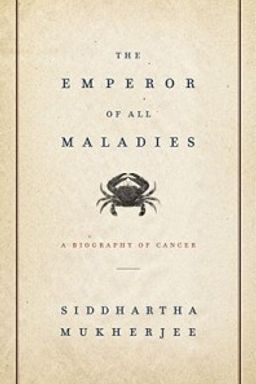
The Emperor of All Maladies cover

The Emperor of All Maladies

by Siddhartha Mukherjee

The Emperor of All Maladies offers a comprehensive exploration of cancer, from ancient beliefs to modern science. Delve into the biological intricacies, historical milestones, and groundbreaking treatments that define our ongoing battle against one of humanity''s greatest medical challenges.

The Long War Against Cancer

You follow a vast, centuries‑long struggle that begins with ancient healers describing incurable lumps and ends with molecular biologists identifying driver mutations. The book argues that cancer’s history mirrors the evolution of medicine itself—from superstition to science, from local beliefs to global trials—and that its conquest depends not on a single cure but on a layered accumulation of prevention, detection, and therapy. Each era redefines both what cancer means and what medicine can do about it.

From ancient recognition to cellular theory

Early physicians such as Imhotep and Galen recognized cancer as a 'bulging mass' or an imbalance of humors. Archaeological evidence from the Chiribaya mummy confirms that malignant disease existed even in antiquity. Yet only Rudolf Virchow’s nineteenth‑century cellular theory finally grounded cancer in observable biology: uncontrolled cell division—neoplasia—arising from cells themselves. His microscope turned mystical illness into cellular pathology, creating the intellectual foundation for all modern treatment.

The shift from humors to surgery and systemic therapy

When anesthesia and antisepsis arrived, surgeons such as Billroth and Halsted could cut deeper. Halsted’s radical mastectomy embodied boldness—the belief that local excision could prevent systemic spread—but later trials proved that metastasis often beats the scalpel. This tension—between local and systemic disease—propelled medicine toward pharmacological solutions. Sidney Farber’s aminopterin experiment in 1947 opened this new domain: drugs could reach where scalpels could not.

Chemotherapy’s rise: toxins turned cures

From battlefield mustard gas to synthetic antifolates and purine analogs, chemists discovered agents that kill fast‑dividing cells. The paradox was constant: poisons became medicine. Cooperative trials under Gordon Zubrod and Emil Freireich transformed these dangerous experiments into systematic science. VAMP and Donald Pinkel’s Total Therapy proved combination treatment could cure childhood leukemia—at immense human cost. The book frames this period as science’s moral crucible: how much toxicity society is willing to bear for cure.

Politics, society, and discovery

Scientific progress was propelled by advocacy. Mary Lasker’s lobbying and the Jimmy Fund’s storytelling turned private suffering into public momentum, culminating in Nixon’s 1971 National Cancer Act. Funding surged, expectations inflated, and oncology became a national enterprise. Yet progress proved incremental; hubris faded after toxic megadose failures and procedural over‑reach. Evidence replaced zeal—Bernard Fisher’s randomized trials and ethical collaborations redeemed scientific rigor.

Precision medicine and prevention in the molecular age

Molecular biology reframed cancer once again. From Peyton Rous’s virus to Varmus and Bishop’s proto‑oncogene and Weinberg’s ras, researchers discovered that malignant potential resides within normal genes. Tamoxifen, Herceptin, and Gleevec prove precision works: find a driving molecule and block it. Epidemiology and prevention then supply the other flank—Doll and Hill’s smoking studies, vaccines for hepatitis B, antibiotic cures for H. pylori, and Pap smear screening. Mortality fell because science finally combined molecular targeting, prevention, and social policy into one coordinated enterprise.

The enduring lesson

You leave understanding that cancer is not a single enemy but an evolutionary process inside every age and society. Each advance—Virchow’s cell theory, Farber’s antifolates, Fisher’s trials, Varmus’s gene discovery—adds one layer to a cumulative war fought on cellular, social, and political fronts. There is no miraculous victory; only persistence, prevention, and precision sustain progress. The moral center of the book is survivorship: proof that small, steady triumphs can change the future of medicine and how humanity imagines hope.


Origins and Evolution of the Disease

Cancer’s history unfolds through observation and biology. In ancient texts such as the Smith Papyrus, you see a doctor describing an incurable breast tumor and conceding defeat: 'There is none.' That sentence reveals both recognition and powerlessness. Only when life spans extended and microscopy arrived did physicians witness cancer’s cellular nature.

Virchow and the cellular revolution

Rudolf Virchow’s insight—'cells arise from cells'—turned cancer into a scientific phenomenon. He identified leukemia as a neoplasia of white blood cells and described tumors as clonal proliferations. This cellular lens explains cancer’s explosive capacity and its evolution inside the body. Mutations accumulate, clones compete, and resistant variants emerge, making every tumor an evolving ecosystem.

Anatomical and social turning points

Vesalius and Baillie’s dissections exposed anatomy’s reality, dismantling Galen’s humors and 'black bile' myth. When anesthesia and antisepsis reduced surgical peril, halstedian radicalism flourished, treating cancer as local invasion rather than systemic illness. Subsequent failures revealed metastasis’s truth and forced medicine to look beyond the knife to chemistry and biology.

Longevity unveils cancer

Cancer appears rarely in ancient records not because it was absent but because few lived long enough to manifest age‑related mutations. Longer lives expose cancer’s evolutionary shadow inside multicellular existence.

By linking pathology to evolution, this section teaches you to see cancer as both ancient and adaptive—a disease impossible to eradicate completely but increasingly comprehensible through cell theory and molecular genetics.


Chemotherapy and Combination Cures

Chemotherapy begins at a crossroad of tragedy and discovery. Sidney Farber’s experiments with aminopterin in Boston children prove that chemicals can induce remission in systemic disease. This is medicine’s leap from anatomy to chemistry. Every subsequent advance—from nitrogen mustard to 6‑mercaptopurine—builds on that first audacity.

Turning poisons into treatment

Wartime observations of mustard gas toxicity led Goodman and Gilman to use it against lymphoma. Hitchings and Elion transformed analog chemistry into 6‑MP. Soil microbes yielded actinomycin D. Each drug balanced the thin line between poison and remedy. Cooperative trials under Gordon Zubrod and randomized protocols introduced scientific rigor to what was once empirical guesswork.

Combination and total therapy

Skipper’s mathematical models revealed drugs kill a constant fraction of cells per dose—so repeated cycles and combinations are essential. Emil Frei and Freireich’s VAMP regimen and Donald Pinkel’s St. Jude Total Therapy applied these ideas to cure childhood leukemia. Intrathecal chemotherapy and cranial irradiation conquered sanctuary sites. The cure came at bodily and ethical cost, forging oncology’s concept of aggressive but curative intent.

Successes, setbacks, and lessons

The later megadose era, marrow rescue, and the STAMP program demonstrate chemotherapy’s ambition and its moral hazards: enthusiasm can outrun evidence. Fraudulent claims like Bezwoda’s high‑dose experiment remind you that scientific rigor must guard against wishful thinking. Yet real miracles persisted—Larry Einhorn’s cisplatin cure for testicular cancer marked the first solid‑tumor chemocure.

This part teaches the essential balance: combine drugs to outsmart evolution, respect toxicity limits, and rely on data, not intuition. Chemotherapy’s triumphs and excesses laid the procedural and ethical framework for modern clinical trials.


Data, Trials, and Evidence over Dogma

Science triumphs only when experience yields to evidence. The dismantling of the radical mastectomy illustrates how data defeated dogma. Surgeons clung to Halsted’s theory that broader excision ensured cure, but Bernard Fisher and his NSABP trials proved otherwise: outcomes were identical whether surgery was radical, simple, or lumpectomy plus radiation.

The rise of randomized proof

Fisher’s decade‑long multicenter study mimicked leukemia cooperative trials, applying rigorous randomization to surgery. Patient activists such as Rachel Carson and Rose Kushner amplified pressure for transparency and consent. The result changed not just technique but culture—surgeons yielded moral authority to data scientists and trialists.

Ethics of experimentation

From Bradford Hill’s trial principles to Fisher’s mantra 'In God we trust; all others must have data,' this part defines modern medical ethics. Controlled trials guard patients against bias while cooperative groups allow scale. Failures of megadose chemo later demonstrate the same principle: without randomization, medicine confuses enthusiasm for efficacy.

Cultural transformation

When public activism intersects with rigorous trial design, orthodoxy can collapse. The fall of the radical mastectomy marks the dawn of evidence‑based oncology.

This idea connects clinical humility to scientific justice: trials become the moral medium through which medicine earns truth. Experience instructs; data decides.


Targeted Therapy and Molecular Precision

After the cytotoxic decades, oncology turns molecular. You see how gene and receptor discoveries reshape treatment: hormones, oncogenes, and kinases become druggable targets. The book’s molecular chapters—tamoxifen, Herceptin, and Gleevec—reveal a chemistry guided by biology instead of brute force.

Hormones and adjuvant logic

Charles Huggins showed testosterone fueled prostate cancer; estrogen deprivation shrank tumors. Elwood Jensen’s estrogen‑receptor discovery and tamoxifen’s anti‑estrogen mechanism convert physiologic dependence into therapy. Gianni Bonadonna’s adjuvant CMF regimen and Fisher’s tamoxifen trial prove microscopic disease can be wiped out after surgery. For the first time, biology and timing merge to produce durable survival gains.

Her-2 and antibody engineering

Robert Weinberg’s neu gene becomes Her‑2, and Dennis Slamon’s collaboration with Genentech transforms it into trastuzumab. Patient activism and trial rigor converge; Barbara Bradfield’s recovery legitimizes molecular targeting. Herceptin changes metastatic and early-stage breast cancer outcomes, proving that an addicted oncogene can be neutralized by a specific drug.

Kinase inhibition and Gleevec

The Philadelphia chromosome unlocks chronic myeloid leukemia’s secret. Imatinib selectively binds the Bcr‑abl kinase—designed by chemists, championed by Brian Druker, and resisted by industry until clinical success silenced doubt. It turns a fatal disease into a chronic one, validating rational drug design as achievable truth.

Targeted therapy ends medicine’s blind shooting. The lesson: understand the molecular engine before attacking, match drug to driver, and coordinate biology, industry, and activism to transform lives.


Resistance, Genomics, and the Evolving Enemy

The victory of precision inevitably exposes cancer’s adaptability. Imatinib’s triumph soon meets resistance: single mutations in Bcr‑abl alter its binding pocket, rendering therapy ineffective. Charles Sawyers and colleagues respond with dasatinib and second‑generation inhibitors—evidence of an endless arms race. The book calls this the Red Queen effect: running fast merely to stay in place.

Adaptive biology and social analogies

Tumors evolve molecular escape routes; societies do the same. Christakis and Fowler’s study of smoking behavior shows networks mutate collectively, demanding adaptive public‑health strategies. Whether in genes or norms, stability is illusion.

Mapping the genome landscape

The Cancer Genome Atlas translates this evolutionary insight into data: most mutations are passengers, a few are drivers forming towering mountains above a landscape of noise. Bert Vogelstein’s analyses reveal cancers cluster in roughly thirteen core pathways. Target those and you can simplify infinite genetic chaos into finite actionable systems.

From map to movement

Sequencing tells you what is altered; physiology tells you how it acts. Drug developers now seek pathway inhibition rather than single‑gene fixes. Genomics thus shifts from catalog to compass.

Practical view

Cancer’s evolution never ends, but understanding its genetic terrain lets therapy evolve faster—combining targeted agents, monitoring resistance, and updating treatment continuously.

This perspective redefines hope as dynamic equilibrium: knowledge and adaptation keep pace with biology’s relentless creativity.


Prevention, Screening, and Survivorship

The later chapters broaden the view: curing matters, but preventing and surviving redefine success. Doll and Hill’s tobacco research, Blumberg’s HBV vaccine, Marshall’s self‑infection proof of H. pylori—all show prevention saves more lives than treatment. Screening adds another dimension: detecting disease early enough to intervene, but only when trials prove mortality benefits beyond statistical illusion.

Science of detection

The Pap smear demonstrates screening at its finest: detecting precancer ensures lifesaving intervention. Mammography’s mixed results caution against bias and overdiagnosis; proper randomized trials like Malmö clarify who truly benefits. Modern approaches integrate molecular tests such as BRCA and HPV typing for precision screening.

Social engineering and global health

The political wars over tobacco or hormone therapy reveal that prevention is partly sociology. Christakis’s network studies imply policies should target influencers within communities. Global prevention demands vigilance against corporate migration of carcinogens into developing markets—cancer now travels with commerce.

The meaning of survivorship

Through Einar 'Jimmy' Gustafson and countless survivors, the text humanizes victory. Survivorship changes medical ethics: every cure creates long‑term needs—care for side effects, identity reconstruction, and advocacy. Patients like Jimmy or Barbara Bradfield embody medicine’s transformation from terminal to chronic, from despair to continuity.

Mortality’s slow fall

Between 1990 and 2005, cancer mortality declined 15 percent overall, breast cancer 24 percent—roughly half from prevention and half from therapy. The book teaches you that progress is cumulative, not revolutionary: sustained public health, rigorous trials, and biologically intelligent therapy jointly move the needle.

Preventing disease, detecting wisely, and celebrating survivors complete the war's moral arc. Cancer’s victory is not eradication but endurance—more lives reclaimed and restored.

Dig Deeper

Get personalized prompts to apply these lessons to your life and deepen your understanding.

Go Deeper

Get the Full Experience

Download Insight Books for AI-powered reflections, quizzes, and more.