
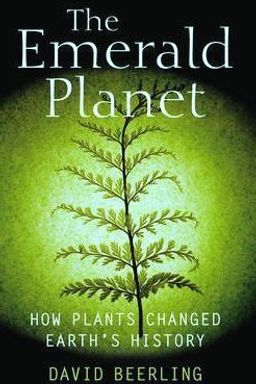
The Emerald Planet cover

The Emerald Planet

by David Beerling

The Emerald Planet delves into the extraordinary influence of plants on Earth''s history. From photosynthesis to mass extinctions, Beerling reveals how plants have been pivotal in shaping our climate and ecosystems, providing essential insights for tackling current environmental issues.

Plants That Made the Planet

How do plants shape the Earth’s climate, chemistry, and future? In The Emerald Planet, palaeobotanist David Beerling argues that vegetation has been the planet’s most transformative engineer. Across geological time, plants have captured carbon, released oxygen, sculpted continents through weathering, and acted as both witnesses and drivers of climate change. To understand how life reshaped a barren rock into a habitable world, Beerling tracks fossils, isotopes, and experimental biology to connect genes to global geochemistry.

You discover that this story unfolds across deep time: from the first leafless stems of the Silurian to the rainforest trees that altered climate feedbacks in the Eocene. Beerling shows that plants are not passive responders; they are active architects of the biosphere. Their evolution altered atmosphere, stabilized climate, and repeatedly reset the evolutionary stage for animals—including us.

The Earth Before Leaves

Early land plants lacked leaves, roots, or the vascular systems that permit tall growth. Fossils like Cooksonia (around 425 million years ago) reveal delicate, branching stems that absorbed CO₂ through their surfaces. For tens of millions of years, Earth’s surface remained a world of spindly stems, not forests. Yet genetic studies show the molecular machinery to make leaves already existed. Something in the environment—not the genome—blocked their evolution.

Genes Meet Geochemistry

Beerling links the timing of leaf evolution to ancient CO₂ levels. When CO₂ was very high, plants had few stomata and weak transpiration, meaning flat leaves would have overheated. Only when atmospheric CO₂ plunged and plants evolved deeper rooting systems could broad leaves survive without cooking. In this way, Earth’s climate constrained plant form. Once leaves spread, they accelerated weathering and pulled down CO₂ further—a self-reinforcing feedback between biology and climate.

Plants and Deep Time Feedbacks

This dynamic repeats across history. As plants grew complex, they intensified silicate weathering, increased nutrient flow, and amplified oxygen through organic burial. These processes drove major transitions: the oxygen-rich atmosphere that allowed giant Carboniferous insects; the ozone shield that protected early ecosystems; and eventually the modern alternating icehouse–greenhouse cycles. The book reveals how feedbacks between life and rocks act as an Earth thermostat, but one that can be jolted by volcanism or carbon release.

Catastrophe and Recovery

At turning points—the end‑Permian ozone crisis, the Triassic–Jurassic methane pulse, the Miocene grassland expansion—plants play central roles. They record atmospheric shocks in their spores and stomata. They also recover fastest, setting the ecological template for what follows. For example, after the Triassic–Jurassic volcanism ignited a greenhouse world, altered leaf types reveal forests adapting to deadly heat. In the Cenozoic, rising C₄ grasses exploited drier, more fire‑prone climates, revolutionizing herbivore evolution and global albedo.

The Science of Connection

Beerling fuses genetics, plant physiology, geochemistry, and atmospheric modeling into one narrative. He shows how stomatal anatomy encodes CO₂ levels like a diary, how radioactive carbon tracing uncovered photosynthesis, and how computer models now replicate Eocene warmth only by including plant‑driven trace gases like methane and nitrous oxide. Each discovery—from Tyndall’s spectrophotometer to modern Earth system models—reveals a deeper symmetry between biology and climate physics.

In essence, The Emerald Planet teaches you that the green world is the planet’s memory and mechanism rolled into one. By decoding the physiology of ancient leaves, you uncover the story of how life began to regulate its own environment, stabilizing the conditions that made complex ecosystems—and humans—possible.


The Birth of Leaves

You might assume a leaf is an obvious evolutionary step, yet the fossil record exposes an astonishing delay between the appearance of vascular plants and the rise of flat leaves. Beerling explores why this 40‑million‑year pause matters for understanding planetary climate control.

Genetic Readiness vs. Environmental Constraint

Molecular genetics reveals that early plants had the full toolkit—KNOX and homeobox genes—to make leaves. Experiments even show ferns and flowering plants share interchangeable leaf‑patterning genes. So why did nature hesitate? The answer lies not in DNA but in the physics of gas exchange and heat. High Devonian CO₂ meant few stomata, low water loss, and poor evaporative cooling. A hypothetical broad leaf would have roasted under intense sunlight.

The CO₂ Thermostat

Fossil stomatal densities, calibrated through modern experiments, reveal a sharp rise in pore numbers as CO₂ collapsed from >2000 ppm to near‑modern levels between 400–350 Ma. That change coincides with the first leafy trees like Archaeopteris. Leaves required not only more stomata but also deeper roots and vascular plumbing capable of sustained transpiration. When these systems converged, large leaves could flourish while helping cool the atmosphere still further—a plant–climate feedback that drew down greenhouse gases and ushered in late Paleozoic glaciations.

Core lesson

Leaves appeared not because genes suddenly evolved but because planetary CO₂ and plant hydraulics finally allowed them to function.

Vegetation as a Geological Force

Once rooting systems, leaves, and mycorrhizal partnerships spread, they accelerated rock weathering and nutrient cycling. This not only cooled the climate but also enriched oceans with phosphorus and silica, stimulating marine productivity. Plants thus transformed the geosphere: they turned rock into soil, soil into ecosystems, and ecosystems into a planetary feedback loop that maintains habitable conditions (a parallel to Lovelock’s Gaia hypothesis, but with testable geochemical roots).

The story of leaves reminds you that planetary transformation can spring from small physiological innovations multiplied across landscapes. The integration of genes, physics, and geochemistry illustrates how life constantly rewires its environment to remain viable—a lesson that applies as much to our CO₂‑laden present as to Devonian Earth.


Oxygen’s Rise and the Age of Giants

Breathing may seem mundane, but Beerling makes it extraordinary by showing that oxygen’s concentration has changed radically through time. During the Carboniferous, O₂ may have reached 35%, allowing colossal insects and amphibians to thrive. The same plant processes that cooled Earth also drove this oxygen spike.

Burial and Atmospheric Oxygen

Photosynthesis releases oxygen, but only burial of plant matter prevents that O₂ from being consumed again. Vast swamp forests buried carbon as coal, effectively pumping oxygen into the sky. Robert Berner’s GEOCARB models and isotope data on carbon and sulfur confirm a Carboniferous oxygen overshoot followed by a later decline when decomposition caught up.

Gigantism Explained

Higher oxygen content increased air density and diffusion capacity. Insects with tracheal systems could support larger bodies, and flight became energetically cheaper. Laboratory analogues—Robert Dudley’s fruit fly experiments in oxygen‑rich air—show size shifts within generations. When O₂ fell after decomposers evolved to eat lignin, giant dragonflies vanished. Oxygen thus set physical limits for life’s scale.

Key insight

Plant burial and decomposition modulate oxygen, linking evolutionary possibilities for animals directly to vegetation and sedimentary recycling.

Feedbacks and Fire Checks

Excess oxygen also meant rampant wildfire potential. Lovelock’s models suggested a negative feedback: more O₂ produces more fires, limiting biomass and restraining further oxygen rise. Fossil charcoal records confirm persistent burning through this era. Hence even planetary oxygen evolved under biotic feedback control—a balance between growth, burial, and combustion sustained by the living world itself.

This oxygen saga stretches from plant tissues in ancient swamps to the chemistry of the sky, uniting geology, biology, and atmospheric physics in one breathtaking cycle of co‑evolution.


Volcanic Worlds and Extinction Turning Points

Every mass extinction in Beerling’s chronicle carries a chemical signature, and vegetation sits at the heart of the story. From the end‑Permian ozone collapse to the Triassic–Jurassic greenhouse crisis, plants reveal and amplify Earth’s disasters.

The Permian’s Ozone Disaster

Mutated spores across multiple continents bear the mark of elevated ultraviolet‑B exposure. Modeling by Beerling’s team suggests that halogens vented from Siberian Trap basalts could have destroyed 60–80% of stratospheric ozone. With the protective filter gone, land plants were irradiated, sterilized, and many lineages perished. This UV‑B stress likely compounded methane release and ocean anoxia, turning the end‑Permian into the greatest biological crisis in history.

The Triassic–Jurassic Methane Pulse

Roughly 50 million years later, volcanism from the Central Atlantic Magmatic Province triggered another upheaval. Fossil leaves from Greenland record massive CO₂ spikes and shifts to dissected forms adapted to heat stress. The distinctive negative carbon isotope anomaly implies a sudden release of isotopically light methane from hydrates on the sea floor—a mechanism echoing the Paleocene–Eocene Thermal Maximum. Rapid greenhouse warming exterminated competitors and cleared ecological space for dinosaurs to dominate.

Lesson from catastrophe

Extreme volcanism can unleash greenhouse or ozone shocks that devastate ecosystems, but plant fossils preserve these atmospheric traumas with extraordinary fidelity.

You learn that vegetation both suffers from and memorializes planetary crises. Through deformities, stomata, and isotopic clues, plants encode the fingerprints of atmospheric catastrophe—providing an ancient mirror for modern climate disruptions driven by similar gases.


Decoding Ancient Forests

Beerling’s polar forest chapters invite you to imagine warm high‑latitude worlds draped in forests where sunless winters lasted months. Fossil evidence from Antarctica and Arctic islands once shocked geologists: tree stumps upright in polar sediments indicated thriving ecosystems far from the equator.

Why Polar Trees Mattered

The discovery of Glossopteris and Metasequoia fossils confirmed that ancient poles were not icy wastelands but mild, forested regions. These finds also anchored Alfred Wegener’s continental drift and Gondwana ideas. Yet the ecological puzzle remained—did those trees drop leaves to survive the dark?

Rethinking Deciduousness

Experiments raising dawn redwoods, Ginkgo, and Nothofagus under simulated polar light revealed that evergreens, not deciduous trees, were more carbon‑efficient in warm dark winters. Shedding leaves yearly costs too much energy. Models confirm that polar deciduousness likely reflected soil drainage, nutrients, or fire frequency rather than light regime alone. In nutrient‑poor polar soils, evergreen strategies often win; in richer, disturbed sites, deciduous trees dominate.

Insight

Environmental complexity, not simple latitude, governs leaf habit—a caution for interpreting fossil floras and predicting Arctic vegetation change today.

Modern warming now pushes shrubs into tundra, altering albedo and feedbacks. Understanding how past polar forests responded to warmth helps you anticipate the biosphere’s coming transformations under rapid climate change.


The Eocene Greenhouse Mysteries

The Eocene (56–34 Ma) was a global hothouse adorned with crocodiles in Arctic swamps and palms near London. Yet standard climate models long failed to reproduce its warmth using reasonable CO₂ estimates alone. Beerling turns to additional greenhouse contributors and biological feedbacks to solve the mystery.

Beyond CO₂

Victorian physicist John Tyndall first identified heat‑trapping powers of methane, nitrous oxide, and water vapour. Modern ice‑core and modeling studies extend his insight: in warm eras, wetlands seethe with methanogenic microbes, tropical soils emit more N₂O, and forests release volatile organics that form tropospheric ozone. Each adds a layer of radiative forcing—collectively about 2.5 watts per square metre in model runs for Eocene‑like conditions.

Feedbacks Multiply Warming

When methane and nitrous oxide rise, they trigger water‑vapour and cloud feedbacks that amplify regional heat. Snow melt exposes dark vegetation, absorbing more sunlight. Model 'hot spots' reveal polar winter temperatures >10°C higher with these trace gases included. The message: modest chemical changes can yield immense climatic effects when feedbacks cascade through the system.

Uncertain Proxies, Clear Lessons

Fossil CO₂ proxies (stomatal vs. boron isotope) disagree, but all indicate elevated greenhouse levels. Beerling’s synthesis shows that only by combining multiple gases and feedbacks can models match the fossil warmth. The Eocene thus serves as a laboratory for testing Earth system sensitivity. It warns that CO₂ is necessary but not sufficient to explain—or to predict—large‑scale climate transitions.

Cautionary lesson

Ignoring trace gases and biosphere–chemistry feedbacks underestimates climate sensitivity; ancient hothouses remind you that small additions can unlock large temperature shifts.


Tracing Invisible Gases

From Tyndall’s Victorian lab to Antarctic ice cores, Beerling charts how we learned to see the invisible gases linking biology and climate. The continuity from 19th‑century spectroscopy to modern geochemical modeling illustrates how empirical curiosity unraveled the greenhouse effect long before it became political.

From Glass Tubes to Polar Ice

Tyndall’s experiments revealed that water vapour, CO₂, methane, and nitrous oxide absorb terrestrial heat far better than oxygen or nitrogen. A century later, trapped air bubbles in deep ice cores confirmed that these gases vary with glacial and interglacial cycles. Methane and N₂O concentrations rise whenever temperature does, showing they act as amplifiers rather than primary triggers of change.

The Microbial Middlemen

Methanogens in wetlands and nitrifying microbes in soils breathe life into climate physics. Their metabolic outputs—methane and nitrous oxide—link ecosystem function to planetary energy balance. Their short atmospheric lifetimes mean regional shifts and seasonality matter as much as global totals. Earth system models now simulate these microbial fluxes alongside vegetation and atmosphere, showing how living chemistry completes the climate puzzle initiated by Tyndall.

The historical arc from bench experiment to ice core makes one point clear: understanding carbon history requires reading the atmosphere as a biological archive, not a mere chemical reservoir.


C4 Grasslands and Planetary Switches

The final chapters highlight a more recent revolution: the emergence of C₄ photosynthesis and its transformation of Earth’s surface. With intricate biochemical engineering, plants invented a carbon‑concentrating mechanism that turned declining CO₂ into opportunity.

The Biochemical Innovation

Inspired by isotopic tracing with carbon‑14, Melvin Calvin mapped the standard C₃ cycle, while Hatch and Slack uncovered a different pathway in maize and sugar cane—the C₄ mechanism that bundles CO₂ into four‑carbon acids before handing it to Rubisco. This design minimizes wasteful photorespiration, excelling in heat, dryness, and CO₂ scarcity. Evolution found the C₄ solution independently forty times, proving its adaptive power.

The Grassland Takeover

Around 8 million years ago, isotopic records from herbivore teeth show a global surge of C₄ vegetation. CO₂ decline set the stage, but climate drying, expanding fire regimes, and monsoon shifts delivered the trigger. Fire–grass feedbacks locked continents into open savannas, transforming faunas and even atmospheric chemistry.

A Systems Perspective

C₄ grasslands exemplify Beerling’s wider argument: planetary change arises when biology, atmosphere, and disturbance interact. Fire’s smoke alters clouds, dry seasons favor new photosynthetic economies, and ecosystems reorganize. Modern ecology echoes these dynamics as human burning, land use, and CO₂ change rewire biomes yet again.

By tracking the C₄ revolution from cyclotrons to savannas, you see how molecular innovation, atmosphere, and disturbance together forge planetary switches—lessons directly relevant to today’s biosphere engineering ambitions.


Plants as Earth’s Engineers

Beerling closes by portraying plants as the ultimate planetary engineers. Through roots, leaves, and microbial partners, they sculpt the long-term trajectories of climate, oxygen, and nutrients. Without them, CO₂ would soar fifteenfold, oceans would stagnate, and most life would vanish.

Geological Engineering

Root networks exude acids that accelerate silicate weathering, pulling CO₂ from air into oceanic carbonates. Mycorrhizae stabilize soils, mobilize phosphorus, and sustain productivity. These minute actions accumulate over eons, shifting global climate from inferno to icehouse.

Ecological Engineers

Vegetation reshapes albedo and hydrology daily. Polar forests once darkened high latitudes, amplifying warmth; modern boreal shrubs do the same as tundra melts. Grasslands alter silica cycling and ocean ecology via herbivore transport of phytoliths. Every biome carries geological consequences.

Final reflection

Plants are not passengers on a changing Earth—they are its pilots, constantly rewiring the planet’s chemistry and climate.

Seen through this lens, protecting vegetation today becomes planetary stewardship. In decoding ancient leaves, Beerling offers a vision of Earth where biology and geology are inseparable—an emerald system still writing its own climate script.

Dig Deeper

Get personalized prompts to apply these lessons to your life and deepen your understanding.

Go Deeper

Get the Full Experience

Download Insight Books for AI-powered reflections, quizzes, and more.