
Idea 1
The Hidden Elephant in the Brain
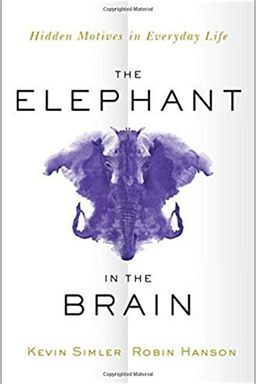
Why do people do good things for complicated reasons they don’t fully admit? In The Elephant in the Brain, Kevin Simler and Robin Hanson argue that much of what drives your choices—charity, medicine, religion, education, even conversation—is not what you claim motivates you. The title’s metaphorical elephant stands for the large, visible yet publicly ignored truth: you are often motivated by hidden self-interest, especially by the pursuit of status, mating prospects, and social approval. Your own mind conspires to keep these motives hidden to help you play the social game more effectively.
Seeing the elephant: why self‑deception evolves
Simler and Hanson’s central claim is that self-deception is not merely a bug, but an evolved feature. Robert Trivers called this “strategic self-deception”—a way to believe your own lies so you can deceive others more convincingly. Humans, blessed with complex communication and keen social detection, needed brains able to hide their truer motives, even from the conscious self. The result: your moral narratives are optimistic cover stories for deeply social and competitive motives.
Evidence comes from psychology, primatology, and economics. Split-brain experiments by Michael Gazzaniga revealed that one hemisphere fabricates reasons for actions it didn’t initiate (“I went to get a Coke”). Experiments by Nisbett and Wilson show that you confidently invent rationales for choices you can’t explain. And from studies of chimpanzees to modern institutions, the same theme recurs: individuals cloak dominance, status seeking, or alliance building under cooperative appearances.
The competitive social brain
The authors tie this to the social brain hypothesis: humans evolved oversized intelligence not just to hunt or craft tools but to navigate social competition. Like redwoods racing skyward to steal sunlight from peers, people evolved to compete for mates, allies, and prestige using mental rather than purely physical tools. Our “arms race of minds” led to creativity, humor, language, generosity, and religion—all as signaling systems that help advertise quality and loyalty.
These displays often follow the handicap principle from evolutionary biology: authentic signals are costly. You believe generosity, bravery, or intelligence more when the display costs the actor something, because that cost makes fakes less likely. As in peacocks’ tails or the Arabian babbler’s altruistic acts, human behaviors—from conspicuous consumption to moral grandstanding—often double as self-advertisements written in the language of virtue and sacrifice.
The role of norms, discretion, and self‑rationalization
Humans counterbalance raw competition with shared norms. Forager groups developed fairness rules and egalitarian traditions enforced by gossip and coalition building—a “reverse dominance hierarchy.” Yet even under norms, people cheat strategically, relying on discretion and ambiguity. According to Michael Chwe’s idea of common knowledge, what matters is not what everyone privately knows, but what everyone knows that everyone knows. You get away with norm violations precisely because the violation never crosses into common knowledge—think of the brown bag hiding alcohol, or quiet collusion in offices.
To sustain this deception, the mind creates a kind of internal press secretary that spins explanations. This function maintains social believability through self-rationalization. You tell yourself you gave to charity to help, that you went to college to learn, that you visit doctors for health—each half-truth concealing multiple social motives.
The map of hidden motives
Simler and Hanson apply this framework to everyday domains—medicine, religion, politics, education, and art—showing how each field’s public rationale conceals private drivers. Medicine becomes a ritual for showing care rather than optimizing health. Charity serves as a status signal. Education signals conformity and diligence more than skills. Religion becomes a coalition‑building technology. Politics becomes team signaling, not rational policy debate. Across them all, you find elegant hypocrisies—institutions that function through the interplay of stated ideals and real incentives.
Core lesson
Your brain isn’t a truth engine—it’s a social survival tool. If you want to understand people’s behavior, don’t stop at what they say motivates them; look for what their actions would signal, reward, or protect in an audience of peers.
Using awareness to reform
The book ends not with fatalism but with design realism. Awareness of hidden motives can guide better institutions and personal ethics. You can redesign systems so that the signals align with the outcomes you actually value—make efficient charity fashionable, effective medicine visible, or rational discourse prestigious. Through such “enlightened self-interest,” you can harness the elephant rather than pretending it’s not there. That, ultimately, is the book’s invitation: to see your mind honestly, then to work with—not against—its evolved social logic.