
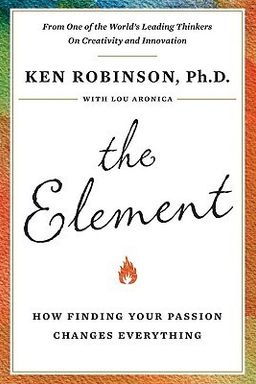
The Element cover

The Element

by Ken Robinson, with Lou Aronica

The Element by Ken Robinson and Lou Aronica offers a transformative guide to discovering your passion and aptitude, empowering readers to find their true calling. Learn how to harness diverse intelligence, overcome challenges, and connect with a supportive community to lead a more fulfilling and authentic life.

Finding Your Element: The Power of Passion and Purpose

Have you ever wondered why some people seem completely alive and fulfilled in what they do, while others feel trapped by routine or uninspired by their work? In The Element: How Finding Your Passion Changes Everything, Sir Ken Robinson argues that discovering the intersection between what you love and what you’re good at—what he calls the Element—is the key to unlocking your potential and living with genuine fulfillment. Robinson contends that most people never reach this state because of restrictive education systems, limited definitions of intelligence, and cultural pressures that drive conformity rather than creativity. To thrive in today’s fast-changing world, he insists, you must reconnect with your innate creativity and passions.

The Central Idea: Where Passion Meets Aptitude

At the heart of Robinson’s thesis is the belief that the Element lies at the intersection of natural aptitude and personal passion. He opens the book with the story of the choreographer Gillian Lynne, who as a child was labeled as having a learning disorder. It took a perceptive psychologist to realize that she wasn’t “sick” at all—she simply needed to move to think. Her mother took her to dance school, where she flourished, eventually choreographing Cats and Phantom of the Opera. This story illustrates one of Robinson’s key truths: our talents reveal themselves when we find the right environment and opportunities. In your life, the same dynamic applies—you might never uncover what you’re capable of if you remain confined to environments that do not nurture your natural energies and tendencies.

Robinson shows that being in your Element produces what psychologists call “flow”—a state where time dissolves, concentration sharpens, and work feels effortless. When British actor and writer John Cleese finally found comedy after years of schooling that failed to notice his wit, or when musician Paul McCartney discovered that formal music lessons couldn’t compare to the joy of creating songs, both experienced what Robinson calls “being in the zone.” These moments aren’t accidents—they happen when passion and aptitude align.

Why We Lose Touch with Our Potential

Robinson argues that most people fail to find their Element because modern education and cultural systems suppress curiosity, imagination, and individuality. Traditional schooling prizes verbal and mathematical intelligence above all others, pushing millions of children to the margins who might excel in art, design, movement, or interpersonal skills. As Robinson notes, when we’re young, every child sees themselves as creative—but as we advance through school, that confidence fades under the weight of grading systems and standardized testing. Education, instead of cultivating individuality, rewards conformity.

This educational mindset has historical roots in the Industrial Revolution, when schools were designed to produce reliable factory workers rather than imaginative thinkers. The hierarchy of subjects—math and language at the top, arts at the bottom—persists to this day. The result? Many adults, Robinson observes, end up in jobs that drain rather than inspire them. They lose their sense of possibility and live as though their best abilities never existed.

The Urgency of Rediscovery

The world is changing rapidly, faster than at any other time in human history. Technology, globalization, and cultural shifts mean that success in the future will depend less on rote learning and more on creativity, adaptability, and emotional intelligence. Robinson insists that the only way to navigate this uncertain future is by understanding what makes you unique. In other words, education and personal growth should no longer be about standardization but about personalization—discovering how you think, what drives you, and what makes you thrive.

To illustrate, Robinson contrasts two equally intelligent but differently gifted individuals: Mick Fleetwood, who floundered in school but found his rhythm behind the drums, and Paul Samuelson, who discovered his calling as an economist after attending a single university lecture while still in high school. Both men reached greatness, but not through standardized routes. Robinson’s point is clear: the future belongs to those who understand their individuality and apply it creatively, not those who simply follow expected paths.

The Promise of the Element

Robinson’s message is optimistic and empowering: the Element is within everyone’s reach. Whether you find it early like Terence Tao, a math prodigy, or later like Julia Child, who began her culinary career in her fifties, discovering your Element transforms your understanding of yourself. It invites fulfillment, energy, and meaning into your work and life. More importantly, it ignites a chain reaction: when individuals find their Element, entire societies benefit—from education systems to organizations to economies.

Throughout the book, Robinson weaves real-life stories with insights from psychology, neuroscience, and education reform. His ultimate challenge is for you to ask a different question—not “How intelligent am I?” but “How am I intelligent?” And once you know the answer, to live accordingly. Finding the Element, Robinson concludes, isn’t just a recipe for personal happiness—it’s a blueprint for a creative revolution.


Rethinking Intelligence and Creativity

One of the most important shifts Robinson invites you to make is in how you define intelligence itself. Rather than viewing intelligence as a fixed quantity measured by standardized tests, he presents it as diverse, dynamic, and distinctive—a living system that works in many forms. This challenges the traditional notion of IQ, which assumes that mental ability can be ranked along a single linear scale. In this view, if you’re not good at math or verbal reasoning, you’re “less intelligent.” Robinson dismantles this narrow framework with three bold assertions: intelligence is multifaceted, interactive, and unique to every individual.

The Diversity of Intelligence

Drawing on psychologists such as Howard Gardner of Harvard University (whose theory of Multiple Intelligences identified linguistic, spatial, musical, bodily-kinesthetic, interpersonal, and intrapersonal forms of intelligence), Robinson shows that the intellect operates through countless channels. For instance, Olympic gymnast Bart Conner didn’t discover his potential in a classroom but in a gymnastics center, where his exceptional sense of balance flourished. Likewise, artist Faith Ringgold discovered creativity through illness; confined at home with asthma, she found imagination her salvation. Each person, Robinson argues, has a unique combination of intelligences waiting to be realized.

This redefinition undermines the tyranny of IQ testing that dominated 20th-century education. Alfred Binet, the inventor of the IQ test, designed it only to identify students who needed extra help; yet society turned it into a tool of ranking and exclusion. Robinson recounts how IQ scores were even used to justify sterilization laws under the eugenics movement—a chilling example of how misunderstanding intelligence can oppress rather than liberate.

The Dynamics of Creativity

Robinson returns often to the connection between intelligence and creativity. “The highest form of intelligence,” he writes, “is thinking creatively.” Creativity, in his definition, is the process of having original ideas that have value. He demonstrates how creative thinking involves multiple modes of mind—rational, intuitive, emotional, and physical—working together. Through stories like physicist Richard Feynman’s playful curiosity about a wobbling plate (which led to his Nobel-winning insights), Robinson shows that creativity thrives when imagination and intellect dance in harmony.

Being creative also requires stepping beyond conventional logic. Rather than moving in straight lines of deduction, creative individuals think laterally. They see connections others miss—what psychologist Edward de Bono called “lateral thinking.” This approach underlies breakthroughs in every domain, from art to science to business innovation (for example, Apple’s fusion of design and technology). Robinson argues that everyone can cultivate this skill if encouraged by the right environments and mentors.

Your Unique Equation

Finally, intelligence is distinctive. Robinson reminds you that no two minds are the same—our patterns of thought, emotion, and perception are as unique as fingerprints. The tragedy, he says, is that most educational systems treat them all as identical. People learn and express understanding in different ways; some think best visually, some kinesthetically, others through words or sounds. Discovering your Element requires recognizing your cognitive style—the particular form of thinking that resonates most deeply with who you are.

In a world obsessed with right answers, Robinson challenges you to value the creative questions. “If you’re not prepared to be wrong,” he warns, “you’ll never come up with anything original.” The invitation is to see intelligence not as a measurement of worth but as a field of possibilities. By redefining what it means to be smart, you reclaim permission to think—and live—differently.


The Role of Imagination in Human Growth

Imagination, Robinson argues, is what separates humans from every other species on Earth. It enables us to create, to simulate experiences that don’t yet exist, and to reinvent the world around us. It underlies everything from language and art to science and philosophy. But despite its power, most of us take imagination for granted—or worse, treat it as childish fantasy. Robinson wants you to reclaim it as the essential foundation of your life and creativity.

Seeing Beyond What Exists

Imagination, as Robinson defines it, is “the power to bring to mind things that are not present to our senses.” It lets you visit the past, anticipate the future, or conceive entirely new realities. In Bertrand Russell’s famous thought experiment, he asked, “Is man what he seems to the astronomer—a tiny lump of carbon crawling on an unimportant planet? Or is he what he appears to Hamlet?” Robinson expands on Russell’s poetic tension: though we may be physically small, imagination gives us the mental capacity to comprehend the cosmos. Only humans can conceive of their insignificance—and still create meaning through art, invention, and story.

Creativity: Applied Imagination

While imagination is internal, creativity is imagination made visible. It’s when you take those imagined ideas and manifest them in some meaningful form—through a painting, an equation, a scientific theory, or a company. Robinson illustrates this with the spontaneous birth of the supergroup The Traveling Wilburys—George Harrison, Bob Dylan, Roy Orbison, Tom Petty, and Jeff Lynne—who accidentally recorded a Grammy-winning album by simply enjoying the creative moment. He juxtaposes this with physicist Richard Feynman’s discovery that led to quantum electrodynamics, which began when he mused about a spinning plate in a cafeteria. In both examples, creativity emerged from play, curiosity, and doing what they loved.

Creativity, Robinson notes, involves several processes: generating ideas, refining them, testing them, and communicating them. At the core of all of these stages is curiosity. Whether you’re composing music or designing a business, you must experiment, take risks, and embrace uncertainty. Mistakes, rather than being signs of failure, are indicators of exploration. That’s why Robinson emphasizes: “If you’re not prepared to be wrong, you’ll never produce anything original.”

Thinking in Multiple Languages

Robinson also highlights the diversity of creative media. Painters think through color and form; musicians think in sound; mathematicians like Einstein think in visual models and equations. As director Ridley Scott told Robinson, his background in fine art shaped his painterly approach to filmmaking—from Alien to Gladiator. Once again, the key message appears: you think best in the medium you love. Finding your Element often depends on discovering the form of expression that unlocks your best thinking.

Imagination frees you from the limits of circumstance by allowing you to reframe them. As Shakespeare’s Hamlet says, “There is nothing good or bad, but thinking makes it so.” The power to reimagine your world is the greatest freedom you possess. In nurturing imagination—through curiosity, play, and creative risk—you nurture your own humanity.


Being in the Zone

When you find your Element, Robinson says, you also find your “zone”—a state of peak performance where time disappears, effort feels effortless, and your abilities seem to expand beyond what you thought possible. Psychologist Mihaly Csikszentmihalyi called this state “flow” in his seminal book Flow: The Psychology of Optimal Experience. Robinson uses the stories of athletes, musicians, and writers to show how being in the zone is both a deeply personal and a universal experience of human excellence.

The Experience of Effortless Focus

World champion pool player Ewa Laurance describes losing herself in the geometry and rhythm of billiards, where “time changes” and hours pass like minutes. Screenwriter Aaron Sorkin experiences the same sensation when writing dialogue for The West Wing. “When it’s going well,” he said, “everything in my life is good. When it’s not, Miss America could be handing me a Nobel Prize, and I wouldn’t be happy.” Being in the zone, Robinson explains, is the meeting point of mastery and immersion—your mind and body working in perfect harmony toward a meaningful goal.

The Science of Flow

Csikszentmihalyi’s research identifies key elements of flow: facing a challenge that matches your skills, having clear goals, receiving immediate feedback, and complete absorption in the task. In this state, self-consciousness fades, and you act without hesitation or fear of failure. Robinson also points out the physiological side—changes in breathing, endorphin release, and increased alpha waves—all signs that the body is aligning perfectly with focused mental energy.

Being in the zone doesn’t deplete energy—it generates it. When you do something you love, Robinson writes, you might finish exhausted yet deeply renewed. By contrast, working on things that don’t engage you drains your spirit in minutes. This explains why people in their Element will persist through frustration, long hours, and setbacks; the activity itself sustains them.

The Freedom of True Engagement

Robinson’s exploration of the zone goes beyond productivity. It’s about authenticity. When you’re in the zone, you are most completely yourself—doing what feels “natural” because it aligns with your deepest identity. For Black Ice, a hip-hop poet, the zone becomes a form of communion with his audience: his words heal, motivate, and connect. For Mick Fleetwood, losing himself in drumming felt like spiritual release—a way to transform nervous energy into ecstatic rhythm. These stories reveal what Robinson calls the alchemy of synergy: when personal energy blends with purpose, you become larger than your limitations.

This experience isn’t reserved for artists or athletes—you can enter the zone in conversation, teaching, parenting, science, or gardening. The key is finding the context where your natural rhythm of intelligence and passion align. “When we connect with our own energy,” Robinson writes, “we’re more open to the energy of others.” Fulfillment, then, is not about chasing happiness but about living attuned to your own creative frequency.


Finding Your Tribe

No one finds their Element in isolation. Robinson devotes an entire chapter to the idea of “finding your tribe”—connecting with the people and communities who share your passions and stimulate your growth. Tribes, in his sense, are not just social circles; they are ecosystems of creativity where validation, inspiration, and collaboration thrive. They help you sharpen your skills, expand your vision, and sustain your motivation.

The Power of Shared Passion

For actress Meg Ryan, finding her tribe of actors in New York transformed a shy girl who froze at a school speech into a confident performer. For sculptor Don Lipski, it was discovering Cranbrook Art Institute, where he met other obsessive creators and finally felt “at home.” Science comedian Helen Pilcher left a laboratory job that stifled her creativity to join a tribe of writers and performers who made science hilarious. Each story demonstrates how being surrounded by like-minded minds validates your calling and pushes you to new heights.

Domains and Fields

Robinson borrows from sociologist Howard Becker’s idea of “domain” and “field.” The domain refers to a discipline—dance, physics, comedy—while the field is the network of people engaged in it. Your Element flourishes at the intersection of both: when you find the environment and the peers who value your work. For instance, Brian Ray, who once practiced Beatles songs as a child, now plays guitar in Paul McCartney’s band—literally joining the field that inspired him.

Validation, Inspiration, and Synergy

Robinson identifies three gifts that tribes provide: validation (recognizing you’re not alone in your passion), inspiration (motivation to improve through exposure to excellence), and synergy (collaboration that multiplies creativity). Miles Davis’s jazz recording Kind of Blue exemplifies synergy: six musicians, improvising with minimal rehearsal, produced one of the most influential albums of all time. Their chemistry proved that collective genius surpasses any individual’s capacity.

As the physicist John Wheeler said, “Nobody can be anybody without somebody being around.” Tribes fuel evolution by feeding discovery. Whether it’s the Renaissance workshops, Ancient Greek philosophers, or Silicon Valley developers, innovation blooms where passionate minds cluster.

Finding your tribe means finding those who “speak your language”—people who pull you out of isolation and into creative flow. Through them, Robinson writes, you realize that “it’s not just me.” The right tribe doesn’t just reflect who you are; it expands what you can become.


Education and the Elemental Revolution

For Robinson, transforming the world begins with transforming education. The final chapters of The Element move from personal growth to systemic change, arguing that traditional schooling is not only outdated but dangerous to human potential. Schools, modeled on factory systems of the 19th century, prioritize efficiency, conformity, and standardized testing over creative exploration. The result is an epidemic of disengagement—children losing curiosity, teachers losing passion, and societies losing innovation.

The Industrial Roots of Education

Public education was designed to serve industrial economies—dividing children by age (“date of manufacture”), moving them through standardized curricula like products on an assembly line, and measuring worth through uniform exams. Robinson calls this a “fast-food model” of quality assurance: predictable but uninspiring. He contrasts it with the “Michelin model,” which sets high standards but allows creative freedom. Just as fine restaurants express individuality while maintaining excellence, schools should enable teachers and students to innovate within guiding principles rather than rigid prescriptions.

Personalizing Learning

Education must shift from standardization to personalization. Robinson showcases revolutionary schools like Reggio Emilia preschools in Italy, which treat children as co-creators of knowledge and emphasize art, exploration, and empathy. In England, the Grangeton project transformed a failing school into a thriving mock city run by students. In Oklahoma, “A+ Schools” use arts integration to teach all subjects—improving test performance while boosting joy and engagement. These programs demonstrate that when students participate actively, achievement and well-being rise together.

Teachers as Creative Mentors

Real transformation, Robinson insists, happens through teachers. The best educators aren’t “deliverers of knowledge” but mentors and coaches who recognize each child’s unique spark. He tells of how his wife, Terry, taught drama in Liverpool by turning lessons into immersive experiences—from mock French Revolution trials to student-designed Roman plays. Her students, many from disadvantaged backgrounds, developed confidence, teamwork, and creativity. “They couldn’t wait to get to their lessons,” she said. Empowering great teachers, not introducing more tests, is the pathway to real progress.

As Robinson concludes, the goal of education—and life—is not uniformity but diversity. Like ecosystems, human communities thrive on variety, individuality, and interdependence. Creating schools and workplaces that nurture creativity isn’t just desirable; it’s essential for our survival in a rapidly shifting world. To secure our collective future, we must make education truly elemental—a living system that cultivates the passions and talents of every human being.

Dig Deeper

Get personalized prompts to apply these lessons to your life and deepen your understanding.

Go Deeper

Get the Full Experience

Download Insight Books for AI-powered reflections, quizzes, and more.