
Idea 1
The Inner Education of a Value Investor
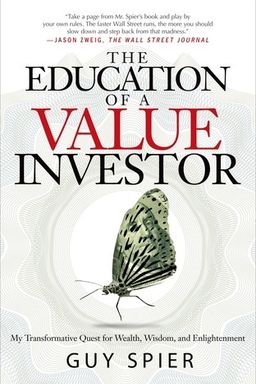
What if the real secret to investing success isn’t about mastering complex financial models, but mastering yourself? In The Education of a Value Investor, Guy Spier invites you into his personal transformation—from an arrogant Wall Street banker chasing wealth and validation to a reflective, principle-driven investor shaped by Warren Buffett’s teachings and his own inner journey. Spier argues that great investing is less about genius and more about character: the ability to think clearly under pressure, behave ethically, and build an environment that protects you from your own worst instincts.
In a world where greed and envy drive much of finance, Spier’s message is radical. He discovered through painful experience that the greatest obstacle to sound investing is not the market’s irrationality—it’s our own. Investing, he contends, is a mirror that reflects who we are: our fears, our ego, and our environment. The path to financial success, therefore, is also a path of personal mastery.
From Greed to Growth: A Redemptive Journey
Spier’s story begins at D.H. Blair, a notorious investment bank that bordered on the unethical, often selling dubious deals to naive investors. Fresh out of Oxford and Harvard, Spier entered this world full of ambition and bravado—but quickly found himself in moral quicksand. He wasn’t just disgusted by others’ behavior; he was disgusted by his own. This painful experience, akin to Buffett’s youthful mistake of buying the failing Berkshire textile mill, became his crucible. It forced him to rebuild his professional life on trust, transparency, and authenticity.
He discovered Benjamin Graham’s The Intelligent Investor and Warren Buffett’s simple, ethical investing philosophy. These books were his “life raft of sanity,” showing him that business could be both rational and moral. Over time, Spier modeled Buffett’s approach—not just his stock-picking style, but his lifestyle and mindset. This transformation would take two decades and lead him to move from the noise of Manhattan to the calm of Zurich.
The Real Education: Rewiring the Mind
Spier’s real education isn’t about finance, spreadsheets, or technical analysis. It’s psychological and moral. He learned that the brain is hardwired for irrationality—it overreacts to fear, desires status, and imitates the crowd. Drawing on Daniel Kahneman’s and Charlie Munger’s work on human misjudgment, Spier realized that intellect alone can’t save you from stupidity; you need to design a system that protects you from yourself. This meant reshaping his physical environment, his decision processes, and even his relationships.
He began to experiment with what he calls “behavioral architecture”: tangible ways to encourage rational behavior—like turning off his Bloomberg terminal, avoiding seductive salespeople, living away from Wall Street, and creating checklists to prevent cognitive errors. These are not quirks; they’re circuit breakers that counter human bias. In this respect, the book reads like a behavioral finance manual blended with a memoir of spiritual rediscovery.
Learning from Masters and Mistakes
Spier’s relationship with Mohnish Pabrai—a fellow Buffett disciple—was pivotal. Together, they co-won a $650,100 charity lunch with Buffett in 2008, an event that became a rite of passage. Buffett’s advice to “live by an inner scorecard, not an outer one” reshaped Spier’s life. He stopped chasing status and started designing a life aligned with his values. This authenticity extended to how he ran Aquamarine Fund: he eliminated management fees, limited redemptions, and surrounded himself only with long-term, like-minded investors. The less he tried to impress others, the better his results became.
Throughout his journey, Spier gleaned lessons from figures like Charlie Munger, Tony Robbins, Atul Gawande (whose “Checklist Manifesto” inspired his investment checklist), and even game theory experts like Richard Zeckhauser. He also found wisdom in bridge, chess, Stoic philosophy, and the study of ants at the Santa Fe Institute—all showing that rational action requires patience, humility, and emotional control.
Why This Book Matters: Investing as a Mirror of Life
Ultimately, The Education of a Value Investor isn’t about learning stock tips—it’s about learning who you are when money is on the line. For Spier, investing became an inner journey of confronting greed, envy, fear, and the relentless pursuit of external validation. The real reward wasn’t just financial independence, but equanimity: the ability to tap dance to work, as Buffett says, and live by one’s own compass.
This book challenges you to see the market not as a battlefield, but as a game worth playing with joy, ethics, and self-awareness. It argues that becoming a great investor and becoming a better person are the same journey. If you master your environment and your emotions, you don’t just outperform the market—you outperform your former self. And that, as Spier shows, is the true education of a value investor.