
Idea 1
Building a Business That Works Without You
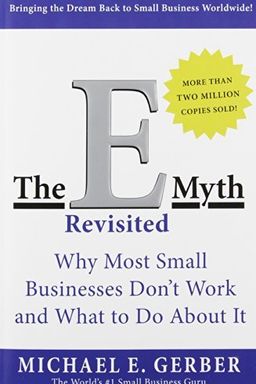
Have you ever wondered why so many small business owners end up exhausted, trapped by the very dream that was supposed to set them free? In The E-Myth Revisited: Why Most Small Businesses Don’t Work and What to Do About It, Michael E. Gerber tackles this painful paradox head-on. He argues that most small businesses fail not because people aren’t smart or hardworking, but because they misunderstand what business really is. The “E-Myth”—short for the “Entrepreneurial Myth”—is the false belief that anyone who understands the technical work of a business automatically understands how to build a business that does that work.
Gerber contends that this assumption dooms the majority of small-business owners from the start. When a talented baker opens a bakery, or a skilled mechanic starts a shop, they bring their craft but not the systems, strategy, and mindset that true entrepreneurship demands. Instead of creating a business that works for them, they create a job that consumes them. To escape that trap, Gerber insists, you must learn to work on your business, not merely in it.
The Three Personalities Within Every Owner
At the book’s core is Gerber’s insight that every business owner is three people in one: the Entrepreneur, the Manager, and the Technician. The Entrepreneur dreams big, focuses on vision, and looks to the future. The Manager brings order and process, ensuring the dream’s details are handled. The Technician loves the practical work itself—baking pies, cutting hair, fixing cars. The trouble is that most businesses are started by Technicians suffering from what Gerber calls an “Entrepreneurial Seizure”—a sudden urge to escape a boss and go it alone. But when that Technician starts a business, they inevitably build a job for themselves instead of a sustainable enterprise.
The story of Sarah, the pie-shop owner, illustrates this conflict vividly. She starts her bakery because she loves making pies. Within a few years, she’s trapped in 16-hour workdays and deep in debt, hating the very pies she once enjoyed. Gerber uses Sarah’s plight to show what happens when a business depends on the owner’s labor and lacks the systems to function independently. Her journey becomes a template for transformation: a Technician learning to develop her entrepreneurial and managerial selves.
The Turn-Key Revolution
Gerber introduces what he calls the Turn-Key Revolution—a new way of thinking about business inspired by Ray Kroc and McDonald’s. The franchise model, he argues, holds the secret to success. McDonald’s doesn’t sell hamburgers; it sells a system for making and selling hamburgers consistently anywhere in the world. The genius isn’t the product, but the design that ensures predictable results. Gerber calls this model the Franchise Prototype—a business built as if it were the first of 5,000 identical franchises, refined until it works perfectly without the owner’s constant involvement.
This approach, he explains, allows entrepreneurs to create a “business that works, not a business that depends on you.” Everything in the book builds from this premise: document every process, define every role, and systematize every function so that the business produces consistent results. McDonald’s, Disney, and Federal Express all thrive because they are systems-dependent, not people-dependent.
A Life-Centered Approach to Business
But Gerber goes beyond business mechanics. He sees building a business as building yourself. He urges readers to define their Primary Aim—the vision of what they want their life to be—and then to design their business around that goal. This flips the traditional logic: your business is not your life; it should serve your life. You start by asking, “What do I really want my life to look like?” and build backward to create a business that delivers that outcome.
Only with that clarity can you set a Strategic Objective—a clear statement of the business’s purpose, direction, and scale. Gerber guides readers step by step: define the money standards, define your customers, define your structure. Then create organizational charts, position contracts, management systems, and operational manuals—all of which form the foundation of a replicable enterprise. He shows that every great business, from McDonald’s to Mrs. Fields’ Cookies, follows a disciplined pattern of innovation (finding new ways to serve customers), quantification (measuring whether those innovations work), and orchestration (turning what works into a repeatable process).
Why This Book Still Matters
Gerber’s message, first published decades ago, remains strikingly relevant today. Many entrepreneurs burn out not because they lack passion, but because they never built a system around their passion. They confuse being busy with being successful. Gerber challenges that illusion and offers a path toward freedom: design your business to thrive without you. Just as Ray Kroc transformed a small hamburger stand into a global empire by perfecting systems, you can transform your small business into a living enterprise that runs smoothly, grows sustainably, and gives you back your life. That’s the real entrepreneurial dream—freedom, not frenzy.
In the pages that follow, you’ll explore how to shift from technician to entrepreneur, how to design your business like a franchise prototype, and how to make systems—not chaos—the heart of your company. Most importantly, you’ll learn how to rediscover joy, purpose, and balance by creating a business that finally works for you.