
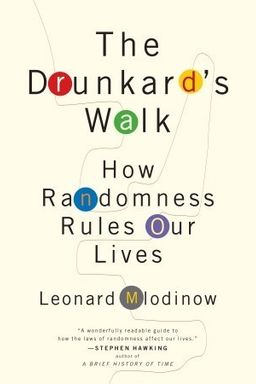
The Drunkard’s Walk cover

The Drunkard’s Walk

by Leonard Mlodinow

The Drunkard’s Walk reveals the surprising influence of randomness in our lives. Leonard Mlodinow explores the historical roots of statistics and illustrates how chance often dictates success, challenging our perception of control and highlighting the importance of understanding probability.

The Math of Chance and the Mirage of Certainty

Why do you so often see patterns, explanations, or destiny in outcomes that may be purely random? In his book, Leonard Mlodinow argues that your brain—engineered by evolution to detect causes—misfires in a world ruled by probability. He combines neuroscience, history, and real-life cases to show how randomness quietly shapes your judgments, successes, and failures, and how understanding probability can make you wiser and more resilient.

How your mind misreads randomness

Mlodinow begins with human psychology: you naturally weave causes from chance. Ancient survival required interpreting a rustle in the grass as either danger or wind; survival favored pattern seekers. That same drive now creates misleading certainty in modern settings—from business to politics to personal life. Emotion, not logic, drives many probability judgments, so you conflate luck with skill, or normal variation with meaning. The stories of a coach fired after a slump or a CEO lionized after good quarters illustrate how the brain confuses performance fluctuations for competence shifts.

From intuition to arithmetic clarity

Against your built-in biases, Mlodinow invites you into the mathematics of uncertainty. He introduces the basic probability laws—addition, multiplication, and the conjunction rule—to reveal how small arithmetic errors blossom into massive mistaken beliefs. Through famous experiments like Kahneman and Tversky’s “Linda problem,” you see how plausibility seduces you more than logical probability. Historical examples such as the People v. Collins case show that even courts once trusted misapplied multiplications of probabilities, convicting people based on mathematical illusions of certainty.

Building up the scientific framework of probability

From the gamblers of Renaissance Italy to modern statisticians, the book shows how humans gradually disciplined guesswork. Gerolamo Cardano listed all possible outcomes—the “sample space”—to compute fair-odds. Blaise Pascal added tools for counting and introduced expected value: multiplying probability by payoff to make rational choices. Bernoulli, De Moivre, and Gauss discovered the stable regularities that emerge in large numbers, leading to the bell curve that underlies measurement and prediction. Thomas Bayes offered the final tool: a way to update beliefs as new evidence appears, a framework now essential to medicine, law, and machine learning.

Probability meets everyday life

Real life rarely delivers textbook data. You confront uncertainty through noisy measurements, imperfect judgment, and tangled systems. Mlodinow translates ancient mathematics into practical wisdom: expect variability when reading polls, ratings, or GDP figures; discount streaks that can arise from multiple players trying multiple times; and beware of hindsight stories in complex systems where chance and feedback amplify small random beginnings. Whether it’s a “hot-handed” basketball player, a mutual fund streak, or a market crash, apparent patterns may be the visible tail of random sequences.

Living wisely with chance

Ultimately, Mlodinow argues you cannot escape randomness—but you can learn to partner with it. Once you think in terms of distributions rather than single outcomes, “luck” becomes less mystical and more manageable. Expectation, variance, and probability laws act like cognitive armor against misjudgment. From the perspective of complexity science and normal accident theory, he closes by suggesting humility: success often grows from many failed trials, and resilience—not prediction—is your best defense. Chance shapes both history and personal destiny, yet understanding its logic frees you from superstition and blame.

Key takeaway

You cannot eliminate randomness from life, but by learning its mathematics—pattern recognition, large numbers, and Bayesian updating—you replace comforting stories with disciplined understanding, turning uncertainty into informed choice.


The Brain’s Pattern Addiction

Your brain is built to find order in noise. Mlodinow shows that this gift, once key to survival, now causes systematic misjudgments. You interpret random fluctuations as meaningful patterns—assigning cause to luck and reading destiny into coincidence. Historical anecdotes and psychological experiments explain why intuition, not mathematics, dominates most decisions.

Illusions of cause and emotional shortcuts

You rarely separate objective probability from emotions like fear or reward. Neural imaging shows that risk perception and emotion share the same brain circuits. So when a company’s stock surges, you label the CEO a “genius,” overlooking random market factors. When failure follows, your brain seeks an “error” rather than acknowledging chance regression toward the mean. Kahneman’s flight‑instructor story illustrates how people misread luck’s role: after praising good performance, the next result looks worse, but not because praise failed—pure statistical regression explains it.

Everyday cognitive distortions

  • Pattern-seeking: seeing faces, omens, or “market trends” in random variation.
  • Availability bias: vivid memories distort estimated frequencies—e.g., fearing plane crashes more than car accidents.
  • Representativeness: believing a detailed stereotype (“Linda the feminist banker”) is more probable than the generic version.
  • Gambler’s fallacy: assuming luck must “even out.”

These biases lead you to trust gut stories instead of base rates or sample sizes. As Kahneman and Tversky showed, you rely on narrative coherence rather than logic, mistaking the plausible for the probable.


Learning the Language of Probability

To think clearly about chance, you must translate stories into numbers. Mlodinow rebuilds your intuition by teaching three pillars: the laws of probability, correct enumeration of outcomes, and expectation. His explanations make mathematical ideas concrete through humor, history, and memorable puzzles.

From Cardano to Pascal

Sixteenth‑century gambler Gerolamo Cardano invented the concept of a sample space—the list of all possible outcomes. From dice and coins to today’s risk models, his method turns guessing into counting. Blaise Pascal refined it using combinations and Pascal’s triangle, showing how to calculate fairness and expected payoff. Every modern probability rule—from the conjunction law to addition and multiplication—arises from these roots.

Making intuition visible: the Monty Hall insight

Mlodinow uses the Monty Hall problem to show that intuition fails even in simple setups. Enumerate all possible doors and you find switching wins two‑thirds of the time. Extending the puzzle to 100 doors makes the lesson unmistakable: probability is not about stories but about proportions of all possible worlds.

Expectation and real choices

The arithmetic of expected value balances probability and payoff. Pascal’s wager introduced the concept, and modern decisions—from buying insurance to investing—still rely on it. Mlodinow’s parking‑meter example shows how expected cost, not emotion, should guide behavior. The Virginia lottery arbitrage tale illustrates how that same logic can expose mispriced risk and opportunity when paired with sound counting and realistic cost estimates.

Practical takeaway

Before acting, translate intuition into arithmetic: enumerate outcomes, check independence, multiply probabilities, and weigh expected value. The math of chance disarms intuition’s tendency to overreact to vivid anecdotes.


When Small Samples Lie

Bernoulli’s law of large numbers and Kahneman’s “law of small numbers” form mirror lessons. Large samples reveal truth; small ones mislead. Mlodinow illustrates both through sports streaks, business trends, and even hero worship. You draw strong conclusions too early and forget how much luck dominates early results.

Why small samples deceive

In tiny samples, random variation overwhelms signal. Poll five voters and you’ll see wild swings from the true 60 percent majority. Yet people and managers act on such micro‑evidence. The firing of film executives after short slumps, or reverence for brief hot streaks, show institutional overinterpretation of random noise. Bernoulli mathematically proved that consistency grows with sample size; Kahneman reminded us that human judgment forgets that.

Regression and the gambler’s impulse

Regression toward the mean explains why extreme performances—high or low—tend to revert toward average. The “due for a change” instinct misreads this regression as law. Maris hitting 61 home runs looks exceptional, but across many players and seasons, such outliers occur predictably. You focus on the winner and ignore all the silent trials. The gambler’s fallacy adds the notion that chance has memory—the conviction that tails “must” appear after many heads. It doesn’t, but emotion insists otherwise.

Rule of thumb

Treat single booms and busts skeptically. Ask how large the sample is before declaring skill, brilliance, or crisis. Randomness averages out—but only with enough data.


Updating Beliefs with Bayes

Thomas Bayes transformed the logic of evidence. Mlodinow brings Bayesian reasoning to bear on modern confusions—from HIV tests to DNA trials—to show how easily you invert cause and effect. The rule is simple: what you believe after seeing evidence depends on what you believed before, multiplied by how likely that evidence is if the belief were true.

The anatomy of a conditional

Difference between P(A | B) and P(B | A) might seem trivial but destroys courtroom and medical reasoning alike. Mlodinow’s HIV‑test anecdote reveals the base‑rate fallacy: even a reliable test misleads when the underlying prevalence is low. Out of 10 000 tests, one true positive and ten false positives yield an actual post‑test infection chance near 9 percent, not 99 percent.

From law to sports: universal misunderstanding

In Sally Clark’s trial and similar cases, prosecutors confused how rare evidence is with how likely guilt is—turning improbable coincidences into wrongful certainty. Even anti‑doping and DNA programs misstate odds by ignoring lab error and real base rates. Mlodinow’s worked examples turn abstract formulas into moral imperatives: misuse of probability ruins lives.

Practical rule

Whenever you see a percentage for risk or guilt, ask: What was the prior probability? What is the test’s false‑positive rate? Bayesian updating restores sanity where intuition breeds panic or overconfidence.


From Measurement Noise to the Bell Curve

Even factual data carry uncertainty. Mlodinow shows that nearly all measurements—grades, polls, ratings—hide random error. Understanding variation, not the single number, makes you statistically literate. The bell curve connects these everyday fluctuations to deep mathematical order.

Quantifying error

Noise arises from human judgment and instrument limits. Teachers’ grades, polling results, and wine scores vary because observers and contexts differ. Scientists use the mean and standard deviation to summarize scatter: under normal distributions, roughly 68 percent of values fall within one standard deviation of the mean. That insight lets pollsters announce ±3 percent margins of error and engineers estimate tolerances.

The bell curve and the central limit theorem

De Moivre, Gauss, and Laplace proved that when many small independent factors combine, their sum forms a bell‑shaped distribution. Heights, test scores, and measurement errors all converge toward this pattern. As Mlodinow notes, the performance of 300 mutual‑fund managers mirrored 300 students guessing coin flips—reminding you how often apparent merit arises from probability’s steady hand.

Living with variation

Whenever you see a statistic, demand its uncertainty. A one‑point shift in approval ratings or wine scores may mean nothing within error bounds. Recognize the bell curve as nature’s way of expressing the law of large numbers; it underwrites both predictability and humility.


Society by the Numbers

From 17th‑century London to today, social regularities astonish: births, deaths, crimes, and marriages fluctuate little year to year despite individual unpredictability. Mlodinow traces this discovery through John Graunt’s life tables and Adolphe Quételet’s “average man.” These pioneers revealed that aggregates can be stable when individuals are not.

Graunt’s demographic insight

By tabulating mortality bills, Graunt produced early statistical models of population and longevity—the ancestors of actuarial science. His method showed that you can learn societal truth from large numbers even when individuals behave randomly.

Quételet and the concept of normality

Quételet applied the bell curve to human traits, defining the “average man.” He found regular seasonal and professional patterns in crime and disease, implying underlying order in social behavior. These discoveries spurred sociology, criminology, and modern policy analytics—but also caution against treating averages as ideals. Mlodinow notes that hit‑driven markets and cultural fads defy normality, reminding you that not all distributions are bell‑shaped.

Key lesson

Aggregation reveals structure; individuality adds noise. Society’s predictability emerges not from control but from the smoothing effect of large numbers.


Seeing Connection and Testing Reality

How can you tell whether two things really move together or if the pattern arises by chance? Francis Galton and Karl Pearson gave you the tools: regression, correlation, and chi‑square testing. Mlodinow integrates them with examples that blend history, biology, and fraud detection to show how correlation can enlighten—but also mislead.

Regression toward the mean

Galton’s study of sweet peas revealed that offspring of extreme parents tend toward average size. The same effect explains why star performers often slip closer to normal next time: extremes partly reflect luck. Recognizing regression prevents you from overreacting to spectacular wins or losses.

Correlation and causation

Pearson quantified relationships as a number from –1 to +1, yet correlation alone doesn’t prove cause. Smoking correlates with cancer due to a biological mechanism; ice cream sales correlate with drownings only because both rise in summer. Chi‑square tests complement correlation by flagging when observed counts diverge from chance expectations—vital for detecting biased dice or rigged data. Mlodinow includes examples from Poincaré’s bread‑weight investigation to modern betting anomalies, proving that statistics can reveal hidden deception.


Illusions, Streaks, and the Myth of Control

Humans crave control and confirmation. Mlodinow exposes how these instincts create illusions—from séance tables to stock‑market gurus. Faraday’s mechanical experiments demolished supernatural claims by revealing unconscious movement; Kahneman and Langer’s psychology experiments extended the insight: belief in control persists even against evidence.

Confirmation bias and illusion of control

You test beliefs by seeking confirming cases, rarely disconfirming ones. Once committed to an idea—about politics, stocks, or personal luck—you filter evidence to fit it. The illusion of control compounds the bias: lottery players who choose their own numbers demand higher prices for tickets, feeling ownership over randomness. Corporate reward systems that idolize “successful” leaders replay the same fallacy at scale, mistaking coincidence for capability.

The hot‑hand and selection trap

Sports and finance overflow with streaks that look causal but mirror random clustering. The famous hot‑hand studies show basketball streaks follow coin‑toss probabilities; mutual‑fund outperformance often collapses under statistical scrutiny. Mlodinow’s analysis of Bill Miller’s streak reframes it as expected luck, given thousands of competing funds. With many trials, extraordinary runs are inevitable.

Defensive mindset

Resist single‑instance triumphalism. Seek replication, independent samples, and quantified uncertainty before crediting skill—or condemning failure.


Randomness, Complexity, and Resilience

Chance doesn’t just affect games and markets—it rules complex systems everywhere. Weather, technology, and careers exhibit sensitivity to small initial differences. Mlodinow closes by reconciling you to a probabilistic universe, one where resilience matters more than foresight.

Butterfly effects and normal accidents

Edward Lorenz’s weather models proved how tiny rounding errors balloon into new worlds—a single decimal truncation rewrote entire simulations. Charles Perrow’s “normal accident theory” showed the same in nuclear plants: independent minor errors combine into catastrophe. You cannot predict exact outcomes; you can only prepare adaptive systems that tolerate deviation.

Serendipity and path dependence

Random sequences also fuel innovation. Bruce Willis’s accidental audition or Bill Gates’s lucky partnership with IBM illustrate how small coincidences lock in massive future consequences (economist Brian Arthur calls this “path dependence”). Once you accept that luck’s role is permanent, persistence and diversification become rational strategies. As IBM founder Thomas Watson quipped, “If you want to succeed, double your failure rate.”

Core message

In uncertain, interconnected worlds, prediction is limited but preparation is infinite. Embrace chance by designing flexibility into your life, your organization, and your thinking.

Dig Deeper

Get personalized prompts to apply these lessons to your life and deepen your understanding.

Go Deeper

Get the Full Experience

Download Insight Books for AI-powered reflections, quizzes, and more.