
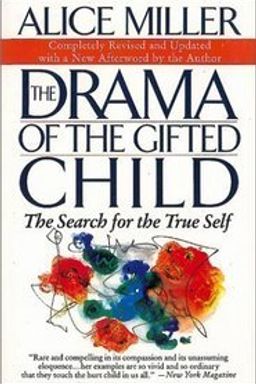
The Drama of the Gifted Child cover

The Drama of the Gifted Child

by Alice Miller

Alice Miller''s ''The Drama of the Gifted Child'' reveals how repressed childhood memories shape adult lives. This international bestseller explores the cycle of emotional pain and offers paths to healing, fostering true self-awareness and breaking generational trauma.

Facing Generational Trauma and the Legacy of Alice Miller

Have you ever wondered what it means to uncover the hidden truths buried in your family history—and what happens when that truth shakes the foundations of everything you’ve believed? In The True Drama of the Gifted Child, psychotherapist Martin Miller turns his gaze toward his own mother, the celebrated author Alice Miller, whose famous book The Drama of the Gifted Child inspired millions to face the wounds of childhood. But here, Martin does something extraordinary: he applies her teachings to her own life, exposing the gap between her public wisdom and her private struggle to confront her Holocaust trauma, her family’s secrets, and her failures as a mother.

This book is both a biography and an act of therapy—a son probing the wounds that defined his mother’s genius and his own pain. Miller contends that Alice Miller’s inability to heal her trauma from the Holocaust shaped her entire life: her tortured relationships, her compulsions, and her struggle to separate her public persona from her private anguish. The heart of his argument is hauntingly simple yet profound: unprocessed trauma doesn’t die—it is inherited, transmitted, and repeated. He shows how denial becomes a form of violence and how the children of survivors often carry their parents’ fear, guilt, and rage as emotional heirs of their unspoken history.

Alice Miller’s Public Brilliance and Private Silence

To the world, Alice Miller appeared as a revolutionary thinker who fought for children’s emotional rights. Her books, including For Your Own Good and Thou Shalt Not Be Aware, revealed the destructive power of toxic child-rearing and challenged Freud’s psychoanalysis by putting the child’s suffering at the center of psychology. Yet Martin Miller exposes that the very woman who demanded emotional honesty and confrontation lived locked behind a wall of silence about her own Jewish identity and wartime trauma. She concealed her years hiding in Nazi-occupied Poland, surviving under a false name, and abandoning parts of her family to their deaths.

This concealment shaped Alice’s emotional life. She lived split between “the gifted child” she described—the perceptive, sensitive child forced to adapt to parents’ needs—and her false self: the survivor who learned to stay alive by suppressing all feelings. Her public theory mirrored her private tragedy. In battling hypocrisy, she embodied it.

A Son’s Search for Truth

Martin Miller’s journey is both filial and professional. As a psychotherapist, he uses biography as a therapeutic tool, showing how facing truth—however painful—is essential to healing. He traces his mother’s refusal to discuss her past and her growing hostility toward intimacy. Her lifelong fear of being exposed, born from surviving under a false identity, led her to control everyone around her—including Martin. In powerful reflections on guilt and silence, he argues that when parents suffer unprocessed trauma, their children inherit the consequences unconsciously. His own life becomes evidence: manipulated, beaten, and accused by both parents, he becomes trapped in the emotional labyrinth his mother’s theories describe.

Ultimately, Miller transforms his personal pain into a message of liberation. By breaking his mother’s taboo and writing her true story, he demonstrates that confronting one’s biography is not betrayal—it’s justice. He invites readers to face their own inherited burdens and to recognize that peace begins not with forgiveness, but with honesty.

Why This Book Matters Today

This is more than an exposé of family dysfunction; it’s a case study in the psychology of denial across generations. The book resonates deeply for anyone exploring intergenerational trauma, particularly children of war survivors. As trauma therapist Oliver Schubbe writes in the afterword, both Alice and Martin symbolize the “postwar generation imprisoned in silence.” Their story shows how societies and families alike reproduce denial, perpetuate violence, and avoid truth. Miller’s account illuminates the connection between private trauma and public repression—the very dynamic that gave rise to world dramas and personal destruction alike.

Reading this book, you find yourself wrestling with difficult questions: How do we break the wall of silence we have inherited? How do we honor those who suffered without idealizing their pain? And how do we live freely when our emotional inheritance is born out of persecution? Through Alice Miller’s paradoxical life and her son’s courageous reckoning, The True Drama of the Gifted Child becomes both a biography and a map for psychological truth-telling—a testament that uncovering the hidden past is not cruelty, but compassion.


The Making of Alice Miller’s False Self

Martin Miller traces the formation of Alice Miller’s inner split—the conflict between her true and false selves—to her childhood and survival during the Holocaust. Born Alicija Englard in 1923 in an Orthodox Jewish family in Piotrków, Poland, she grew up amid strict religious rules and emotional coldness. From an early age, she felt alienated from her parents, whom she saw as unfeeling and repressive. Her sensitivity and rebellion marked her as “different.” These early experiences, Martin writes, would later become the psychological blueprint for her theories about the gifted child forced to suppress feelings to gain parental approval.

The War That Ended Childhood

When the Nazis invaded Poland in 1939, Alicija’s privileged childhood shattered instantly. She witnessed her community’s destruction and her family’s deportation to the ghetto. Displaying extraordinary resourcefulness, she escaped under a false Polish name—Alice Rostovska—and smuggled her mother and sister out. Her father, sick and visibly Jewish, died in the ghetto. In her words, she “had to kill myself” to survive, meaning she annihilated her identity to stay alive. For years, she lived as someone else, adopting Catholic customs and renouncing her origins.

This act of survival formed a lasting psychological wound. As Martin explains, the creation of a false identity saved her physically but killed her spiritually. In clinical terms, she experienced dissociation—a self-splitting into two beings: one authentic and one adaptive. This duality defined her later life and writings. The “true self” was the rebellious girl who refused authority; the “false self” was the compliant survivor who could not afford emotion. Together, they created the paradox that propelled her intellectual power yet poisoned her personal relationships.

Living as a Survivor

After the war, Alice carried the trauma of constant vigilance and guilt. She couldn’t speak Polish without fear of exposure. She distrusted intimacy and rejected her Jewish identity. In Switzerland, she became intellectually powerful but emotionally closed—what trauma researchers (like Judith Herman and Elie Wiesel) describe as the survivor’s numbness. The very repression that saved her created her later perfectionism and need for control. When trauma is hidden, Martin notes, love becomes synonymous with fear, and independence turns into self-protection. Alice’s refusal to speak about her past echoed the silence of countless Holocaust survivors who lived in what Erwin Leiser called “the prison of life after survival.”

In essence, Alice Miller’s false self became the armor of her public success. Her theories about the damaged child mirrored her own hidden suffering. Martin’s insight is pivotal: the gifted child was not just her audience—it was her own ghost self, the silent girl who once denied herself to stay alive.


The Family Drama—From Survival to Domination

At the heart of Martin Miller’s story lies a chilling paradox: his mother, the champion of children’s emotional freedom, treated her own child as an object of control and projection. The roots of this hypocrisy, Martin explains, lie in Alice Miller’s postwar marriage to Andreas Miller, a Polish academic whose possessive love resembled captivity.

Love as a Survival Mechanism

Alice met Andreas at the University of Lodz in 1945. When he followed her to Switzerland—a gesture she found intrusive—she married him partly out of fear and loneliness. Martin interprets their marriage as an example of the Stockholm syndrome: the emotional bond that forms between captors and captives. Having survived blackmail and terror, Alice identified safety with submission. Andreas, jealous and authoritarian, became both protector and persecutor. His violent mood swings and anti-Semitism only deepened the tragic irony: Alice’s wartime blackmailer and her husband shared not just a name but a psychological role.

The Consequence for Their Children

For Martin, born in 1950, this environment meant growing up as the emotional hostage of two damaged adults. His father beat him; his mother refused protection. Their conflicts became background noise in his childhood. As he recalls, Alice spent most of her energy escaping Andreas through intellectual work and psychoanalysis while neglecting her son’s emotional world. He was given away to caregivers—once placed in an orphanage under the pretext of curing bedwetting—and learned to be silent. His “outsider role,” observing without participating, became both his wound and his therapist’s gift later in life.

Alice’s letters to Martin reveal her internal contradiction. In one, she chides him for repeating his father’s cruelty; in another, she admits with guilt that she was unable to give him enough love. Her insight, however, remained theoretical. She could analyze childhood trauma in others but not bear witness to her own role in it. Martin describes this as the hereditary transmission of the “false self”: parents who never process pain turn their children into mirrors of their denial.

What’s striking is that the same dynamics Alice identified in others—parental arrogance, forced love, repression—became the architecture of her own home. Her brilliance illuminated the world but cast her family in shadow.


Breaking the Wall of Silence

Martin’s lifelong struggle culminates in his decision to break the family’s silence—an act that felt both liberation and betrayal. The “wall of silence,” as he calls it, was not just his mother’s personal secrecy but a generational fortress built after the war. Survivors hid their suffering to protect their children, yet that concealment trapped both generations. His book becomes an act of demolition, transforming guilt into truth.

The Psychology of Denial

Throughout the book, Martin observes how trauma forces people into patterns of defense: lying to survive, controlling to avoid exposure, and idealizing to escape guilt. Alice Miller embodied all three. Her fear of discovery led her to hide her Jewish identity and attack anyone who came too close—from journalists like Jeffrey Masson to colleagues and family. Every relationship oscillated between closeness and war. Martin notes that her volatility was not simple narcissism but the echo of persecution—when intimacy once threatened death, distance became safety.

Writing as Therapy

Martin Miller discovered that writing his mother’s biography was a therapeutic act. He compared it to psychotherapy itself: confronting truth rather than assigning blame. He wanted readers—and clients—to understand that to process biography is to reclaim freedom. By unveiling his mother’s contradictions, he gives voice to millions constrained by inherited silence. As he writes, uncovering lies is “active peace work,” because it breaks the chain of repression that perpetuates violence.

His courage to speak the unspeakable mirrored his own therapeutic rule: once one faces how one was victimized as a child, one no longer needs to victimize others. His insight resonates far beyond his personal story—it redefines healing as moral clarity rather than reconciliation. Facing the truth becomes an act of justice not only for oneself but for history.


Inherited Suffering and Psychological Transmission

Martin introduces one of the book’s most powerful concepts: inherited trauma. Drawing on research from trauma psychologists and the Holocaust studies he cites (Erwin Leiser, Katharina Drexler), he explains that survivors seldom manage to process their experiences, and their children become emotional carriers of what remains unspoken. In his case, Alice’s war trauma and guilt were passed on through silence, not words.

Emotional Contagion Across Generations

Martin’s childhood reflected the emotional residue of war. He lived under authoritarian fear, mirroring what Holocaust children describe as “being restricted by coordinates of invisible horror.” Without direct exposure, he nonetheless internalized his mother’s terror—her vigilance, her mistrust, her avoidance of intimacy. As trauma science now shows (via epigenetic studies Martin references through Schubbe’s afterword), stress responses can persist biologically across generations, producing heightened sensitivity, guilt, and anxiety.

Turning Poison into Wisdom

The concept of the enlightened witness, first coined by Alice and then reinterpreted by Martin, becomes the antidote to inherited suffering. If silence transmits pain, presence transforms it. The enlightened witness—a therapist, friend, or writer—offers recognition without judgment. For Martin, writing this book and engaging in therapy embodied that witnessing. He proves what his mother taught theoretically but could not live personally: only through emotional authenticity can the chain of transgenerational trauma be broken.

His insight reframes healing not as forgetting but integrating. You cannot erase inherited trauma, but you can give it meaning by naming it. In doing so, you transform inherited suffering into empathy—a lesson as relevant to individual therapy as to historical memory.


From Psychoanalysis to Empathy—Revisiting Alice’s Ideas

In later chapters, Martin steps back from biography to evaluate his mother’s influence on psychotherapy. He respects her radical focus on the child’s perspective, yet critiques her failure to test her theories in practice. Alice’s work freed psychology from Freudian dogma, insisting that repression stems from parental domination rather than innate drives. But Martin argues that her approach lacked one essential element: relational accountability.

The Power and Limits of the Gifted Child Theory

Alice taught that psychologically gifted children intuitively adapt to parental needs and lose themselves in the process. Martin expands this by showing how therapy must restore the lost relationship to the self—not just confront the parents. He combines her insights with modern theories like Peter Fonagy’s concept of “mentalizing”—the ability to recognize mental states in oneself and others. By linking emotion to reflection, clients can escape the roles their parents scripted for them.

Healing Through Relationship

Combining Alice’s radical empathy with Fonagy’s reflection, Martin reframes the therapist’s role as the enlightened witness who mirrors the client’s emotions and helps them build an inner adult self. Healing, he suggests, requires not confrontation but compassionate understanding. Adults must become protective partners for their own inner child—a process of internal re-parenting that replaces inherited patterns of fear with autonomy.

By merging trauma studies, neurobiology, and psychohistory, Martin modernizes his mother’s thought. He transforms her rage against parents into a balanced vision: compassion and boundaries instead of blame. In this sense, his book becomes not only a biography but an evolution of Alice Miller’s psychology—one that integrates trauma research into her legacy of emotional truth.


Reconciliation Beyond Forgiveness

In the final chapters and his concluding letter to his mother, Martin Miller grapples with the idea of reconciliation. Unlike sentimental closure, his version of reconciliation is grounded in truth, not forgiveness. Addressing his mother posthumously, he declares that facing reality is the only way to redeem her work. Through meticulous research and personal reflection, he reconstructs the missing parts of her history and, by doing so, liberates himself.

Truth as Moral Restoration

Martin confronts his mother with painful facts—her complicity, her lies, her failures—but refuses hatred. He insists that hatred is another form of bondage; only understanding brings freedom. Despite her attempts to control and vilify him, he recognizes that her intellectual brilliance carried a hidden message of redemption: by writing about children’s pain, she was trying unconsciously to heal her own. His forgiveness lies not in forgetting, but in transforming her contradictions into insight.

In his final words, he calls himself her “intellectual heir,” claiming that her ideas saved his life even as her actions endangered it. That paradox sums up the book’s emotional truth: trauma and genius can coexist, but peace comes only when both are illuminated. His reconciliation frees the reader to understand psychological inheritance without resentment—to see that liberating ourselves from our family’s ghosts begins by naming them.

Dig Deeper

Get personalized prompts to apply these lessons to your life and deepen your understanding.

Go Deeper

Get the Full Experience

Download Insight Books for AI-powered reflections, quizzes, and more.