
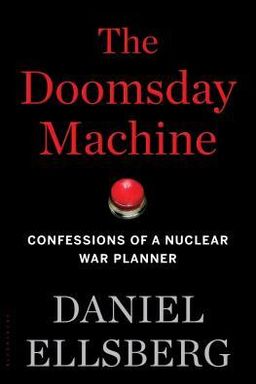
The Doomsday Machine cover

The Doomsday Machine

by Daniel Ellsberg

The Doomsday Machine by Daniel Ellsberg unveils the dark realities of nuclear warfare. From the Cold War''s origins to today''s ongoing risks, Ellsberg''s insider perspective reveals alarming system flaws and advocates for public awareness to dismantle these existential threats. A gripping narrative that challenges us to rethink our approach to global security.

Inside the Doomsday Machine

Imagine holding a sheet of paper predicting hundreds of millions of deaths—numbers mechanically generated by secret plans most citizens never knew existed. Daniel Ellsberg’s The Doomsday Machine is an insider’s revelation about how the United States built and maintained a nuclear system capable of ending civilization, not by accident but by design. Ellsberg argues that deterrence, secrecy, bureaucratic inertia, and technological optimism produced a global “doomsday machine”—a distributed system of weapons, protocols, and people that could annihilate humanity through miscalculation or mechanical failure.

Ellsberg’s personal discovery

In 1961, as a RAND consultant inside the Pentagon, Ellsberg encountered the Joint Chiefs’ casualty table showing immediate deaths of more than 275 million and eventual tolls approaching 600 million if U.S. nuclear plans (the SIOP) were executed. The experience was transformative. He realized these were not hypothetical scenarios but real, operational plans rehearsed daily by Strategic Air Command crews. The revelation defined his understanding of the “doomsday machine”: a posture ready to launch thermonuclear war with assumptions that cities—and thus civilizations—were fair military targets.

From moral norm to mechanized extermination

Ellsberg traces how twentieth‑century airpower theory normalized the destruction of civilians. The shift from moral prohibitions against bombing cities before World War II to deliberate firestorm strategies by LeMay and Harris established the precedent. By the Cold War, planners already saw “urban‑industrial targets” as legitimate. The logic of efficiency—destroying production capacity and morale—evolved seamlessly into city‑busting nuclear targeting. The scientific mastery of combustion, tested over Hamburg, Dresden, and Tokyo, made it easier to imagine obliterating Moscow and Beijing. Once total war became bureaucratized, ethics were translated into megatons, not moral limits.

A system of secrecy and delegation

Through RAND and Pentagon research, Ellsberg discovered that authority to initiate nuclear war had long been delegated far below the presidential level. Eisenhower’s predelegation letters to Admiral Felt in the Pacific, and sub-delegations down to carrier task-force commanders, meant dozens of officers could launch nuclear operations if communications failed. This diffusion was intentionally hidden from both Congress and the public. To avoid paralysis under surprise attack, planners created mechanisms that virtually ensured that a local misunderstanding—an outage, a radar glitch—could start a nuclear war. Secrecy thus multiplied risk: procedures designed to guarantee retaliation also made accidental first use likely.

The false alarm problem

Operational drills and early warning systems produced repeated near‑disasters. The BMEWS moon‑echo false alarm, 1979 computer-glitch events, and field experiences at bases like Kunsan revealed a frightening pattern: ambiguous signals, pressure to launch quickly, and authentication loopholes. Even with “positive control” procedures, Ellsberg saw that human psychology and technical uncertainty could trigger catastrophe. Pilots with live nuclear weapons might interpret a drill as real and proceed to targets. He documents that silo locks once used the code “00000000”—a chilling symbol of how safety measures were routinely undermined to preserve responsiveness.

The moral and scientific reckoning

Beyond operational risk, Ellsberg illuminates scientific ignorance about the full consequences of nuclear war. The planners who gave him those death estimates excluded firestorms and climate effects. Subsequent research on nuclear winter—global temperature collapse and agricultural failure due to soot clouds—revealed that even limited nuclear exchanges could starve most of humanity. The discovery reframed deterrence logic as an extinction machine. Ellsberg merges historical analysis with moral urgency: the system is not merely dangerous but structurally suicidal, maintained through institutional denial.

Ellsberg’s call for reform

Ellsberg’s story culminates in activism. He drafted reform proposals urging secure command systems, prohibitions on launch‑on‑warning, and physical safeguards like Permissive Action Links. Though McNamara adopted some changes, military resistance and secrecy blocked broader reform. In later decades Ellsberg advocated dismantling fixed ICBMs—the most vulnerable and destabilizing leg of the triad—and exposing the command arrangements that still enable “accidental Armageddon.” His overarching claim remains stark: humanity survives by luck, not design, and unless citizens expose and dismantle the doomsday machine, extinction remains a live policy option hidden in bureaucratic files.


The Rise of Total Destruction

You can trace the Doomsday Machine’s roots to the cultural and technological drift toward total war decades before nuclear weapons existed. Ellsberg shows how humanity reversed centuries of moral progress when air theorists proposed deliberately targeting civilians. Those ideas—Douhet’s moral‑breaking bombing, Mitchell’s independent air force vision, Trenchard’s emphasis on morale—created the intellectual framework that made Hiroshima conceivable and the SIOP inevitable.

From Roosevelt’s pledge to LeMay’s infernos

In 1939, Roosevelt’s appeal for restraint against civilian bombing echoed centuries of just‑war principles. Yet operational failure pushed Allied commanders to abandon precision. In early World War II, the Norden bombsight promised meticulous attacks on ball‑bearing plants; reality produced broad misses. Britain’s Bomber Command shifted to nighttime area bombing, officially prioritizing civilian morale destruction, and American forces followed in Japan with deliberate firestorms engineered for maximum kill ratios. LeMay’s incendiary design—alternating high‑explosive and magnesium‑bomb waves—created controllable conflagrations, such as Tokyo’s March 1945 inferno that killed over 80,000. Once civilians were officially categorized as strategic targets, moral prohibitions collapsed.

Firestorms as technology

Ellsberg emphasizes the quasi‑scientific craft of mass immolation: pre‑fire explosives followed by incendiary sequencing designed to generate hurricane‑speed winds. Hamburg and Dresden became laboratories for this new warfare. Engineers optimized bomb loads; economists like Walt Rostow quantified efficiency. The transformation from ethics to engineering taught decision‑makers that suffering was calculable. By the time atomic bombs arrived, they were regarded not as moral aberrations but as technological enhancements of already‑accepted tactics.

The thermonuclear gamble

The shift reached scientific absurdity during the Manhattan Project, when Teller considered whether atmospheric nitrogen could ignite during bomb testing. Leaders like Fermi and Compton proceeded despite finite risk of planetary ignition—demonstrating how secrecy and ambition nullify moral restraint. (Note: Ellsberg emphasizes this episode to expose a recurring logic—risk magnitude is minimized by classification.) The same mentality guided Cold War strategists who accepted millions of deaths as feasible outcomes of deterrence models.

The lesson is historical continuity. Once civilian targeting became routine, civilization accepted annihilation as operationally rational. The fusion of scientific precision and bureaucratic secrecy made apocalypse technically efficient and morally invisible.


Secrecy and Strategic Bureaucracy

Ellsberg insists that secrecy, not malice alone, sustained nuclear recklessness. The RAND Corporation and Joint Chiefs cultivated isolation where mathematical models replaced ethical debate. Inside RAND’s “secular priesthood,” theorists like Wohlstetter and Kahn debated deterrence probabilities while designing concrete war plans. Ellsberg describes these communities as brilliant but detached—elite minds treating the survival of humanity as a technical puzzle.

The single‑plan problem

Ellsberg uncovered the JSCP and SIOP—the integrated “Single Plan” defining all nuclear operations. Structured around “general war with the USSR,” it mandated total attack on Soviet and Chinese targets regardless of circumstance. Civilian leaders were denied access: documents were rewritten to omit the phrase “JSCP” before reaching the Secretary of Defense. This bureaucratic opacity meant presidents seldom saw what the machines would actually do. Military planners optimized megaton coordination—multiple waves calculated for simultaneous arrival—turning deterrence into choreography for extermination.

RAND’s intellectual insulation

The RAND scene fostered moral abstraction. In smoke‑filled conference rooms, analysts used game theory to balance “damage limitation” and “credibility,” converting moral dilemmas into algebra. Euphemisms like “urban‑industrial targets” disguised civilian massacre. Ellsberg’s horror—seeing casualty graphs of hundreds of millions—was amplified by realizing the plans were circulating among these very conferences, shielded from public oversight by classification rules.

Ellsberg’s later act of copying and hiding classified materials, then watching them literally lost to a storm, symbolizes his central message: secrecy destroys accountability and indeed erases truth itself. Knowledge buried—whether in vaults or mud—allows systems of annihilation to proceed unchecked.


Delegation, Deception, and Human Error

The book exposes an administrative reality contrary to public belief: the President is not the sole trigger for nuclear war. Ellsberg discovered systems of predelegation enabling field commanders to act autonomously. Eisenhower’s written authorizations created cascading sub‑delegations. Practically, if communications failed, numerous officers across fleets and airbases could decide war had begun and launch nuclear weapons.

Psychology under pressure

Ellsberg’s conversations with pilots reveal chilling human vulnerability. At Kunsan, crews practiced partial takeoffs because live bombs were unsafe; they had never rehearsed full flights. One major admitted that if a pilot misinterpreted an alert and flew toward his target, others would follow instinctively. Mistaken perception could literally cascade into nuclear exchange. These anecdotes ground Ellsberg’s argument that complex systems amplify small errors through organizational psychology. Under stress, individual judgment replaces abstract procedure.

Delegation and false confidence

Positive control doctrine and envelope authentications were flawed. Spark Plug codes recycled across squadrons; two‑man rules were routinely broken; silo locks defaulted to trivial combinations. Each shortcut made wartime responsiveness faster but peacetime safety weaker. Bureaucrats who feared being unable to retaliate inadvertently guaranteed accidental initiation. It is this inversion Ellsberg calls the “logic of catastrophe.”

The Cuban missile crisis later proved his fears. Soviet submarines harassed by U.S. destroyers nearly fired nuclear torpedoes. Captain Savitsky prepared the weapon; flotilla chief Vasili Arkhipov’s refusal prevented detonation—an act Ellsberg celebrates as an individual saving civilization. You learn that deterrence depends less on grand strategy than on single human hesitations under chaos.


False Alarms and Systemic Fragility

Ellsberg’s fieldwork exposes how complex technical systems interact with imperfect humans under impossible time pressure. Early warning radars can misread signals; communications can fail; training can create misleading confidence. When every minute counts, false data can trigger irreversible launches. Nuclear command systems, built for speed, magnify rather than manage uncertainty.

Ambiguity of warning

Ellsberg recounts the BMEWS radar interpreting a moon reflection as Soviet missiles. The design logic demanded response within minutes. Wohlstetter’s RAND analyses concluded that definitive warning is impossible—“perhaps” is the best we can know. Yet the procedures mandated launching on possibly false signals to preserve retaliatory credibility. The contradiction—act on uncertainty to prove certainty—reveals structural insanity embedded in deterrence logic.

The cascade effect

Ellsberg shows how one false alarm could propagate through layers of command: alert aircraft launch, communication breaks, inbound crews lose contact, and assumption becomes action. The world has survived these cascades repeatedly by chance. Historical incidents in 1979, 1980, 1983, and 1995 proved that nuclear forces respond fast but recover slow—each time exposing how close the system sits to spontaneous eruption.

Structural fragility

The insight is universal: high-speed systems dependent on human interpretation will fail catastrophically. Launch‑on‑warning is inherently incompatible with bounded rationality. Ellsberg’s portraits of base routines—pilots with limited scenario training, safes with known codes—make existential death seem procedurally mundane. Failure modes aren’t hypothetical; they’re operational norms.


The Dead Hand and Mutual Paradox

Ellsberg extends his critique to global systems. Secrecy, he argues, undermines deterrence itself. When adversaries conceal command protocols, each assumes it might decapitate the other’s leadership successfully. This temptation leads to construction of automatic retaliation systems—the epitome of the Doomsday Machine. The Soviet 'Perimeter' system, known as Dead Hand, institutionalized apocalypse as fallback mechanism.

The paradox of secrecy

If you hide predelegation, the opponent believes a surprise strike might neutralize command centers. Deterrence theory suggests transparency would prevent attack risk; real policy favors secrecy for fear of public alarm. The resulting confusion incentivizes first strikes. Kubrick’s fictional Doomsday machine dramatized this irony: what deters only works if known, yet governments keep it secret.

Autonomy of machines

Soviet engineer Valery Yarynich later admitted Perimeter could authorize launches automatically detecting command destruction. It required human input but was designed for autonomy—a literal mechanization of vengeance. The U.S., Ellsberg notes, maintains analogous predelegations though unpublicized. Both systems aim for survivable deterrence and end up guaranteeing civilization’s destruction if triggered improperly.

Ellsberg concludes that real deterrence demands credible restraint, not hidden capability. Transparency and de‑alerting, not secrecy and automation, are foundations of survival.


Reform and Dismantlement

Ellsberg’s final argument turns from diagnosis to remedy. Having revealed nuclear systems’ fragility, he proposes immediate, feasible steps to dismantle the Doomsday Machine without depending on universal disarmament. His central proposal: abolish fixed land‑based ICBMs and end launch‑on‑warning postures. This reduces incentives for first strikes and removes the most vulnerable link in the danger chain.

Practical steps

  • Retire silo‑based Minuteman missiles and dismantle related infrastructure.
  • De‑alert nuclear forces; extend decision windows for leaders to evaluate ambiguous warnings.
  • Reorient submarines and bombers toward defensive deterrence rather than decapitation targeting.
  • Establish congressional oversight with scientific testimony on nuclear winter and technical failure probabilities.

The political challenge

Ellsberg confronted military opposition even when McNamara endorsed moderate reforms in the 1960s. The culture of secrecy preserved institutional privilege. He argues any meaningful change now requires democratic disclosure. Transparency, hearings, and citizen engagement—not elite negotiation—are the real instruments of safety. (Note: Ellsberg’s emphasis mirrors his later Pentagon Papers ethos: informed citizens are moral agents of restraint.)

Ultimately, dismantling the Doomsday Machine is both technical and ethical: a recognition that civilization cannot depend on luck. Ellsberg insists survival begins by publicly acknowledging that these weapons exist not as deterrence but as suicide devices—and then by having the courage to turn them off.

Dig Deeper

Get personalized prompts to apply these lessons to your life and deepen your understanding.

Go Deeper

Get the Full Experience

Download Insight Books for AI-powered reflections, quizzes, and more.