
Idea 1
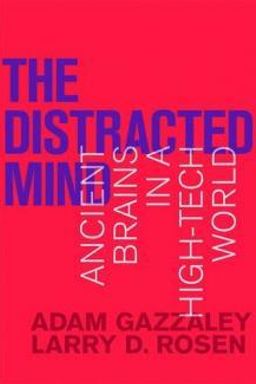
The Distracted Mind: Why We Lose Focus and How to Regain It
Why do you constantly feel pulled away from what matters most? In The Distracted Mind, neuroscientist Adam Gazzaley and psychologist Larry D. Rosen argue that your brain’s ancient architecture is at war with your modern environment. The book’s central thesis is that distraction isn't a moral failing or a sign of weakness — it’s a predictable result of the tension between advanced goal‑setting systems and limited cognitive control mechanisms. To reclaim focus, you must understand how this mismatch evolved, how technology amplifies it, and how behavioral and neural strategies can restore balance.
The Collision Between Goals and Control
Humans evolved an extraordinary capacity for projection — you can plan future meals, build civilizations, or design spacecraft. These long‑term goals emerge from your prefrontal cortex (PFC), the brain's conductor of executive function. But while your goal‑setting machinery has become powerful, the implementation systems that control attention, working memory, and goal management are narrow bottlenecks. The result is constant goal interference: you intend to finish a report, yet your phone pings, your thoughts drift, and your attention fractures. This is what Gazzaley and Rosen call the collision at the core of the modern distracted mind.
Evolution’s “Pause” and Its Vulnerability
To see how this problem began, the authors trace cognition back to the perception–action cycle shared by animals. Early organisms reacted reflexively: see threat → run. Humans evolved an adaptive pause — the ability to delay action, evaluate options, and plan responses. That pause made goal‑driven thought possible. But it also made interference possible: when multiple goals arise during a single pause, your limited control systems must choose, often imperfectly. This human “pause” creates flexibility but breeds susceptibility to distraction.
Top‑Down Goals Versus Bottom‑Up Drives
Every moment, your mind balances two opposing forces. Top‑down goals direct your attention — for example, reading this paragraph. Bottom‑up pulls arise from salient, novel stimuli — a phone buzz, a ping, a sudden movement nearby. The PFC tries to suppress irrelevant input while reinforcing what serves your aim. When control falters, bottom‑up drives win, pulling you toward novelty and away from purpose. This push‑and‑pull dynamic is normal; technology, however, weaponizes the bottom‑up system by offering endless novelty at zero cost.
From Distraction to Interruption
The authors distinguish between distraction (goal‑irrelevant material intruding on your focus) and interruption (your own decision to switch to a new task). A passing noise is a distraction; checking social media mid‑task is an interruption. Both are forms of goal interference, but they require different responses. You can ignore or filter distractions; interruptions demand metacognitive discipline — deciding when and how to switch tasks. Knowing this difference reframes distraction not as failure, but as a manageable cognitive event.
The Ecological Model of Information Foraging
To understand why you constantly switch, the authors borrow from ecology. Just as animals forage for diminishing food patches, humans forage for information patches (apps, websites, inboxes). According to Eric Charnov’s Marginal Value Theorem (MVT), you should leave a patch when expected return drops below the expected gain from moving elsewhere. Digital technologies collapse the cost of switching: a tap delivers new stimuli instantly. Evolutionary reward systems release dopamine for novelty, turning your foraging instinct into compulsive app‑checking. Herbert Simon’s warning that “a wealth of information creates a poverty of attention” becomes literal — abundant informational acorns exhaust your limited attention supply.
Technology’s Amplification of Ancient Limits
Technology didn't invent distraction; it supercharged it. The book traces waves of amplification: the web, email, smartphones, and now algorithmic social media. Each iteration compresses time—speeding exchange, reducing switching costs, and feeding your brain’s craving for novelty and reward. Linda Stone’s phrase “continuous partial attention” captures how you now hover across multiple informational fronts, scanning rather than immersing. The behavioral outcome is predictable: diminished deep work, constant low‑grade stress, and poorer cognitive performance.
Consequences Across Domains
The fallout is visible everywhere. In classrooms, multitasking students retain less; in offices, self‑interruptions and emails hollow out hours; on roads, distracted driving kills at levels comparable to intoxication. Even social connections suffer: just placing a phone on a dining table reduces empathy and perceived closeness. Night‑time screen light disrupts melatonin, undermining sleep and executive control. The collision between goals and control, once abstract, becomes tangible in missed deadlines, frayed attention spans, and mental fatigue.
Individual Variation and Vulnerability
Control capacity isn’t fixed. Children and teens, whose PFC networks are immature, are especially vulnerable; they believe they multitask effectively but perform worse than adults. Older adults, as shown by Gazzaley’s EEG research, lose suppression efficiency and exhibit slower reengagement after interruptions. Add in daily fluctuations — fatigue, stress, or alcohol — and the system falters further. Clinical conditions such as ADHD, PTSD, and depression amplify these deficits, showing how technological interference compounds neurological vulnerability.
Optimizing Control: From Neural to Behavioral Repair
Despite grim evidence, the authors present the hopeful message that cognitive control is trainable. Neurofeedback and adaptive video games (like NeuroRacer) can increase the neural oscillations associated with control, while mindfulness, physical exercise, and scheduled email checks offer behavioral leverage. The unifying goal is to adjust the MVT levers: increase the reward of staying on task (deep satisfaction, clarity) and raise the cost of leaving (reduced accessibility). Your job isn’t to disconnect from technology but to design friction that protects your ancient brain from modern overload.
Core Understanding
Distraction is not new — it is evolutionary inertia meeting technological acceleration. You live with a Stone Age brain in an information age world. The fix lies not in blame but in design: shaping environments, expectations, and training that align human capacity with modern demand.