
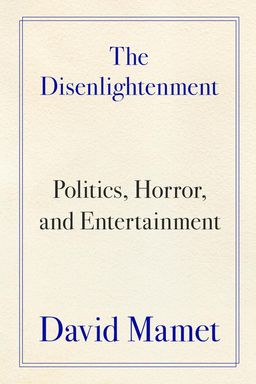
The Disenlightenment cover

The Disenlightenment

by David Mamet

The author of “Recessional” shares his views on politics and entertainment.

From Enlightenment to Open City

What happens to a civilization when its organizing stories no longer discipline power, direct attention, or restrain the state? In The Disenlightenment, David Mamet argues that the West—and particularly the United States since 2020—has drifted from Enlightenment commitments to reason, law, and individual responsibility into a condition he calls an “Open City.” In an Open City, the old sovereign has fled, the new hegemon hasn’t arrived, and unaccountable actors loot the civic storehouse while the press hangs curtains over the broken windows. The core claim is stark: our institutions—government, media, universities, arts—have inverted their missions, weaponizing language and spectacle to induce panic, dissolve law, and normalize rule by faction rather than by constitutional limits.

Mamet contends you can only understand the present if you think like a dramatist and a general: strategy before tactics; plot over applause; objective above momentary thrills. Leaders and activists who speak the loudest are like stage talkers on a carnival midway—shills whose job is to keep you titillated long enough to buy the ticket. But in drama, as in politics, what matters is whether every beat serves the objective. When nothing important seems to converge—when objectives blur—what fills the vacuum is not wisdom but appetite. That, Mamet says, is how you get confiscated borders, politicized prosecutions, “gender-neutral” bathrooms as policy theater, and emergency money for everything but hydrants when the hills catch fire.

What the book covers

You’ll see Mamet’s governing metaphor of the Open City—borrowed from wartime Naples and Paris—applied to 2020–2024 America: a caretaker administration presides as self-appointed fiefdoms (DEI offices, activist guilds, captured newsrooms, cartelized political donors) ransack the civic pantry. You’ll learn how he connects attention, anxiety, and addiction through the “springbok interval” (our seven-to-ten-minute wiring for vigilance) and explains how the internet hijacks it into perpetual dread. You’ll watch him move from the backstage of show business (temp scores, look books, awards rituals, and union logrolling) to the frontstage of politics (slogans, shibboleths, and “proof by repetition”) to show how myth-making once guided behavior but now anesthetizes scrutiny.

Several recurring threads stitch the essays together. First is the primacy of law as a bright-line operating manual, not a mood ring—his “decision height” parable from aviation: below minimums, you go missed or you die. Second is the family as the original political unit and the Left’s effort (in his telling) to displace it with factional dependence—intersectionality as rival septs vying for tribute. Third is speech: when language decouples from reference (gender as software patch; pronouns as loyalty oath), politics shifts from persuasion to threat. Finally, he writes candidly about Jews, Israel, and the return of an old story: diaspora passivity meets IDF clarity after October 7; American Jews, he argues, must stop “passing” for approval and rejoin a politics of citizenship rather than appeasement.

Why it matters now

Mamet doesn’t claim novelty so much as diagnosis. His vantage is practical, not professorial: a playwright who measures truth by what keeps an audience leaning in, and a director who learned that temp music can fool executives but it can’t finish a film. That’s the wake-up: we have mistaken the temp score (slogans, curated outrage, moralized fear) for the story (law, duty, competence). If you’ve felt the vertigo of being hectored to “follow the science” while watching hydrants run dry, schools close, and speech zones narrow, this book supplies a grammar for that dizziness.

A line to carry

“Government makes nothing; all it can do is coerce.”

What you’ll take away

Expect a bracing tour of cultural mechanisms: how propaganda exploits our springbok wiring; how “intersectionality” functions like feudal clans; how “Open City” politics makes everyone a plunderer by incentive; how talkback culture and awards show hagiography replace craft with catechism; why bright lines—of law, language, and sex—must be non-negotiable. You’ll also get hopeful prescriptions embedded in the asides: scrutinize actions over words; reject euphemism; rebuild the family and local competence; starve programs that cannot show benefits; say no to compelled speech; re-teach the Constitution as a tool, not a talisman.

The Disenlightenment reads like a stage manager’s notes for a civilization trying to finish Act Two. If you’ve suspected that our current turbulence isn’t a set of isolated scandals but a single plot problem—attention without objective, tactics without strategy—Mamet gives you a way to see the whole board and a handful of rules to start fixing the scene.


The Open City: Power Without Adults

Mamet’s most forceful image is the “Open City.” It’s not simply decay; it’s vacancy of sovereignty. Think Naples in 1943 or Paris in 1944: the old regime has evaporated, the invaders haven’t arrived, and those with keys to the storerooms help themselves. Applied to the U.S. after 2020, he claims this looks like abandoned borders, politicized prosecutions, administrative fiats substituting for legislating, and captured legacy media furnishing narrative cover for chaos.

What an Open City looks like

In an Open City, the people who should say no are paid to say yes. Mamet’s example list is granular: the Bagram Air Base abandonment as a nameless bureaucrat’s overreach; Los Angeles fires as the fruit of budget diversions (he cites a $17.8 million cut from LAFD operations redirected to DEI) and long-ignored warnings about uncleared brush and empty reservoirs; hydrants that don’t work because inspections were cut. Meanwhile, the press supplies the veil—e.g., downgrading assaults on synagogues to a “clash of protesters.”

He widens the frame to elections and lawfare: the June 28, 2024, presidential debate, which he says made an obvious incapacity undeniable; the overnight pivot of newsrooms from “disinformation” policing to removal calls; prosecutions against Trump culminating in a conviction he treats as the Left’s admission that due process is now optional. In Open City logic, guilt shifts from acts to identities; enforcement becomes factional tribute (compare Tacitus on imperial Rome or Václav Havel on “post-totalitarian” rituals).

Why Open Cities seduce

Plunder feels like progress when every group gets its turn at the till. Mamet maps “intersectionality” onto medieval septs: micro-sovereignties making overlapping claims (#MeToo, DEI, LGBTQ, climate, BLM). The rhetoric promises solidarity; the reality is a derby—“gay rights versus transgender rights,” “defunding Israel” alongside “Black wealth creation”—where wins are distributive and losses are externalized. It’s not a coup with a mastermind; it’s centrifugal politics (note: Mancur Olson made a similar point in The Rise and Decline of Nations).

How Open Cities end

They end when citizens reimpose adult supervision—bright lines, hard stops, and competent stewardship of universal goods (fire, police, water, roads, sewers, border, army). Mamet sees the 2024 vote as a plebiscite between “rule of law” and “chaos,” not between platforms. He is explicit: we don’t need unanimity on abortion, climate, or tariffs; we need consensus that the Constitution disciplines the state so individuals can disagree without civil war.

Open City checklist

Ask of any policy: Does it preserve universal, non-factional goods? Does it keep bright lines bright (due process, borders, elections)? Does it reward competence over creed? If not, you’re watching the pantry get looted.

The lesson for you is pragmatic. Don’t be hypnotized by a thousand micro-stories. Evaluate actions as a dramatist does dialogue: do they advance the objective (public order under law), or are they temp music laid over an empty reel? When it’s the latter, you’re in an Open City—and the grownups have to come back onstage.


Attention, Myth, and the Midway

Mamet’s craft lens—how you keep an audience leaning forward—doubles as a civic X-ray. He draws three intertwined lessons: strategy beats tactics, spectacle without plot is theft, and language shapes intention. He takes you from a poker table to a cutting room to a carnival lot to show how elites buy your attention on credit.

Strategy vs. tactics (and why the temp lies)

Great drama eliminates superfluity; each beat must drive the objective. He recalls how studio executives demanded “temp scores” on rough cuts—music borrowed from other films to make an unfinished reel feel like a finished movie. Once the habit set in, scores began to sound alike, and executives learned to greenlight based on the comfort of the temp rather than the coherence of the cut. Politics mirrors the move: slogans (“Hope and Change”; “We Must Go Forward”) and mood music (“Joy”) paper over the absence of constitutional plot.

He extends the analogy to the “look book,” a paste-up that projects how a finished film might appear. As an executive’s crutch, its real function is prerogative: giving the non-creator something to annotate so he can claim authorship. In public life, that’s your fact sheet, your nudge unit, your DEI rubric—props for managerial power that never touches the work (compare Neil Postman’s Amusing Ourselves to Death).

The carny bally and the tip

On the midway, the talker’s job is to build a “tip” (a crowd), excite it, and convert it. The promise—“They’re on the inside, folks!”—is the same as a modern trailer or stump speech. But the box rarely holds what the bark promised. Mamet’s examples bite: museums as three-way grifts (board, curator, artist); PricewaterhouseCoopers at the Oscars as ritualized “our ballots are pure” catechism; “gender-neutral restroom” as moral marketing rather than plumbing.

He also skewers the shill’s favorite flattery: “You’re too smart to be fooled.” From three-card monte to contemporary verse, he shows how faux-randomness sells profundity (his New Yorker party game interleaving two poems often beats either original). The rule for you: when someone sells you Random—as mystery, complexity, or “lived experience”—ask to see the plot.

A dramaturg’s test for politics

1) What’s the objective? 2) Does each action advance it? 3) Would this beat still be here if the temp music stopped?

If you treat news, campaigns, and cultural crusades like a rehearsal room, the noise sorts itself. Spectacle that doesn’t serve a lawful objective is a con. The cure isn’t cynicism—it’s craft: insist the music match the cut.


The Springbok Interval and Your Phone

Why do you “just have to check” your phone—again—right now? Mamet’s “springbok” chapter offers a biological parable that explains your itch and the culture war’s constant siren. On the veldt, springbok leap vertically every few minutes to scan for predators. Jump too rarely, you get eaten; jump too often, you starve. He argues humans carry an analogous seven-to-ten-minute vigilance cycle: the length of a scene, the time to a TV commercial break, the moment a dinner party hushes (“un Ange passe”).

From vigilance to panic

In theater and film, good storytellers refresh attention at these intervals by introducing a new element—sex, betrayal, car crash—resetting curiosity. The internet hijacks the same circuitry without the craft: every seven minutes, your limbic system pings, you feel an unnameable anxiety, and the phone promises reconnection to the herd. The repeated relief trains you to infer a threat that only the feed can interpret. That loop manufactures generalized dread—global warming, “systemic” everything, existential news-in-progress—that’s indistinguishable, to your body, from real danger (see Jonathan Haidt and Jean Twenge on teen anxiety).

Inventing the witch to save the village

Dread demands an object. Mamet links Salem’s witch trials to modern moral panics. The villagers drowning old women could not stop Indian raids, but they could control their fear by fighting a target to which they felt superior. Likewise, when the real challenges of prosperity—discipline, tradeoffs, local responsibility—prove hard, elites baptize a pseudo-threat you can battle online: “climate apocalypse,” “trans genocide,” “white supremacy everywhere,” “heterosexual AIDS”—causes infinitely fundable because they can never be cured.

Practical hygiene for the springbok mind

- Timebox check-ins to scene lengths (10-minute windows, twice morning/afternoon).
- Replace doom-scroll intervals with plot-advancing acts (call a neighbor, fix a hinge, read a primary source).
- Ask at each ping: what real predator is this supposed to name?

Mamet’s point isn’t to throw away the phone but to reclaim the jump for its purpose: scan, decide, return to the plot. You can’t tell a life story if you’re forever living in the teaser.


Family, Clan, and Captured Institutions

Mamet braids biblical anthropology, mafia sociology, and American dynasty to explain today’s “intersectionality.” His claim: power tends to re-clan. When trust in universal law thins, people retreat to septs—blood, belief, grievance—whose myths justify taking care of their own first. He riffs on the Kennedys, the Five Families, and The Godfather to show how myths inoculate scrutiny and secure tribute.

From tribes to Torah to state

In Genesis and Exodus, you see the human arc: family betrayals (Cain/Abel, Jacob/Esau, Joseph’s brothers), then Moses’s attempt to scale rules from hearth to people. The brilliance of biblical law—and later the Constitution—is not utopia but containment: it constrains rulers first so ordinary people can work out differences without slaughter. When law decays into “penumbra” and politics turns into theater, the state reverts to family logic—favor cousins, punish rivals, split the spoils (compare James Q. Wilson on “politics of particularism”).

Intersectionality as feudal derby

Mamet sees intersectionality’s coalitions as tactical marriages of septs. Solidarity lasts only until spoils are scarce: gay rights collide with trans sports, BLM’s cash doesn’t build Black wealth, climate bans crush working-class wages. The school becomes the new castle—pedagogy replaces parents; tenured guilds install soft theologies (“women don’t lie,” “lived experience is unchallengeable”), and students are trained to assent rather than reason. He labels many blue-city systems “bust-outs”: like the mob buying a business, stripping it for parts, and leaving creditors (citizens) with the shell.

His Chicago chapters channel both pride and postmortem: South Side invention (blues, skyscraper, Sears catalog) versus machine politics maturing into national habit (mics turned off for dissenters then; deplatforming now). The civic motto becomes “We owe it to the stockholders” on one side and “We owe it to our brave martyrs” on the other—two jerseys, one loot.

Rebuilding from family up

Mamet’s fix is not technocratic. It’s familial: parents reclaim schools (or remove children), churches/synagogues recover discipline over “perfumed” theology, neighborhood competence beats credentialed plans. The state protects universal goods; clans stop legislating for all.

If intersectional politics feels like being ruled by cousins you never met, Mamet is telling you why—and where to start pruning.


Decision Height: Bright Lines or Bust

An instrument pilot descends on a published approach. At 200 feet above the runway, you either see the lights or you go missed. If you “duck under” because you feel lucky, you may live this time, but you’ve just taught yourself a fatal habit. Mamet’s “decision height” is the book’s legal heart: constitutions are bright-line procedures distilled from hard-won failures. If leaders fly below minimums—censoring speech, tribalizing justice, redefining sex by fiat—you don’t get better humanity; you get terrain.

The case for bright lines

Law’s job is to bind rulers most. Mamet tallies the below-minimums flying: pandemic decrees that overrode legislatures, prosecution as political instrument, compelled pronouns and “belief checks,” airlines “mandating” 50% female/minority pilot intake without enough qualified applicants (he warns you cannot safely fudge training criteria systemwide). He’s blunt on “belief” politics: asking whether one “believes in” global warming redefines a policy question into a creed test—guilt is no longer about acts but about heresy.

His remedy is procedural, not performative. If you lost a policy fight under the rules, you lick your wounds and try again. If you suspend the rules to get your good, you’ll soon meet a more ruthless successor who keeps the suspension and drops the good (Solzhenitsyn made the same point about revolutionary shortcuts).

Below mins checklist

- Are we replacing law with “because science says”?
- Are we swapping evidence for belief declarations?
- Are we loosening standards systemwide for optics? If yes, go missed.

The action for you is practical courage: refuse compelled speech, demand statutory authority for all extraordinary acts, and starve programs that can’t show outcomes. Pilots don’t land on vibes; free peoples can’t either.


Jews, Israel, and Saying No to Passing

Some of Mamet’s most personal chapters address Jews and the American Left. He sketches a long habit of “passing”—diaspora Jews securing safety by performative passivity in majority polities—and contrasts it with the IDF’s ethic after October 7. He’s withering about what he sees as liberal Jewish complicity: voting for leaders who bankroll Iran, admonish Israel to show “restraint,” and ghost visiting Israeli PMs, while anti-Semitic street thuggery is massaged into “clashes.”

The Woody persona meets the IDF

With affectionate acidity, he notes the Woody Allen archetype: the schlemiel who always gets the girl because wit beats brawn. Diaspora humor elevated the survival strategy: “I’m Jewish, but I’m not that Jewish.” October 7 exploded the joke. “From the river to the sea” isn’t a pun; it’s an ultimatum. The LAPD barring Jews from their own shul while letting attackers jeer reframed old anxieties: you are “that Jewish”—the enemy says so.

He flays political theater: Senator Schumer refusing to shake Netanyahu’s hand; Vice President Harris skipping the address to attend a sorority reunion; the ICC’s indulgence of “genocide” charges against Israeli self-defense. Passing for approval, he argues, now aids your enemies and abandons your friends.

A hard counsel

Rejoin citizenship. Stop outsourcing safety to parties that despise your existence. Say the old words plainly (nation, borders, self-defense) and live by them.

Whether you agree with his political prescriptions, his narrative spine is clear: dignity begins when you stop hoping appeasement will buy time and start acting like a free person under law.


Show Business as Civics: From Method to Marvel

Mamet’s backstage tour doubles as a civics seminar. “Method acting” became catechism, he argues, because it focused on actors’ feelings rather than audiences’ needs—like politics that centers activists over citizens. He praises the early Soviets not for their ideology but for their craft insights: drama works when thought progresses as audience minds do—thesis, antithesis, synthesis—and every act resolves to a “zero point” where the hero’s options run out and something external must intervene.

When craft dies, catechism rushes in

He roasts talkbacks—post-show confessionals where creators explain what you just saw—as a director’s vanity masquerading as pedagogy. It’s identical, he says, to politics that treats you as a remedial audience for moral instruction. The test for both is the same: do they hold you without coercion? If not, they will seek compulsion—blacklists yesterday, HR seminars today.

On film’s present, he’s unsparing. Top Gun: Maverick is “the death rattle”—a computer game intercut with a star in front of a blue screen, dialogue present as vestigial organ. Oscars are a pousse-café of trade-show promotion and ritual guilt offerings (“diversity checklists,” “PWC ballots”) rather than honors for stories that arrest. When spectacle grows, plot dies; when plot dies, coercion enters.

A citizen’s rule from a playwright

Demand to be entertained by competence rather than schooled by catechism. In public life, that means outcomes over slogans, law over “conversations,” proof over vibes.

You don’t need to love theater to use the trick. When an institution replaces plot with pedagogy, you’re not the audience—you’re the prop.


Rewarming a Hypothermic West

The most haunting medical trope is hypothermia. As core temperature drops, your body steals heat from the extremities to keep the heart going; soon the brain goes stupid; finally, the victim strips off clothes as if the cold were heat. Mamet says the West is hypothermic: we redirected resources from police, grid, water, and civil order to DEI and performative programs; then we explained away crime, let borders dissolve, starved hydrants, and called it justice. When flames came to the Palisades and Altadena, no water; when synagogues were besieged, “clashes.”

The false third way

Like a freezing logger slashing at hallucinated heat, hypothermic societies seek the painless solution. “Bring us together” becomes code for “compel dissenters.” “Unite the people” substitutes for “enforce the laws.” Mamet insists there is no third thing: either the state protects universal, non-factional goods and prosecutes crime, or power devolves to gangs—whether urban mobs or credentialed ones in offices. Ulysses’s lesson with the Sirens applies: stuff the crew’s ears (de-politicize operations), bind the captain to the mast (constitutional limits), and sail through the song.

Rewarming moves

- Restore service hierarchies: fires out, water works, criminals jailed, borders enforced.
- Replace euphemism with names (vandalism, theft, riots—not “mostly peaceful”).
- Starve programs that cannot show outcomes in cost-benefit terms.
- Rebuild family and congregation; pull kids from captured schools if needed.

Rewarming is not a vibe; it’s a protocol. Treat your city like a hypothermic patient: stop the bleed, warm the core, then reintroduce complexity. Feelings don’t fix frostbite; heat does.


A Playwright’s Toolkit for Citizens

Mamet doesn’t hand you a party platform; he gives you habits. They’re theatrical, not theoretical—tools to cut through temp music, carnival patter, and panic peddling so you can regain plot control in your home, school, city, and country.

Five working rules

1) Ask the objective. In every policy, headline, curriculum, or protest, ask: what is the stated objective, and does each action actually advance it? If not, it’s a talkback, not a play.
2) Watch actions, not words. The pilot who busts minimums is dangerous regardless of how eloquently he briefs. Apply this to budgets (follow hydrants, not hashtags), prosecutions (due process or show trial?), schools (reading and math up or down?).
3) Keep bright lines bright. No compelled speech. No belief tests. No systemic standard-lowering. Borders enforced. Trials fair. If it must be explained by “penumbra,” it’s probably theft.
4) Reclaim your intervals. Replace seven-minute pings with scene work: knock a door, read a founding document aloud with your kids, help a neighbor patch a roof.
5) Start at home. Teach the Constitution as a tool (“our hatchet,” as he puts it): what it forbids, who it binds, how it’s used when things go wrong. Pull kids from captured institutions; rebuild local competence.

Two stock lines to memorize

“Government makes nothing; it can only coerce.”
“In unity is strength” really means “individuality is weakness.” Use these to test claims.

Mamet closes like a man returning from a storm with a simple bag of tools: questions to ask, lines not to cross, and a stubborn faith that a free people can still finish the act if they remember how stories—and republics—actually work.

Dig Deeper

Get personalized prompts to apply these lessons to your life and deepen your understanding.

Go Deeper

Get the Full Experience

Download Insight Books for AI-powered reflections, quizzes, and more.