
Idea 1
Turning Discomfort into Breakthrough Conversations
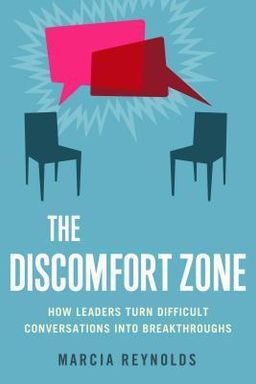
Have you ever dreaded a conversation because you knew it might get uncomfortable—but also suspected it needed to happen for something to change? In The Discomfort Zone: How Leaders Turn Difficult Conversations into Breakthroughs, Marcia Reynolds argues that the most meaningful growth, both personal and professional, happens when we lean into discomfort instead of avoiding it. Reynolds contends that leaders who can stay centered and curious while inviting others into productive discomfort become catalysts for transformation. But to do this, you must learn to balance challenge and care—to transform tension into insight rather than resistance.
Drawing from neuroscience, psychology, leadership theory, and her experience as a master coach and organizational psychologist, Reynolds explains that our brains are wired to protect our existing beliefs, habits, and sense of identity. Discomfort arises when these are threatened, but that’s also when learning becomes possible. By mastering presence, empathy, and courageous inquiry, leaders can use challenging conversations to unlock awareness, reconnect people with their values, and propel genuine behavioral change. As she puts it, ‘The Discomfort Zone is the moment of uncertainty when people are most open to learning.’
Why Discomfort Is the Doorway to Growth
Reynolds begins by reframing discomfort as a generative state rather than a threat. When people experience tension or contradiction between what they believe and what they observe, their brains scramble to reconcile the dissonance. This neurological reshuffling opens the door for new perspectives and possibilities to emerge. Leaders who can skillfully create this environment—one that feels safe yet challenging—help others question limiting assumptions and see themselves more clearly. Think of it as emotional strength training for the mind: every productive struggle strengthens awareness and resilience.
In her view, many leaders avoid these moments out of fear—fear of confrontation, rejection, or loss of control. Yet avoiding discomfort breeds stagnation. Growth requires tension. Reynolds draws on thinkers like Joseph Jaworski (who wrote about helping others ‘create new realities’) and Daniel Kahneman (who showed how human decision-making relies on both rational and automatic processes) to ground her argument. When a person’s automatic story about themselves is disrupted—when they realize that their current approach no longer fits—the brain must reorganize and find new meaning. That’s the essence of the Discomfort Zone: the quiet, awkward, emotional pause before the breakthrough.
From Managing People to Thinking Partners
Reynolds redefines leadership as a relational partnership, not a hierarchy of control. “The function of leadership,” she reminds us via Ralph Nader, “is to produce more leaders, not more followers.” Instead of directing or fixing others, your role is to serve as a thinking partner who facilitates self-discovery. This involves asking questions that help people see patterns, blind spots, and emotional drivers behind their behavior. As she notes, most breakthrough moments don’t come from advice—they come from a single, well-timed question that helps someone recognize their own truth.
To do this effectively, you must build a foundation of trust and psychological safety. People must feel your intention is for their growth, not your agenda. Reynolds calls this creating a “safety bubble” of trust where both participants can stay open even when emotions surface. Within that bubble, discomfort doesn’t feel like attack—it feels like learning. Over time, leaders who create these moments are not just problem solvers; they become mirrors and mentors for growth.
A Framework for Breakthrough Conversations
The book offers a roadmap for these conversations using the acronym DREAM: Determine the desired outcome, Reflect on stories and beliefs, Explore blind spots and resistance, Acknowledge new awareness, and Make a plan or commitment to act. This nonlinear approach balances structure and spontaneity. It gives you confidence to enter a conversation with direction while remaining flexible to follow the person’s unfolding insights. (It’s similar to coaching frameworks like GROW or the “Head, Heart, and Guts” model by Dotlich, Cairo, and Rhinesmith but integrates emotional and somatic awareness more explicitly.)
Each stage helps unpack the narrative through which people construct their ‘truth.’ For instance, reflecting on someone’s story—paraphrasing their words back and acknowledging the emotion underneath—helps them witness their own thinking. Exploring blind spots through curious questions can surface fear or attachment that’s holding them back. The goal is not to give answers but to stimulate awareness so deeply that the person sees new possibilities for themselves.
The Art of Three-Centered Listening
Reynolds also introduces the concept of “three-centered listening”—engaging not only your head (analysis and reasoning) but also your heart (empathy and values) and your gut (instinct and courage). Drawing from neuroscience, she references Dr. Michael Gershon’s research on the ‘Second Brain’ in our gut and Dr. Andrew Armour’s findings on the ‘heart brain.’ These centers provide distinct data streams. When you align curiosity (head), compassion (heart), and courage (gut), you listen with your whole being. This allows you to detect not just words but emotional cues, bodily tension, and unspoken truth. Leaders who integrate these forms of intelligence become remarkably intuitive communicators.
Throughout the book, Reynolds provides practical exercises—such as breath-and-visualization techniques to open your awareness or partner drills to practice listening from different centers. She warns that memorizing questions doesn’t work; real breakthroughs come from spontaneous presence. Like a jazz musician improvising within a structure, effective leaders trust themselves to respond authentically in the moment.
Why These Ideas Matter Today
In an age of constant change, hybrid teams, and emotional burnout, technical expertise alone can’t create transformation. The leaders who will shape the future are those who master radical empathy and courage—the ability to speak truth with care. “If you want to make a real difference for someone,” Reynolds challenges, “step into the Discomfort Zone.” These skills build engaged cultures where people feel seen, heard, and inspired to grow. They also redefine success—not just achieving goals, but developing human potential.
Over the chapters that follow, Reynolds teaches you how to build trust (Chapter 2), map the conversation with the DREAM model (Chapter 3), listen intuitively (Chapter 4), break through barriers (Chapter 5), and guide transformation (Chapter 6). Chapter 7 closes by showing how to make the process sustainable—both personally and organizationally. Together, these ideas offer a roadmap for any leader or coach who wants to move beyond comfort and into authentic connection and growth.