
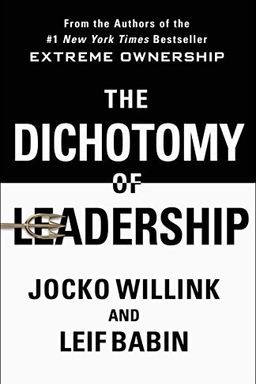
The Dichotomy of Leadership cover

The Dichotomy of Leadership

by Jocko Willink & Leif Babin

The Dichotomy of Leadership unveils the delicate balance needed to lead effectively. Drawing from their Navy SEAL experiences, Jocko Willink and Leif Babin offer transformative insights applicable in both military and business contexts, showing how to navigate leadership challenges with strategic balance.

Balancing the Dichotomies of Leadership

How can you lead decisively while staying humble, care for your people while risking their lives, or enforce standards without crushing initiative? In The Dichotomy of Leadership, former Navy SEAL commanders Jocko Willink and Leif Babin explore the delicate balances that define effective leadership. Their premise is simple yet profound: every strength, taken too far, becomes a weakness. Leadership is a continuous calibration between opposing forces—caring and toughness, discipline and flexibility, ownership and decentralization.

Drawing from their combat experience with Task Unit Bruiser in Ramadi in 2006, Willink and Babin reveal how the principles that kept SEALs alive in battle also apply to business, families, and any high-stakes team. The book builds on their earlier concept of Extreme Ownership by showing that ownership alone isn’t enough; to sustain excellence, you must navigate these dualities with judgment.

Leadership as Balance

Leadership is never a fixed formula—it’s a balance between extremes. In Ramadi, Willink and Babin learned that being too aggressive led to danger, while moving too slowly lost momentum. Too much discipline produced rigidity, but too little led to chaos. The same pattern holds true in civilian life: leaders who micromanage crush initiative; those who are too hands-off breed confusion. Great leaders live in the tension between opposites and adjust constantly.

In corporate contexts, this means blending empathy with accountability, enforcing rules without eroding trust, and empowering subordinates while maintaining oversight. What makes this framework powerful is its universality: whether leading a SEAL platoon or a sales division, the same principles apply.

From the Battlefield to the Boardroom

Every lesson in the book comes from real-world pressure. When SEALs in Charlie Platoon faced life-or-death decisions, these tensions surfaced vividly. In one mission, Leif Babin had to send his men forward knowing they could be killed—a painful test of balancing care with mission success. In another, Jocko learned to delegate authority without relinquishing responsibility, teaching the essence of Decentralized Command.

The narratives span from tactical firefights to leadership reviews, like when Leif and Chief Tony had to remove a failing team member (“Rock”) after extensive mentorship attempts. Each story translates directly into business parallels: firing an underperformer, planning complex projects, or maintaining accountability without micromanagement. The emotion of combat amplifies what managers experience every day under less lethal conditions.

Key Dichotomies You Must Master

The book’s heart is a series of balancing acts that define real leadership:

  • Care deeply, but win the mission: Love your people like family, but make the hard calls that may cost them.
  • Own everything, but empower others: Take full accountability, then decentralize execution so your team can lead.
  • Be resolute, not overbearing: Enforce non-negotiables while preserving flexibility and morale.
  • Be disciplined, not rigid: Use procedures as tools, not cages.
  • Train hard, but train smart: Balance realism and learning—push your team to failure points where lessons stick, not where confidence breaks.
  • Be humble, not passive: Build respect through service but know when to push back.
  • Lead, and be willing to follow: Step forward when needed; step back when others know best.

The SEAL Leadership Ethos

Underpinning every paradox is trust. SEALs survive because trust runs both up and down the chain of command. Subordinates execute without hesitation, knowing their leaders have prepared, trained, and planned thoroughly. Leaders, in turn, trust their people to act within intent. This ethos translates directly to civilian teams: autonomy only works when supported by clarity, relationships, and discipline.

Core Principle

Effective leadership lives in the balance: care but stay detached, plan but act, discipline yet adapt. The best leaders can hold two truths at once and move fluidly between them.

Throughout this synthesis, you’ll see these dichotomies illuminated across training, combat, and business. Each chapter shows how the tension points that frustrate leaders are actually the proving grounds of mastery. To lead well, you must be comfortable living between extremes—where clarity, courage, and humility coexist.


Own Everything, Empower Everyone

Extreme Ownership remains the foundation of great leadership—but taken alone, it can backfire. If you insist on owning every detail yourself, you create dependency and stifle initiative. Willink and Babin call this the tension between ownership and empowerment. The leader owns results, not all the actions. The team must own execution.

When Ownership Becomes Micromanagement

In Fallujah (2003), Jocko led a platoon where he controlled every decision. The result was paralysis. No one acted without him. As missions multiplied, he learned to assign concurrent operations to junior leaders—each with their own plan and accountability. The shift transformed performance. Teams moved faster, adapted better, and grew stronger. Leadership’s job is to set intent, not run the show.

When Empowerment Slips Into Neglect

Complete hands-off leadership causes drift. In a maritime rehearsal, petty officers forgot critical gear because supervision had gone missing. The lesson: you can’t abandon standards. Leaders define boundaries and verify the essentials. Successful empowerment needs clarity—intent, priorities, and rules of engagement—so initiative stays aligned.

Principle

Own the outcomes completely, but give others full space to execute. Real ownership looks like trust, not control.

In business, this means setting clear goals, providing resources, and backing your people publicly. The best CEOs stop being the “Easy Button” for decisions—they define direction and let others lead. The result: resilience, speed, and a culture of leaders at every level.


Care Deeply, Win the Mission

Leadership’s hardest choice is caring deeply for your people while accepting the risk of losing them. In Ramadi, Leif Babin and Jocko Willink lived this dichotomy every day—balancing love for their men with uncompromising duty to the mission. It’s the test of ultimate responsibility.

The Combat Reality

When Ryan Job was shot and Marc Lee was killed covering others, Leif and Seth Stone questioned every decision. Could different choices have saved them? Jocko reminded them: leaders are responsible—they plan, they execute, and they carry that burden. The balance lies in mitigating risk through preparation without letting fear halt progress.

How You Manage the Tension

You honor people best by preparing them. Train relentlessly, plan intelligently, and communicate the mission’s purpose clearly. You reduce risk but never abolish it. Making the hard call—sending teams into danger or laying off loyal employees—is the essence of duty. It hurts because you care, and that pain proves you’re leading with integrity.

Principle

A leader must care more than anyone, yet still choose the mission when called—because the mission protects everyone in the long run.

In the mining company example, the regional manager who laid off 80 people to save 600 embodied this same balance. Compassion guided the decision, not replaced it. Great leaders make painful choices for the greater good.


Discipline That Sets You Free

Discipline creates the foundation for freedom. That’s one of Willink’s most famous lines, but here it finds nuance: be disciplined, not rigid. Procedures and routines give structure, but they must remain tools, not traps.

SOPs as Lifelines

In combat, standard operating procedures allow teams to communicate instantaneously. When Jocko’s convoy was ambushed in Baghdad, shouts like “CONTACT RIGHT!” instantly organized the platoon. Discipline eliminated hesitation. Everyone moved with precision because training had etched those responses into muscle memory.

Flexibility Within Discipline

But overreliance on SOPs becomes blindness. Seth Stone once held position so rigidly that he lost situational awareness. A leader must always read the ground, not just the rulebook. When Seth moved to higher ground to regain vision, another SEAL filled his space and the mission continued—proof that disciplined teams can flex safely.

In business, the same pattern shows when strict scripts or policies smother creativity. A VP of sales who mandated uniform speech turned her reps into robots and killed rapport. The fix: keep structure but encourage adaptive judgment.

Principle

Train SOPs hard, but teach leaders when and how to bend them. Discipline gives you freedom only when applied with intelligence.

Discipline without thought is tyranny; discipline with adaptability is mastery. The goal is reflexive competence that leaves room for awareness and leadership.


Accountability with Trust

Accountability must never degrade into control. Willink and Babin show that the strongest compliance comes from understanding—not inspection. When soldiers removed their back plates in Ramadi’s heat, Jocko didn’t punish them; he explained the risk. Once the men understood lives were at stake, they policed themselves.

Accountability as Education

Teaching the why transforms behavior. When leaders resort to constant inspections, they create dependence. But when they pair accountability with education and trust, people internalize standards. The shift from extrinsic enforcement to intrinsic commitment is what sustains excellence under pressure.

Fix the System, Not Just the People

In business, the same played out when technicians refused to use cumbersome software. Only after leadership streamlined the system and explained benefits—more jobs, better pay—did compliance rise. Accountability often reveals broken systems before broken people.

Principle

True accountability arises from purpose and empowerment, not surveillance. Hold people responsible, but give them the tools, reasons, and respect to succeed.

When people understand why standards exist and feel trusted to uphold them, you get a culture of self-regulation. That’s how SEALs—and high-performance companies—operate.


Be Aggressive, Not Reckless

Action is the default setting for effective leaders. But aggression must be tempered with judgment. When opportunity emerges, act fast; when risk outweighs reward, hold fire. Task Unit Bruiser lived this contrast constantly.

Act Decisively When It Matters

In the Mav Market operation, rapid movement saved lives and seized the initiative against insurgents. Aggressive posture brought clarity and momentum. Waiting would have surrendered advantage. Aggression, when informed, wins.

Restraint as Courage

At C-Lake, however, eagerness to pursue mortar fire nearly led to disaster. The risk was massive; the payoff minimal. Willink’s restraint preserved the team. Boldness and patience are not opposites—they are twin virtues used in the right context.

Rule

Default to action, but run every move through a risk–reward filter. Aggression without analysis is recklessness; analysis without action is paralysis.

In business, the same applies. A CEO who expands blindly burns resources; one who tests and stages growth acts with disciplined aggression. Lead boldly—but never blindly.


Training That Builds Leaders

Great performance under pressure comes from training that is hard, realistic, and smart. Willink and Babin argue you must push your team until they fail—but not so far that they stop learning. Training is leadership’s lab for developing judgment.

Realism, Repetition, Reflection

In TRADET’s MOUT exercises, Big Walt’s simulated death showed the cost of inaction. When revived, he led decisively, demonstrating how one order can shift chaos to cohesion. Training must reveal cause and effect clearly. That’s how lessons stick under fire.

(Note: similar to Anders Ericsson’s “deliberate practice,” effective training stretches you just beyond capacity without breaking confidence.)

Purposeful Difficulty

Overly harsh or confusing drills, like chaotic Huey-saw exercises, only produce stress, not learning. Leaders must calibrate difficulty and debrief every scenario. In business, poorly designed programs fail when participants feel humiliated rather than challenged. The fix: difficult yet psychologically safe environments for growth.

Principle

Train hard enough to test limits, then pause to reflect. Too easy teaches nothing; too hard teaches helplessness.

Repetition builds confidence, debriefs create insight, and balanced stress cultivates leaders who act decisively when the stakes are real.


Humble, Yet Unafraid to Push Back

Humility is not weakness—it’s awareness that others’ expertise can save your mission. But humility without courage becomes passivity. In Ramadi, Leif Babin’s team earned allies and influence by doing small, humble acts—like carrying sandbags with Army soldiers—and by respectfully challenging directives that endangered them.

Building Trust Through Service

Humility builds bridges. Cooperation with Team Bulldog turned into life-saving tank support because the SEALs treated Soldiers as equals. Humility opens channels of communication across silos—whether military, corporate, or bureaucratic.

When Humility Must Lead to Courage

When the higher command imposed a dangerous ratio of Iraqi-to-U.S. troops, Willink respectfully appealed and won a waiver. His credibility—earned through prior compliance and professionalism—made that pushback possible. Leaders earn the right to dissent by demonstrating loyalty first.

Principle

Be humble enough to follow, courageous enough to challenge. The greatest leaders balance submission with integrity.

In companies, this means creating environments where dissent is safe and valued. Arrogance kills feedback; humility invites it. That’s how teams avoid catastrophic errors and improve continuously.

Dig Deeper

Get personalized prompts to apply these lessons to your life and deepen your understanding.

Go Deeper

Get the Full Experience

Download Insight Books for AI-powered reflections, quizzes, and more.