
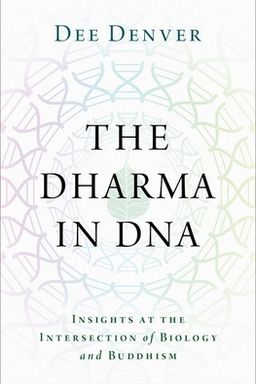
The Dharma in DNA cover

The Dharma in DNA

by Dee Denver

The Dharma in DNA delves into the unexpected parallels between Buddhist philosophy and biological science, offering a thought-provoking exploration of humanity''s essence. By examining these intersections, the book challenges traditional Western notions of self and identity, revealing a dynamic and interconnected view of existence.

The Dharma in DNA: Bridging Buddhism and Biology

What happens when a hard-nosed evolutionary geneticist, trained to worship data and dismiss spirituality, encounters the teachings of the Buddha? In The Dharma in DNA, biologist Dee Denver invites you to witness that collision of worlds—one that transforms his understanding of both science and self. The book argues that the foundational insights of Buddhism—impermanence, interdependence, and the absence of a fixed self—are not mystical abstractions but scientific truths embedded deep within the biology of life itself. Through the story of his personal awakening and scientific exploration, Denver makes the bold claim that the wisdom found beneath the Bodhi tree more than two millennia ago resonates profoundly in modern biology’s most potent symbol: the DNA molecule.

At its heart, the book contends that Buddhism and biology need not be enemies or even distant cousins. They can, and should, be collaborators in understanding reality. Denver’s core argument unfolds through his own improbable journey—from a fiercely atheistic scientist whose ego was tied to professional achievement, to a man reshaped by Buddhist philosophy. When evolutionary theory meets Buddhist insight, Denver shows us that science can adopt humility, and spirituality can gain empirical grounding.

From the Lab to the Bodhi Tree

The story begins in 2003, when the author—then a young evolutionary biologist basking in the success of publications in Nature and Science—unexpectedly encounters the Dalai Lama at an interfaith event in Bloomington, Indiana. Expecting superstition, Denver instead hears the monk affirm a principle familiar to every scientist: truth must be tested, not merely believed. That single statement—both rational and radical—plants a seed that begins to germinate in Denver’s mind. Soon, his professional focus on DNA’s mutability begins to mirror his growing fascination with impermanence, a cornerstone of Buddhist thought.

Like the Buddha under the Bodhi tree realizing that the rain and the tree are one, Denver comes to see parallels between the transformations in nature and those within himself. His life—rooted in rational empiricism—now opens to a new method of inquiry: one that honors observation but also embraces introspection. Buddhism’s teachings about duhkha (suffering), anatman (no-self), and pratityasamutpada (interdependence) begin to emerge as experimental hypotheses, ripe for testing with the tools of modern biology.

Molecules as Monks

Denver’s narrative is more than autobiography; it’s an experiment in epistemology. He sets up a scientific test of Buddhist principles using DNA—the molecule of heredity—as his subject. His logic is provocative: if all phenomena are impermanent and interdependent, then the molecule that encodes life’s stability should express those qualities too. In a series of meticulous chapters, he uses examples from genetics to show that DNA’s apparent permanence is an illusion. It changes, mutates, interacts, and is influenced by its environment—just as the Buddha described the nature of self and reality.

For instance, Denver explores how DNA’s form shifts between single- and double-stranded states, how its so-called “universal” genetic code varies between species, and how inheritance is not as linear as once assumed. These findings, he argues, echo Buddhist doctrines of impermanence (anitya) and dependent origination (pratityasamutpada). Each molecule, he shows, is in constant transformation—an idea that resonates as much in the lab as in the meditation hall.

From Personal Quest to Ethical Revolution

But Denver’s exploration doesn’t stop at molecules. As his life evolves—particularly through his experience adopting two Ethiopian children with his wife—he extends his inquiry into questions of identity, compassion, and purpose. What does it mean to be a father whose family transcends biological lineage? What insights does Buddhism offer to a scientist tempted by ego and ambition? In the later chapters, Denver proposes a new approach to science itself: “Bodhi science,” a practice of research grounded in four Buddhist qualities—selflessness, detachment, awareness, and compassion. Rather than seeing science as cold objectivity, he implores scientists to integrate mindfulness into their work, acknowledging how bias and desire shape even their most rigorous experiments.

The result is a book that functions as both a manifesto and a meditation. Denver’s synthesis of Buddhist philosophy and biological insight illustrates a truth accessible to scientists and seekers alike: that meaning and matter are inseparable. Life, in all its genetic and spiritual complexity, demonstrates the interwoven fabric the Buddha glimpsed under the Bodhi tree—a unity that science, when practiced with humility, can help reveal.

Why This Matters Now

In an age where scientific precision often coexists with existential confusion, The Dharma in DNA offers a way forward. Its lessons invite you to reconsider what it means to know something—to balance data with wisdom, and analysis with compassion. Denver’s approach also challenges a deeply rooted narrative: that science and spirituality belong in separate realms. Like the water that becomes the tree in his recurring parable, the two can flow into one another, nourishing a more complete understanding of existence. Whether you are a biologist, a Buddhist, or simply a curious human navigating the uncertainties of life, Denver’s synthesis reminds you that truth is both measurable and immeasurable—and that awakening may begin, surprisingly, in your own cells.


Impermanence in Biology and the Nature of DNA

Dee Denver uses DNA, the very molecule many imagine as life’s eternal blueprint, to prove the Buddhist principle of anitya—impermanence. In doing so, he reveals that nothing, not even the code of life, stays the same. This key idea bridges centuries of Buddhist insight with laboratory evidence, offering a stunning picture of existence as continual flux.

How the Double Helix Teaches Impermanence

Biology textbooks present DNA as a stable double helix containing fixed sequences of A, C, G, and T. But Denver walks you through the reality: DNA constantly unwinds, mutates, and interacts with its surroundings. High heat separates its strands in standard lab techniques like PCR (polymerase chain reaction), showing that its structure is reversible and conditional. Even the genetic “backbone” breaks under certain chemical conditions or radiation. These changes illustrate what the Buddha meant by anitya—all forms are temporary, arising and ceasing in dependence on conditions.

This dynamic nature is even clearer in the discovery of single-stranded viruses and the ‘breathing’ of genetic material as it adapts. DNA, it turns out, only appears permanent because its changes happen beyond your everyday perception—just as people mistake continuity of the self for stability when in fact everything is transforming moment to moment.

Epigenetics and the Universe of Change

Through epigenetics, Denver shows that your genome—often seen as biologically fixed—is chemically rewritten throughout your life. Methylation marks come and go depending on stress, diet, and environment. These biochemical signals remind us that even your inherited material is not destiny; it adapts to experience. The same DNA sequence in two identical twins can express itself differently, mirroring Buddhist teachings that form and experience are intertwined and transient. (In Why Buddhism Is True, Robert Wright argues similarly that the mind’s features evolved for flexibility, not permanence.)

Hydrogen Exchange and the Dancing Atoms

One of the most striking examples in Denver’s analysis is the atomic-level experiment showing that DNA’s hydrogen atoms exchange with the hydrogens in water within minutes. Molecle and solvent literally swap parts, losing stable identity altogether. Under Buddhist lenses, this experiment demonstrates pratityasamutpada—interbeing or co-dependent transformation. Just as the solute can’t exist without the solvent, your body and mind continually exchange atoms and influences with your environment. When you breathe, eat, or even think, you are part of that exchange.

What You Can Take Away

Recognizing impermanence isn’t just theoretical; it can reshape how you relate to stress, identity, and science itself. If your cells and atoms are forever passing away and arising again, then your suffering over stability becomes misplaced. Denver’s point is liberating: even the molecule that makes you “you” lives—and dies—with every breath. Instead of fearing change, you can see it as the most natural rhythm in the cosmos. As the Buddha would say, seeing deeply into impermanence is the beginning of wisdom.


No-Self and the Myth of Genetic Identity

If impermanence undermines the illusion of stability, then the Buddhist doctrine of anatman—no enduring self—destroys the illusion of singular identity. Dee Denver examines how modern genetics supports this idea: there is no core, unchanging essence in DNA or human identity, only a web of relations and differences. Science, he argues, may have disproven the very metaphors it once depended on.

Beyond the Myth of the “Genetic Self”

You’ve likely heard phrases like “It’s in my DNA” or seen ancestry kits promise to decode your “genetic self.” Denver calls this language deeply misleading. Modern genetics shows that genes do not define a person’s essence. DNA is not uniform even within a single body—mutations occur across cells; chimeric DNA from pregnancy or organ transplant mixes one person’s genetic code with another. Your so-called “self” is already a biological community. In one extraordinary example, scientists discovered fetal DNA persisting in mothers’ brains decades after childbirth—microchimerism that blurs any distinction between “self” and “other.”

Inheritance Without Ownership

Classical heredity theories placed DNA as the fixed vehicle of identity, but Denver turns that assumption around. RNA viruses pass life forward without any DNA at all, and prions—infectious proteins—replicate and evolve without genes. Even parental inheritance is bi-directional: not only does genetic material flow from parent to child, but fetal cells travel in reverse, influencing the mother’s physiology. These revelations echo the Buddha’s interdependent vision of creation, where nothing exists independently or possesses intrinsic self-nature.

The Mirage of Race and Gender as Genetic Truth

Denver doesn’t avoid controversy. He exposes how scientific racism, from 19th-century skull measurements to James Watson’s modern remarks about racial intelligence, distorted genetics into ideology. Likewise, binary assumptions about sex crumble under evidence of intersex conditions, chromosome mosaics, and temperature-dependent sex determination in other species. Biology confirms what Buddhism intuited: the boundaries we glorify are conventions, not essences. As Thich Nhat Hanh would say, each being ‘inter-is’ with the others; a chromosome or race label cannot define the whole.

Selflessness as Scientific Humility

Ultimately, acknowledging no-self transforms both the scientist and the human being. When you understand that identity is relational, not solid, you cannot cling to prestige or separation. Denver models this transition by showing how Anatman reshapes not just beliefs but research ethics: science, stripped of ego, becomes a compassionate inquiry into connection. Your body, your genes, your life—they are not yours. They are borrowed patterns, temporarily held in time’s flowing experiment.


The Interdependent Universe: Pratityasamutpada in Science

Among all Buddhist concepts, pratityasamutpada—dependent origination—is the most profound. It teaches that every phenomenon arises through multiple conditions; nothing exists alone. Dee Denver uses it as the bridge connecting Buddhist philosophy and biological science. In both, cause and effect operate as networks, not chains. To grasp this is to change how you understand not only the cell but the cosmos.

Life as a Web, Not a Mechanism

Classical Western science, from Aristotle to Newton, has sought linear explanations: A causes B. The Buddha, by contrast, saw reality as a mutual interplay—“when this exists, that arises.” Denver argues that modern biology, especially systems theory, vindicates this view. Denis Noble’s systems biology, for instance, replaces genetic determinism with dynamic feedback between levels of life: gene, cell, organ, and environment. DNA doesn’t simply cause traits; proteins and hormones shape DNA’s activity in return. Every part of life is both cause and effect—a living demonstration of dependent arising.

From Evolution to Ecosystems

Denver expands this framework to evolution itself. Mutation, for example, is not purely random as once claimed—it follows contextual patterns governed by biochemical environments. Natural selection, too, depends on cooperation and altruism as much as competition. He highlights how the Dalai Lama challenged geneticists’ assumptions about randomness, arguing instead for hidden causality. This dialogue reshapes the notion of evolution from a cold struggle for survival into a mindful dance of adaptation and interconnection.

Indra’s Net and Modern Networks

Borrowing the Mahayana metaphor of Indra’s net—a vast web where each jewel reflects all others—Denver finds imagery that fits modern biology’s web-like complexity. From the microbiome to climate systems, everything mirrors Indra’s vision of interbeing. When a bacterium acquires a gene from another species (horizontal gene transfer), or when human DNA merges with viral fragments, you’re seeing dependent origination in molecular form. The line between individuality and ecology dissolves.

Seeing the Pattern in Yourself

For you as a reader, recognizing this web changes accountability. Your choices—how you eat, speak, experiment—ripple through this network. Denver wants scientists and laypeople alike to abandon the illusion of isolated action. In The Dharma in DNA, understanding pratityasamutpada becomes a moral awakening: to harm another being, species, or system is to harm yourself. Life’s beauty lies not in autonomy but in mutual creation.


Bodhi Science: An Ethical Method for Discovery

After demonstrating that biology supports Buddhist insight, Dee Denver asks: how should scientists live and work in light of this revelation? His answer is Bodhi Science—a reimagined scientific method rooted in wisdom. Whereas Western science often prizes ego, competition, and objectivity, Bodhi Science invites self-reflection, compassion, and awareness into the lab. Its mission: to do science without delusion.

The Four Qualities of a Bodhi Scientist

  • Selflessness: Science must begin by dissolving the illusion of the neutral, separate observer. Scientists, like everyone, influence their observations. A self-aware scientist asks not “How objective am I?” but “How attached am I to being right?”
  • Detachment: Denver notes that many researchers cling to their hypotheses as identities—whether Linus Pauling’s doomed triple-helix model or Moto Kimura’s stubborn defense of neutrality theory. A Bodhi scientist learns to let go of attachment to theories and even to ‘science’ itself, staying open to what the data—and reality—teach.
  • Awareness: Mindfulness sharpens perception. Just as meditation cultivates clarity, a reflective scientist can notice biases and hidden assumptions. Denver likens this to samatha and vipassana meditation—calm observation and penetrating insight turned toward one’s own research process.
  • Compassion: True motivation in science, he argues, must be the alleviation of suffering. Whether developing medicine or exploring ecosystems, intention should stem from bodhicitta—the wish that all beings benefit from discovery.

Science Without Ego

Denver criticizes the cult of personality—the James Watsons and Craig Venters who equate success with fame. Ego, he warns, distorts research just as it distorts perception in meditation. The Buddhist remedy is humility and presence. A selfless scientist recognizes that every experiment reflects the universe’s interdependence. In that humility, science becomes a spiritual discipline as well as an intellectual one.

Guarding Against Pseudoscience

Bodhi Science also inoculates against pseudoscience’s seven sins—from data manipulation to grandiose “all-explaining” theories. By cultivating mindfulness and compassion, researchers resist self-deception. A scientist motivated by wisdom and empathy will seek understanding, not confirmation. Denver’s framework thus promises ethical clarity at a time when misinformation threatens both science and society.

Bringing Mindfulness to the Lab

For you, this approach suggests questions beyond the microscope: Why am I seeking knowledge? Who benefits from my discoveries? By practicing mindfulness—whether before an experiment or a conversation—you invite balance between curiosity and care. Bodhi Science, at its core, is awareness-in-action: a middle path uniting truth-seeking with wisdom-seeing.


Compassion, Adoption, and the Practice of Interbeing

The book concludes not in the lab but in the living room. Dee Denver’s story of adopting two children from Ethiopia becomes the ultimate field study in interdependence and compassion. Through it, he tests Buddhist principles not with pipettes but with parenthood, examining how love transcends genetics and ego. The final chapter, “Intimacy,” turns science’s gaze inward—toward family, race, and the ethics of belonging.

Beyond the Genetic Family

By adopting Amani and Hirut, Denver and his wife Stephanie defy the biological primacy of DNA. Here, parenting becomes an act of bodhicitta—unconditional compassion that acknowledges interbeing over inheritance. He wrestles with guilt, privilege, and the Western fixation on lineage. Yet through Buddhism, he realizes that family isn’t defined by genes but by shared experience and mutual transformation. When he watches his son lock eyes with a tuatara—New Zealand’s ancient reptile—he sees symbolic continuity across time, species, and identity: the Buddha’s rain becoming tree, tree becoming rain.

Deconstructing the Savior Narrative

Denver also critiques the “white savior” trap that often shadows Western adoption narratives. Drawing from Teju Cole’s critique of the White Savior Industrial Complex, he confronts how good intentions intertwine with cultural blindness. The Buddhist approach, he suggests, is not rescue but relationship—seeing others not as projects but as mirrors. In interdependent compassion, saving dissolves into sharing; each party transforms the other.

Living Interdependence

Buddhist logic ultimately helps him understand his parenting drive as a manifestation of dependent arising. Multiple causes—his upbringing, his empathy, even pop culture images like “We Are the World”—converged to form his family. Compassion, in this view, isn’t supernatural; it’s the natural consequence of understanding connection. Bodhisattvas, he notes, act compassionately because separation is illusion. When you truly experience interbeing, to care for another becomes as instinctive as breathing.

The Final Meditation

The closing parable repeats: “The rain became the tree, and the tree became the rain.” Life—scientific, spiritual, personal—is an endless cycle of transformation without ownership. Family, like DNA, is impermanent yet endlessly renewed through relationship. Denver leaves you with a quiet but powerful realization: awakening isn’t achieved under a sacred fig but in the ordinariness of shared life. The dharma, it turns out, flows even through your blood—and your love.

Dig Deeper

Get personalized prompts to apply these lessons to your life and deepen your understanding.

Go Deeper

Get the Full Experience

Download Insight Books for AI-powered reflections, quizzes, and more.