
Idea 1
From Forts to Flags: Why War Ignited
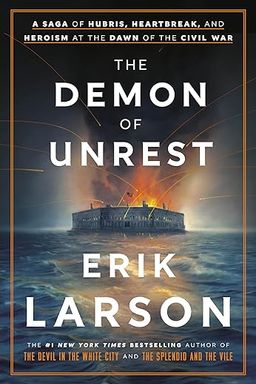
How can you watch a handful of tactical, cultural, and communicative choices turn a solvable dispute into civil war? This book argues that the road to Fort Sumter—and from there to total war—runs through five interlocking forces: a commander’s tactical gamble, a society’s honor code, rival slogans that hardened expectations, a vacuum of leadership in Washington, and the mundane (but decisive) constraints of logistics and information. You see how Major Robert Anderson’s December move to Fort Sumter, the South’s chivalric self-understanding, the politics of words like “house divided” and “Cotton is King,” cabinet infighting and back-channels, and a single ship allocation (the Powhatan) together made collision likely. Sumter is the magnifying glass: it focuses energy that has been building for decades and concentrates it into a symbolic explosion.
Tactical choice as political detonator
You start with Anderson’s calculated transfer from Fort Moultrie to Fort Sumter on the stormy night of December 25–26, 1860. He treats engineering and deception as statesmanship—spiking guns at Moultrie, feinting with family evacuations, and rowing seventy-five men by moonlight. He judges Moultrie untenable and Sumter defensible, and he silently stakes federal dignity on a better fort. That soldierly prudence doubles as political clarity: the United States will not abandon its property by default. In Charleston, that looks like provocation; in the North, it looks like courage. The result is polarization by geography.
Honor culture turns policy into insult
You then step into a world wired for affront. Charleston elites accept the Code Duello’s logic—insults demand satisfaction—while slavery confers status and fear of revolt enforces vigilance. Balls, jousts, and race weeks perform grandeur; slave patrols and auctions enforce order. Critics like Harriet Beecher Stowe or John Brown are read not as political opponents but as moral assailants. That culture matters: when the 1860 election delivers Lincoln, secessionists translate defeat into self-defense of honor. The South Carolina convention, moved from Columbia to Charleston under a smallpox pretext, turns grievance into law and theater, then into seizures of federal sites. Legality, ceremony, and militia converge.
Rhetoric becomes a self-fulfilling map
Meanwhile, words do more than decorate. Lincoln’s “house divided,” Seward’s “irrepressible conflict,” and Hammond’s “Cotton is King” give each side a worldview. Hammond’s mudsill thesis feeds hubris—Europe needs our cotton; no one will dare make war. Seward’s phrase registers inevitability. Newspapers like the Charleston Mercury and the New York Tribune amplify each frame, and rumor fills gaps. Slogans simplify, harden, and crowd out compromise.
A leaderless center, and back-channels that backfire
In Washington, Buchanan wants peace without coercion and produces paralysis. War Secretary John B. Floyd’s scandals and ambiguous orders corrode trust; cabinet factions publicly fray. Lincoln inherits a chaos of whispers: Seward positions himself as strategist-in-chief, files a deniable memo, and privately hints (through Justice John A. Campbell) that Sumter may be evacuated. Confederate commissioners mistake these hints for policy. Intelligence fragments—Pinkerton, New York police, and Army reports collide without synthesis—while the Baltimore plot forces Lincoln into a secret transit that opponents mock and allies deem necessary. Miscommunication does not merely mislead; it sets expectations that guarantee disappointment.
Core claim
Small, human-scale choices—who signs an order, how a captain interprets a telegram, when a newspaper prints a rumor—compound with culture and logistics to force the hand of states.
Logistics set the clock; symbols set the stakes
Sumter’s math is unforgiving: flour barrels dwindle, powder stocks run low, and Anderson counts days to starvation while Confederate engineers ring the harbor with new batteries (including the ironclad-style rail-and-sand work at Cummings Point). Gustavus Fox’s midnight reconnaissance says a relief is possible; Anderson’s caution says not without twenty thousand men. Lincoln splits the difference and orders a provision mission—then a single administrative error divides the navy’s strongest ship, the Powhatan, between Sumter and Fort Pickens. The sea adds insult: storms scatter Fox’s tugs; one steamer grounds; another diverts. Logistics turn intention into immobility.
Bombardment, ritual, and memory
When Beauregard opens with a signal mortar on April 12, 1861, and Edmund Ruffin fires one of the first shots, the spectacle galvanizes crowds and cameras. Fires inside Sumter threaten the main magazine; a negotiated evacuation follows; then a ceremonial salute explodes and kills men after the battle. Lincoln calls for 75,000 troops; Virginia secedes; the war’s scale leaps overnight. Four years later, Anderson rehoists the original flag over a shattered fort on April 14, 1865—the same day Lincoln is assassinated. The book closes the circle: symbols that started the war also script its memory.
Across these chapters you learn to see crisis as a braid: tactics, culture, language, leadership, logistics, and ritual twist together. Cut any single strand and perhaps war delays; bind them all and ignition is almost certain. (Note: the book’s method—braiding political narrative with engineering detail and social ritual—recalls works by David Hackett Fischer on cultural determinants of conflict.) You finish with a sobering insight: the path to war is paved with ordinary choices that feel reasonable in the moment—and fatal only in retrospect.