
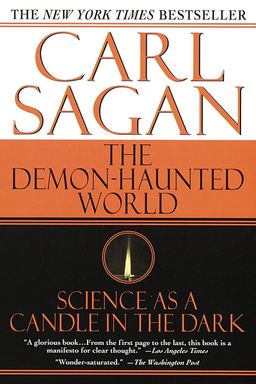
The Demon-Haunted World cover

The Demon-Haunted World

by Carl Sagan

The Demon-Haunted World by Carl Sagan champions critical thinking and science as keys to progress. It debunks pseudoscience, advocates for scientific literacy, and explores the societal benefits of embracing skepticism and evidence-based learning.

The Candle of Science and the Human Future

How can you tell what’s true in an age of claims, cults, and confusion? In The Demon-Haunted World, Carl Sagan argues that science—understood not as a list of facts but as a disciplined way of thinking—is humanity’s most reliable tool for distinguishing truth from illusion. He contends that scientific reasoning is a candle in the dark: it dispels superstition, safeguards democracy, and empowers ordinary citizens to take responsibility for the future.

Science as Skeptical Inquiry and Wonder

Sagan begins with personal stories—a child stunned by the 1939 World’s Fair, parents who taught both wonder and doubt, mentors such as Enrico Fermi and Subrahmanyan Chandrasekhar at the University of Chicago—to show how curiosity and skepticism can coexist. For him, science is not cold calculation; it is a disciplined form of awe. You can question the world deeply and still feel reverence for its complexity. Every time you test your beliefs against evidence, you participate in the same process that built medicine, sanitation, and the understanding of our cosmos.

Why Science Matters to Society

Scientific reasoning has improved the human condition more than any ideology: antibiotics, vaccines, agriculture, and public health have doubled life expectancy. But Sagan worries that most citizens and legislators lack the scientific literacy to navigate the 21st century’s dangers—global warming, genetic engineering, and nuclear weapons. When Congress dissolved its Office of Technology Assessment, a key source of expert review disappeared. Without critical understanding, democracy becomes hostage to demagogues and special interests who manipulate fear or ignorance.

The Cost of Ignorance

Ignorance is not merely private; it has public costs. Misguided science policy or credulous acceptance of pseudoscience can cause pandemics, famine, ecological collapse, or prejudice disguised as revelation. The witch hunts of Europe, the Lysenkoist purge of genetics under Stalin, and the tobacco industry’s manipulation of doubt all reveal how rejection or corruption of science leads to human suffering. Sagan insists that the values of science—open criticism, replicability, peer review—mirror and sustain the values of a free society.

Science, Meaning, and the Human Psyche

Why, then, does pseudoscience flourish? Because it addresses deep emotional needs. Myths promise comfort and control where reality seems indifferent. People turn to astrology, faith healing, or UFO cults because science is often poorly communicated or stripped of wonder. Sagan’s answer is not ridicule but education: scientific curiosity can sustain meaning and beauty without illusion. The true universe—filled with pulsars, DNA, and supernovae—is more astonishing than any manufactured mystery.

The Book’s Central Promise

Across essays and cases—from hoaxes to the “Face on Mars,” from abductees to conspiracy promoters—Sagan weaves one argument: your defense against deception is the habit of skeptical, evidence-based thought applied compassionately. Science, properly understood, is a moral enterprise. It humbles human arrogance, exposes self-deception, and gives you tools to act responsibly. The book culminates in the union of two virtues: wonder at reality and skepticism toward claims without proof. Together they form a worldview robust enough to face the darkness without surrendering to it.

Core Lesson

Every time you exercise self-criticism and test your ideas against evidence, you are practicing science. That discipline—married to compassion and imagination—is the surest light in humanity’s long night.

Sagan’s plea is therefore civic as well as intellectual: if you want a civilization capable of surviving its own power, you must protect the flame of scientific reasoning through education, transparency, and curiosity. The book’s candle metaphor becomes not just a call for rationality but a summons to stewardship of the very faculty that makes us human—the capacity to doubt wisely.


Pseudoscience and Emotional Comfort

You live in a world eager for marvels, yet easily deceived by emotional allure. Sagan asks why pseudoscience—belief in crystal energies, psychic surgery, Atlantis, telepathy—thrives even as real science changes the world. His answer: pseudoscience offers immediate emotional gratification, while scientific literacy demands patience, humility, and uncertainty. When schools and media fail to convey what makes science genuinely exciting, cultural voids fill with seductive myth.

The Appeal of Easy Meaning

People crave stories where they matter, where hidden powers explain chaos. A belief that meditation can stop crime or that crystals store ancient wisdom gives coherence and comfort. Pseudoscience whispers that the universe hears you personally, while real science reminds you that understanding comes through labor and error. (Note: Sagan likens this to psychologically adaptive myths—comforting but hazardous when they replace critical reasoning.)

Media Amplification and Bad Incentives

Sagan describes a “Gresham’s Law of ideas”: sensational nonsense drives careful truth out of the marketplace. TV specials on ancient aliens or psychic detectives attract viewers better than measured scientific debate. In Russia after Communism, in China’s market reforms, and in the U.S. talk-show circuit, he finds the same pattern: in times of upheaval or mistrust of authority, miraculous claims surge. Weak popular science creates ecological niches that superstition eagerly fills.

The Moral Danger

Pseudoscience is not harmless entertainment; it shapes policy and health decisions. Belief in anti-vaccine propaganda, racist biology, or miracle cures costs lives. Sagan urges you to counter it not with ridicule but with vivid, accessible teaching. Only by sharing how science actually works—the testing, replication, and thrill of discovery—can you satisfy the human longing for wonder without sacrificing truth.

Guiding Principle

If science educators fail to fill imaginations with awe grounded in evidence, charlatans will fill that hunger with illusion.

The cure for pseudoscience is not scorn, but better storytelling—stories that reveal how genuine discovery, however demanding, is more magical than any easy fantasy.


The Baloney Detection Kit

To protect yourself from deception, Sagan provides a “baloney detection kit”: a practical set of reasoning tools to evaluate extraordinary claims. You cannot depend on authority or charisma; truth demands testing. The kit’s power lies in ordinary habits anyone can practice—habits that make democracy function as much as science.

Core Heuristics

  • Seek independent confirmation. Ask if multiple observers reproduce results.
  • Encourage debate among experts. Truth emerges through public criticism, not authority.
  • Consider multiple hypotheses. Don’t stop at the one that feels right.
  • Insist on falsifiability. A claim that cannot be disproved says nothing meaningful about reality.
  • Quantify uncertainty. Numbers reveal how strongly evidence supports a claim.

Learning from Errors

Sagan illustrates with astronomy’s missteps: the “canals” on Mars became a sobering lesson about pareidolia—our brain’s tendency to see order in randomness. When the Soviet Union misread radio signals from CTA-102 as aliens, others checked and found natural pulsars instead. With rigorous testing, illusion became discovery. The same method saved medicine from bloodletting and alchemy.

Fallacies and Manipulative Rhetoric

Pop culture and politics overflow with flawed arguments—ad hominem attacks, post hoc reasoning, appeals to authority, and selective evidence. Corporations exploit these lapses: tobacco companies claimed correlation wasn’t causation even after controlled experiments showed tar caused tumors. The kit teaches you to ask who profits, what data exist, and whether simpler explanations fit better.

Practical Motto

Sincerity is not evidence; faith is not a test. Compassion demands critical thinking when lives or policy are at stake.

Using Sagan’s kit—especially on cherished personal beliefs—teaches humility. You learn that being wrong, and correcting it, is the highest intellectual virtue.


Seeing Faces and Inventing Stories

Your brain evolved to find patterns, a gift that makes both science and superstition possible. Sagan explores how pareidolia—the tendency to perceive faces and intentional design in random shapes—leads to recurring myths, from the Man in the Moon to the 'Face on Mars.'

Pareidolia: Evolution’s Double-Edged Sword

For survival, early humans needed instant recognition of predator or friend. Better to mistake a shadow for a tiger than the reverse. But the same impulse makes you see canals on Mars or prophets in clouds. Nineteenth-century astronomers mapped imaginary lines; only when spacecraft like Mariner 9 returned detailed images did the illusion vanish. The correction came not by revelation, but by improved data.

The Face on Mars and Cognitive Bias

Low-resolution photos of the Cydonia region seemed to show a carved human face. Tabloids declared evidence of ancient aliens; later high-resolution probes revealed a natural mesa. The myth’s persistence shows how easily emotion overwhelms statistics. Sagan argues that fascination is good—but it should lead to better inquiry, not blind acceptance. (Note: this episode anticipates social media’s viral illusions today.)

From Fairies to Aliens

Similar pattern recognition shapes UFO abduction claims. Neurology explains many through sleep paralysis or temporal-lobe events; culture then gives imagery—once demons, now “greys.” Sincerity doesn’t equal reality. In both witch hunts and abduction therapy sessions, poorly tested testimony produced moral and psychological harm.

Interpretive Lesson

Your greatest strength—the mind’s love of patterns—is also your greatest vulnerability. Science’s power lies in turning that impulse toward controlled testing.

The lesson extends to all myths: the stories you make from noise reveal your hunger for meaning. Science ennobles that hunger by tethering it to evidence.


Hoaxes, Healing, and Manufactured Miracles

Sagan dissects modern marvels—from crop circles to faith healers—as case studies in how hope, deception, and media incentives distort truth. The 'Carlos' hoax, orchestrated with magician James Randi, demonstrated how a fabricated mystic could entrance newsrooms. The exposure, aired on television, revealed how few journalists verified credentials or corroborated facts. The spectacle eclipsed the correction.

How Hoaxes Work

Hoaxes exploit cognitive biases: you notice confirming evidence, ignore disconfirming data, and crave novelty. From Silas Newton’s 'flying saucer crash' to the Wiltshire crop-circle prank, the mechanics remain constant: credible-sounding witnesses, emotional images, repetition. Once an idea enters popular culture, refutation rarely travels as fast. (Sagan compares this to epidemiology: misinformation spreads virally unless tools of verification interrupt transmission.)

Faith Healing and Placebo Reality

Sagan handles healing claims with compassion and precision. Placebo effects can relieve pain through endorphin release, but there is no reliable evidence that prayer or channelling cures organic disease. Studies of Lourdes and William Nolen’s investigations found spontaneous remissions rare and often misreported. He distinguishes spiritual comfort—which is real and valuable—from biological efficacy, which demands controlled evidence. The lesson: hope needs humility.

Institutional Credulity

Media often reward the dramatic instead of the verified. Editors admit that skepticism 'kills stories.' The public, saturated with unchallenged wonders, loses the habit of asking for proof. Sagan’s antidote is media literacy: follow sources, track incentives, and separate testimony from testable data.

Civic Takeaway

The confession of a hoax often reaches fewer ears than the original myth. Guard your mind by demanding verification before wonder becomes conviction.

Authentic miracles—germ theory, vaccines, radio, space flight—come from disciplined curiosity, not theatrical claims. Cherish the awe of understanding, not the thrill of being fooled.


The Responsibilities of Science

Sagan reminds you that science is powerful enough to destroy as well as enlighten. The same rational inquiry that cures diseases builds nuclear arsenals. Scientists like Edward Teller, J. Robert Oppenheimer, and their contemporaries faced moral crises: should knowledge be used for deterrence, domination, or survival? The hydrogen bomb and the discovery of nuclear winter forced ethical reflection within science itself.

Ethics and Freedom of Inquiry

The Lysenko tragedy in the Soviet Union, where ideological orthodoxy replaced genetics with pseudo-Marxist dogma, destroyed lives and crops. Sagan uses it to illustrate how political interference corrupts truth. When science serves power instead of evidence, error multiplies unchecked. Ethical science requires openness, dissent, and willingness to publish unpalatable data.

Reductionism and Human Values

Critics often say science reduces wonder to mechanism. Sagan replies that understanding structure deepens, not diminishes, meaning. Maxwell’s equations, conceived from curiosity about electromagnetism, led decades later to radio and radar. Knowledge of atoms enables art conservation, green energy, and medicine. Reductionism, properly understood, unites disciplines rather than flattens them.

The Scientist’s Duty

Because science grants immense power, it carries moral obligations. When uncertainty remains, you must err on the side of safety—testing, transparency, and long-term consideration. Sagan urges citizens to demand accountability and to reward ethical courage in researchers who speak hard truths against political convenience.

Moral Principle

If power and profit conflict with planetary safety, choose caution. In science as in democracy, free criticism is the only reliable self-correcting mechanism.

Science, ethics, and liberty stand or fall together: silence and secrecy endanger all three.


Education, Media, and the Culture of Inquiry

The book closes with hope anchored in action: rebuild the culture of skeptical curiosity through education and communication. Sagan shows that nations rise when they nourish critical literacy and fall when they suppress it. Yet U.S. polls reveal alarming ignorance: large fractions of adults doubt evolution or basic astronomy. The cure starts early, in classrooms and local communities.

Restoring Curiosity

Children begin as fearless questioners; poor schools and media boredom extinguish that spark. Sagan highlights initiatives like Ithaca’s community-built Sciencenter, where kids experiment and discover firsthand. Hands-on engagement transforms abstract science into usable habits of mind. Like Frederick Douglass learning to read in secret, scientific literacy is a path to freedom—intellectual and political alike.

Repairing the Media Ecosystem

Television, which could illuminate, often markets ignorance. Programs sell ghosts and UFOs while real research goes unseen. Sagan proposes “Solved Mysteries”: shows explaining how science untangles real-world puzzles. He defends funding for pure research like SETI or the Superconducting Supercollider, reminding you that curiosity-driven study historically yields enormous, unpredictable payoffs. Maxwell’s theoretical equations birthed communication technology; canceling basic research betrays national vision.

Enduring Message

Science education and honest media are the lifelines of democracy. Without them, reason dims and manipulation flourishes.

Sagan leaves you with a constructive prescription: cultivate the twin virtues of skepticism and wonder, teach them to children, and defend institutions that make truth publicly testable. Civilization’s survival may depend less on technology itself than on our shared capacity to ask: “How do we know?”

Dig Deeper

Get personalized prompts to apply these lessons to your life and deepen your understanding.

Go Deeper

Get the Full Experience

Download Insight Books for AI-powered reflections, quizzes, and more.