
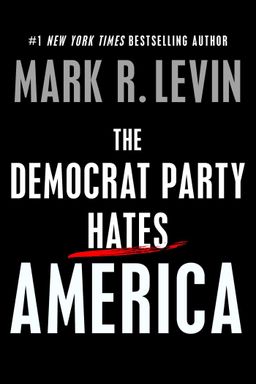
The Democrat Party Hates America cover

The Democrat Party Hates America

by Mark R. Levin

The Fox News host and author of “American Marxism” argues for the defeat of the Democratic Party.

Party-State Project in America

How can you tell when normal party competition gives way to a project for permanent power? In this book, Mark Levin argues that the Democrat Party is no longer simply a rival in a constitutional republic. He contends it operates as a party-state, fusing public authority and private influence to entrench rule across government, culture, media, education, and corporate life. Levin insists the change is systemic and intentional, not episodic or merely partisan.

Levin borrows the vocabulary of scholars like Raymond Aron and organizations such as Freedom House to frame the modern authoritarian playbook: capture institutions, claim pluralism’s language, then hollow out checks and balances. He connects high-profile episodes—the 2020 ‘shadow campaign’ Molly Ball described, Biden’s equity executive orders, and federal pressure on social platforms—to show how governing, narrative, and law now move in lockstep. The aim, he says, is to win once and then restructure the field so you never truly lose again.

Core claim and why it matters

Levin’s core claim is stark: the Democrat Party seeks ideological monopoly rather than alternating governance. That requires four reinforcing moves: inflate the administrative state, reprogram culture, engineer electoral rules, and weaponize law against opposition. If this is right, the stakes for you are constitutional, not just policy-based—free inquiry narrows, separation of powers thins, and citizens learn to accept top-down management as normal.

(Note: Supporters of Democratic reforms call them necessary modernization or protection of democracy; Levin’s interpretation is that the rhetoric of ‘democracy protection’ often masks power consolidation.)

Mechanisms that entrench power

First, administrative-state entrenchment: rules, guidance, and career officials carry policy through election cycles. Executive orders on ‘equity,’ agency grants keyed to identity categories (SBA and USDA), and Title IX reinterpretations make ideology durable in code and practice. Even if you vote for change, mid-level machinery can stall or reverse it.

Second, cultural capture: media, universities, foundations, and entertainment converge on a shared lexicon and storyline. Levin cites Zach Goldberg’s data on mainstream media’s rapid adoption of new racialized vocabulary, Disney’s internal activism, and university DEI regimes that set hiring and speech rules. When cultural referees align, dissent looks deviant, not debatable.

Third, electoral engineering: federalizing election administration through proposals like H.R. 1, normalizing mass mail ballots, and weakening verification standards tilt the system toward a permanent coalition. The National Popular Vote drive and attacks on the Electoral College, Levin argues, aim to centralize power in large metro states and dilute federalism’s guardrails.

Fourth, legal weaponization: the DOJ, FBI, and aligned prosecutors target political adversaries while soft-pedaling allies. Levin threads the line from Crossfire Hurricane to the Mueller probe, then to parallel prosecutions of Donald Trump by Alvin Bragg, Letitia James, Fani Willis, and Jack Smith—framing the prosecutions as lawfare that criminalizes opposition politics.

Levin’s touchstone

He cites Freedom House’s warning that modern authoritarians cripple opposition while maintaining a veneer of legality and prosperity—exactly the pattern he sees in agency rulemaking, social-media moderation, and selective prosecution.

Why now—and what you face

Levin ties the present moment to a longer progressive lineage that normalizes expert rule and social planning. He argues that crisis politics—pandemic dictates, race-crisis narratives, climate emergency—accelerate transfers of discretion to unaccountable actors. When you combine this with the ‘Twitter Files’ showing government-platform coordination and the DHS’s floated Disinformation Governance Board, you see how speech boundaries and policy can move together.

For you, the result is practical: parents hesitating at school board mics, journalists wary of platform bans, entrepreneurs bending to ESG scorecards, and voters numbed by rules they never debated. Levin’s call is to spot the architecture—the routines and alliances that outlast news cycles—and rebuild countervailing institutions.

What the rest of the book develops

The chapters that follow deepen this architecture: a historical genealogy (Wilson, Sanger, FDR) that explains the comfort with centralized power; the rise of identity-based governance (CRT and ‘equity’); cultural and linguistic engineering across media and academia; the weaponization of law and assaults on constitutional guardrails; the politicization of education and family life; mass immigration as a demographic and fiscal lever; and economic-energy policy as an instrument for managing behavior (ESG and climate rules). Each arena, Levin argues, reinforces the others.

Whether you accept his partisan diagnosis or not, the book asks you to audit power as a system, not a set of isolated fights. Levin’s wager is that if you recover constitutional habits—federalism, free speech norms, institutional pluralism—you can still turn back a party-state before it becomes your civic default.


Roots of a Power Ideology

Levin argues that today’s Democrat Party project grows out of a long history of comfort with social engineering and centralized control. He points to past leaders and movements—Jefferson Davis and postbellum Democrats, Woodrow Wilson’s segregationist federalism, the Progressive Era’s embrace of eugenics, and Franklin D. Roosevelt’s transformative New Deal—to show institutional habits that persist. The claim is not that coalitions never change, but that key instincts toward expert planning and paternalism remain.

He stresses the Progressive Era’s infatuation with ‘scientific’ control. Drawing on Thomas C. Leonard’s scholarship, Levin recounts how eugenics shaped elite thinking, with figures like Madison Grant influencing policy and even Nazi admiration. Wilson, as New Jersey governor, signed sterilization legislation; as president, he resegregated federal offices and screened ‘The Birth of a Nation’ at the White House. These are not stray anecdotes; they signal a governing culture that rationalizes top-down control for social ends.

From Progressive expertise to the administrative state

Levin reads the New Deal as institutionalizing expert rule. FDR built vast agencies that made public life legible to planners, but also vulnerable to bias and mission creep (consider redlining under the FHA or Japanese internment via Executive Order 9066). When bureaucracy becomes the central instrument, elections matter less than who staffs and directs the permanent apparatus. That, Levin argues, is the template for modern governance—now rebranded as ‘equity,’ ‘sustainability,’ or ‘public health.’

(Note: Many historians highlight Democratic leadership in 1960s civil rights; Levin acknowledges shifting coalitions but emphasizes structural continuities—confidence in state supervision and elite tutelage—that he says reappear in today’s identity politics and administrative rulemaking.)

Race, patronage, and political realignment

Levin tracks how black political loyalty migrated from Republicans to Democrats during the 1930s, arguing that New Deal benefits, urban machines, and later Great Society programs fostered dependency on centralized distributions. In his view, this was not a moral conversion but a political realignment that entrenched the party’s leverage over communities via programs and bureaucratic intermediaries. He connects that dynamic to today’s DEI and equity policies that define ‘socially disadvantaged’ by race in federal contracting and grants.

He also emphasizes Margaret Sanger’s eugenic ties and Planned Parenthood’s long alliance with Democratic coalitions to suggest ideological through-lines about population ‘management’ and family policy. While critics argue Sanger’s history is complex and the modern organization distances itself from eugenics, Levin uses it to illustrate how elite rationales for social design can quietly persist under new labels.

Continuity thesis

Levin: a party comfortable with experts determining social outcomes—whether in Wilson’s segregationist bureaucracy, FDR’s economic agencies, or today’s equity offices—retains a governing instinct that favors central direction over citizen autonomy.

Why this genealogy matters to you

If institutional memory bends toward expert control, you should expect similar responses to new crises—more rulemaking, more arbiters of acceptable speech, more identity sorting. Levin sees Biden’s ‘one word: possibilities’ rhetoric as harnessing FDR-style ambition to expand federal power into schools, energy, and finance. He frames the 2020 ‘shadow campaign’—foundations, media, election administrators coordinating—as the Progressive synthesis of public-private management of political outcomes (Molly Ball’s defenders call it ‘fortifying’ elections; Levin calls it a capture play).

The takeaway is not to freeze history; it is to track institutional DNA. When you hear ‘equity’ mandates, climate emergencies, or ‘disinformation’ units, ask whether you are seeing the latest iteration of an older idea: that self-governing citizens need guardians. Levin’s counsel is to resist paternalism’s new clothes and rebuild countervailing institutions—local control, plural media, and civic associations—so national power remains balanced by independent centers of influence.


Capturing Culture and Language

Levin argues that modern power works through words and the institutions that set their meanings. If you can redefine ‘equity,’ ‘racism,’ or ‘disinformation,’ you can pre-sort arguments before they begin. He assembles a file of examples—from agency style guides and media framing to social-media content moderation—to claim a coordinated effort to police language and narrow acceptable views.

He cites classic warnings. George Orwell wrote about euphemism as a tool of domination; Friedrich Hayek warned that beliefs imposed from above must become the people’s own; Joost Meerloo, Hannah Arendt, and Mikhail Heller chronicled how totalitarians normalize obedience by reprogramming speech. Levin sees American echoes: Dictionary and agency revisions, congressional bans on gendered terms, and federal ‘inclusive language’ directives that nudge institutions into a single lexicon.

Words as policy levers

Consider ‘equity.’ It shifts the aim from equal treatment to equal outcomes—inviting race-based preferences and bureaucratic oversight. ‘Disinformation’ moves from foreign psy-ops to domestic dissent on elections, COVID, or climate—triggering speech restrictions. The CDC, NIH, and even the FAA have issued language or framing guidance; universities bake DEI criteria into hiring and curricula; corporate HR replicates the code at scale.

In media, Levin points to Zach Goldberg’s research showing rapid adoption of ‘structural racism,’ ‘white privilege,’ and related terms in elite outlets after 2013. Editorial decisions, he argues, transform contested theses into air you breathe—so dissenters look fringe. He also highlights Chuck Todd’s no-debate stance on climate policy as an emblem of enforced consensus.

The platform-security nexus

The ‘Twitter Files’ (reported by Matt Taibbi and others) revealed agency-platform channels—FBI, DHS, CDC, CISA—flagging content and sometimes leaning on moderation choices. Levin notes the DHS’s aborted Disinformation Governance Board, Missouri AG documents, and Judge Terry Doughty’s injunction language to argue the government built a public-private censorship regime. Add in civil-society pressure, like the Global Disinformation Index’s ad blacklists, and you see a distributed system that can throttle reach and revenue for disfavored outlets.

(Note: Platforms defend moderation as harm reduction; Levin counters that the net effect is ideologically asymmetric and state-adjacent, especially during COVID and election cycles.)

Hayek’s warning (via Levin)

“The most effective way of making everybody serve the single system of ends... is to make everybody believe in those ends.” Language reform is the front door to that belief.

Institutional cascade and your daily life

When universities define truth through ‘positionality,’ media sets bounds of coverage, and platforms demote heterodox voices, you feel it at school board meetings, in your newsfeed, and at work. Levin connects corporate ESG and DEI to this linguistic regime—procurement preferences and HR checklists translate abstractions into hiring, promotion, and vendor choices. Over time, dissent feels career-risky, and silence becomes rational.

Levin’s remedy is pluralism with teeth: push for transparency about government requests to platforms; protect viewpoint diversity in universities and professional guilds; support independent media and lawsuits that defend free speech norms (he cites platform revelations and injunctions as early wins). For you, that means becoming language-literate—asking who defined the terms, who enforces them, and how to keep public debate genuinely public.


Lawfare and Structural End-Runs

Levin claims the justice system has been bent into a political weapon and that constitutional guardrails are under coordinated pressure. He uses the arc from Crossfire Hurricane to the Mueller investigation to John Durham’s findings to argue that intelligence and law enforcement were marshaled against a presidential campaign and later a presidency. While Mueller found no collusion, Levin underscores the process’s damage: years of criminal suspicion that reshaped politics and media narratives.

He then catalogues prosecutions of Donald Trump as illustrations of lawfare. In Manhattan, DA Alvin Bragg revived a novel theory; New York AG Letitia James pursued civil penalties to cripple business operations; Fulton County DA Fani Willis constructed a sweeping RICO case; Special Counsel Jack Smith used statutes like the Espionage Act for documents disputes. Levin’s core point is not legal minutiae but the pattern—campaign promises to ‘get Trump,’ aggressive theories, and media amplification that together criminalize opposition.

Process as punishment

Levin highlights FISA abuse episodes, leaks, and unprecedented actions like the Mar-a-Lago search to argue that even when cases fail, the process drains resources and chills political participation. He invokes historical comparisons—Eugene Debs prosecuted under Wilson—to show how national-security law can be stretched against dissenters. If you learn that political risk includes indictment risk, fewer citizens will contest power.

Parallel to lawfare, Levin describes structural end-runs around the Constitution. He cites S.J. Res. 19 (2014), a proposed amendment to regulate political spending, as a direct attempt to undercut First Amendment protections beyond media carve-outs. He also tracks the campaign to delegitimize and then pack the Supreme Court, naming academics like Kermit Roosevelt III advocating expansion.

Rewiring elections and federalism

Levin defends the Electoral College and state-run elections as federalism’s bulwarks. He warns that the National Popular Vote compact and H.R. 1’s centralization proposals concentrate authority in populous states and Washington bureaucracies. Combined with permissive mail voting norms, he says, they harden a national coalition that can ignore local variation and minority voices—the opposite of Madisonian design.

Liberty under emergency

Levin quotes Justice Neil Gorsuch: since March 2020, we may have seen the greatest peacetime intrusion on civil liberties. He uses this to show how emergencies accelerate both lawfare and structural shortcuts.

(Note: Reformers argue that court expansion and campaign finance limits restore democratic balance; Levin rejects this as pretext for consolidation.)

What you can do within the system

Levin’s prescription is procedural and civic: back state legislatures defending election integrity; oppose court packing and speech-curbing amendments; insist on strict FISA and special counsel accountability; and support watchdog litigation that punishes leaks and coercive censorship. For you, that means understanding rules—the forums where leverage hides—and pressing representatives on process, not just outcomes.


Identity Regime and Civil Rights

Levin argues that Critical Race Theory has migrated from academic debate to a governing framework that replaces equal treatment with ‘equity’—managed outcomes enforced by bureaucracy. He identifies Ibram X. Kendi’s maxim—‘The only remedy to racist discrimination is antiracist discrimination’—as the blueprint for policy that normalizes race-conscious preferences across education, contracting, lending, and hiring. In this regime, disparities are presumptive evidence of racism and justify ongoing preference systems.

He lists federal moves as evidence: Biden’s equity executive orders; SBA and USDA guidance defining ‘socially disadvantaged’ by race for program priority; student debt proposals framed as closing racial wealth gaps. Levin ties these to DEI bureaucracies that embed ideology in HR and compliance, and to ESG criteria that add ‘S’ mandates across corporate finance. The result, he says, is a public-private lattice that governs by identity.

From theory to operating system

Levin says CRT’s key move is interpretive: treat all gaps as structural racism and thus transform the state from neutral arbiter into compensator and punisher. Agencies write rules, schools revise curricula, and companies adopt scorecards. The goalposts shift—your rights turn contingent on group identity, and dissent is suspect because it ‘upholds systems.’ He points to curricular shifts (1619 Project promotion, ‘antiracist’ readings across disciplines) as cultural reinforcement.

He offers empirical pushback: upward mobility trends for minorities, interracial marriage increases, and the role of markets in reducing discrimination (citing Milton Friedman and commentators like Coleman Hughes). Levin’s point: if you treat individuals primarily as group members, you erase agency and equality before the law—the civil-rights ideal that animated the 20th century.

Levin’s warning

Equity regimes entrench new discrimination—against whites and dissident non-whites—and require permanent managerial supervision, which becomes a justification for ever-larger bureaucracies.

Counterarguments and your choices

(Note: Advocates say equity counters entrenched injustice; Levin accepts historical injustice but rejects perpetual preference systems and speech codes as illiberal and counterproductive.) He urges you to defend race-neutral law, transparency in program eligibility, and viewpoint diversity in institutions. Audit school curricula; ask employers to separate compliance from ideology; push representatives to sunset identity-based rules unless empirically justified.

For everyday life, Levin suggests noticing how forms and trainings now categorize you first by identity. When ‘lived experience’ trumps argument, insist on standards and debate. The more you let identity become the master key, the more power flows to managers who decide how identities rank.


Schools, Unions, and the Family

Levin contends that the classroom is now the frontline for shaping citizens away from parental authority and toward party-approved norms. He traces this to Marx’s critique of the bourgeois family and calls for communal childrearing, then shows how modern institutions operationalize the transfer: teachers’ unions, school boards, education bureaucracies, and corporate partners that steer curricula and policies without parental consent.

He presents three pillars of capture. First, curricular infusion: CRT and identity frameworks integrated across subjects. The National Council of Teachers of Mathematics recommends ‘antiracist’ readings; the National Science Teaching Association frames science as culturally situated. Second, administrative secrecy: districts and groups like GLSEN advise handling student gender changes without notifying parents, policies affecting millions (Levin cites reporting on 3.2 million students). Third, suppression of dissent: the National School Boards Association’s letter likening parent protests to domestic terrorism prompted Merrick Garland’s memo involving federal agencies—seen by Levin as a chilling message to families.

COVID, unions, and collateral damage

Levin documents NEA and AFT influence over CDC guidance and prolonged closures, tying them to McKinsey’s learning-loss estimates and research suggesting developmental harms for pandemic-born children. He notes Politico/Harvard polling that parents perceived masking harms. While union leaders claimed safety, Levin argues decisions reflected political leverage more than child welfare. The result is a shift in who decides: professionals over parents, centralized scripts over local judgment.

He also connects electoral incentives: Democrats win large margins among unmarried, childless women; policies emphasizing abortion rights, expansive gender autonomy, and state-centered services track with that coalition. Nancy Pelosi credited abortion-focused messaging for 2022 gains; Biden abandoned ‘safe, legal, rare’ for assertive abortion rights framing. Levin frames this as political payoff for devaluing the traditional family structure.

Levin’s charge

‘The Democrat Party intends to subjugate children to the ideological purposes of the party’—by shifting final authority from parents to systems that administrators and allied groups control.

What you can do as a parent or citizen

Levin recommends simple audits: review curricula, attend board meetings, request policy documents on gender and parental notification, and organize slates for school board elections. He urges legislation for parental bills of rights, transparency portals, and opt-in rather than opt-out for sensitive content. Corporate pressure matters too—Target’s donations to GLSEN and Disney’s content pivots show how consumer and shareholder action can push back against classroom spillovers.

(Note: Advocates of current policies argue they protect vulnerable youth and correct historical omissions. Levin answers that child safety and accurate history do not require secrecy from parents or ideological litmus tests in math and science.) Your guiding question: who owns your child’s moral education—you, or a bureaucracy allied with a national party platform?


Borders, Economy, and ESG Levers

Levin links immigration policy and economic-energy policy as twin levers for remaking the electorate and managing daily life. On immigration, he argues the Biden administration’s reversals—first-day executive orders, expanded parole, CBP One usage—produced record encounters and releases that empowered cartels and strained communities. He cites fiscal burdens on schools and hospitals, trafficking risks, and fentanyl seizures as evidence that humanitarian rhetoric masked a permissive regime.

Politically, Levin says Democrats view mass migration as demographically advantageous—more residents in metro hubs, more clients for redistributive programs, and eventually more voters after regularization. He notes past restrictionist statements from leaders like Harry Reid and Chuck Schumer that flipped as coalition incentives changed. Meanwhile, identity-framed benefits in federal programs reinforce loyalty by group categorization.

Security, costs, and civic cohesion

Levin highlights rising cartel profits, ‘got-away’ estimates, and DHS resource overload. He warns that assimilation norms and civic education cannot keep pace with unmanaged flows—especially when K–12 curricula already emphasize grievance narratives over integration. For you, that translates into crowded classrooms, higher local taxes, and safety anxieties—regardless of your compassion for migrants.

(Note: Advocates push humanitarian asylum reforms and argue for economic benefits of immigration; Levin accepts the moral imperative to help but insists that sovereignty and orderly entry are preconditions to justice.)

Economic control via climate and finance

On the economy, Levin says climate policy and ESG investing operate as managerial controls. He points to EPA carbon-capture rules that could raise electricity costs, and to FERC Commissioner Mark Christie’s warnings about grid reliability as dispatchable plants retire. Rapid mandates for vehicles, appliances, and building codes shrink your choices and raise your bills—de facto rationing through price and availability.

ESG turns finance into politics. Asset managers like BlackRock (Larry Fink) steer trillions using environmental and social metrics that redirect capital away from optimal returns toward ideological goals, Levin argues. Pensioners and passive investors become unwitting funders of a political program. Combined with SEC nudges and corporate HR, ESG/DEI extend government preferences through private leverage points.

Degrowth by other names

Levin’s thesis: climate and equity are the ruses for reorganizing society—fewer cars, costlier power, managed speech—so that planning replaces choice.

Your counter-levers

Levin urges border enforcement reforms—tight asylum standards, E-Verify, and congressional constraints on parole—as civic necessities. On energy, he presses for reliability-first regulation, technology-neutral standards, and voter scrutiny of state utility plans. With finance, he recommends state-level pension protection laws that require fiduciary primacy, shareholder votes on ESG mandates, and transparency for proxy advisors.

(Note: Proponents say these policies mitigate climate risk and modernize the economy; Levin replies that reliability and affordability are preconditions for prosperity—and that politicized capital undermines both growth and self-government.)

Dig Deeper

Get personalized prompts to apply these lessons to your life and deepen your understanding.

Go Deeper

Get the Full Experience

Download Insight Books for AI-powered reflections, quizzes, and more.