
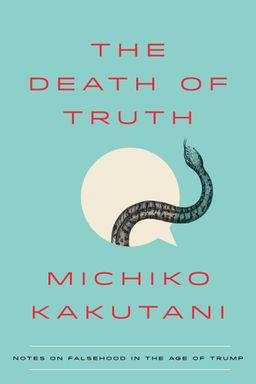
The Death of Truth cover

The Death of Truth

by Michiko Kakutani

In ''The Death of Truth,'' Michiko Kakutani examines the erosion of truth in contemporary politics, highlighting how misinformation, tribalism, and postmodern thought contribute to societal division. Through a literary lens, she explores historical parallels and offers insights into reclaiming truth and reason in a fractured world.

The Death of Truth in the Age of Falsehood

What happens to a society when people can no longer agree on what’s true? In The Death of Truth, Michiko Kakutani—a Pulitzer Prize–winning critic known for her precise cultural insights—argues that we’ve entered a moment of profound moral and intellectual crisis. She contends that the steady erosion of objective truth is destabilizing democracy, empowering demagogues, and leaving citizens vulnerable to manipulation. Through a brilliant synthesis of history, philosophy, and contemporary analysis, Kakutani traces how postmodern relativism, political propaganda, and digital technology combined to produce today’s dizzying environment of disinformation, cynicism, and tribal reality.

Kakutani begins by invoking Hannah Arendt’s warning that totalitarian regimes thrive when people can no longer distinguish fact from fiction. In our world, she suggests, that disorientation has returned—not through censorship or physical coercion, but through distraction, social-media manipulation, and the deliberate flooding of public discourse with lies. Her core argument is that truth itself—the foundation of reasoned debate and democratic governance—is dying, undermined by a culture that prizes emotion over evidence, identity over reason, and partisan loyalty over shared reality.

From Enlightenment to Disinformation

The book situates our current predicament within a long arc of declining faith in reason. Since the Enlightenment, facts and rational inquiry were meant to be our safeguards against tyranny. Yet, Kakutani shows how those principles have been eroded by cultural shifts—from the rise of postmodern philosophy, which denied the existence of objective truth, to the explosion of digital media that rewards sensationalism and emotional outrage over accuracy. The same relativism that once seemed liberating in academia, she argues, has now been weaponized by political movements and authoritarian leaders who twist the notion of “multiple truths” to justify lies and conspiracy theories.

Trump and the New Reality Wars

At the center of Kakutani’s examination is former president Donald Trump, whom she portrays not as an anomaly but as the culmination of decades of cultural decay. Trump’s relentless lying, his performative use of language, and his exploitation of social media represent not only personal narcissism but a systemic breakdown in how truth functions in the public sphere. By branding all critical journalism as “fake news,” he turned legitimate inquiry into partisan performance. Kakutani draws chilling parallels between Trump’s rhetorical tactics and those of twentieth-century authoritarian propagandists, where repeated lies eventually reframe reality itself.

The Convergence of Culture, Technology, and Politics

To understand how this environment emerged, Kakutani threads together the cultural revolutions of the 1960s and 1970s, the rise of postmodern deconstruction in universities, the narcissism of what Tom Wolfe called the “Me Decade,” and the explosion of digital echo chambers. Each represented a shift from collective understanding toward personal narrative. Over time, she argues, the pursuit of “your truth” replaced “the truth.” Add to that the disruptive economics of the internet—where attention, not accuracy, drives profit—and the result is a perfect storm of noise, outrage, and fragmentation. Facts are no longer anchors; they’re flexible weapons wielded to affirm identity or ideology.

Why This Matters Now

Kakutani warns that the collapse of a shared factual foundation is not merely a philosophical concern—it’s a practical threat to democracy. As George Washington once cautioned, factionalism and deceit destroy the public’s trust, paving the way for “cunning, ambitious, and unprincipled men” to seize power. Without commonly agreed-upon facts, reasoned debate becomes impossible, and public policy devolves into spectacle. Drawing on thinkers from Orwell to Neil Postman, Kakutani demonstrates that we now face both dystopian nightmares: Orwell’s world of authoritarian control and Huxley’s world of numbing distraction. When lies dominate and truth becomes optional, civic life itself unravels.

A Call to Reclaim Reason

Ultimately, The Death of Truth is both diagnosis and warning. Kakutani pleads for a return to the Enlightenment ideals that first defined democracy: open inquiry, scientific integrity, and a shared sense of reality. She calls on readers—citizens, journalists, educators, and anyone who engages with public life—to resist cynicism and disinformation by strengthening their commitment to evidence and empathy. In an era of “alternative facts,” this is not merely an intellectual obligation; it’s a moral one. Without truth, she cautions, democracy cannot stand.


The Decline and Fall of Reason

Kakutani opens with a sobering reminder: reason, the cornerstone of American democracy, is under siege. Drawing a direct line from Abraham Lincoln’s reverence for “cold, calculating reason” to our current age of emotion-driven politics, she shows how the abandonment of rational thought has allowed resentment, conspiracy, and fanaticism to thrive.

From Enlightenment Ideals to the 'American Berserk'

The founders designed the Constitution to withstand tyranny precisely because they believed that reason could and should guide self-government. Yet as historian Richard Hofstadter observed in his essay “The Paranoid Style in American Politics,” waves of anti-intellectualism and conspiracy always lurk beneath the surface of U.S. history. Kakutani revives Hofstadter’s insight to explain the current climate: when people feel dispossessed or anxious, they often retreat from reason and embrace ideology. Donald Trump, like demagogues before him, exploited that susceptibility with the skill of a showman.

Manufacturing Distrust and Ignorance

Citing studies showing that large numbers of Americans believe conspiracy theories—from “millions of illegal votes” to “deep state plots”—Kakutani argues that willful ignorance has become a badge of identity. This is no accident. Right-wing media ecosystems like Fox News and Breitbart feed these narratives, while educational neglect erodes people’s ability to think critically. Leaders such as Trump cultivate chaos precisely because confusion strengthens their control. “I’m the only one that matters,” he famously declared—a chilling echo of authoritarian egoism.

The Assault on Expertise

One of Kakutani’s sharpest observations is that contempt for expertise has become normalized. Scientists, journalists, and scholars—once respected as guardians of truth—are now derided as “elites.” The administration’s disregard for evidence, from climate change to public health, illustrates how ideology now outweighs data. Tom Nichols’s The Death of Expertise and Susan Jacoby’s The Age of American Unreason (both cited by Kakutani) reinforce this theme: when opinion is treated as equivalent to knowledge, democracy devolves into mob sentiment.

How We Got Here

From the Iraq War’s “weapons of mass destruction” to anti-science rhetoric and social-media echo chambers, Kakutani paints a picture of a nation losing its cognitive compass. She likens Trump’s governance—impulsive, performative, disdainful of complexity—to the culmination of decades of intellectual decline. Like Stefan Zweig’s tragic account of Europe’s descent into fascism, she warns that democratic institutions crumble not overnight but through cumulative indifference. When facts become negotiable and truth becomes partisan, reason itself perishes.


The New Culture Wars and the Rise of Relativism

In one of the book’s richest chapters, Kakutani traces how postmodern philosophy migrated from the ivory tower to the populist right, transforming skepticism of authority into skepticism of reality itself. What began as an academic critique of power became, in her words, “a philosophical Trojan horse” for propagandists and demagogues.

When ‘Everything Is Narrative’

Drawing on theorists like Derrida and Foucault, postmodernism argued that truth is socially constructed—that knowledge reflects perspective, not universal reality. In literature and art, this brought creative liberation, allowing voices historically marginalized by Western rationalism to be heard. But as Kakutani notes, its “dumbed-down” popular versions eventually eroded faith in any shared fact. When the alt-right troll Mike Cernovich boasts, “If everything is a narrative, we need alternatives to the dominant narrative,” he’s hijacking postmodernism to justify disinformation. The result is philosophical relativism turned political chaos.

Left-Wing Theory, Right-Wing Weapon

Ironically, she writes, the same ideas that the radical left once used to critique power now empower populist authoritarians. Trump’s defenders borrow academic jargon—“alternative facts,” “multiple ways of knowing”—to rationalize lies about climate change or immigration. “The truth,” once Enlightenment bedrock, becomes a matter of branding. Orwell foresaw the peril: once facts dissolve, only the Leader’s narrative remains.

How Skepticism Became Cynicism

Skepticism, rightly used, challenges bias and deepens inquiry. But when overextended, it morphs into nihilism. Kakutani tracks this shift from legitimate cultural critique to a toxic conviction that all perspectives are equally valid—even those rooted in hate or deceit. Holocaust deniers deploy “deconstructionist” logic to recast genocide as narrative dispute; creationists demand that evolution be taught as “one side of the story.” When every claim is treated as opinion, lies gain parity with truth.

Through the postmodern lens, reality itself becomes negotiable—a dynamic that, amplified by digital media, traps citizens in epistemic silos. The death of truth, Kakutani insists, did not begin with Trump; it began when a culture stopped believing facts existed at all.


Moi and the Age of Narcissism

What happens when the self becomes the ultimate authority? This is the question behind Kakutani’s powerful exploration of subjectivity, tracing the path from the “Me Decade” of the 1970s to today’s selfie-driven politics. Drawing on thinkers like Christopher Lasch and Tom Wolfe, she argues that our obsession with personal expression—once harmlessly hedonistic—has metastasized into a cultural narcissism that blurs truth with feeling.

From the ‘Me Decade’ to the Twitter Presidency

Lasch diagnosed narcissism as a national malaise born of insecurity; Wolfe saw it as liberation through self-styling. Both anticipated the rise of hyper-subjective politics. Kakutani shows how Norman Vincent Peale’s The Power of Positive Thinking and Ayn Rand’s celebration of selfishness shaped not only corporate America but also Donald Trump’s worldview. When he told a court that his net worth “goes up and down with feelings… even my own feelings,” he epitomized a culture where emotion trumps fact.

Feeling as Political Currency

Kakutani cites an exchange between CNN’s Alisyn Camerota and Newt Gingrich, who dismissed FBI statistics about falling crime because “people feel” unsafe. It was a pivotal moment: the substitution of anecdote for evidence, emotion for data. When politicians privilege feelings over facts, they normalize a worldview where authenticity means accuracy, and empathy replaces empiricism.

Memoir, Confession, and the Cult of Moi

The shift toward self-obsession shaped art and academia too. The memoir boom, from Mary Karr to Karl Ove Knausgaard, blurred the line between fact and fiction; “moi criticism” in universities replaced analysis with autobiography. Even scholars now preface research with personal anecdotes about race or gender, as if subjectivity were proof. For Kakutani, this endless self-reference is both symptom and accelerant of truth’s decay: when all knowledge is filtered through the self, inconvenient reality simply disappears.


The Vanishing of Reality

In a culture saturated with media illusions, how do you tell the real from the fabricated? Kakutani’s fourth major theme shows that our confusion about truth is not just philosophical—it’s sensory. From TV spectacle to social media simulation, contemporary life has blurred the boundaries between reality, performance, and propaganda.

From P. T. Barnum to The Apprentice

Kakutani traces modern image-making back to historian Daniel Boorstin’s concept of “pseudo-events”—staged spectacles designed to be reported rather than experienced. Trump, she notes, is their logical outcome: a businessman-turned-reality star whose fame exists mostly as branding. Like Barnum’s museum hoaxes, his “well-knownness” substitutes notoriety for substance. Truth, in this landscape, becomes whatever image dominates the feed.

The Hyperreal and the Matrix Effect

French theorist Jean Baudrillard called this phenomenon the “hyperreal”—the simulated world we often prefer to the mundane real one. Kakutani shows how the internet and politics have fused to create hyperreality: memes, conspiracy theories, and alternative-news networks transform ideological fantasy into emotional fact. “Red pilling,” a metaphor borrowed from The Matrix, describes this process of conversion into manufactured truth. Once a joke, it’s now the rallying cry of extremist groups manipulating the disoriented public.

When Fiction Overtakes Fact

Quoting Borges, Pynchon, and Philip K. Dick, Kakutani argues that modern reality feels like science fiction: conspirators and nihilists rewrite history faster than journalists can verify it. Russian and alt-right propagandists understand this intimately: flood the zone with fabrications until truth itself seems quaint. The more outrageous the lie, the more viral its spread. Citing researcher Renée DiResta, Kakutani warns that algorithms amplify passion over proof—connecting “truther” communities until virtual fantasies override the real world entirely.


The Co-opting of Language

Language, Kakutani argues, is the oxygen of truth. When words lose their meaning, societies lose their moral compass. Drawing on George Orwell’s 1984 and Victor Klemperer’s diaries of Nazi Germany, she shows how political regimes weaponize words—not simply to deceive, but to reshape reality itself.

Newspeak and Its Descendants

In totalitarian systems, euphemism and repetition create linguistic hypnosis. Terms like “fake news,” when twisted by Trump to attack legitimate journalism, mirror the doublethink of “blackwhite” in 1984, where truth means obedience. Kakutani draws chilling parallels between Trump’s rhetorical style—his sloppy syntax, self-contradictions, and hyperbole—and Mussolini’s “word salad nationalism.” When leaders distort language, citizens lose not just understanding but their ability to resist.

Orwell’s Warning Realized

In the digital age, the Ministry of Truth wears new faces: state media, algorithmic feeds, and presidential Twitter accounts. Kakutani recounts how the Trump administration scrubbed “climate change” from government websites and replaced scientific terms with ideological euphemisms like “energy dominance.” This is, she notes, “updating language to reflect the approach of new leadership”—a bureaucratic version of historical erasure. Orwell’s nightmare lives on in our browsers.

Dumbing Down Public Speech

The degradation of language isn’t only political; it’s cultural. Tweets filled with typos (“covfefe,” “unpresidented”) signal a disdain for clarity. Yet this chaos serves a purpose: as linguist Masha Gessen notes, autocrats lie “to assert power over truth itself.” Trump’s incoherence, like Putin’s propaganda, aims not to persuade but to demoralize. When meaning collapses, confusion reigns—and power fills the void.


Filters, Silos, and Tribes

If language divides us, social media walls us in. In this chapter, Kakutani analyzes how technological algorithms and tribal politics have fractured America into isolated echo chambers. Facts now circulate within airtight communities, and consensus—a prerequisite for democracy—has eroded.

The Big Sort Goes Digital

Kakutani builds on journalist Bill Bishop’s concept of “The Big Sort”: Americans clustering in like-minded neighborhoods and communities. Add Facebook and Google algorithms, and this self-sorting becomes algorithmic determinism. Eli Pariser’s term “filter bubble” captures the effect: personalized feeds tailor information to confirmation bias, showing conservatives one truth and liberals another. The result: parallel universes.

From Talk Radio to Breitbart

The right’s media ecosystem, from Rush Limbaugh to Fox News to Breitbart, perfected outrage as entertainment. Kakutani shows how this alternate media world rejects mainstream journalism wholesale, labeling science, academia, and government “the four corners of deceit.” By feeding resentment and rejection of fact, it laid the groundwork for Trump’s rise. The left, she notes, has its own silos, but right-wing disinformation dominates the landscape due to its scale and shamelessness.

Psychologist Cass Sunstein’s research on “group polarization,” which Kakutani highlights, explains the dynamic: when like-minded people talk only to each other, their opinions grow more extreme. The internet transformed this dynamic into a national epidemic. The cost is clear: truth itself can no longer compete with belonging.


Attention Deficit and the Digital Economy

In her examination of how technology reshapes our minds, Kakutani argues that we’re drowning not in censorship but in distraction. The web’s open design, once idealistic, has become an economy of attention where outrage equals revenue and lies spread faster than facts.

The Internet’s Broken Promise

Tim Berners-Lee imagined the Web as a global commons for creativity and connection. But as Nicholas Carr ($em The Shallows$em) and Jaron Lanier have warned, its algorithms reward immediacy over understanding. Kakutani shows that platforms like Facebook transformed curiosity into compulsion: fake news stories routinely outperformed real journalism in 2016, and users began choosing validation over truth.

Microtargeted Truth

In her account of the Cambridge Analytica scandal, Kakutani reveals how personal data became political ammunition. Micro-targeted ads and “dark posts” allowed campaigns to deliver individualized illusions. The Russians exploited the same system, using trolls and bots to inflame division. It wasn’t persuasion—it was chaos engineering. As one disinformation expert put it, “The strategy is to take a crack in society and turn it into a chasm.”

By the book’s end, attention itself has become the rarest resource. Truth loses not because it’s falsified but because it’s drowned in noise. Neil Postman foresaw it: Orwell feared censorship; Huxley feared distraction. Kakutani concludes that we now suffer both.


Propaganda, Trolls, and the Triumph of Nihilism

Kakutani’s final major theme examines how the Russian model of “firehose propaganda” and the rise of online trolling transformed politics into theater and moral reasoning into mockery. Here, truth doesn’t just die—it’s ridiculed to death.

Lenin to Putin to Trump

She maps a chilling genealogy: from Lenin’s call to “destroy the enemy” to Vladislav Surkov’s postmodern manipulation of reality in Putin’s Russia. Modern propaganda, she explains, doesn’t persuade—it overwhelms. The goal is confusion: flood the public sphere with contradictions until people give up seeking clarity. Russian troll factories exploited precisely this fatigue in the 2016 U.S. election through fake accounts, staged protests, and contradictory messaging designed to erode trust.

The Rise of the Troll Ethos

At home, that same nihilism animates online culture. Alt-right trolls and 4chan activists cultivate irony as cover for hate, turning racism into memes and cruelty into humor. Quoting David Foster Wallace, Kakutani calls postmodern irony “a critical and destructive force”—able to mock hypocrisy but incapable of building anything in its place. When trolling becomes governance, empathy dissolves and cynicism rules.

Ultimately, Kakutani warns, the triumph of nihilism is not the loudest lie—it’s the shrug. When citizens stop caring whether anything is true, democracy ceases not with a bang, but with a laugh. Her closing reflections, invoking Washington, Jefferson, and Madison, remind readers that civic renewal begins where truth begins: in the courage to insist on reality.

Dig Deeper

Get personalized prompts to apply these lessons to your life and deepen your understanding.

Go Deeper

Get the Full Experience

Download Insight Books for AI-powered reflections, quizzes, and more.